




How Bus Builders Have Integrated 2007 Engine Technology
Lower-emission diesel engines and new aftertreatment devices have forced school bus manufacturers to modify their product designs.

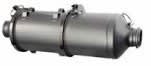
An exhaust aftertreatment device that captures and converts soot to carbon dioxide and water is standard on 2007 MBE 900 engines.
The efforts of engine manufacturers to design new powerplants that meet tightened EPA emissions standards in 2007 have been complemented by the efforts of school bus manufacturers to integrate those engine packages into their new models.
EPA regulations now require that new diesel engines run cleaner, with a more than 50 percent reduction in nitrogen oxide and 90 percent reduction in soot and ash. They must also run on ultra-low sulfur diesel fuel, which has no more than 15 parts per million (ppm) of sulfur versus the previous standard of 500 ppm.
To accomplish this reduction in emissions, engine manufacturers had to make some key changes to their products’ exhaust gas recirculation systems, cooling capacity and crankcase design (see sidebar at end of article).
In turn, this forced school bus builders to come up with strategies to integrate these new engines, as well as downstream components, such as diesel particulate filters (DPF) and dashboard DPF status and warning gauges, into their product design.
The end result is that school bus manufacturers such as IC Corporation and Thomas Built Buses are offering models that have upgraded features that accommodate the engine packages and, in some cases, offer improvements over previous models. At the same time, engine manufacturers are touting possible improvements in performance of their 2007 engines. They’re also looking ahead to 2010, when even more stringent emissions standards will come into play.
Here are a few examples of the changes incorporated by these manufacturers.
IC changes are minimal
IC Corporation has made only slight modifications to its bus design, and those are mainly to accommodate the DPF and the diesel oxidation catalyst (DOC).
On conventional and front-engine transit-style buses, the DOC and DPF are located on the right-side frame rail, similar to the location of the muffler in 2006 and earlier models. On rear-engine transit-style models, the DOC and DPF are combined into one unit and located on the left-side frame rail beside the engine.
In addition, the tailpipe on IC buses will be made of stainless steel. In the past, exhaust gas carried particulates that formed a carbon coating that inhibited corrosion. Because the 2007 emission technology is removing so much of the particulate matter, a corrosion-resistant material was chosen for the tailpipe.
Regeneration will be essential
IC engineers say the main difference in the 2007-compliant engine systems will be the need for regeneration of the DPF to remove particulate matter. Three types of regeneration are possible — passive, active and manual.
Passive regeneration occurs when the engine experiences enough natural load to elevate the exhaust gas temperature enough to begin clearing the particulates. This will typically happen when the bus is driven at high speeds and/or is operating at maximum passenger capacity.
Active regeneration will occur when the engine’s computer senses an elevated level of particulate matter in the DPF due to periods of light engine loading and/or low ambient temperature conditions that may not produce sufficient exhaust temperatures to initiate a passive regeneration. During active regeneration, a small amount of fuel will be injected into the exhaust stroke of the cylinder and sent through the exhaust stream to assist in clearing the particulate matter.
Manual regeneration can only be activated when the engine computer senses an elevated level of particulate matter. To activate manual regeneration, the bus must be in neutral with the parking brake set and the filter indicator on.
{+PAGEBREAK+} To alert drivers and technicians to the status of the DPF, indicator lights have been placed on the dashboard. Each bus will have operational instructions located on the bulkhead to explain the indicator lights and the required driver or technician response.
A manual regeneration switch will be standard on IC buses and located in the right-hand switch panel. An option to omit the switch to limit manual regeneration to technicians will be offered. An additional indicator light will come on during manual regeneration to warn the driver or technician that the exhaust gas temperature has been elevated.
Thomas’ small changes
Officials at Thomas Built Buses also say that design modifications to their buses with ’07 engines are minor from the end-user’s perspective.
In the manufacturer’s conventional and transit-style models, an exhaust aftertreatment device replaces the muffler assembly. The unit comprises a DPF and DOC, which work together to capture and oxidize soot.
On the dashboard, two new lights are connected to the DPF, indicating high heat and regeneration processes. Both are explained in the engine service manuals.
For the most part, DPF regeneration (in which captured soot is converted to carbon dioxide and water) doesn’t require any action of the driver. While the bus is in motion, passive and active regeneration processes occur automatically as needed.
If enough soot can’t be converted in transit, stationary active regeneration is required. This process, which takes about 20 to 40 minutes, can be performed by either the driver or a technician while the bus is parked (as in IC models, the bus must be in neutral with the parking brake set). The indicator light notifies drivers several hours before the process needs to be completed.
When buying a new bus, Thomas Built customers can choose an MBE 900 series engine or a Cummins ISB, both of which meet all 2007 EPA requirements.
Since the 2007 engines are larger than their predecessors, engine compartments needed to be expanded accordingly. In rear-engine buses, this has the potential to affect seating in the back row.
However, Jed Routh, Thomas Built’s Type D (transit-style) product manager, says that there are no changes to seating in the company’s buses in “95 percent of cases.” Only in rare seating configurations on rear-engine buses would one passenger seat be lost.
Engine makers eye new emissions challenges
With each round of diesel-emission reductions, the challenges for engine makers such as Caterpillar, Cummins, Detroit Diesel and International Truck and Engine Corp. multiply. The EPA’s most recent regulatory hurdle, which took effect Jan. 1, mandated the addition of several new components and more sophisticated electronic controls to monitor vehicular operating conditions and make adjustments as needed.
The new rules kept engineering teams busy for the past five years, designing and testing systems that would lower emissions without hampering performance and reliability. That work resulted in the following changes to on-highway diesel engines:
Probably the single most expensive piece of new hardware is the diesel particulate filter (DPF). Although DPFs have been used on some buses for a while, the ’07-compliant versions are said to be “active aftertreatment devices” because they’re capable of on-demand cleaning, or regeneration, when internal soot levels reach unacceptable limits. In such instances, a dash-mounted warning light signals the need for manual cleaning.
Manufacturers using cooled exhaust gas recirculation (EGR), first widely deployed in 2002, have “optimized” (i.e., increased) the amount returned to the intake manifold to further quell nitrogen oxide formation during combustion. Caterpillar’s ACERT engines now come with a variation of this technology, too, but they draw spent gases from the backside of the particulate filter instead of the discharge end of the turbo.
Added EGR flow results in greater heat rejection and higher engine temperatures. To counter this problem, ’07 engines are designed with more robust cooling systems. The improvements, ranging from larger radiators and fans to higher-capacity water pumps and oil coolers, vary by model and manufacturer.
More Maintenance

The Evolution of DEF Header Technology: What School Bus Operations Should Know at Replacement Time
See what school bus fleets should consider when replacing DEF headers to improve reliability, reduce repeat repairs, and control maintenance costs.
Read More →
The Essential Guide to School Bus Maintenance and Student Safety
Your district's buses carry students to school every day. This guide shows how predictive maintenance powered by fleet data helps keep buses reliable, drivers accountable and students safer from the first bell to the last stop.
Read More →
Kerry Brothers Grows Michigan School Bus Repair Network
The acquisition of Downriver Truck and Bus expands Kerry Brothers’ school bus maintenance footprint across southeast Michigan, adding repair capacity, diagnostic resources, and state inspection support.
Read More →
Noregon Introduces CAN Bus Diagnostic Tool, Expands JPRO Features
CAN Mentor and the latest JPRO update aim to simplify vehicle network diagnostics and improve repair efficiency for technicians of all experience levels.
Read More →
Cummins on Smarter, Simpler Engine Innovation
Cummins discusses its first-ever gasoline engine for school buses, EPA 2027, and why bus fleets still want durable, simpler internal combustion options.
Read More →
Report: 72% of Diesel School Buses Now Use Advanced Low-Emission Engines
New data shows advanced low-emission diesel technology continues expanding across school bus fleets, even as electric bus adoption gains momentum.
Read More →
Vampire Tools' CAIMAN 7.5-Inch Multi-Purpose Screw Extractor Long-Nose Pliers with Crimper
Vampire Tools introduced the VAMPLIERS Caiman 7.5-inch multi-purpose pliers, combining screw extraction, cutting, crimping, and gripping functions into a single tool designed for fleet maintenance professionals.
Read More →
How Advanced Diagnostics Helps Bus Fleets Stay Ahead of Repairs
Chat with Noregon’s Kevin Smallhorn at ACT Expo about bus diagnostic tools, telematics integration, CNG maintenance support, and strategies to help reduce downtime and improve uptime.
Read More →
How School Bus Fleets are Getting Ahead of Breakdowns
Don’t let bus downtime wear you down. Here’s how bus operators are shifting from manual processes to AI-powered, data-driven maintenance systems for improved reliability and safety.
Read More →
Pennsylvania School Bus Maintenance Team Praised for Dedication to Safety
Matthews Bus Company’s West Jefferson received a letter of commendation from the Pennsylvania State Police for their fleet inspections.
Read More →