




High-Tech Options for Tracking Students
School bus operators who want to track the time and place of student boardings and deboardings have three options: bar codes, radio frequency identification (RFID) and biometric systems. Each has its own benefits and drawbacks.

Public and private school bus operators who have installed global positioning system (GPS) technology to track the location of their buses in real time can add an interesting component to their vehicle location system — tracking the boardings and exits of their passengers.
Although not yet common in the pupil transportation industry, student tracking is being considered by a growing number of school bus operators, many of whom have already installed GPS systems in their fleets.
“We’re seeing more and more demand from our large districts for this type of technology,” says Dave Pettine, vice president of sales and marketing at Everyday Wireless LLC in Concord, Mass. “We definitely believe this technology will be adopted with much more frequency in the future.” Everyday Wireless is the largest provider of GPS services to U.S. school bus operators, with about 7,500 GPS units in operation.
Pettine says adding a student tracking component to a GPS system is a natural progression. “The first question that we help school transportation officials answer is “Where are my buses?’” he says. “The next question we help them answer is, “Where are my students?’”
“Ultimately, everyone wants to know where their kids are,” says Brad Bishop, chief operating officer at Synovia Corp., a provider of GPS and student tracking equipment and software in Indianapolis. “There are a million reasons why they didn’t get on or off the bus.” With real-time tracking, transportation managers can find out who’s on a bus at any time.
Like Pettine, Bishop says student tracking is a logical extension to GPS vehicle tracking.
“The technology’s there,” Bishop says, but he adds that school districts need to carefully consider their options. “We try to take a consultative approach,” he says. “School administrators and school boards need to know what’s realistic. If you have 50,000 students riding your buses, it would be remiss for a vendor to say that student tracking would work flawlessly.”
Student tracking can be accomplished using three different technologies: bar codes, radio frequency identification (RFID) and biometrics such as fingerprint recognition devices.
Each system has pros and cons that need to be carefully considered by prospective users. What works for one operator might not make sense for another. Within an operation, what works for regular routes might not make sense for special-needs routes. And some operators might not want or need to install a student tracking system.
Why track students?
Before we discuss the different types of student tracking systems, let’s look at the possible benefits of real-time tracking.
Security has remained a critical concern over the nearly five years since the 9/11 terrorist attacks. The recent revelation that convicted sniper John Allen Muhammad had reportedly considered a bombing campaign against schools, school buses and children’s hospitals only reinforces anxiety over possible attacks.
Installing a GPS system in buses to track their whereabouts can help to alleviate some of the apprehension about terrorist attacks and bus hijackings. Adding a student tracking system would provide even more critical information to school officials and emergency response teams in the event of an attack or hijacking.
Security, although important, is not the primary reason why a school bus operator would install a student tracking system. More important would be the ability of school administrators and parents to know where and when students got on and off the bus for safety reasons.
This safety component is becoming increasingly important because of the growing complexity of today’s routing and scheduling. For example, some students have varying afternoon drop-off points depending on the day of the week. This can be confusing to students, especially younger ones. If they should happen to get off at the wrong stop, parents can call the district and immediately obtain the time and location of the drop-off.
Also, if a child is reported missing after taking the bus in the morning or afternoon, school officials will be able to quickly check if he or she got off the vehicle. If not, it’s possible that the child fell asleep on the bus and was not discovered by the driver during the walk-back. The sooner that district officials can determine whether this is what occurred, the better the chances of finding the student unharmed. For more information about the problem of children being left on buses, see Managing Editor Thomas McMahon’s article “Bus Empty?”.
Special-needs factor
Safety and security are important considerations in student tracking, but another key reason that a school bus operator might install a tracking system is the need to document the travel of special-needs students for reimbursement programs such as Medicaid. The federal government requires the operator to track mileage for special-needs students and reconcile that data with classroom attendance.
[PAGEBREAK]
“It’s a very cumbersome process to manually track this information,” says Pettine. “Oftentimes, school districts don’t have the resources to track and process the information required by the federal government, so there can be hundreds of thousands or even millions of dollars left on the table.”
Synovia’s Bishop says the automated collection of data for federal reimbursement of special-needs transportation is one of the biggest benefits for school districts, especially because budgets have been tight over the past several years. “You get a lot of support from parents and the community because they’re eager to maximize the federal reimbursement,” he says.
Student tracking can also monitor the time that each special-needs student spends on the bus, which can help to defuse parental complaints if the rides are not as long as the parents assert. The ride time data can also be used in the other direction to help bus operators identify students who are spending too much time on the bus and to suggest routing and scheduling alternatives to cut down on the ride time.
Bar code scanners
The least expensive tracking system uses bar code scanners like those found in retail stores. Bishop says the price for a scanner ranges from $300 to $1,000, depending on the type of reader chosen (stationary, portable, wand style, handheld).
Here’s how it works. The driver is provided with a manifest that has each passenger’s name and a bar code next to it. When the student enters or exits the bus, the driver uses a handheld or other device to scan the bar code. The information is then sent back to the base station using either cellular or radio transmission.
Although it’s the cheapest alternative, bar code scanning has operational drawbacks. The main problem is the amount of time it takes the driver to scan the passenger names into the system.
If a dozen students streamed onto a bus in the morning or off the bus in the afternoon, the driver would be hardpressed to find and scan each of their names without a certain amount of delay. Thus, bar code scanning is not practical for runs with many students. “The last thing we want to do is negatively impact load times and put buses behind schedule,” Bishop says.
With special-needs transportation, where fewer students are transported and a monitor is often present to help load the students, bar code scanners can be a good fit. The driver can scan the student information while the attendant helps with the loading or unloading. “It seems to work well for a small group of five or 10 passengers,” Bishop says.
RFID technology
RFID is an automatic identification method that uses radio waves. Commonly used for inventory purposes, the system relies on memory chip-based tags and a reader. The tags, which are coded with unique identification attributes, can be embedded in keychain fobs or plastic cards such as student ID cards.
Two types of RFID systems are available for student tracking. The less expensive system employs a reader with a recognition distance of only three inches or so. Students must take out their RFID card and wave it close to the reader, adding some delay to the loading and unloading process.
The more expensive system employs a reader with a special antenna that extends its reach. Pettine says Everyday Wireless’ passive RFID reader has a range of 36 inches. This system allows students to board the bus at a normal pace without having to produce anything in their hands. The card can be buried in their pocket, backpack or purse. As long as they’ve got the card with them, they can board and be tracked, Pettine says.
One disadvantage of an RFID student tracking system is that it’s more expensive than a bar code system. According to Bishop, the cost for the card reader and the necessary software ranges from $400 to $1,800 per bus, depending on the range of the reader (from a few inches to several feet).
Another drawback is that the system relies on students remembering to bring their RFID-enabled card. Pettine says a fallback solution to forgetful students is the installation of a mobile data terminal. This would allow the driver to input the student’s name using a keyboard mounted in the driver’s compartment.
Biometric identification
Neither Pettine nor Bishop is a proponent of biometric tracking using fingerprint-recognition technology, at least not yet. They say it’s too expensive and unreliable.
The idea sounds good, though. Each child swipes his finger on a reader as he enters or exits the bus. The reader identifies the student through his unique fingerprint and sends the time and location to the base station.
The problem is that the reader requires a few seconds to process the fingerprint and can require as many as three or four swipes to get a positive identification, especially if the student’s fingers are dirty.
“If you had 60 kids getting on the bus and each one took 10 seconds to swipe his fingerprint on the reader, that would add 10 minutes to the run,” says Pettine. “That conflicts with what your GPS objectives were in the first place in terms of route optimization.”
Pettine notes that spare buses would also need to have fingerprint readers, but these would need to be loaded with the fingerprints of all student riders, not just the ones that ride a specific bus. This would significantly slow the fingerprint recognition process and add even more delay. “The whole concept of fingerprint recognition is very flawed,” he says.
More Management

The Right Ride for Every Student: Navigating the New Student Transportation Ecosystem
How should districts blend school buses with small-vehicle transportation and other options? EverDriven CEO Mitch Bowling discusses safety, costs, partnerships, and strategy.
Read More →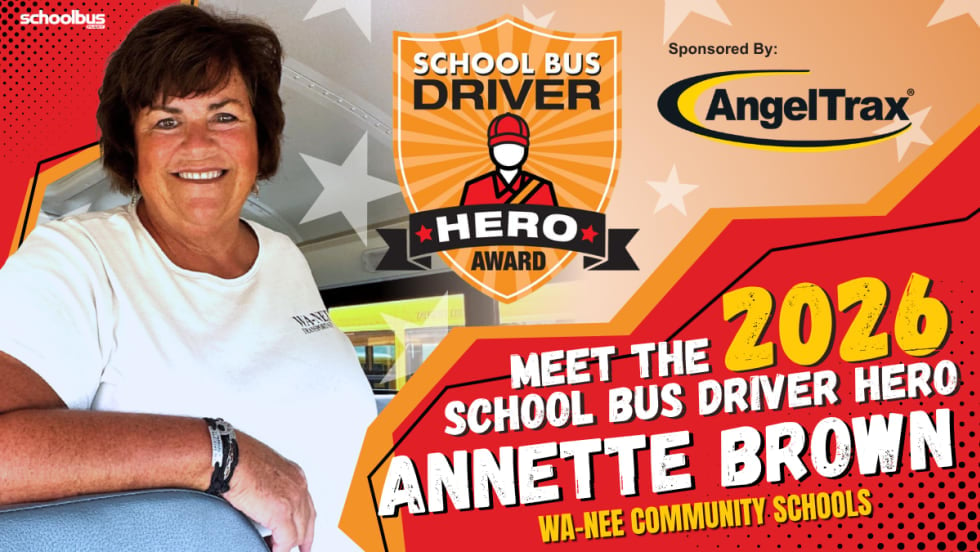
Annette Brown Always Takes the Extra Time: Meet Our 2026 School Bus Driver Hero
For more than 30 years, the Wa-Nee Community Schools driver has treated students like family, combining safety, compassion, and servant leadership to make a lasting difference on and beyond the school bus.
Read More →
How to Build a Better Driver Training Program
Ready to boost up your school bus instructor training? Here’s how to pick the right talent and improve recruitment, retention, and safety.
Read More →


CALSTART and Forth Combine to Form Catalyst Mobility
The new name represents a renewed vision for the nonprofit focused on advancing clean, equitable, and affordable transportation solutions that move people and goods.
Read More →
What Makes a Great School Bus Driver Trainer?
Choosing the right school bus driver trainer takes more than experience. Learn six keys to selecting and developing trainers and evaluating program effectiveness.
Read More →
School Bus Contractors Expand Through New Deals, Acquisitions & Partnerships
STA's Canadian division acquires Ontario-based G&L Stevenson Transport; Durham School Services adds a new district in California; First Student expands in New Jersey; and Minnesota Coaches rebrands and acquires Halo Transportation.
Read More →
Logan Bus Company Rolls Out AI Phone System for NYC School Bus Families
A summer pilot found that AI agents could handle most routine calls, freeing up time for customer service staff to focus on emergencies and complex family concerns.
Read More →
From Intent to Impact: What I Learned About Leadership from TAPT
A Texas transportation supervisor shares lessons on self-awareness, accountability, managing stress and building trust — and why investing in leadership development matters at every stage of your career.
Read More →
NAPT Names 2026 Award Recipients, Hall of Fame Inductee
Who earned national recognition for their work in student transportation? This year, NAPT named five recipients of its 2026 awards for service, safety, and leadership, plus its newest Hall of Famer.
Read More →
2026 State of Student Transportation Report
Driver shortages. Rising costs. Growing safety expectations. More data, but not enough time to act on it. The 2026 State of Student Transportation Report reveals what transportation leaders say is putting the most pressure on their operations—and where they’re investing next. See how your priorities compare.
Read More →