




Great Fleets Across America (Part III)
Safe, Efficient Routes Lead to Excellence Jefferson County Schools Birmingham, Ala. Self-sufficiency has its merits. A t...

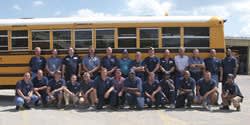
Safe, Efficient Routes Lead to Excellence
Jefferson County Schools
Birmingham, Ala.
Self-sufficiency has its merits. A transportation department that can safely sustain overall efficiency through cost-saving measures that exclude excessive outsourcing has the makings of a world-class operation. The team at Jefferson County Schools in Birmingham, Ala., is all that and more.
“We do our own bodywork, our own glasswork and upholstery,” says Tico Sanchez, one of three assistant directors of the transportation department. “There are very few things on our buses that we have to depend on outside sources to repair.”
Finding top performers
Having a well-rounded staff of mechanics who make productivity and safety top priorities helps solidify the department’s excellence.
“Our mechanics must have at least eight years of experience before we even consider them for employment,” says Mike Doss, assistant director. Shop staff members are hired as technicians and must undergo a training process that culminates with a test to become a school bus driver and certified technician. “Upon passing the state’s test, they become certified technicians,” Doss says.
Many of the district’s 34 technicians have children who ride on the school buses they repair, which adds to the degree of commitment and workmanship.
Passing muster
Jefferson County mechanics not only repair vehicles, but they also double as trainers. Driver trainees spend at least four to 12 hours with a technician before they can advance to the state-administered driving courses. “If a mechanic says a driver trainee can’t drive, then they don’t go to the state’s school,” says Doss.
Shop Foreman Jeff Snyder has been instrumental to the effectiveness, efficiency and safety of the garage. It’s his leadership and knowledge that helps keep Jefferson County’s transportation department ahead of the curve.
Outside of yearly inspections, the district is subject to monthly inspections conducted by three very meticulous inspectors who check every bus. In this summer’s state inspection, only one bus out of 425 had to be sidelined for mechanical servicing.
Last year, the state found nine majors, which is only about 2 percent of the district’s fleet. Management challenged the mechanics to best that record. If they succeeded, management would treat them to steak dinners. “To be honest, I didn’t think the techs could do better than that,” says Sanchez, “But they did.”
Driving force
Jefferson County’s bus drivers are the operation’s lifeblood. They keep things moving in a timely and safe manner.
Drivers go through six days of in-service training annually. Additionally, bus manufacturers will do site visits and conduct training, especially when new buses are purchased. Blue Bird visited recently and conducted training sessions after the district bought 13 new buses.
Management plans to eventually offer CPR and sign language training to its drivers to better equip them for the rigors and challenges of the job. There’s also a mandatory licensing recertification required by the state.
Drivers seldom miss an opportunity to show their mettle and will often compete in local and state school bus roadeos. “We had two drivers who qualified this year at the state level for the southeastern roadeo,” says Della Baker, assistant director.
The district has 65 special-needs routes that serve 500 to 600 students. All of the district’s special-needs buses are equipped with wheelchair lifts.
Generally, turnover has been low at the district. Recently, about five people retired, but they had been with the department for between 25 and 32 years.
Suffice it to say, when people get in at Jefferson County, they stay for the duration. “As of this month, veteran driver Sarah Grisby will have been with us for 50 years,” says Baker. The district prides itself on having good benefits and a harmonious work environment.
{+PAGEBREAK+} Strong leadership
Drivers and mechanics have the three assistant directors and three dedicated secretaries to thank for such an amiable work place. Baker has only been with the district for a year but has already made a place for herself within the operation. Previously, she’d been with a smaller district for eight years as a director.
Doss started as a mechanic and worked his way up through several positions, including shop foreman, area mechanic and route supervisor. He’s been with the district for 32 years. Sanchez also got his start as a mechanic. Baker, Doss and Sanchez work together at tackling the difficulties that confront the district.
Facing challenges
A constant challenge for the district is its geography, which is so widespread that it’s sometimes difficult to get students to destinations on time.
The rising cost of fuel and locating funding to purchase fuel is another concern for management. “This year, we budgeted $1 million for fuel alone,” Sanchez says. “But it doesn’t look like $1 million is going to cover it.”
District buses average about 16,000 miles a day, not counting extracurricular activity trips. This brings the district to about $30,000 a week for fuel.
Fighting the rising costs and maintaining safety is a challenge. Measures like consolidating routes for more efficiency has helped. Still, the problem is exacerbated by other challenges like the demands of No Child Left Behind and the school choice program. “We’ve got probably 150 students total that we transport to choice schools,” says Baker.
A changing landscape
Jefferson County is a mostly rural area that is mountainous, with about 95 percent of roads paved. There are approximately 14 cities in the county, and the district services about half of them.
The state recommends that buses be replaced after 10 years of service, but up to now Jefferson County Schools hasn’t been able to adhere to the recommendation.
“Some of that is because our system is growing and we’re adding new routes,” Baker says. “We’re having to add our spares because that’s all we have.” Jefferson County has buses that are 16 years old, but they’re being used as spares.
Bus specifics
The district sticks to the basics when it comes to spec’ing its buses. That’s why it was a pleasant surprise when Alabama Bus Sales delivered 13 new Blue Birds loaded with radios, a PA system, air-ride driver seats, acoustic ceilings and heated mirrors. The dealer had come in with the lowest bid, but it delivered the goods when all was said and done.
The district runs diesel fuel only and has onsite pumps as well as fuel cards so drivers can fill at local stations under a county-wide purchasing agreement.
The preventive maintenance program consists of a two-man crew that goes out and lubricates all the district’s buses, performs oil changes and conducts thorough checks. Techs also check buses three times a month and repair whatever they find. Once a month, inspectors team up with the mechanics to perform inspections of all the buses.
— ALBERT NEAL
FLEET FACTS
Buses — 372
Students transported daily — 21,000
Total students in district — 40,000
Schools served — 53
Transportation staff — 418
Average driver wages — $11,000/year (regular-ed drivers); $15,000/year (special needs)
{+PAGEBREAK+}
Blue Moose, Gingerbread — and Excellence
Kent School District
Kent, Wash.
When the Kent School District’s transportation department hands out the Blue Moose award at its end-of-year banquet, the proper response isn’t applause, it’s laughter. The award goes to the bus driver who has done the craziest thing during the school year. As an example, one driver "won" the award after her horse ate the remote control to the bus yard’s automatic gate. Transportation Manager Bob Kahl says the award is indicative of the high spirits and camaraderie shared by the staff. "We've got no walls in our office," he says. "Everybody hears what's going on. Everybody works well together. We're a tight group."
This camaraderie seems to arise naturally, but some of it can be attributed to strategic efforts. This past year, the department bused the entire staff up to a camp in the mountains for an eight-hour workshop that combined learning with fun. "These kinds of events help to pull us all together," says Transportation Supervisor Don Walkup. "We try to emphasize that everyone is here to support the drivers and help them succeed."
Safety is rewarded
Rewarding top performance is another way to motivate the staff. Drivers with perfect attendance receive an assigned parking spot adjacent to the office. Safe driving is also highly valued. In fact, drivers who manage to accumulate 20 years of safe driving receive chrome lugnuts for their buses.
Management also strives to make sure that drivers are comfortable in their buses by spec'ing ergonomic features such as air-ride seats.
A high level of morale is helpful, given the challenges that all school bus operations face. It's especially critical considering the explosive growth taking place in the district's service area, which is located between Seattle and Tacoma. "The population growth is just incredible," Kahl says. "And it's not going to stop for years to come."
Boundary analysis is key
Currently, the department transports about 11,000 students on 110 routes, including 28 special-needs routes. To minimize the impact of student population growth, the school board has allowed the transportation department to shift walking boundaries as necessary. "We also work closely with the board on staggering bell times," Kahl says.
The department has been adding one or two routes a year, which Kahl says has not been difficult. Supervisors rely on Edulog to keep track of routing and scheduling. "It works wonderfully," he says.
Weather and topography can be a problem, however. "There are hills everywhere," Kahl says, adding that the district's 75 square miles encompass three different climates. "We can get ice and fog in one area, snow somewhere else and rain in another area," he says.
Keeping parents happy is also a prime consideration but a difficult accomplishment. "We try to please everybody but don't always do it," Kahl says. "But we're consistent with our guidelines."
For parents of special-needs students, the department has found a helpful way to remind them to call ahead when their child is going to be absent. "We created refrigerator magnets that have our phone number and their route number," Kahl says. "If Johnny's not going to be coming to school, his mother can refer to the magnet and make that call so we know about the change."
Kahl says much of the department's success can be attributed to the fact that it doesn't view itself as an island. "We're a team here, not a transportation department," he says. "We work well with each other as well as with principals, teachers, parents and students."
{+PAGEBREAK+} Shop team is sharp
The other ingredient of the department's success is the shop program. The department maintains 134 buses with an eight-man staff, including a shop foreman, a lead technician, five technicians and a service person. Overall, the staff maintains 250 vehicles, including buses and the district's non-bus vehicles.
Blaine Sells, shop manager, attributes some of the garage's efficiency to the FleetVision maintenance software they've been using since 1996. "It works very well,' he says. “We set up the maintenance schedule and have it tied into the fuel island and odometer readings.” Buses are automatically flagged when they’re due for regular maintenance such as oil changes and brake adjustment.
Sells says the garage follows the manufacturer’s recommendations for its preventive maintenance program. He tweaks some of the intervals, however, based on experience. Every 2,000 miles, the buses are brought in for lubes and safety inspections. Oil changes are done every 6,000 miles, and fuel filters are changed out every 18,000 miles.
Not surprisingly, the fleet performs well in state-mandated inspections. A full inspection is done each summer, and there’s also a surprise inspection of 25 percent of the fleet. “Typically, we’re in the 95 to 100 percent approval range,” Sells says.
Because of manpower shortages in the shop over the past few years, training has been a secondary concern to getting the work done, but Sells says he’s got a skilled staff that can handle not only preventive maintenance, but also larger projects, such as rebuilds of engines and transmissions.
Good reputation helps
Morale among the shop staff is high, which is reflected in a low turnover rate. “We’re known as a good place to work,” Sells says.
Although the five-bay shop facility is pushing 50 years in age, it’s been well taken care of, according to Sells. Coming soon will be a new, and long overdue, bus-washing system. “We’re going to open the bids next week,” he says. Until the new system is put into operation, the district will continue to have students wash the buses after school.
Washington weather can be nasty, but the garage is equipped accordingly. “We’re probably one of the few shops with a painted, heated floor,” Sells says. “It can be cold and wet outside when you drive a bus in, but the water just evaporates and is gone.”
— STEVE HIRANO
FLEET FACTS
Buses 134 — 206
Students transported daily – 11,000
Total students in district — 27,000
Schools served – 42
Transportation staff – 165
Area of service – 75 square miles
Average driver wages – $17.14/hour
More Management

How to Build a Better Driver Training Program
Ready to boost up your school bus instructor training? Here’s how to pick the right talent and improve recruitment, retention, and safety.
Read More →
CALSTART and Forth Combine to Form Catalyst Mobility
The new name represents a renewed vision for the nonprofit focused on advancing clean, equitable, and affordable transportation solutions that move people and goods.
Read More →
What Makes a Great School Bus Driver Trainer?
Choosing the right school bus driver trainer takes more than experience. Learn six keys to selecting and developing trainers and evaluating program effectiveness.
Read More →

School Bus Contractors Expand Through New Deals, Acquisitions & Partnerships
STA's Canadian division acquires Ontario-based G&L Stevenson Transport; Durham School Services adds a new district in California; First Student expands in New Jersey; and Minnesota Coaches rebrands and acquires Halo Transportation.
Read More →
Logan Bus Company Rolls Out AI Phone System for NYC School Bus Families
A summer pilot found that AI agents could handle most routine calls, freeing up time for customer service staff to focus on emergencies and complex family concerns.
Read More →
From Intent to Impact: What I Learned About Leadership from TAPT
A Texas transportation supervisor shares lessons on self-awareness, accountability, managing stress and building trust — and why investing in leadership development matters at every stage of your career.
Read More →
NAPT Names 2026 Award Recipients, Hall of Fame Inductee
Who earned national recognition for their work in student transportation? This year, NAPT named five recipients of its 2026 awards for service, safety, and leadership, plus its newest Hall of Famer.
Read More →
2026 State of Student Transportation Report
Driver shortages. Rising costs. Growing safety expectations. More data, but not enough time to act on it. The 2026 State of Student Transportation Report reveals what transportation leaders say is putting the most pressure on their operations—and where they’re investing next. See how your priorities compare.
Read More →
How to De-Escalate an Angry Person: 5 Steps for Handling Workplace Conflict
What makes emotions run high, and how should you handle an angry colleague or parent? Follow these steps for staying calm, listening, showing empathy, and resolving conflict.
Read More →
What Readiness Looks Like This School Year
Learn about the challenges shaping the 2026–2027 school year, from persistent driver shortages and budget pressure to technology and readiness gaps. See how school districts are responding and adapting in Zonar’s 2026 Back-to-School Readiness Report.
Read More →