




Emergency Response Tips for School Bus Drivers
Drivers can help fire and medical services personnel and enhance the safety of their passengers during accidents or other serious incidents by being certified in CPR and first aid. Knowing when a bus evacuation is necessary and establishing a system for identifying the students on the bus are also important.
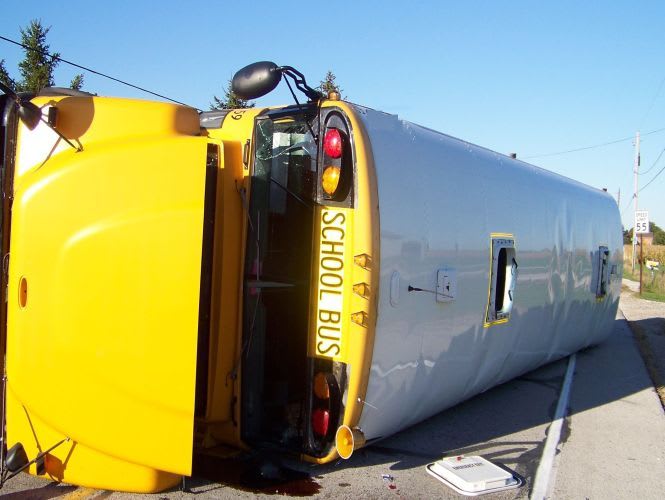
During emergencies, particularly those involving a school bus, fire and EMS (emergency medical services) personnel will come from all directions, and they are expected to bring calm to chaos.
School bus drivers can help by preparing for the "never happen to me" emergencies, having good situational awareness and remaining calm.
They can also assist first responders by attending first aid/CPR training sessions, knowing when to evacuate their buses and keeping a record of the passengers who are riding their buses.
With this knowledge and information, drivers' observations, decisions and actions can have a substantial impact, preventing serious injuries or even death both before and after fire and medical professionals arrive.
Training in CPR and first aid can save lives
Bus drivers usually have regular contact with the passengers on their school buses; many drivers talk with their students on a daily basis.
Oftentimes, this level of communication enables drivers to become familiar with their passengers' medical histories and knowledge of a recent injury or illness.
Insight into students' conditions is useful, particularly if a student becomes sick on board or if an emergency occurs, but it is equally important for drivers to be trained in first aid and CPR since they have initial contact with their passengers in an incident. We hope to never have to utilize the skills and procedures we learn, but they might prove to be lifesaving.
Basic first aid and CPR training can be obtained through numerous organizations, such as the American Red Cross or your local fire department.
During sessions, trainees learn how to handle medical and trauma emergencies including bleeding control, shock, respiratory and cardiac arrest, seizures, diabetes-related problems, hypo- and hyperthermia, and spinal precautions.
Knowing when to evacuate a school bus
[IMAGE]503[/IMAGE]Many school districts have procedures for their drivers to follow in different emergencies, and the procedures may involve evacuating the school bus.
What scenarios merit a bus evacuation? I believe there are several types of instances when an evacuation should take place:
Fire. If a fire starts on the bus, statistics show that smoke, hazardous gases and fire will spread throughout the bus within two minutes. Therefore, an evacuation is essential.
Fuel spill. If, following an accident, fuel is leaking from the school bus or another vehicle involved in the crash, all it will take is a spark to ignite a fire. You must evacuate the bus.
Downed power lines. If power lines are draped across the bus and there is no fire hazard, it will be safest on the bus until emergency responders and the power company shut the electricity off.
If a fire has ignited, you must evacuate, but in doing so, the driver and students cannot make contact with the energized bus and the ground at the same time or they will risk being electrocuted.
Jumping out of the bus from the exit that is farthest from the point of contact with the power lines may be necessary.
Roadway positioning. If a bus emergency occurs on a busy section of roadway or on a dangerous curve in the road, it may be safest to evacuate the passengers. School bus drivers know their routes best, and it will be a judgment call.
Passenger injury. If none of the immediate threats to life outlined above are present following a school bus emergency that has left passengers injured, drivers should not try to evacuate them until emergency responders arrive — they could risk further injuring the students. Drivers should care for the injured parties to the best of their abilities using the knowledge they have gained from first aid training.
[PAGEBREAK]
[IMAGE]504[/IMAGE]Accounting for students will help first responders
School bus drivers will have a huge impact and greatly assist emergency responders if they can account for the students on their buses following an accident or some other type of emergency.
For drivers who have taken the time to learn the names of the students they transport, identifying them becomes second nature, and as long as the driver is capable, he or she can identify students for first responders.
However, there are a number of situations where this might not be possible. The driver may be unconscious or otherwise disabled; there may be a substitute driver operating the bus; the driver may be transporting students for a field trip and there may be students on board whom he or she does not know, etc.
Most adults carry a driver's license or another form of identification. Students do not always have photo identification with them. Other ways to identify students if a driver is unable to do so may be to check a backpack for a name or ID tags, to ask other students or to check a wallet for identification.
In the event that no name can be established, a detailed physical description of the student should be documented. Specifics should include gender, ethnic origin, approximate age, speech accent, hairstyle and color, approximate height and weight, clothes, shoes and any other distinguishing characteristics. If a driver is unable to document all of these characteristics, he or she should choose the critical and most distinguishing characteristics.
To establish a list of students on a bus, emergency responders will search the driver's area for a roster of students who are assigned to the bus. If a list is found, it will only be a starting point to identify the students on board, as it may not be accurate or complete.
I recommend that each school bus have a list of potential passengers on the bus located in a place that is easily accessible to emergency responders — perhaps by the driver's seat near the front door of the bus.
Some students may need to be transported to hospitals, some may released to parents after being checked by EMS and others may need to be placed on another bus to be transported home or to school. A seating chart with names of the students riding the bus would also reduce some of the confusion in an emergency and help in determining which students, if any, were transported away from the scene of the incident.
During field trips and sporting events, the chaperone or coach should provide the school bus driver with a list of passengers on the bus. (Names can easily be scratched off the list if students were unable to attend the trip or event at the last minute.) The list can then be placed in an accountability packet near the driver's seat. Again, this will help emergency responders account for all passengers, especially if the driver, chaperone or coach becomes incapacitated.
Language may be a barrier in communicating with some students and parents. If you feel that this could be a problem, notify the school district to find an interpreter and arrange in advance for that person to be transported to the location where his or her services will be needed in the event of an incident, whether it's to the accident scene, a medical facility or a briefing area. Oftentimes, law enforcement and fire officials have contacts for bilingual individuals.
Lt. Paul Hasenmeier has been a firefighter for the Huron (Ohio) Fire Division since 2000. He is also a paramedic and a fire inspector. Hasenmeier has an associate's degree in fire science and has gained knowledge through technical rescue disciplines. He has presented at numerous national fire and pupil transportation conferences. Hasenmeier can be reached atphas@bex.netorwww.criticalrescuetraining.com.
More Safety

How to Build a Better School Bus Driver Training Program
Is it time to strengthen your driver training? Here’s how to pick the right talent and improve recruitment, retention, and safety. This video is brought to you by IC Bus.
Read More →
Recent School Bus Accidents Leave 2 Dead, 2 Injured
Four school bus crashes in Florida, Illinois, and Georgia highlight risks in transportation lots, at bus stops, and during student loading and unloading.
Read More →
When Every Second Matters, Clarity Keeps Routes Moving
From routine delays to urgent incidents, strong communication practices help drivers, dispatchers, schools, and families respond with confidence.
Read More →

What Happens When a School Bus Catches Fire — and What Can Help
School bus fires are rare but can be devastating. Learn how advances in fire suppression and asset protection help fleets detect fires earlier, reduce damage, and improve safety.
Read More →
Geotab Launches Tool to Help Fleets Investigate Road Incidents
Geotab Investigations combines telematics data, video, documents, and other evidence to help fleets reconstruct incidents, resolve claims, and determine what happened.
Read More →
Texas Sixth Grader Wins 2026 National School Bus Safety Poster Contest
Sai Darshana Yekolu of Moseley Middle School in Prosper, Texas, was named the newest winner for her artwork, bringing the theme of “Safe Rides, Everyday Heroes” to life.
Read More →
Doing More With Less: How Transportation Directors Can Prioritize Safety Amid Budget Uncertainty
With diesel prices soaring and nearly one-third of transportation directors expecting budget cuts, maintaining student safety has never been more challenging. Download this guide to learn how leading districts are prioritizing risk, funding critical safety technology, and building stronger budget cases with data.
Read More →
Walton County Schools Adds Gatekeeper Stop-Arm Enforcement System
The Florida district will deploy Gatekeeper’s updated Student Protector technology, which now incorporates AI to improve video evidence.
Read More →
How To Build a More Secure School Bus Yard During and After Hours
As thefts and overnight security threats continue, school transportation leaders are combining stronger operational practices with AI-enabled surveillance to better protect buses, facilities, and staff.
Read More →
FMCSA Names New Chief Safety Officer: What School Bus Operators Should Know
Steve Dowling is set to lead the federal agency's efforts to advance commercial motor vehicle safety and reduce crashes, fatalities, and injuries on the nation's roadways.
Read More →