




For more information on school bus stop-arm camera systems, see these companies’ websites:
• 247Security: www.247securityinc.com
• American Traffic Solutions: www.atsol.com
• AngelTrax: www.angeltrax.com
• Fortress Mobile: fortressmobile.com
• Gatekeeper Systems: gatekeeper-systems.com
• Redflex Traffic Systems: www.bypass.redflex.com
• REI: www.radioeng.com
• Safety Vision: www.safetyvision.com
• Seon: www.seon.com
Districts Put a Dent in Bus Passing With Stop-Arm Cameras
Combined with public education efforts, the camera systemshave helped enhance student safety by deterring stop-arm running.Some school districts have cut violations by 50% or more.

Thomas McMahon・Executive Editor
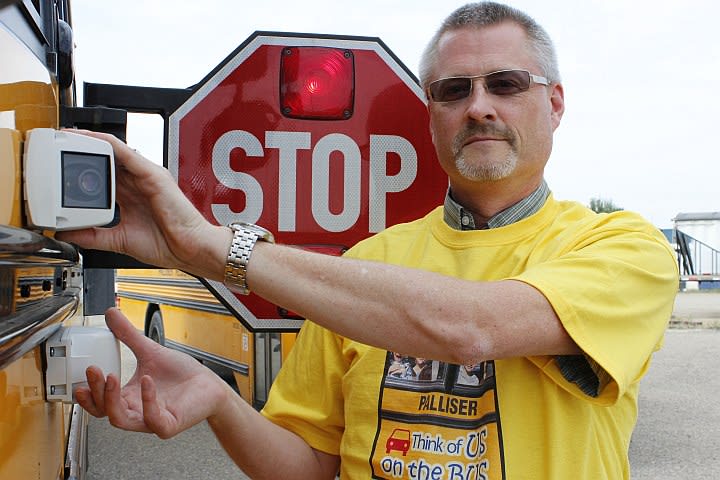
Palliser Regional Schools’ stop-arm camera program has been combined with
efforts to educate the community. Here, Transportation Services Supervisor David Shaw draws attention to the cameras, supplied by Seon.
8 min to read
Palliser Regional Schools’ stop-arm camera program has been combined with
efforts to educate the community. Here, Transportation Services Supervisor David Shaw draws attention to the cameras, supplied by Seon.
For Cobb County (Ga.) School District, the push for stop-arm cameras started with a tragedy.
In 2009, a Cobb County school bus was dropping off 5-year-old kindergartner Karla Campos in front of her home. A car had stopped behind the bus, as required by law. Then another motorist came up from behind, swerved to the right to avoid the stopped car, and drove up onto the sidewalk.
Rick Grisham, executive director of transportation for Cobb County School District, says that the elderly motorist hit the gas pedal instead of the brake. She careened along the right side of the bus and fatally struck Campos as the kindergartner exited the school bus.
Suddenly, the dangerous potential of illegal school bus passing — aka stop-arm running — had materialized in Cobb County. The district’s response would include extensive efforts to warn the public about stop-arm running, and the installation of cameras to catch those who would continue to illegally pass the district’s buses.
“You don’t look at it the same once you’ve had a fatality,” Grisham says of the stop-arm running issue. “That hit home for us — it has to stop.”
Community education
School transportation officials who have implemented stop-arm cameras concur that they can be an effective part of campaigns to crack down on illegal passing. The cameras can go hand in hand with another key component: public awareness.
When Palliser Regional Schools began using stop-arm cameras in earnest about four years ago, the Lethbridge, Alberta-based district also launched a campaign called “Think of Us on the Bus.” David Shaw, Palliser’s transportation services supervisor, describes it as a “three-prong program.”
In the first prong, Palliser ran local newspaper and radio ads to inform the community about the need to stop for school buses, the new stop-arm cameras on the district’s buses, and the fines for illegal passing.
In the second prong, Palliser transportation staff members went to schools to educate students on school bus safety. The third prong was a law enforcement operation in which officers rode on school buses to watch for illegal passing, with patrol cars waiting nearby to catch violators.
Shaw says that his relatively rural school division doesn’t get a high volume of stop-arm running compared to many bigger districts, but the violation numbers have decreased in the four years since the “Think of Us on the Bus” campaign began.
In the first school year of Palliser’s program, 2012-13, there were 77 violations reported, followed by 56 in the second year, 55 in the third, and 53 in the fourth.
In 2012, Palliser had stop-arm cameras on two buses. Now, the district has half of its 60 route buses equipped with Seon stop-arm cameras. Shaw notes that there was most likely an even higher rate of illegal passing before the district’s wider implementation of stop-arm cameras, but it was harder for the bus drivers to document them.
As he puts it, “I have no doubt that some of [the violations] probably weren’t being reported” when most buses didn’t have stop-arm cameras.
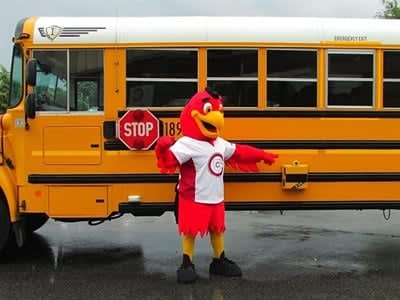
Along with AngelTrax cameras on its school buses, Cobb County School District’s safety campaign includes a stop-arm hawk mascot named Hawkeye, which was provided by American Traffic Solutions.
Successful test
Jones County Schools in Laurel, Mississippi, first tested stop-arm cameras as part of a state pilot program with Fortress Mobile about three years ago.
“We got two cameras to utilize, and they were super successful,” says Terry Graham, transportation director for Jones County Schools.
The district’s stop-arm initiative also included a public relations campaign to inform the community about school bus safety and the presence of the cameras on buses. Since the initial two cameras for the pilot program, Jones County Schools has installed them on more of the total 144 route buses, but Graham declines to divulge how many.
“I want people to think we have cameras on all my buses,” he explains. “In Jones County, most people know the cameras are on buses. [Stop-arm violations] have dropped dramatically.”
Before the camera and PR program, Jones County Schools averaged about four violations per day. Now, Graham says, there is about one violation every other day. That equates to a reduction of approximately 88%.
Automated or manual
Some stop-arm cameras can be set up for automated enforcement, such as the American Traffic Solutions/AngelTrax system that Cobb County School District uses.
The Redflex Student Guardian is another example. It automatically detects stop-arm violations, captures footage and data, and transmits them to a Redflex server for review. Violation evidence packages are then sent to the jurisdiction’s law enforcement agency for final review and approval.
Gatekeeper Systems also offers an automated stop-arm camera system called the Student Protector, with a revenue-sharing model that allows school districts to obtain the equipment at no cost, according to the company. Gatekeeper currently has a stop-arm camera project underway in Jones County, Georgia, with a second project expected to launch soon in Habersham County, also in Georgia.
Some districts that have stop-arm cameras use a manual process to identify violations, like Palliser Regional Schools and Sheridan County (Wyo.) School District. However, most vendors now offer automatic violation detection as part of their standard product offering, including Seon and 247Security.
Independent School District (ISD) 15 in St. Francis, Minnesota, has a manual stop-camera system from REI on its entire fleet of 42 school buses. (REI also offers an automated system in partnership with American Traffic Solutions.) When a vehicle illegally passes an ISD 15 bus, the bus driver pushes a button to flag that time in the video for review.
Dean Krause, program supervisor for transportation at ISD 15, says that his drivers love the stop-arm cameras. The bus drivers can better focus on safely loading and unloading, he says, because they don’t have to try to write down illegal passers’ license plate numbers and other information — which in itself was not an easy task.
“Before the cameras, I think we used to get the information on about 15% [of the violations that were occurring],” Krause says. “Now we have information to take care of about 95% of them, and probably 80% are processed and ticketed.”
Critical evidence
Transportation officials say that having stop-arm surveillance footage as evidence is a big help in cracking down on violations. When bus passers know that they’ve been caught in the act on camera, they’re less likely to contest the ticket.
“With stop-arm cameras, there are no conflicting stories,” says Lori Thornburg, transportation supervisor for Sheridan County School District #1 in Ranchester, Wyoming, which has 247Security systems on all 19 of its buses. (The district had begun using stop-arm cameras before Wyoming mandated them on all school buses in the state in 2014.)
Thornburg notes that the video footage serves as critical evidence not just of the illegal passing, but also that the bus was stopped and that its warning devices were functioning.
“In one incident, the violator said the lights weren’t on yet, but with the way we have the cameras set up, you can see the stop arm and the tires stopped,” she explains. “The red lights were on. That person was ticketed and convicted. That’s huge.”
Still, the success of stop-arm safety programs depends on cooperation from law enforcement and the judicial system. Thornburg says that her local police have been supportive, but the judge hasn’t.
“Our law enforcement makes personal contact with the offender,” Thornburg says. But when some citizens have contested the violations, “we have not had good luck in the courts with them.”
Palliser Regional Schools has had better backing from the judicial system. Shaw says that police issued about 22 tickets for stop-arm violations last year. Two of those recipients went to court to fight the tickets, but both were upheld by the court. Ultimately, all 22 tickets — which are more than $500 for a first-time violation — were paid.
Response to tragedy
Cobb County School District started with two manual enforcement stop-arm cameras in 2009. Three years later, in 2012, the district went live with American Traffic Solutions’ automated enforcement system, with AngelTrax stop-arm cameras installed on 102 buses. The district now has 142 out of about 1,000 route buses equipped with the cameras.
In addition to the surveillance systems, Cobb County police officers occasionally do sting operations to catch illegal passers. Also, the school district has employed multimedia to educate the public on the issue, including video PSAs, a children’s book, T-shirts, and a stop-arm hawk mascot named Hawkeye, which was provided by American Traffic Solutions.
The stop-arm cameras and other initiatives have yielded clear results for Cobb County. According to Grisham, over a span of about four years, violations dropped from 1,800 to 900 per day — a 50% decrease. Also, less than 2% of the motorists who are caught in the act are repeat offenders.
“There’s no doubt in my mind it reduces the violations that are going on out there every day,” Grisham says of the stop-arm cameras.
Like Cobb County, Jones County Schools’ stop-arm camera program was preceded by a fatality, also in 2009, right after Graham became the district’s transportation director.
Five-year-old Nathan Key was killed by a vehicle illegally passing his school bus as he was exiting. His death ultimately led to the passage of Nathan’s Law, which increased penalties for illegal passing and authorized the use of stop-arm cameras in Mississippi.
Graham says that a combination of efforts — use of the stop-arm cameras, PR campaigns, and effective prosecution of violations — have been vital in Jones County’s response to the tragedy of Nathan Key’s death.
“If a child gets killed on my watch, then that’s on me,” Graham says. “You don’t want anything left undone when it comes to child safety. Stop-arm cameras are just another avenue.”
Subscribe to Our Newsletter
More Safety

Sponsored•August 27, 2026
Doing More With Less: How Transportation Directors Can Prioritize Safety Amid Budget Uncertainty
With diesel prices soaring and nearly one-third of transportation directors expecting budget cuts, maintaining student safety has never been more challenging. Download this guide to learn how leading districts are prioritizing risk, funding critical safety technology, and building stronger budget cases with data.
Read More →
How To Build a More Secure School Bus Yard During and After Hours
As thefts and overnight security threats continue, school transportation leaders are combining stronger operational practices with AI-enabled surveillance to better protect buses, facilities, and staff.
Read More →
FMCSA Names New Chief Safety Officer: What School Bus Operators Should Know
Steve Dowling is set to lead the federal agency's efforts to advance commercial motor vehicle safety and reduce crashes, fatalities, and injuries on the nation's roadways.
Read More →
New Study Finds School Zone Speed Safety Cameras Cut Speeding Violations 97%
A Florida university's research demonstrates that Verra Mobility's automated enforcement changes driver behavior and significantly improves school zone safety.
Read More →
What Changed in DOT’s New National Roadway Safety Strategy?
The federal agency's new plan shifts its focus to safer people, roads and vehicles, with a new three-pronged approach instead of five. One outlined action even addresses a key industry concern around illegal school bus passing.
Read More →
Are Autonomous Vehicles Ready to Safely Navigate School Bus Stops?
NHTSA is accelerating autonomous vehicle deployment through new safety standards and commercial approvals. See why school transportation leaders are watching.
Read More →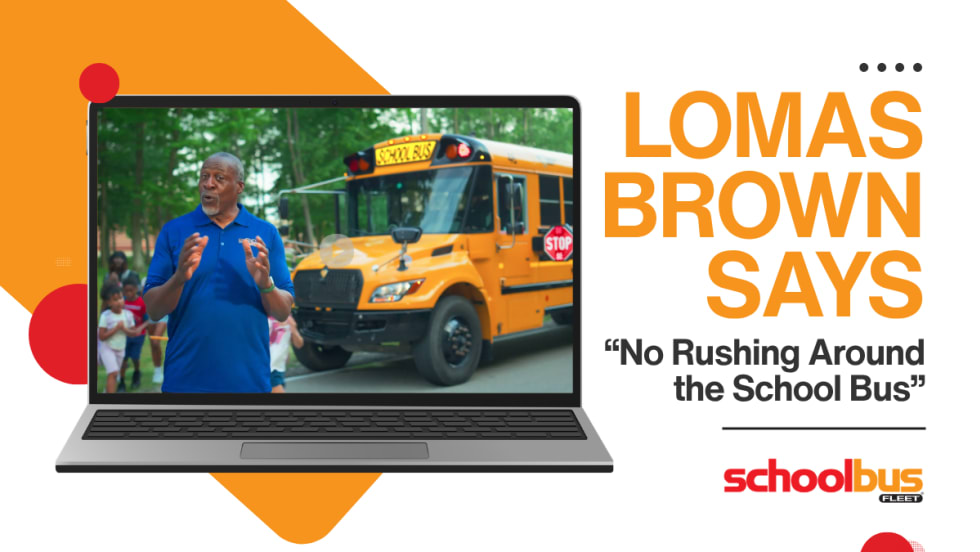
NFL Star Lomas Brown Kicks Off New Illegal School Bus Passing PSA
Just in time for the back-to-school season, the former Detroit Lions offensive tackle took time to record a video encouraging motorists to slow down around school buses.
Read More →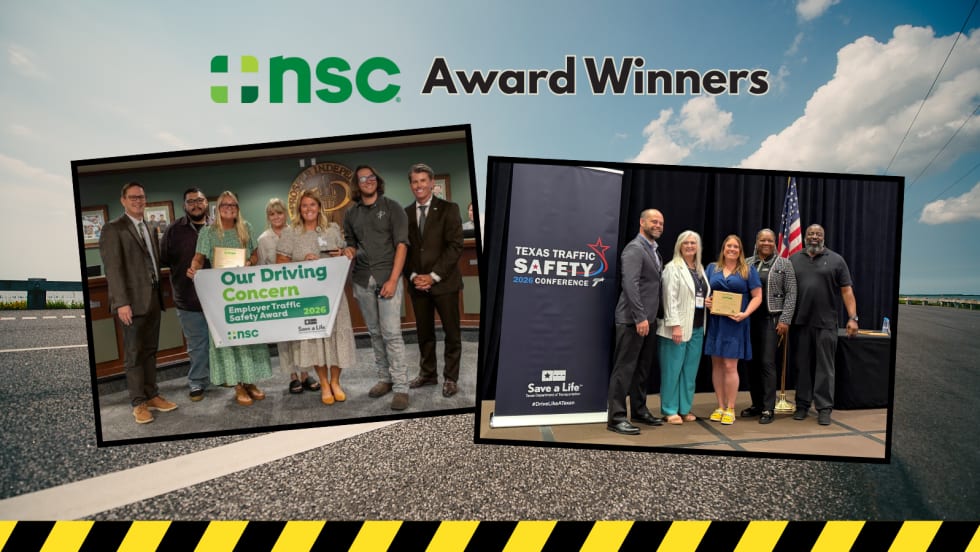
How Two Texas Districts Built Award-Winning Safety Programs
Learn how Prosper ISD and Rockwall ISD earned National Safety Council honors through hands-on training, safety culture, and strategies that reduced transportation incidents.
Read More →
NHTSA Releases 10-Year Review of Fatal School Bus Crashes
The latest federal analysis reinforces the safety of school buses while identifying where school-age pedestrians and other motorists remain most at risk.
Read More →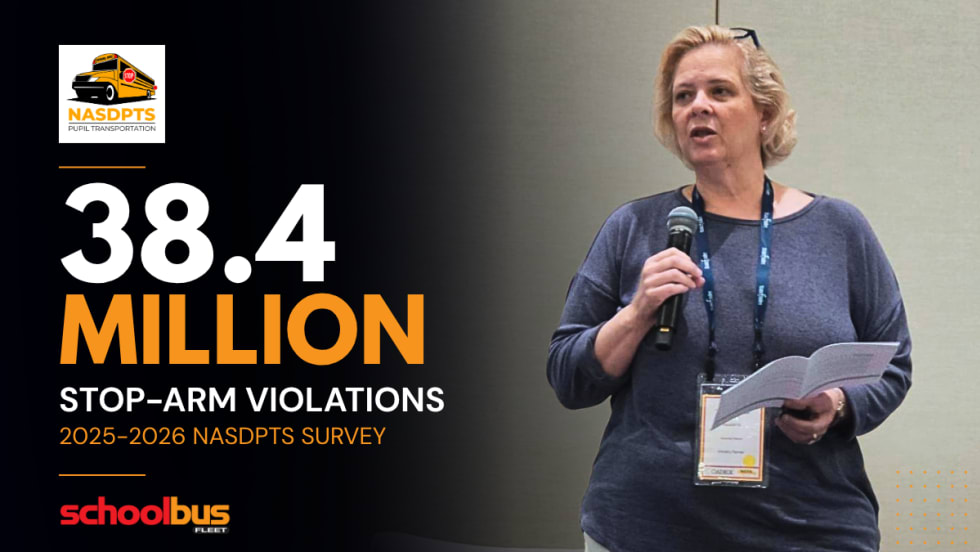
2026 NASDPTS Survey: Data Shows Further Reduction of Illegal Passing
New data is in! School bus stop-arm passings are down to 38.4 million violations per year, about a 2.3% decrease from last school year — but passings on the right side of the bus are higher than ever.
Read More →