




Building and Maintaining a Partnership with Special Educators
For many of us, more than half of our pupil transportation business comprises providing service for students with disabilities. Almost all of us s...
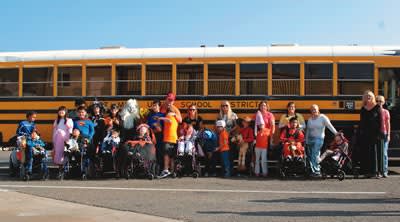
For many of us, more than half of our pupil transportation business comprises providing service for students with disabilities. Almost all of us started in this profession because we really care for kids. However, we may not have really done our best in the special-needs area because we either didn’t have enough time or didn’t know how to get there.
The Individuals with Disabilities Education Act (IDEA) considers transportation a related service just like many forms of therapy and supplemental education. What we do is crucial in providing students with access to their educational program. In fact, what we do can and, in many cases, should be part of the educational program.
Things to share
Counselors tell us that sharing is critical to successful relationships. Here are some things to share with your “partners” in the special-education department:
Vision — There is nothing more important than sharing a common vision of where you want the relationship between your two departments to be. Yogi Berra said, “You’ve got to be very careful if you don’t know where you’re going, because you might not get there.” You must make time to meet with your counterpart no matter how busy you both are.
IEP data — If we are going to safely and effectively transport students with special needs, we have to know what those needs are. Not only should we know about special equipment needs but also behavioral conditions and medical issues. We have a right to know very detailed specifics about student disabilities, but we have to train our staff properly to ensure that this information is not mishandled.
Similarly, the IEP team has a right to know about transportation-related issues, including incident reports and driver strategies. An effective way to share this information is by attending IEP meetings. With some training and advanced communication, the IEP meeting can be one of the most effective means of sharing strategies, options and goals for students.
Behavior plans — Students with special needs occasionally exhibit severe behaviors on the bus and in the classroom. Typically, the IEP team knows about the behaviors in the classroom and then can devise effective strategies to address them. Whether it is a behavior support plan (BSP) or a more thorough behavior intervention plan (BIP), teachers, psychologists, administrators and parents routinely develop plans to reduce problems and to reward appropriate behavior. These plans may be very elaborate or as simple as using red, yellow or green cards or a smiley face/frowny face form.
Students’ behavior during transportation is equally significant and should be addressed in the same manner. Why not use what works in the classroom? If we involve drivers in the reward system that’s working in the classroom, the student is more likely to succeed in terms of bus behavior because she or he is familiar with the “reinforcers.” Most drivers would be glad to extend the classroom onto the bus by marking a behavior chart or handing out a colored card, especially if it helps improve a student’s behavior.
Cost — The two largest “encroachments” on almost every school district budget are special education and transportation. Although we have separate budgets and, in most cases, report to different bosses, there are many advantages to sharing the cost of transportation in support of special education.
For example, even though the costs of transporting a student might be higher, the overall cost of educating a student at a certain site might be less. Certainly, it wouldn’t make sense for the transportation department to object to such a placement decision. Similarly, changing a school’s bell times might produce significant transportation savings despite minor additional staff cost to the educational program. In this case, it wouldn’t make sense for our friends in special-ed to object.
Devising shared strategies that allow us to meet compliance requirements can lead to major cost avoidance. By sharing expenses on these and such varied items as bus monitor staffing, in-services, wheelchair lifts and cameras for buses, districts can both improve service and preserve funding for education. Bottom line: If it saves money for the organization overall, it should be pursued regardless of what it does to your budget.
Organizational politics — Although my district is politics-free, some districts aren’t quite so fortunate. When viewed from a shared perspective, it makes a lot of sense for special-ed and transportation to present a united front on many issues. For example, we frequently hear of “the battle for classroom space.” The concept of educating students at their neighborhood schools merits aggressive support from both departments. It is not only the right thing for students, but it has tangible payback for both of us.
Similarly, shortening the school day for students receiving special education for logistical reasons should be resisted by both departments. We all benefit when the organization thinks in terms of “students with special needs” instead of “special-education students.”
Developing news — Don’t you hate finding out about things once you’re already in crisis? Since we “bus folk” travel in different circles than “special-ed folk,” we need to create opportunities to hear about things well before they happen. Our counterpart might not be in the loop unless we make the effort to bring them in on it. That’s one of the reasons that meeting with your counterpart is essential. Even if nothing is boiling over, I can assure you something is heating up. Maybe you’ll just verify some rumors, but maybe you’ll be able to prevent a crisis.
{+PAGEBREAK+} How to build it
Any partnership requires an exchange of ideas and feelings. Relationships between departments should be focused on the former but not ignore the latter.
The most common way to implement your ideas for cooperation between departments is to sell them. Starting with things that don’t require the other department to adapt much seems to work best. For example, you might want to start by running by your counterpart your school bus service guidelines for students with special needs. If you don’t have guidelines, then a parent pamphlet can be an easy way to ensure you’re all on the same page and to improve communications with your customers. Here are some other ideas worth discussing/selling:
Scheduling therapy bus service around bus availability.
Regionalizing bus service either within your district or between districts.
Timelines for delivery of data.
Automating data exchange between departments — or at least giving each other access.
Sharing in-services on specific disabilities, mobility devices and severe behaviors.
Guidelines for when curbside service is appropriate.
Creating student data sheets for drivers.
Guidelines for when transportation staff should attend IEPs.
You’ll notice all of these ideas have some benefit for our friends in special-ed. When you sell the idea, it’s best to emphasize the value you would be adding to their department. Even if it’s just improved bus service, they’ll hear fewer complaints as a result.
Another effective technique to build the relationship is to plant a seed and fertilize it. Mention an idea in one of your regular meetings. In following meetings, water and fertilize the idea. Eventually, when they’re ready for it and they own the idea, you can just step back and watch it grow. Of course, this requires trust, patience and a willingness to suppress your ego. The key is to focus on the results rather than the credit. When the partnership is successful and you collectively are doing great things, there will be plenty of credit to go around.
Sustaining the relationship
So you’ve got the relationship built and you’ve even experienced some successes. How do you keep it from falling apart? There’s always going to be friction! One important factor is keeping things positive. Don’t allow anyone in your department to blame the other (especially the customer). If there are issues, elevate it to the director level, where it can be dealt with in regular meetings in a non-confrontational manner.If it is one of those very rare occasions when transportation is at fault, don’t just explain it away — sincerely apologize. Better yet, devise or revise a process to ensure it doesn’t happen again.
Taking it to the next level
Once the relationship is built, your successes will become so frequent that you might stop recognizing them. At the next level, your departments will have a culture of helping each other. Processes will routinely be revised and enhanced based upon both positive and negative feedback. You’ll start treating each other as customers owning the quality service the other supplies.I can’t conclude an article about successful special-ed/transportation partnerships without discussing celebrations. As you experience successes, make sure to celebrate them. Celebrations build bonds and provide free advertising, which, in turn, builds credibility. That’ll make your next idea even easier to sell.
Each year, we invite our severely handicapped classes to come to the bus yard and “trick-or-treat.” These students might not otherwise get the opportunity. We’ve also trick-or-treated in our special-ed offices. It’s an opportunity for us to share, celebrate and remind ourselves why we’re here.
If your district or company has an employee reward program, consider selecting and rewarding someone who has gone above and beyond.
One of our special-education teachers is working on improving student independence by gradually moving the bus stop away from the home. She has taken an idea she heard from us at an IEP and expanded it. She “gets it,” and now she’s been recognized by our district as a “Super Star.”
If your organization doesn’t have a reward program, you can create your own version. I hear special-ed administrators have a soft spot for chocolate.
Pete Meslin is the transportation director at Newport-Mesa Unified School District in Costa Mesa, Calif.
More Special Needs Transportation
Kelli Goterba Named 2026 Special-Needs School Bus Driver of the Year
Through building trust with students and strengthening her transportation team, Goterba exemplifies the impact special-needs drivers can make.
Read More →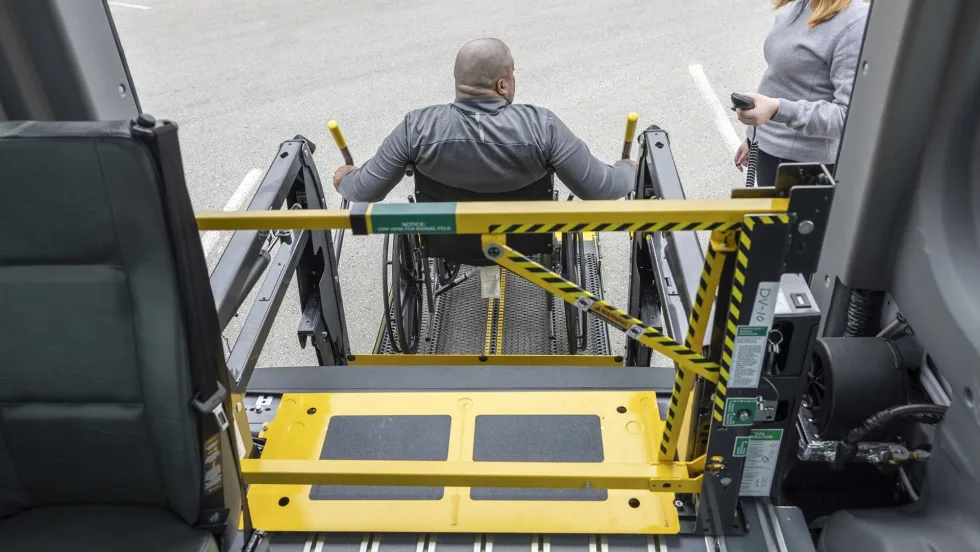
BraunAbility Introduces New Safety Barrier for Wheelchair Lifts
LiftSentinel is designed to add another layer of protection during wheelchair loading and unloading and can be retrofitted to many existing commercial lift installations.
Read More →
HopSkipDrive Launches New Safety, Driver Consistency Features for 2026-27 School Year
The company’s free ride recording, live ride tracking, and consistent driver assignments aim to improve safety and continuity for diverse student transportation needs.
Read More →
The Most Common Wheelchair Securement Mistakes on School Buses (and How to Fix Them)
Small missteps in wheelchair securement can have serious consequences. Here are 32 tips from experts to reduce risk and increase student safety on the bus.
Read More →
Inside AMF Bruns’ New Showroom: School Bus Securement Solutions Explained
Go inside AMF Bruns America’s new Ohio showroom with Maritza Valentin to see its FutureSafe technology, driver training tools, securement systems, and seating innovations.
Read More →
What AMF Bruns’ New Facility Means for Customers [Video]
Inside AMF Bruns’ new Stow, Ohio, operations: See how expanded space and innovation will enhance customer support and operations.
Read More →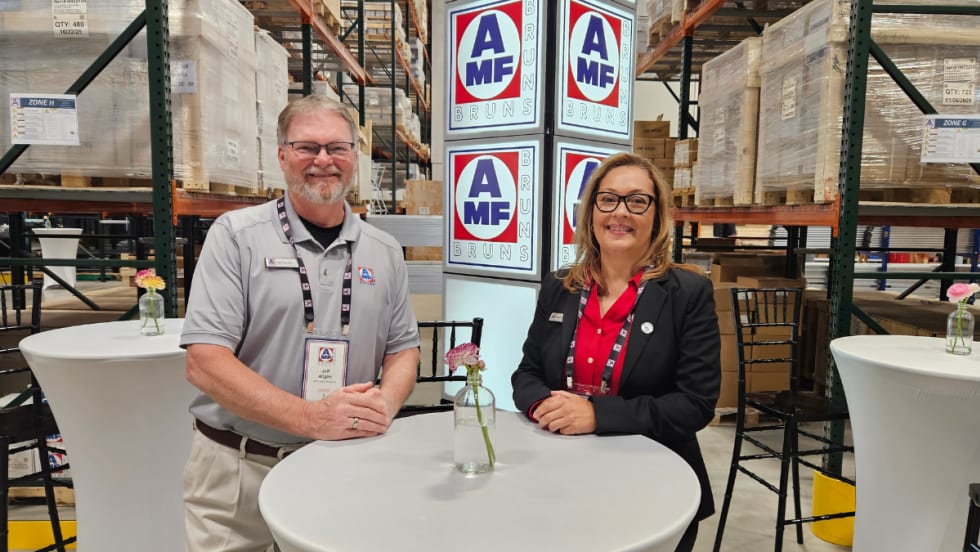
AMF Bruns Expands in Ohio, Investing in Growth and Community
With expanded production space, local investment, and a growing workforce, AMF Bruns is scaling its U.S. presence. Here’s an exclusive first look inside the new Stow, Ohio, HQ.
Read More →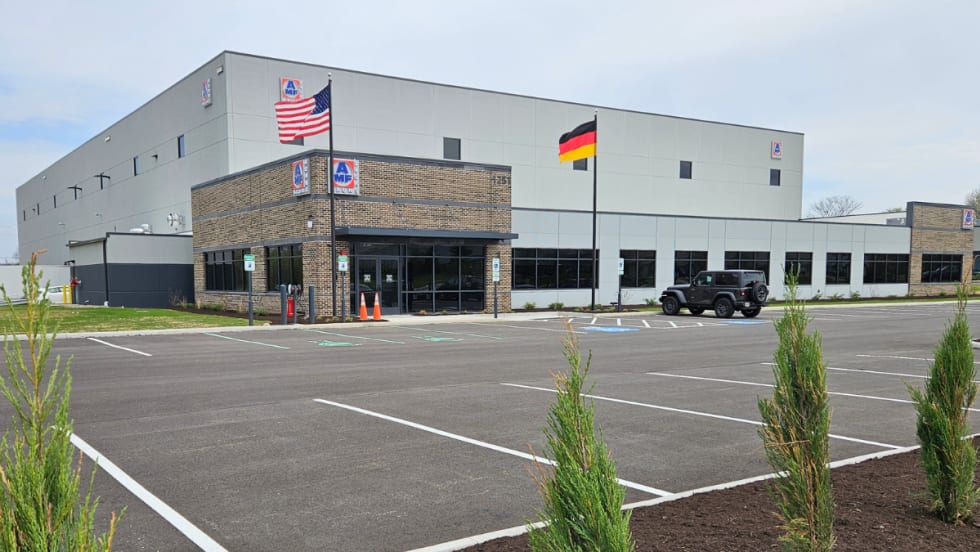
Inside AMF Bruns of America’s New Ohio Manufacturing Facility [Photos]
Take a behind-the-scenes look at AMF Bruns of America’s new 41,000-square-foot Stow, Ohio, headquarters, featuring advanced manufacturing, expanded space, and future-ready mobility solutions.
Read More →
First Student Boosts Student Support in Wichita & Texas
First Student and Wichita Public Schools are using behavioral support strategies to improve student ride experiences, while a separate initiative expands access to after-school programs through a bus donation.
Read More →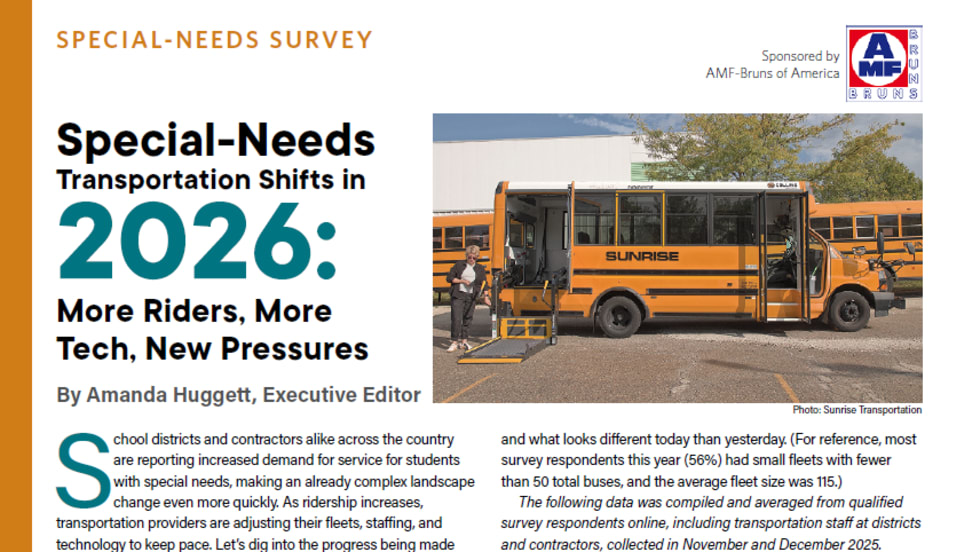
2026 Special-Needs Transportation Survey
What’s changing in special-needs transportation? This year, student transportation operators report a rising need, easing driver shortages, growing tech adoption, and evolving challenges. Sponsored by AMF Bruns of America.
Read More →