




Buckle up: The latest in restraint systems
As the prevalence of lap-shoulder belts in buses grows, it is important for operations to consider the type of students they are transporting and the ability to upgrade to meet future safety standards before selecting a belt system.
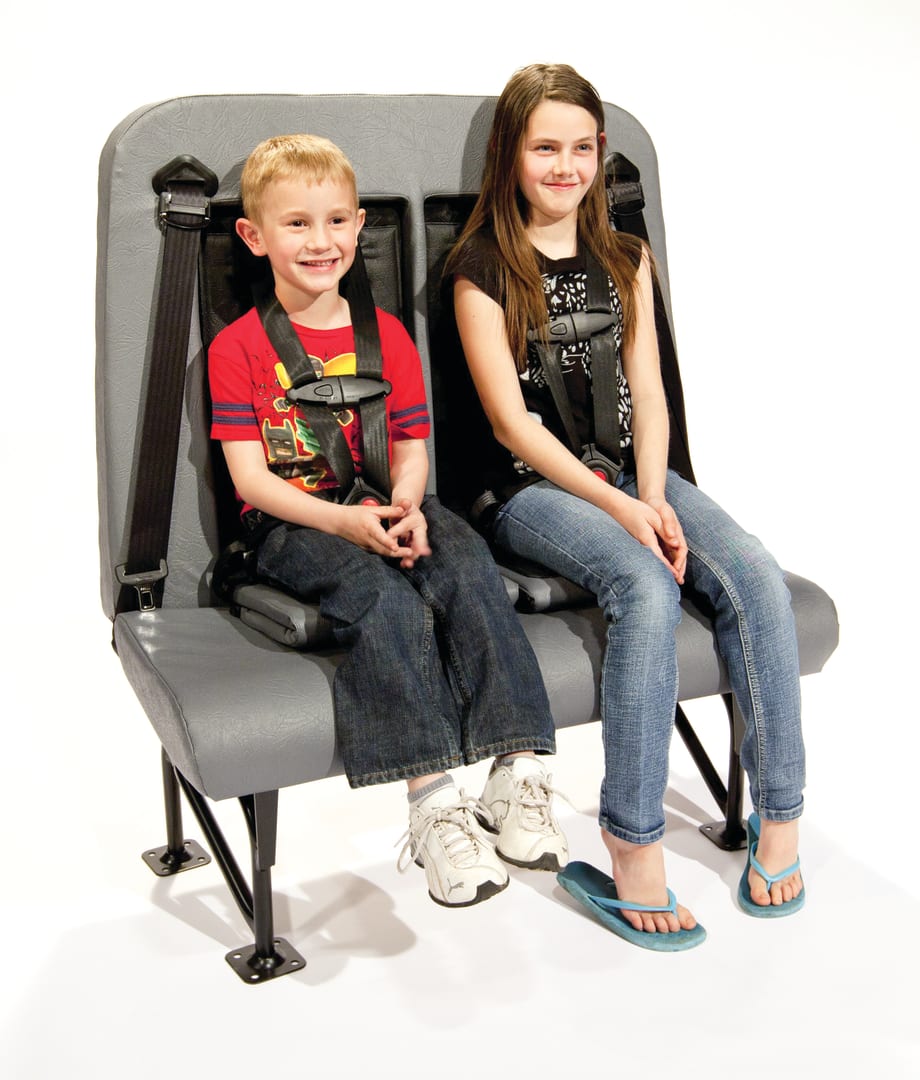
The C.E. White Co. offers a fully integrated Type 2 seat belt system in its seats with an adjustable D-ring, emergency locking retractors and locking tongue.
More and more school bus operations are making the investment in lap-shoulder belts to better protect students while the bus is in motion. Today’s belts are adjustable, easy to use and go above and beyond when it comes to meeting federal motor vehicle safety standards (FMVSS).
To find out what features make a seat belt system safe and secure, SCHOOL BUS FLEET spoke with officials from manufacturers The C.E. White Co., Freedman Seating Co., SynTec Seating Solutions and SafeGuard/IMMI about their products.
Exceeding standards
Freedman’s new Family-3PTA seating solution includes an integrated, adjustable three-point seat belt, and every seat meets the Quasi-static and FMVSS 202A head and neck safety standard.
“The belt is ‘adjustable’ because it can accommodate a child and adult,” says Jack Sullivan, Freedman’s national sales manager — school bus. “[The seat] passes or exceeds the federal motor vehicle safety standards for school buses — the new ones are the Quasi-static and 202A. The seat is also FMVSS 222 compliant.”
FMVSS 202A is designed to reduce the frequency and severity of neck injury in rear-end and other collisions. Quasi-static testing simulates a scenario in which an unrestrained child has gone forward and hit the seat, while a restrained child is simulated by the seat being pulled forward at the same time.
C.E. White’s seats and belts also meet these standards. “The belts and seat frame are built to comply with all federal specifications, including FMVSS 222 for Quasi-static as well as seat surface area and seat cushion retention,” says Steve Frazee, director of product and OEM development for C.E. White. “Also, the seat allows for a 15-inch aisle at hip level to allow for emergency egress.”
SynTec Seating Solutions’ new S3C school bus seat, the first in its family of S3 seats, has interchangeable backs that allow for non-belted, lap belts, lap-shoulder belts and integrated child seats. The integrated child seat option is tested and certified for children weighing 22 to 85 pounds, and the entire system is FMVSS 222 compliant.
Easy to use
SafeGuard/IMMI promotes a simple procedure for using seat belts, similar to the one created for commercial vehicle drivers several years ago: Click, Tug and Snug.
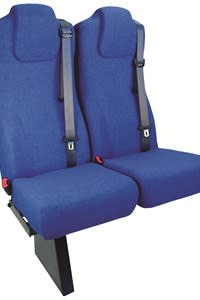
Freedman Seating Co.’s Family-3PTA seating solution is equipped with integrated, adjustable three-point seat belts.
“We teach children to first sit properly in the seat and then pull out the retracted shoulder belt on the seat,” explains Charlie Vits, market development manager at SafeGuard, a seating brand of manufacturer IMMI. “When engaging the latchplate in the buckle, they are to listen to the click, then tug on the latchplate to confirm engagement, and finally for proper usage, they are to snug the belt system by pulling on the shoulder belt so the lap belt is tight and properly located low on the waist. We finish by moving the shoulder height adjuster to a position that properly and comfortably locates the torso belt on the child’s shoulder.”
Frazee says that it is important that the student sit upright with his or her back against the seat when putting on the seat belt.
“The belt should slide easily and comfortably over their shoulder. The D-ring should be adjusted so that the belt is positioned across the shoulder and not too high and rubbing against the neck,” he explains. “It is also important that the belt is located properly throughout the route, not worn under the arm. Finally, it is important to hear the ‘click’ to make sure the tongue is securely latched into the buckle.”
Sullivan says that the belts on Freedman’s Family-3PTA seating are simple to use. “There’s a male tongue that goes into a female buckle, and when you pull it over your shoulder, it automatically adjusts. So there’s a tensioning system that keeps it snug across your lap, very similar to a car seat belt. “
Increasing student safety, discipline
“From the first uses of lap-shoulder belts 10 years ago, significant improvements in behavior have been reported when a required usage policy is established and enforced,” Vits says.
According to Vits, Bartholomew Consolidated School Corp. in Columbus, Ind., experienced a 90% reduction in reportable school bus incidents the first year the lap-shoulder belts were introduced. On SafeGuard’s website, a video comparison of the same students and driver on a bus without and then with lap-shoulder belts shows a significant difference in behavior.
“Behavior improvement frees the driver to focus on driving the bus safely rather than also having to monitor the behavior in the bus while driving,” Vits explains. “As a means of crash avoidance, this could be the biggest impact to student safety. Distracted driving has become a national concern, and lap-shoulder belts are a tool to deal with a major distraction affecting most school bus drivers.”
[PAGEBREAK]
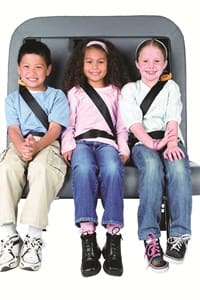
The SafeGuard XChange FlexSeat has a flexible capacity, enabling belted seating for one, two or three students.
Frazee says he has also seen numerous videos of students on a route before and after shoulder belts were installed, and that these videos indicate that lap-shoulder belts really do make an impact on student discipline issues.
“School buses are the safest form of transportation on our roads today,” he says. “They are built to absorb the energy caused in a crash, as are the seats. However, three-point seat belts enhance compartmentalization, keeping the students in the compartmentalized zone for maximum safety.”
Larry Bannon, vice president of new business development at SynTec, says that while he hasn’t witnessed firsthand student behavior improvements as a result of seat belts, operators have reported seeing positive changes to the company. “I have definitely heard that [lap-shoulder belts improve behavior] from transportation supervisors,” he says.
Options available
Freedman’s seat belts are available with under-seat retractors, and some seating systems can be equipped with integrated child seats. The seats can also be ordered with sustainable options like bio-cushions made with vegetable oil or cloths made with recycled yarn.
With C.E. White’s current conversion seat, “You can take a C.E. White standard bench seat and convert it into a three-point child restraint in about five minutes,” Frazee says. “Also, we came out with a three-passenger, three-point seat with two integrated child restraint seats, giving the bus operator the ultimate choice in flexibility.”
SafeGuard’s new generation of seating, XChange, allows features and configurations to be easily revised as needs for the seat change with time. Operators can buy standard seats now and add or configure seat belts at a later time.
Belts should be flexible, familiar
Having lap-shoulder belts that are similar to those in a passenger vehicle will ensure that students will properly use them, according to Frazee. Belts that require minimal maintenance are also preferable.
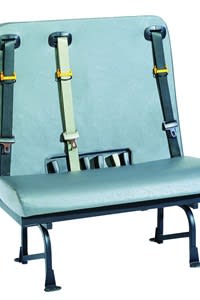
SynTec Seating Solutions’ new S3C school bus seat has a common base and interchangeable backs, which allows for non-belted, lap belts, lap-shoulder belts and integrated child seats.
“Finally, it is important that a seat has the flexibility to fit most any size student and not limit the height or weight in any location,” he adds.
Bannon suggests that seat maintenance should be a significant concern for operators. “One of the big issues that we tried to deal with when we were designing our [new S3C] seat was the fact when you’ve got the harnesses and/or the modules for the integrated child seats in the seat back, it’s just not as easy to replace a cover … as it is on a regular seat.”
Bannon also says that operators need to carefully consider their options if they decide to retrofit their buses.
It is important to make sure “that the bus and the seat that they are retrofitting it with are compatible; it’s not just a matter of taking one seat out and putting another seat in,” he says. “They need to make sure that the procedure is done correctly.”
Vits says operations should consider who they are transporting before they select a seating system.
“Do they plan for three elementary students to a seat, or will they always limit two students to a seat? Will they have to transport any pre-K children or infants? What about transportation of students with special needs?” he asks.
Belt usage continues to grow
“I think that the trend toward lap-shoulder belts is probably — because of the economy and tight school budgets — not moving as fast as I think it normally would,” Bannon says. “But definitely we are still seeing school districts, whether [belts are] mandated or not, heading that way.”
Despite the budget challenges, Vits is also certain there are going to be a lot more lap-shoulder belts on buses.
“The major trend we have observed is a greater acceptance by school districts of all sizes for new buses equipped with lap-shoulder belts,” he says.
More Safety
School's Back. Here's What Happened to Traffic, Speeding & Distraction
What happens to traffic when school resumes? New data analysis examines changes in distracted driving, congestion, and speeding around schools.
Read More →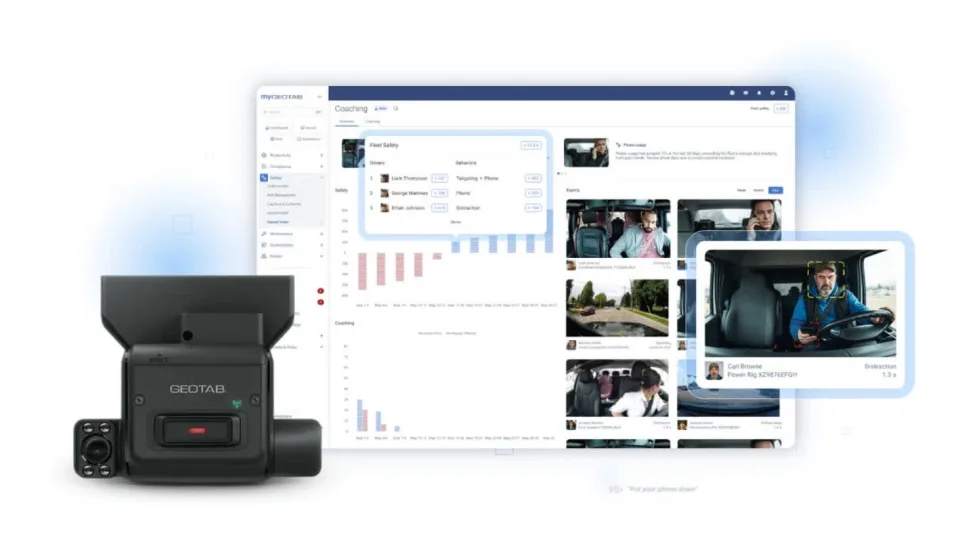
Geotab Expands Fleet Safety Tools With Video Coaching, Risk Insights
New safety and video capabilities aim to help fleet managers assess risk, support drivers, and take targeted action through video coaching, red-light violation detection, and more.
Read More →
How to Build a Better School Bus Driver Training Program
Is it time to strengthen your driver training? Here’s how to pick the right talent and improve recruitment, retention, and safety. This video is brought to you by IC Bus.
Read More →

Recent School Bus Accidents Leave 2 Dead, 2 Injured
Four school bus crashes in Florida, Illinois, and Georgia highlight risks in transportation lots, at bus stops, and during student loading and unloading.
Read More →
When Every Second Matters, Clarity Keeps Routes Moving
From routine delays to urgent incidents, strong communication practices help drivers, dispatchers, schools, and families respond with confidence.
Read More →
What Happens When a School Bus Catches Fire — and What Can Help
School bus fires are rare but can be devastating. Learn how advances in fire suppression and asset protection help fleets detect fires earlier, reduce damage, and improve safety.
Read More →
Geotab Launches Tool to Help Fleets Investigate Road Incidents
Geotab Investigations combines telematics data, video, documents, and other evidence to help fleets reconstruct incidents, resolve claims, and determine what happened.
Read More →
Texas Sixth Grader Wins 2026 National School Bus Safety Poster Contest
Sai Darshana Yekolu of Moseley Middle School in Prosper, Texas, was named the newest winner for her artwork, bringing the theme of “Safe Rides, Everyday Heroes” to life.
Read More →
Doing More With Less: How Transportation Directors Can Prioritize Safety Amid Budget Uncertainty
With diesel prices soaring and nearly one-third of transportation directors expecting budget cuts, maintaining student safety has never been more challenging. Download this guide to learn how leading districts are prioritizing risk, funding critical safety technology, and building stronger budget cases with data.
Read More →
Walton County Schools Adds Gatekeeper Stop-Arm Enforcement System
The Florida district will deploy Gatekeeper’s updated Student Protector technology, which now incorporates AI to improve video evidence.
Read More →