




Avoiding Backpack Risks on the Bus
What rides the bus with students of all ages, resting on the floor or in laps throughout the passenger compartment? Backpacks, of course. While b...

What rides the bus with students of all ages, resting on the floor or in laps throughout the passenger compartment? Backpacks, of course.
While backpacks are essential for students to carry their books and other items in, they can become a safety hazard on the bus if they’re not kept in check.
Here’s a look at the many issues that backpacks can present and how best to handle them.
Backpack weight matters
Heavy backpacks often push the limits of student safety. Backpacks should weigh no more than 15 percent of the student’s body weight. Those that weigh more can strain students’ backs and distort their walking and seated posture.
Backpacks can also present students with significant balance problems while entering or alighting from the bus. The smaller the student and the bigger the backpack, the more imbalanced the student becomes, creating a higher risk of falling at the stairwell or in the bus.
“Heavy backpacks” is a relative term that drivers may not understand. Here’s a good example: For a 50-pound student, a backpack that is 15 percent of his or her body weight would be 7.5 pounds. Very few backpacks worn by elementary students are so light.
For a 150-pound adult, a backpack that is 15 percent of his or her body weight would be 22.5 pounds. Most middle and high school students have backpacks that typically weigh less than the 22.5-pound safety margin.
Checking for safe use
At the school loading zone and under the supervision of a teacher or building administrator, place a bathroom scale near the bus entrance and ask only those students who wear backpacks to voluntarily weigh themselves with and without their backpack.
Record the students’ names and their weight with or without backpacks. You may find that the smaller the students, the heavier their backpacks will be.
Checking each student’s backpack weight to body weight ratios reveals that backpack weight varies from day to day and from morning to afternoon bus service.
Look for a higher percentage of elementary students to have backpacks that are too heavy for their own body weight. Middle and high school students are less likely to have backpacks that are too heavy relative to their body weight as they approach adult size.
If one student per school year per bus is helped to avoid injury caused or aggravated by heavy backpacks, the checking effort will be worthwhile. District liability for student slips, trips and falls on the school bus will be minimized.
Alerting parents to risks
Backpack weighing could have the same types of safety effects as mandated bus evacuation drills. Students with heavier backpacks can be identified, and parents can be alerted privately using a handout mailed by the building administrator.
Each school year, student handbooks should have a section on “Backpack Safety on the School Bus,” with a table showing maximum backpack weight for body weights in increments of 10 pounds up to 300 pounds. Parents and students must become more aware of the risks imposed by backpacks that are too heavy.
Bus stop and boarding safety
Falls into the approaching bus’ pathway can occur with students at the front of the line who have backpacks that are too heavy for them. A quick recovery from a fall and the return to the safe boarding area is slowed by a heavy backpack. Also, students running toward the bus with heavy backpacks can easily slip, trip or fall under the bus with tragic results.
Improper lifting of backpacks by bending at the waist instead of bending at the knees may harm students before boarding the bus or while on the bus. Holding a backpack in one hand or the other before boarding instead of wearing it destabilizes students and makes them more vulnerable to slips, trips and falls.
These types of accidents at the stairwell occur more frequently with those wearing backpacks. Boarding the bus presents hazards without the added weight of backpacks, which offset the student’s center of gravity. Disturbing the body’s center of gravity can cause students to fall backward in the stairwell.
Preschoolers and primary grade students are already top heavy in their physical development. Students lined up too closely behind one another can lead to a domino effect, as others fall behind the first student.
Using the handrail during stairwell entry or exit helps students maintain their balance. However, some students do not wear their backpacks properly, leaving one strap open that can catch on the handrail.
Bus drivers should have their passengers wear their backpacks properly or carry their backpacks in the hand on the opposite side of the handrail.
On the bus
Backpacks left at the front of the bus near the driver present safety hazards. Storage of backpacks next to the firewall above the stairwell blocks access to the fire extinguisher. Backpacks can fall into the stairwell during hard turns or heavy braking maneuvers. And backpacks left at the front of the bus can roll or slide under the driver’s brake or accelerator pedals.
Backpacks should not be worn on the student’s back during the bus ride. This would hinder compartmentalization by adding a significant amount of weight to the force of gravity on the student in a bus collision.
Students wearing backpacks are moved forward away from the seat backs, preventing them from having their heads against the seat back. During a rear-end collision, the “head rest” effect of high-back seats is lost when students’ heads are out of their safety position.
When students wearing backpacks are properly seated — facing forward with feet on the floor — their center of gravity makes them top heavy. A top-heavy student during a mild braking or turning maneuver can fall forward onto the bus floor, leading to head, facial, neck and back injuries. In this case, the student falls to the floor and does not hit the back of the seat ahead. A fall off the bus seat to the floor removes the student from the protection of the compartmentalization envelope.
Safety for secondary students
Secondary students with larger body weight wearing heavier backpacks may exceed the seat back deformation tolerances ahead or behind them during minor bus collisions. The bigger the student and the heavier the backpack, the less compartmentalization can work for those passengers during a frontal or rear-end collision.
Collision forces of the backpack added to the student’s body weight may lead to additional neck and back injuries. Student ejections backward by ramping up and over their own seat back and into seat rows behind them can occur when seat backs deform following a rear-end collision.
Backpack positioning
Where students store their backpacks is important for safety and practical reasons.
Students or their backpacks — or both — can be ejected into the bus aisle, where no compartmentalization protection exists. Backpacks ejected in the aisle cause passengers to trip over them.
Students who trip in the aisle for any reason may be trampled by others during a bus evacuation. Sixteen-inch wide bus aisles do not easily accommodate 24- to 30-inch wide students walking or stumbling there.
School bus seating capacity is reduced by one third when two backpacks are placed beside their owners to occupy the seating space in the middle that is intended for another student. With the high cost of fuel and the need for maximum bus capacity, backpacks can cause a significant cost overrun to already-strained pupil transportation budgets.
Smaller students may place their backpacks under themselves in their seating area to have a better view. Sitting on a backpack can place the student above the height of the seat backs. Again, improper seating removes students from the protection of the compartmentalization envelope. Improperly seated students are the most vulnerable to ejection from their seats during a collision.
Backpacks on the floor present a significant tripping hazard to seatmates during regular loading or unloading. Backpacks on the floor during heavy braking, or during mild to moderate frontal or rear bus collisions, become displaced objects, sliding forward or backward toward the point of collision. If backpacks are ejected from under the seat and across the aisle, other students then have tripping hazards within their own seat rows.
Backpacks stored at rear seat rows not occupied by students can become missiles during a frontal bus collision. Visualize a bowling ball hurtling through the bus and the damage it would cause to those in the collision trajectory before coming to rest at the driver’s feet — or worse, into the back of the driver’s head.
Backpacks stored on the rear seat rows can become dislodged and act as significant barriers to students during emergency evacuations requiring rear-door exit.
During an evacuation, backpacks must be left behind. The delay of students attempting to retrieve their backpacks instead of immediately evacuating the bus is a critical, life-threatening delay that can and should be avoided. Leaving backpacks behind should become an integral part of school bus evacuation drills.
Good news, bad news
First, the bad news: Backpacks are here to stay. Their owners value their own property and their right to bring that personal property onto the bus. Parents view their child’s right to bring their own backpacks on board as a fundamental privilege of the school bus ride without considering the risks of backpacks being misused and misplaced.
Also, as discussed earlier, parents often do not consider the potential harm that backpacks weighing over 15 percent of their child’s bodyweight can do to a developing body.
Next, the good news: Backpacks can be safely stored on each seat row under the seat in front of their owners and attached with an “S-hook” to the seat leg nearest the bus wall. Three S-hooks placed there with a closed loop of high-strength webbing can easily hold three backpacks under the seat.
With this type of securement in place, collision forces within the bus will impose backpack weight on bus seat legs anchored to the floor rather than on the seat backs. Seat backs are less likely to be deformed in a bus collision without the added weight of backpacks. Seat anchorages are far less likely to fail even with severe collision loads and the added weight of three backpacks for each bus seat.
Properly securing backpacks reduces tripping hazards, and backpacks will not become missiles anywhere on the bus during hard turning, sudden stops or other collision-avoidance maneuvers.
During evacuations, bus aisles will remain clear of ejected backpacks that would slow students’ movement. Also, a student tripping in the aisle is less likely to cause a “stampede effect” of others who are panicked to get out, trampling over that student.
With driver efforts, parents and students can become aware of the risks that backpacks on school buses can present.
Dr. Ray Turner is a special-needs transportation authority, expert witness and author of numerous books and newsletters. For more information, visitwww.whitebuffalopress.comandwww.schoolbusaccidentreconstruction.com.
More Safety
School's Back. Here's What Happened to Traffic, Speeding & Distraction
What happens to traffic when school resumes? New data analysis examines changes in distracted driving, congestion, and speeding around schools.
Read More →
Geotab Expands Fleet Safety Tools With Video Coaching, Risk Insights
New safety and video capabilities aim to help fleet managers assess risk, support drivers, and take targeted action through video coaching, red-light violation detection, and more.
Read More →
How to Build a Better School Bus Driver Training Program
Is it time to strengthen your driver training? Here’s how to pick the right talent and improve recruitment, retention, and safety. This video is brought to you by IC Bus.
Read More →

Recent School Bus Accidents Leave 2 Dead, 2 Injured
Four school bus crashes in Florida, Illinois, and Georgia highlight risks in transportation lots, at bus stops, and during student loading and unloading.
Read More →
When Every Second Matters, Clarity Keeps Routes Moving
From routine delays to urgent incidents, strong communication practices help drivers, dispatchers, schools, and families respond with confidence.
Read More →
What Happens When a School Bus Catches Fire — and What Can Help
School bus fires are rare but can be devastating. Learn how advances in fire suppression and asset protection help fleets detect fires earlier, reduce damage, and improve safety.
Read More →
Geotab Launches Tool to Help Fleets Investigate Road Incidents
Geotab Investigations combines telematics data, video, documents, and other evidence to help fleets reconstruct incidents, resolve claims, and determine what happened.
Read More →
Texas Sixth Grader Wins 2026 National School Bus Safety Poster Contest
Sai Darshana Yekolu of Moseley Middle School in Prosper, Texas, was named the newest winner for her artwork, bringing the theme of “Safe Rides, Everyday Heroes” to life.
Read More →
Doing More With Less: How Transportation Directors Can Prioritize Safety Amid Budget Uncertainty
With diesel prices soaring and nearly one-third of transportation directors expecting budget cuts, maintaining student safety has never been more challenging. Download this guide to learn how leading districts are prioritizing risk, funding critical safety technology, and building stronger budget cases with data.
Read More →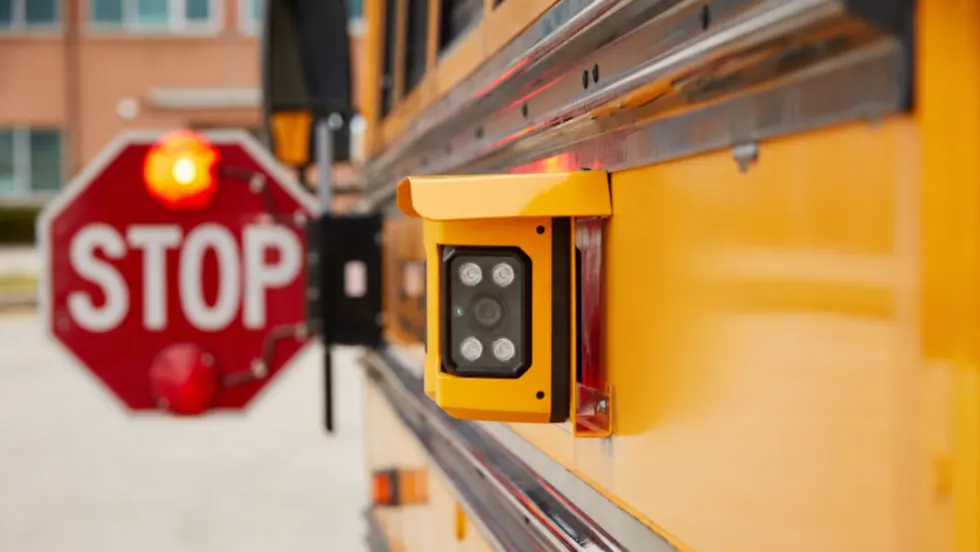
Walton County Schools Adds Gatekeeper Stop-Arm Enforcement System
The Florida district will deploy Gatekeeper’s updated Student Protector technology, which now incorporates AI to improve video evidence.
Read More →