




Fire Suppression Systems: Saving Lives & Reducing Damage
Assume a Bus Fire Is in Your Future
The Sept. 23 motorcoach fire near Dallas that claimed 23 lives during the evacuation before Hurricane Rita should serve as a wake-up call for everyone...
by Ted Finlayson-Schueler
December 1, 2005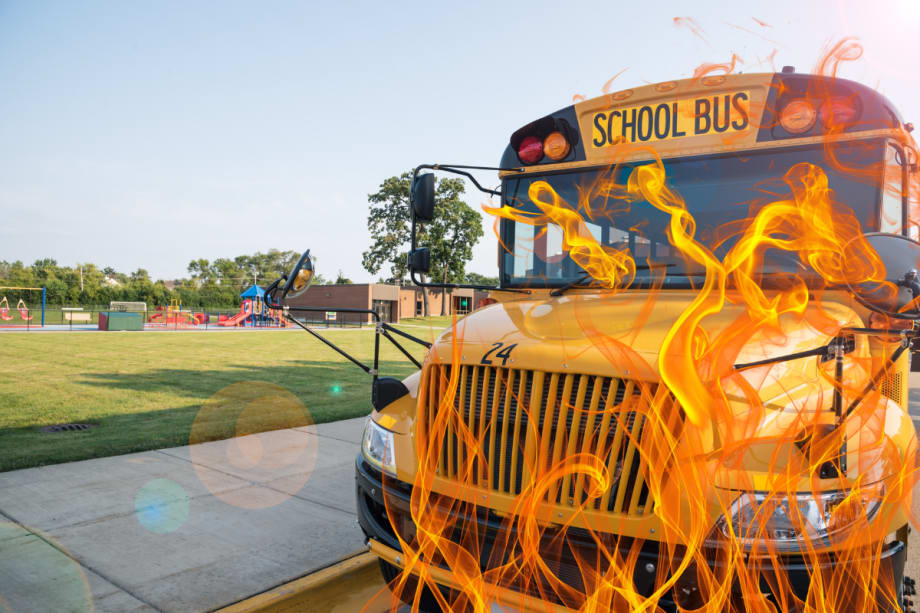
There are so many accelerants on a school bus that once it has burned down to the shell, there is seldom a way to determine where a fire started.
Photo: School Bus Fleet/Canva
8 min to read
The Sept. 23 motorcoach fire near Dallas that claimed 23 lives during the evacuation before Hurricane Rita should serve as a wake-up call for everyone involved in passenger transportation.
The physical challenges of the victims — seniors with mobility limitations, many of whom carried oxygen with them — are not that different from the children with mobility limitations that we transport every day on school buses. Why do we need a wake-up call? The discussion of school bus fires is often dismissed with the quick assumption that they are too rare to worry about.
It Burns in our Memory
Those of us who were in the school bus safety business on May 14, 1988, remember the shock of hearing that 27 people had died in a bus collision and fire in Carrollton, Ky. The church bus was struck head-on by a pickup truck that swerved across an interstate highway. The truck driver was found to be intoxicated and spent 11 years in prison.
Bodies were burned beyond recognition, and a community was destroyed by the grief. Carrollton was a tragedy that must not be forgotten with the easy rationalization that it was a church bus — no longer a school bus — that it was powered by gasoline rather than less-flammable diesel fuel, or that the fuel tank was not protected as a post-1977 fuel tank would have been.
If you are aware of school transportation issues, you know that field trip buses are still crowded with baggage and coolers, you know that there are still drunken drivers on the road, you know that a broken spring leaf could easily penetrate the fuel tank cage and you know that bus fuel is still very flammable. The circumstances of Carrollton could be reproduced again, and it is our professional responsibility to expect such an incident and prepare for it.
School Bus Fires on the Rise?
Joe Scesny of the New York State Department of Transportation says he’s seeing an increase in school bus fires starting in the increasingly complicated circuit boards on today’s buses. More traditional locations of fires include the engine compartment, due to leaking power steering and transmission fluids, and the rear tires.
Because power steering and transmission fluids can be operating under pressure, leaks are not uncommon. These fluids have a flash point similar to gasoline’s, so while engine oil and diesel fuel are less prone to ignite, these fluids dripping on the exhaust system or near any electrical spark can ignite quickly.
Failure to refill the oil in the hub after a brake job on rear dual wheels can create friction and enough heat to start a fire, especially in rear-engine buses where numerous accelerants may be present near the rear axle.
Scesny says there are so many accelerants on a bus that once it has burned down to the shell, there is seldom a way to determine where a fire started.
The best defense against a fire, Scesny says, is to ensure that the bus is properly spec’d and maintained. Overloaded electrical componentry can best be avoided by proper specifications. Installation of aftermarket products that could increase the chances of a fire should be done in consultation with the manufacturer. Clean, regularly inspected engine compartments allow leaks to be identified more easily and reduce the presence of accelerants, either leaking or accumulated.
The Proper Response
There are three different responses to fires on school buses, as there are with most safety issues — engineering, education, and enforcement.
Engineering includes bus design and specific equipment that can be incorporated into the design or equipping of the bus. Education includes the training of school bus drivers and passengers. Enforcement, meanwhile, may seem less obvious here than in programs to arrest those who pass our loading and unloading school buses. Perhaps it is more important than we think.
Most states spend millions of dollars reimbursing schools for transportation expenses, but I’m not aware of a single state that uses that “hammer” to require safety compliance. The federal government hangs highway dollars over the states’ heads to influence them to enact primary seat belt laws, .08 blood-alcohol limits and graduated licensing, but states do not use the power of the dollar to enforce safety requirements for school transportation.
How many states have any plan in place to determine if bus safety drills are conducted along state or federal guidelines? Are students trained in the “use” of emergency exits and equipment? “Use” means doing, not just identifying where the exits are. The Seward Public Schools students in the deadly 2001 crash in Omaha, Neb., which was investigated by the National Transportation Safety Board, knew where the exits were but did not know how to open them.
Most states require the presence of emergency equipment on the bus, but how many have a way to determine if their drivers properly understand its use? How many school bus drivers have actually evacuated themselves through a side emergency window and a roof hatch? If a driver cannot exit out the roof, how will they respond if their bus is caught in a flash flood or other water emergency? Knowing to exit emergency windows “face down, feet first” is different from having actually done it. Does the driver know how to open all the roof hatch styles in the fleet
Keeping Fires Suppressed
A requirement for fire-suppression systems on school buses was brought to the National Congress on School Transportation this past May for consideration for inclusion in the Specifications and Procedures for School Bus Operations document. Although fire-suppression systems have been standard issue in transit bus systems for decades, they are still rare in school bus operations.
The congress voted to send the issue to the School Bus Manufacturers Technical Committee to review and possibly draft standards for fire-suppression systems to be considered at the 2010 meeting.
Fire-suppression systems can only serve the location where they are placed. Florida specifications for fire-suppression systems as an option require placement in the engine compartment, under the dash or in the battery compartment.
The continued occurrence of electrical fires on school buses poses a different challenge because these can occur anywhere on the bus where wires can be rubbed bare and come in contact with combustible material. New electrical designs that minimize the number of wires running the length of the bus will help. But the non-standardized specifications of school buses force manufacturers to build buses in ever-expanding configurations, and aftermarket additions to buses are often not properly engineered, making the safe design and wiring of every possible configuration an ongoing challenge.
Extinguishing the Flame
In addition to fire-suppression systems and protection of wiring in almost limitless bus configurations, the other fire equipment issue on the school bus is the much-maligned fire extinguisher. I’ve heard industry folks suggest that it is worthless to have on the bus or that all it is good for is to break the front window for use as an emergency exit.
We train drivers to use a fire extinguisher by aiming at the base of the fire and sweeping back and forth, but at the same time we say, “Evacuate the kids and forget the bus.”
Generally, the fire that drivers put out in practice has been set on the ground or in a barrel — not a likely scenario in a real fire. Do we train drivers when to fight and when to abandon or do we just hope they will decide correctly? Is the fire extinguisher of any use? Bob Crescenzo of Lancer Insurance suggests that buses should carry 20-pound fire extinguishers. He made the point at a recent workshop, stating, “Five-pound extinguishers are almost useless in the case of a bus fire.”
To respond scientifically to this training need, we must identify typical fires, determine the extinguisher type and capacity needed to put out certain fires, and then train drivers how to differentiate and how to fight those specific fires.
2 Minutes or Less
By federal regulation, evacuation of airplanes must be possible in 90 seconds. Almost 20 years ago, Linda Cary at Monroe BOCES in Fairport, N.Y., coined the phrase “Two Minutes or Less” to describe how much time we had to evacuate a burning school bus.
Despite a 20-year awareness of Cary’s concept and its general acceptance within this industry, children across this country are being transported on buses by drivers and attendants who have no idea how they would react in a fire. I’ve visited school districts transporting thousands of children with disabilities where evacuation plans were not even a consideration.
Staff shortages, high absenteeism and rapid turnover mean that drivers and attendants often don’t even know the children they are transporting on a given day, let alone their physical and mental abilities or needs.
Education, engineering and enforcement have reduced bus stop fatalities from 75 a year in the early 1970s to the current rate of fewer than 15 a year. These same strategies need to be used to respond to the danger of school bus fires. Rather than ignore the specter of Carrollton raised by the 23 deaths of senior citizens near Dallas and the emergency exit warnings raised once again in Omaha, we must pursue an analysis of fire-suppression systems and fire extinguisher use as well as be sure that all school bus drivers, attendants and passengers are trained in the location and operation of all the emergency exits in their buses.
Evacuation Guidelines
National Highway Traffic Safety Administration’s Guideline 17: Each pupil ... should participate in supervised emergency evacuation drills, which are timed.
National Association of State Directors of Pupil Transportation Services’ Emergency Evacuation Information Paper: Provide all students with instruction in the location and operation of all emergency exits.
National Conference on School Transportation Specifications and Procedures for School Bus Operation: All exits should be opened by students during evacuation drills to ensure their ability to operate such devices.
National Transportation Safety Board: In the 2001 Omaha, Neb., crash, had the district conducted emergency evacuation drills and demonstrations for all students, the passengers’ ability to open emergency exits and evacuate the vehicle would have been greatly improved.
Subscribe to Our Newsletter
More Safety
NHTSA Releases 10-Year Review of Fatal School Bus Crashes
The latest federal analysis reinforces the safety of school buses while identifying where school-age pedestrians and other motorists remain most at risk.
Read More →
2026 NASDPTS Survey: Data Shows Further Reduction of Illegal Passing
New data is in! School bus stop-arm passings are down to 38.4 million violations per year, about a 2.3% decrease from last school year — but passings on the right side of the bus are higher than ever.
Read More →
Another School Bus Fatality Reported in Monsey, New York
A 7-year-old girl died after being struck by a school bus in Rockland County, New York while crossing the street. Here's what we know.
Read More →
NSTA Announces 2026 School Bus Driver International Safety Competition Winners
Drivers from across the U.S. and Canada showcased their safety and driving skills, with two defending champions successfully retaining their titles.
Read More →
Sponsored•June 22, 2026
The Driver Shortage Playbook
Driver shortages are still a major challenge for student transportation fleets, but the real issue has shifted. It’s no longer just about filling seats quickly. It’s about finding safe, reliable drivers who meet performance expectations and want to stay. The Driver Shortage Playbook covers why traditional recruitment tactics are falling short and how school fleets are adapting with smarter hiring, stronger retention strategies and a greater focus on driver quality.
Read More →
Pro-Vision Launches AI-Powered 360° Camera System
The new Birdseye camera delivers real-time AI-based pedestrian and vehicle detections, full visibility around the bus, and telematics integrations.
Read More →
N.Y. & N.J. Coalitions Call for Modernized Transportation for Vulnerable Students
New statewide coalitions in New York and New Jersey are urging lawmakers to expand student transportation options for vulnerable students amid ongoing driver shortages.
Read More →
America Has a School Bus Passing Problem — and Distraction Is Making It Worse
Illegal school bus passing remains a major safety threat as distracted driving rises. This op-ed explores why awareness, enforcement, and stop-arm cameras matter more than ever.
Read More →
School Bus Laws to Watch: New York Delays EV Mandate
Plus, federal lawmakers seek new funding for school bus safety as states weigh stop-arm enforcement, disability protections, and education spending.
Read More →
Operation STEER Brings Emergency Response Training to North Texas
Prosper ISD hosted the third annual training for transportation professionals across 67 districts to learn how to respond to emergencies, such as rollovers and evacuations, and proper use of safety equipment.
Read More →