




Alt-fueling Equipment Offers Myriad Options for Fleet Needs
For operations that run propane or CNG school buses, suppliers can provide customized solutions for efficient and reliable fueling.

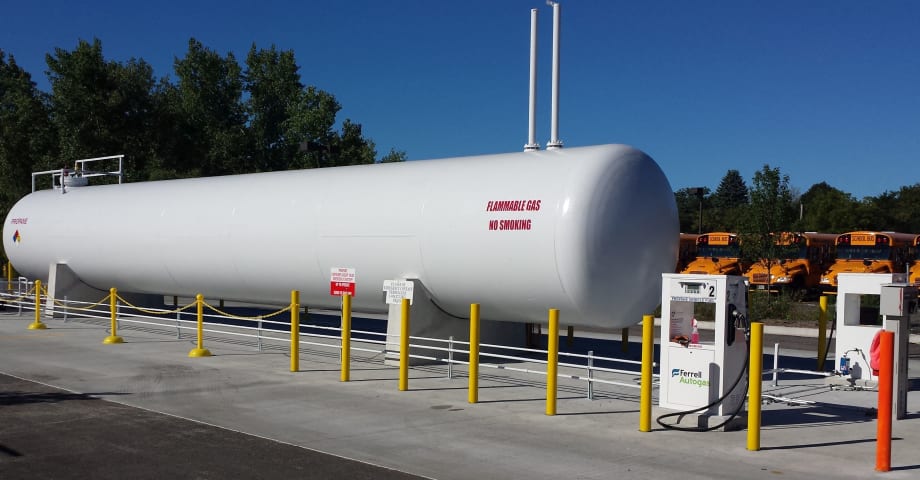
FerrellAutogas worked with a Wisconsin school district on a propane fueling station that
includes a 30,000-gallon tank with three single-hose dispensers.
When fleets consider a shift to alternative-fuel school buses, one of the key considerations is fueling infrastructure.
Whether it’s propane or compressed natural gas (CNG), fleets need to determine what type of fueling equipment will work for their facility and their operational requirements. Here, CNG and propane fueling suppliers share details on the various equipment options that are available.
Time-fill refuels overnight
For some operations that acquire compressed natural gas (CNG) buses, it may be practical to use an existing fueling station — perhaps at a local government agency facility. But many districts prefer to have a fueling station installed at their own facility.
Peter Grace, senior vice president of sales at CNG supplier Clean Energy Fuels, says that the most popular CNG fueling setup for school bus fleets is a time-fill system. When the bus comes back to the yard at the end of the day, the driver connects a filling hose to the bus and flips a switch. At a predetermined time during the night — typically when electricity is cheapest — the compressor kicks in and fills the bus over a period of several hours.
“The advantage is that the buses are sitting there anyway,” Grace says. “There’s no labor time for the driver to fill it up.”
The other option for CNG fueling is fast fill, which is more like using a diesel or gasoline pump. The driver pulls the bus up to the dispenser, connects the nozzle and waits five to 10 minutes.
Clean Energy works with school bus operations to customize their fueling stations. The company can also help with finding grants and financing.
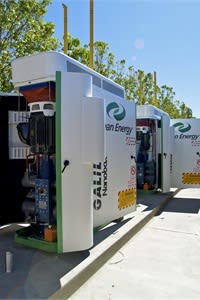
Peter Grace of Clean Energy says that the most popular CNG fueling setup for school bus fleets is a time-fill system. Pictured are time-fill compressors.
Single-hose pumps preferred
Propane supplier FerrellAutogas also works with fleets to determine the best fueling equipment configurations.
According to the company, the fueling infrastructure for propane autogas is easily scalable to fit the current and future needs of the fleet. Autogas dispensers can range from basic pump-and-go configurations to state-of-the-art computer-integrated versions.
As an example, FerrellAutogas worked with a school district in Wisconsin on a customized propane fueling station. It includes a 30,000-gallon tank with three single-hose autogas dispensers and three-phase high-differential pumps/motors.
“It’s possible to run two dispensers off one pump, but we like to build in redundancy in case we have mechanical issues,” says Nathan Ediger, director of autogas at FerrellAutogas.
The Wisconsin school district installation is also equipped with two FuelMaster 2500 fuel management systems to track individual consumption on each of the 120 buses in operation.
[PAGEBREAK]
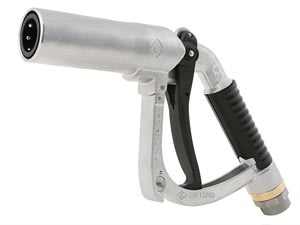
Propane autogas technology supplier CleanFUEL USA now offers the Elaflex ZVG2 Euro-style nozzle.
New nozzle reduces emissions
Propane autogas technology supplier CleanFUEL USA now offers the Elaflex ZVG2 nozzle for fleets.
The ZVG2 utilizes a Euro-style, push-on coupling. Company officials say that the unit offers low weight and one-handed operation, as well as a significant reduction in emissions.
According to CleanFUEL USA, the nozzle’s advantages include high performance, low total cost of ownership and little maintenance requirements.
“There has been a recent industry push to standardize use of the Euro-style nozzle for autogas refueling in the United States based on its lower emissions and ease of refueling,” says Curtis Donaldson, founder and managing partner of CleanFUEL USA. “Many of our largest customers are utilizing the [ZVG2] nozzles and are thrilled with the performance and simplicity.”
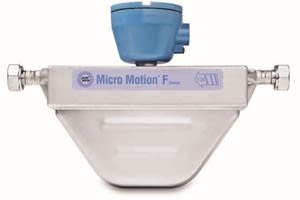
Superior Energy Systems has incorporated mass flow meters (pictured) into several of its propane autogas dispensers.
Mass flow meters added
Mass flow meter technology is now incorporated into Superior Energy Systems’ PRO-Vend 1000, 2000 and Dual Hose propane autogas dispensers. Company officials say that this technology provides more accurate long-term fuel measurement compared with mechanical meters.
The anti-corrosive, stainless-steel Micro Motion Coriolis mass flow meters from Emerson Process Management reportedly help reduce fleet operators’ costs. Company officials say that the devices require little to no maintenance and can be replaced less often because they have no moving parts.
Mass flow meters are said to virtually eliminate unaccounted fuel that slips through the worn moving parts of mechanical meters.
“Mass flow metering technology is heavily used in compressed natural gas dispensers and is long overdue in the propane autogas market,” says Jim Bunsey, director of operations for Superior Energy Systems. “We’re adding it to several of our top-selling dispensers while maintaining our competitive pricing.”
More Alternative Fuels

CALSTART and Forth Combine to Form Catalyst Mobility
The new name represents a renewed vision for the nonprofit focused on advancing clean, equitable, and affordable transportation solutions that move people and goods.
Read More →
Alt-Fuel Moves: New Buses, Charging Hubs & Real-World EV Testing
Propane and electric school bus deployments continue to grow as districts add new vehicles, expand charging infrastructure, and gather more real-world operating data.
Read More →
Fewer Electric School Bus Models Reshape the U.S. Market
WRI’s latest buyer’s guide points to a consolidating electric school bus market, but fewer options may reflect a maturing industry rather than fewer meaningful choices for school bus operators.
Read More →
The Fuel Budget You Can Actually Predict: How Propane Autogas Keeps Money in the Classroom
Learn how propane autogas helps school districts manage fuel costs with predictable pricing, lower maintenance, and reduced emissions from former transportation director Joel Stutheit.
Read More →
Hendrickson, Driventic Introduce New Electric Powertrain for School Buses
ELECTRAAX, the electrified, lightweight drive axle offers integrated ePowertrain efficiency and modular flexibility for Class 6–7 school bus use.
Read More →
The Mobility House Joins PowerFlex in Fleet Electrification Deal
The acquisition combines intelligent charging software, bidirectional charging expertise, and fleet electrification services to support the growing adoption of electric school buses across North America.
Read More →
Alt-Fuel Moves: Electric School Bus Investments Hit the Road
See which districts across the U.S. are putting electric school buses into service, expanding charging infrastructure, and planning the next phase of fleet electrification.
Read More →
With Fuel Volatility Ahead, School Districts Turn to Propane
While diesel prices peaked above $5 this spring, districts with propane autogas-powered fleets paid under $2 per gallon, according to PERC.
Read More →
EPA Unveils Proposed Changes to 2027 Heavy-Duty Engine Rules
The federal agency has proposed changes to next year’s targets that would eliminate DEF derates, ease warranty requirements, and retain current NOx emissions standards.
Read More →
Alt-Fuel Moves: EV Charging & Infrastructure Projects Gain Momentum
The latest developments include new funding, charging infrastructure, utility investments, and fleet technologies designed to support the transition to electric school buses nationwide.
Read More →