To bolster protection of passengers with mobility devices, training expert Darren Reaume shares tips for getting the best fit with securement equipment.
When it comes to transporting students with disabilities, proper securement of wheelchairs ranks high on the list of priorities, but uncertainty remains about how to handle some types of wheelchairs.
“There’s a lot of confusion among trainers about what makes a [wheel]chair safe to transport,” says Darren Reaume, national training manager for Q’Straint and Sure-Lok. “The reality is most chairs really aren’t designed to be transported. That’s always been the case.”
Ad Loading...
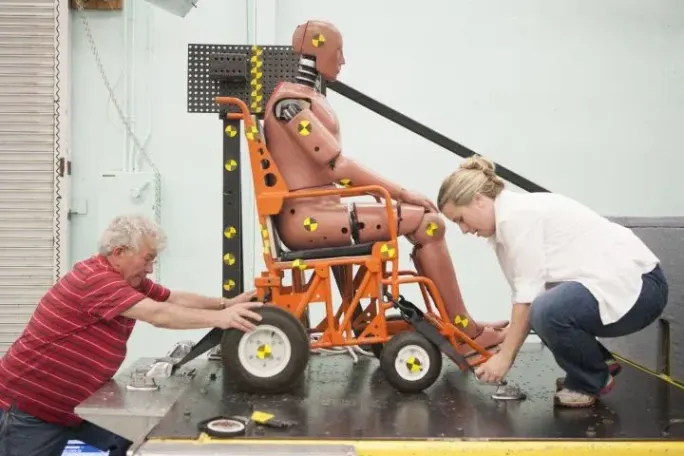
Ideally, students would travel in WC19-compliant wheelchairs — which are crash-tested for use in transportation and have easily accessible attachment points for tie-down straps — but that’s often not the case. Many student riders use wheelchairs that don’t meet the ANSI/RESNA standards. Even so, they need to be transported to and from school, and the school bus is still the safest way for them to go.
Lawrence Schneider, a research professor emeritus with the University of Michigan Transportation Research Institute, notes that the goal of industry standards and guidelines is to provide occupants seated in wheelchairs with a comparable level of safety and crash protection as that available to other occupants.
To that end, Reaume has been working to educate student transporters about the principles of wheelchair securement in a new webinar series that Q’Straint and Sure-Lok have launched.
Securement Steps
Reaume has distilled wheelchair securement best practices into six principles, which he says is a reasonable number for anyone to remember. Three of the steps are for the wheelchair, and three are for the occupant.
For the wheelchair:
Ad Loading...
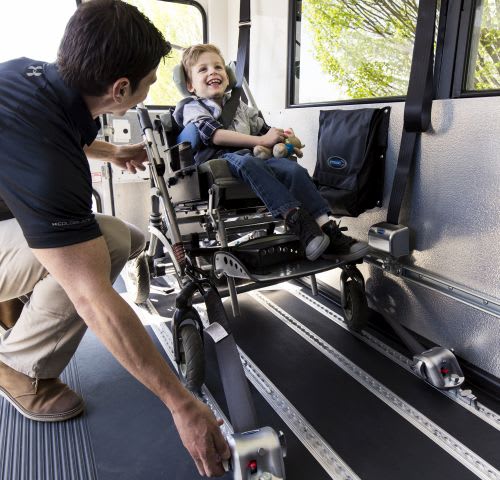
Find a solid welded frame member on the wheelchair to attach the hook of the retractor.
Take a direct path with belts, avoiding any crossing or twisting of the belts.
Try to achieve a 45-degree angle from the retractor to the attachment point of the chair.
For the occupant:
Ensure that the lap belt component is actually resting on the wheelchair occupant’s pelvis and the shoulder belt is actually resting on his or her shoulder.
Ensure that the belts are not held away from the occupant’s body by any component of the wheelchair frame.
The red release buckle should be tight against the occupant’s hip on the aisle side.
Reaume recommends that school bus drivers and aides use this checklist when they secure any kind of wheelchair. “We cover a lot more than that in the webinar, but we distill it down to those principles,” he says.
Interactive Training
The webinar series signals a new approach for Q’Straint and Sure-Lok in how they educate student transporters. Because of the safety impact and the technical nature of wheelchair securement, the need for instruction is great, but in the past it has been hard to meet the demand efficiently.
Ad Loading...
“As a company, we get tons of requests for training,” Reaume says. “Really up until this point, there were two ways of doing the training.”
One was to have a regional manager conduct on-site training, but Reaume notes that this is only possible in extreme circumstances, considering how many school bus operations there are.
As another training method, Q’Straint produced and distributed a training DVD, but that, too, had its shortcomings.
“It was 20 minutes long, and it tried to cover a little bit of everything. It wasn’t interactive; there was no place to ask questions,” Reaume says. “We wanted to be able to train a larger number of transportation providers in a more effective way.”
To that end, the company found webinars to be the best solution. The free monthly sessions are longer, at 75 minutes, and they go into more detail than the DVDs did.
Ad Loading...
Also, because the webinars are presented live, attendees can submit questions that Reaume or another presenter can answer during the session. The company can also use those questions to update the presentation for the following month’s session.
“For school districts and transportation providers, it’s an opportunity for you to get a live securement expert to provide you with training that’s truly interactive,” Reaume says.
In addition to the securement training sessions, Q’Straint and Sure-Lok are offering industry presentation webinars, each of which covers a specific topic. So far, those have included emerging trends in wheelchair transportation and problem-solving protocols for securing difficult wheelchairs. Over time, the company plans to build up a library of archived presentations that can be accessed on demand.
“We wanted to be able to train a larger number of transportation providers in a more effective way.” - Darren Reaume, national training manager, Q’Straint and Sure-Lok
Crash Protection
The basic format of the training webinars is a PowerPoint presentation with 10 videos integrated. The video component highlights why proper wheelchair securement is so crucial: protecting the passenger in the event of a crash or even a sharp turn.
Ad Loading...
“The videos show real-life crash situations and crash tests,” Reaume says. “We show how proper securement can protect the passenger. There’s also a video where a girl on a school bus was injured because of improper securement.”
Along with securement procedures, issues covered in the training webinars include the various types of equipment, pre-trip inspection, basic maintenance, liability, and sensitivity training.
After the webinar, participants get a certificate of attendance, which Reaume says is important documentation for school bus operations to have in their records.
To comply with the new voluntary industry standard known as WC18, wheelchair tiedowns or other securement devices must pass two different dynamic strength tests.
“This offers school districts a way to … protect themselves against added liability,” he says. “It certifies that they’ve been trained by the manufacturer.”
The webinar series is also helping to sharpen pupil transporters’ skills in wheelchair securement and addressing many of their questions and uncertainties.
Ad Loading...
“The need for training on this topic … is something we’ve been hearing for years,” Reaume says. “This is something that’s really a useful tool for school transportation providers.”
In August, Q’Straint and Sure-Lok will offer two training webinar sessions per day for a week. For details on upcoming webinars and to register, go to www.qstraint.com and click “Training.”
Get Up to Speed on Wheelchair Standards
Two recent standards — WC18 and WC19 — were designed by the Rehabilitation Engineering and Assistive Technology Society of North America (RESNA) to increase safety for people who travel in wheelchairs. But a survey of pupil transportation professionals found that about three-fifths of respondents were not sure about or had no plans to implement the WC18 standard. Read more about both RESNA standards in a new Q’Straint white paper, which is available for free download at schoolbusfleet.com/wc18.
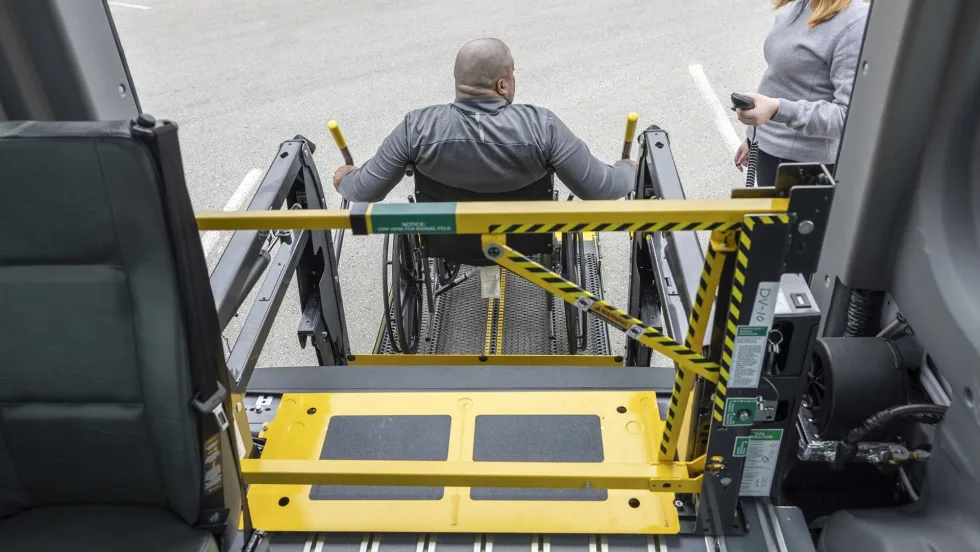
LiftSentinel is designed to add another layer of protection during wheelchair loading and unloading and can be retrofitted to many existing commercial lift installations.
The company’s free ride recording, live ride tracking, and consistent driver assignments aim to improve safety and continuity for diverse student transportation needs.
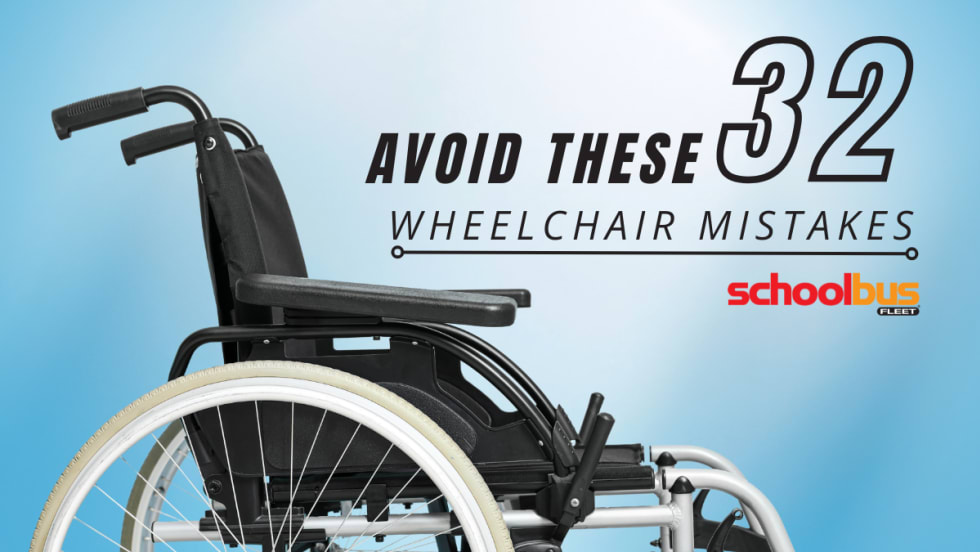
Small missteps in wheelchair securement can have serious consequences. Here are 32 tips from experts to reduce risk and increase student safety on the bus.
Go inside AMF Bruns America’s new Ohio showroom with Maritza Valentin to see its FutureSafe technology, driver training tools, securement systems, and seating innovations.
With expanded production space, local investment, and a growing workforce, AMF Bruns is scaling its U.S. presence. Here’s an exclusive first look inside the new Stow, Ohio, HQ.
Take a behind-the-scenes look at AMF Bruns of America’s new 41,000-square-foot Stow, Ohio, headquarters, featuring advanced manufacturing, expanded space, and future-ready mobility solutions.
First Student and Wichita Public Schools are using behavioral support strategies to improve student ride experiences, while a separate initiative expands access to after-school programs through a bus donation.
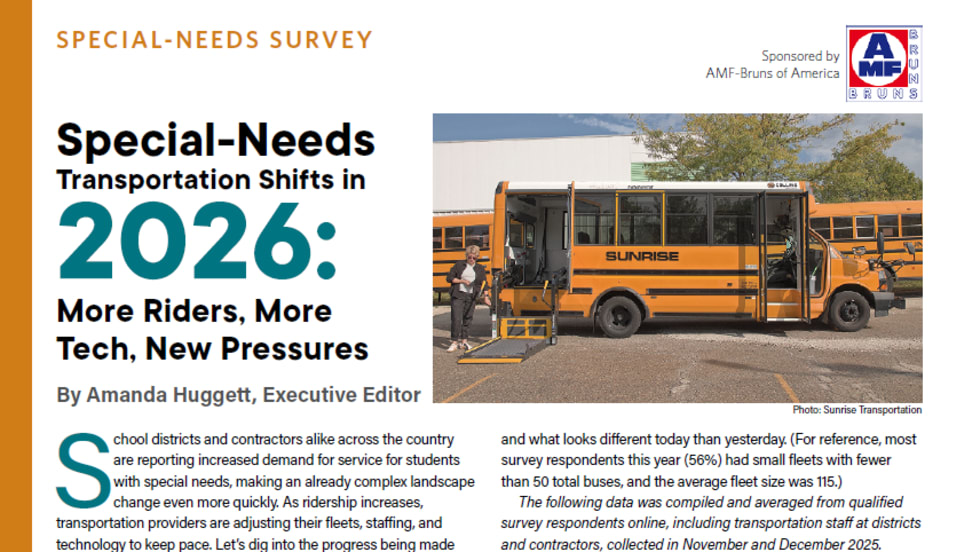
What’s changing in special-needs transportation? This year, student transportation operators report a rising need, easing driver shortages, growing tech adoption, and evolving challenges. Sponsored by AMF Bruns of America.
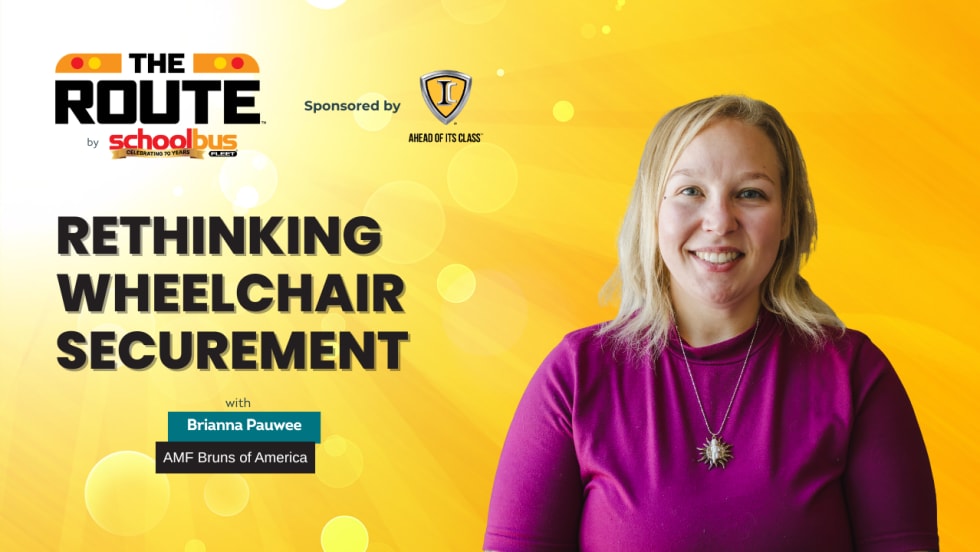
Brianna Pauwee, a product application specialist at AMF Bruns of America and a wheelchair user, drops in to The Route to share practical securement and training insights, plus the story behind the new “Beyond Mobility” podcast. The Route is sponsored by IC Bus.