




6 Helpful Routes to Take When a School Bus Driver Dies
What courses of action should a transportation leader follow when a school bus driver dies? Here, a veteran director who recently faced that sad situation shares steps to help staff members, students and the driver’s family deal with their loss.

Family members and friends of school bus driver Jennifer Foughty are pictured here in front of her bus. Foughty died unexpectedly in 2013 at age 39.
Pre-Trip
What does a transportation director do when a school bus driver dies? For me, it was a new wrinkle in an old administrator’s career.
The night before the first day of school following our winter break (Christmas) in 2013, I was awakened from my slumbers to the news that one of our well-loved and highly respected school bus drivers had died in her sleep, apparently from a heart attack. She was only 39 years old.
I had not had to deal with such an issue before. It was not covered in my (so-called) transportation supervisor’s course of study, and it was rarely even spoken of in the general conversations of our everyday life. However, like it or not, it was in my “here and now.”
A big part of the here and now was properly responding to the countless routes of action, especially as it pertained to my driver’s personal family as well as her school bus family. Having no prior experience, my first reference point was my fellow supervisors and their history with such circumstances.
From that source and from my own personal research, I have developed a plan for what to do when a school bus driver dies. In honor and remembrance of my former driver, Jennifer Foughty, I humbly offer the following route directions to those supervisors who might one day be awakened from their slumbers into the “here and now” of life and death.
Route 1: Stay calm
The transportation leader must at all times stay calm. Take a deep breath, grab a pad of paper, and start your planning and actions. The entire event will seem surreal. It will be difficult to come to terms with the fact that this special driver will not be checking in for his or her route, ever again.
Route 2: Notifications
Depending on the time of the news, you should notify your router/dispatcher to make sure the driver’s route is covered. Make sure the district or company knows as well. The human resources department will need to put its own plan into action. Grief counselors may be in order. The sooner they know, the sooner they can help.
The bigger and more difficult notification, from your perspective, is to the employee’s fellow drivers and staff. A note on the bulletin board or a radio transmission is not the correct way to share such sensitive news. In most cases, the school bus grapevine will have already taken care of the unofficial notification; however, the manner in which you share this sensitive and deeply impactful news will be of the utmost importance.
"One of the most meaningful and touching actions I have seen is to provide transportation, in the school bus of the deceased driver, for drivers who wish to attend the service."
A special meeting of staff would be in order. Know what you are going to share in advance, and be prepared for questions. Again, most will know what to expect, but seeing their boss with heart on sleeve separates the true leaders from the cyborg supervisors. That meeting does not need to go into details, just the basic facts as known at the time. Avoid speculation and encourage folks to stay tuned for more information.
The other important aspect of notification has to do with the students on the bus, those little and big ones who have no idea why their driver is gone. While some may be less concerned, others will find the loss of their driver very emotional. Getting a formal but personal letter home to the students and parents is the right thing to do. While you must speak to the obvious, it is OK to keep it as simple as possible.
Remind the substitute driver that he or she may get questions about the incident, and help the substitute with the right response.
Route 3: Pay respects to the family
One of the first steps an employer can take is simply “pay respect.” As soon as possible, load up the superintendent and others as needed, stop by the local flower shop, and head to the driver’s home. No matter how full calendars may be, or how many “can’t miss” meetings are pending, this must take priority.
The only thing you need to bring to this first meeting is an understanding heart and a willingness to be available. Take some time to survey the driver’s locker, inbox and school bus. There may be important personal items that the family would need and appreciate.
The importance of this timely interaction cannot be overstated. Your response and follow-through will mean the world to the family and your staff.
It is also good to keep in mind that some families may opt not to have any contact with the former employer, with the exception of the required notifications and documentation — we must abide by that request. Refer all media requests to the appropriate channels.
[PAGEBREAK]
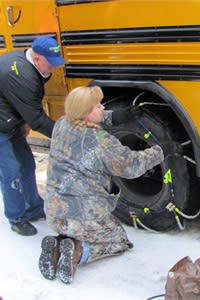
Foughty, shown here putting snow chains on a bus tire, was a “well-loved and highly respected” driver at Washington’s Centralia/Chehalis Pupil Transportation Cooperative.
Route 4: Provide resources
Along with your cell phone number, it is a good idea to have a “go to” list of resources for the family as a means to assist them through the maze of paperwork. This list could include information on such items as the Social Security office, other mid-day or weekend employers who should be notified, and points of contact for retirement systems, final checks and life insurance.
Another much-appreciated resource is providing meals. While this is usually handled by family members, it is always good to volunteer to provide a meal. Drivers and staff will want to contribute, and this is a comfortable way in which they can help.
Coordinate with a family member and set up a meal delivery program. There are websites dedicated to creating a calendar of meals and providers, such as Mealtrain.com, that serve as an excellent and free link to help with such important family needs.
Route 5: The service
Working closely with the family and introducing yourself and your drivers will allow for possible considerations on the timing of the funeral and memorial services. Weekdays are difficult, as drivers do have other pressing responsibilities, such as their routes. Generally speaking, weekends work best for everyone, especially as it relates to travel and availability.
Keep in mind that some of the driver’s own students may be interested in attending the service, too. Making their families aware of the details is in order.
There are countless steps that you can take to allow for a grieving period for your staff and to support the driver’s personal family. These can be as simple as a condolence card signed by all the drivers and staff, as well as a collection to help offset some of the unexpected expenses — and there will be lots of them. Again, there are a number of online resources that can help with this important need. Giveforward.com, YouCaring.com and GoFundMe.com are just three examples.
Another simple (but potent) action could be to hang a 5x8 picture of the driver in the drivers’ room as a local memorial. Another fitting tribute is to plant a tree in honor of the driver.
One of the most meaningful and touching actions I have seen is to provide transportation, in the school bus of the deceased driver, for drivers who wish to attend the service. Of course, getting permission from the district and approval from the family is important.
Route 6: Follow-up and follow-through
Once the memorial services are done, add a reminder to your calendar to check back in with the family after a week or so and then again after a month or so. On the one-year anniversary, be sure to make a call or even stop by the home to simply check on the driver’s family.
As for your drivers, set aside a remembrance time, and add the 5x8 picture of the driver to the lounge area or another prominent location. Create a special, one-time scholarship fund in the driver’s name for the school that he or she drove for.
Another wonderful tribute is to allow the students from the driver’s route to draw pictures of their driver with the school bus or to tell a story about an encounter with the driver. Gathering these special remembrances and sharing them with the family will certainly serve as a healing mechanism.
Ask your drivers and staff to provide their own personal stories that may bring a smile to the family or a smile to themselves. Open up the drivers’ lounge to the joy of the person’s life, rather than the sadness of his or her death. In most cases, everyone has a story to tell and just needs an ear or two to listen. Again, for a family that has suddenly been thrust into a world of uncertainties and loss, hearing these kinds of stories will provide an anchor of love to all.
Post-trip
There is no easy route through this most difficult of challenges in a supervisor’s life. Oftentimes, your course of action will depend on the reason for the death. A natural death, heart attack, car accident, violent death or suicide will present different challenges and a lot more routes to choose from.
Being as prepared as you possibly can, being willing to do whatever it takes to help your staff and the family, feeling empathy and staying calm will serve as your GPS.
The most important gift that you can give to families, drivers and staff is time. Time does heal. Nothing will change the realities of the “here and now” of death, but time will certainly help.

Lionel Pinn is the director of transportation for the Centralia/Chehalis Pupil Transportation Cooperative in Centralia, Washington, and the author of the critically acclaimed nonfiction book Greengrass Pipe Dancers.
More Management

How to Build a Better Driver Training Program
Ready to boost up your school bus instructor training? Here’s how to pick the right talent and improve recruitment, retention, and safety.
Read More →
CALSTART and Forth Combine to Form Catalyst Mobility
The new name represents a renewed vision for the nonprofit focused on advancing clean, equitable, and affordable transportation solutions that move people and goods.
Read More →
What Makes a Great School Bus Driver Trainer?
Choosing the right school bus driver trainer takes more than experience. Learn six keys to selecting and developing trainers and evaluating program effectiveness.
Read More →

School Bus Contractors Expand Through New Deals, Acquisitions & Partnerships
STA's Canadian division acquires Ontario-based G&L Stevenson Transport while Durham School Services adds a new district contract in California, First Student adds a New Jersey contract, and Minnesota Coaches acquires Halo Transportation.
Read More →
Logan Bus Company Rolls Out AI Phone System for NYC School Bus Families
A summer pilot found that AI agents could handle most routine calls, freeing up time for customer service staff to focus on emergencies and complex family concerns.
Read More →
From Intent to Impact: What I Learned About Leadership from TAPT
A Texas transportation supervisor shares lessons on self-awareness, accountability, managing stress and building trust — and why investing in leadership development matters at every stage of your career.
Read More →
NAPT Names 2026 Award Recipients, Hall of Fame Inductee
Who earned national recognition for their work in student transportation? This year, NAPT named five recipients of its 2026 awards for service, safety, and leadership, plus its newest Hall of Famer.
Read More →
2026 State of Student Transportation Report
Driver shortages. Rising costs. Growing safety expectations. More data, but not enough time to act on it. The 2026 State of Student Transportation Report reveals what transportation leaders say is putting the most pressure on their operations—and where they’re investing next. See how your priorities compare.
Read More →
How to De-Escalate an Angry Person: 5 Steps for Handling Workplace Conflict
What makes emotions run high, and how should you handle an angry colleague or parent? Follow these steps for staying calm, listening, showing empathy, and resolving conflict.
Read More →
What Readiness Looks Like This School Year
Learn about the challenges shaping the 2026–2027 school year, from persistent driver shortages and budget pressure to technology and readiness gaps. See how school districts are responding and adapting in Zonar’s 2026 Back-to-School Readiness Report.
Read More →