




5 Tips for Transporting Service Animals
As the number of students with service dogs needing transportation has risen, awareness of the law and responsibilities, advance planning and communication are key.
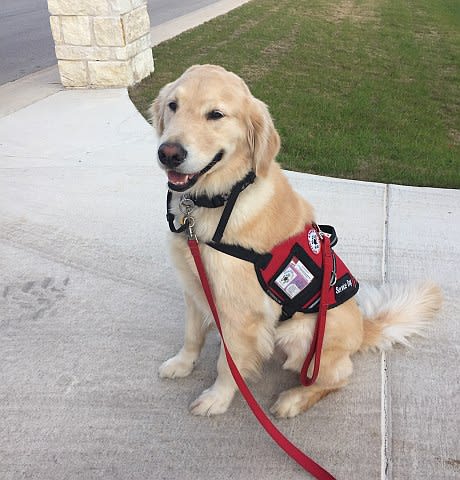
Flint, a seizure-detection dog for a student at Dripping Springs (Texas) Independent School District, is trained to put his head in the student’s lap when it senses she is about to have a seizure so that the staff can take measures to protect the student.
Flint, a seizure-detection dog for a student at Dripping Springs (Texas) Independent School District, is trained to put his head in the student’s lap when it senses she is about to have a seizure so that the staff can take measures to protect the student.
There has been a significant increase in the last decade in the number of requests to transport service animals on school buses. A service animal, typically a dog, though miniature horses may also be used, can guide a student with visual impairment, alert a student when they are about to have a seizure, or comfort a child who is having an anxiety attack.
The concept of transporting service animals on a school bus is fairly new, but school transporters are now more aware of laws, such as the Americans with Disabilities Act (ADA), that require them to transport service animals, says Kathy Furneaux, executive director for the Pupil Transportation Safety Institute.
“Because [school transporters] weren’t doing it before, many thought that it was within their right to say ‘we don’t transport dogs,’” she explains. “Now, it is commonly known that students must be transported with their service animal.”
The state of New Jersey even passed a law in March 2015 that adds school buses to the list of school locations in which students’ service animals are allowed. Service animals were already allowed on school buses in New Jersey, but state law didn’t previously specify that.
Despite greater awareness, questions remain: To what extent is the bus driver responsible for the dog? Who handles its toileting needs? What about passengers who have allergies or a phobia of dogs? School Bus Fleet spoke with transportation directors who have addressed these issues, and they shared these tips.
1. Flexibility in planning is key.
The amount of time given to plan to transport a service animal can vary widely, Furneaux says. Sometimes, a request to transport a student with a service animal comes before school starts, allowing more time to plan, but a child’s condition may also change mid-year, and the transportation department may find out at the last minute that a child will have a service animal when they get on the bus the following day. In that case, the transporter can ask the parents to transport the student and service dog for reimbursement or can use a school car temporarily until the details can be worked out for the school bus environment.
However, if possible, start planning weeks in advance, says Kim Large, transportation operations supervisor at Newport-Mesa Unified School District in Costa Mesa, California. The process can be lengthy, especially if a route change is needed for a service dog that can’t go on a long ride, or for a student who is allergic to or afraid of dogs. Large says the planning process to board a service animal for the first time took four weeks.
A Dripping Springs (Texas) Independent School District (ISD) special services staff member talked with the transportation team over the summer about the seizure-detection dog they would be transporting, says Pam Swanks, director of transportation for the district. The psychologist explained that the dog puts his head in the child’s lap when it senses she is about to have a seizure so that the staff can take measures to protect the student.
2. Clarify process, responsibilities.
Large recommends, either in an IEP meeting or a separate meeting, verifying any medical documentation. A Newport-Mesa student submitted a doctor’s note saying that she needed the dog with her at school and on the bus because it helped bring her out of periodic, severely withdrawn states in which she became unresponsive to people speaking to her.
Large also advises discussing the loading process for the dog, emergency protocols and what the dog does to help the student. The transportation team verified with educators, school psychologists and the medical team that the dog recognizes when the student is non-responsive, and nuzzles and licks her to bring her out of that state.
The service dog has two names: a pet name, “Hershey,” and a command name, “Baby,” for when he is working for the student, Large explains. “In an emergency, we would use the command name for the dog, along with one-word commands, such as ‘Baby, come.’”
Additionally, the transportation team clarified that the dog is under the care of the student at all times. “You have to set boundaries,” Large says. “That means the student is the one who controls the dog and is responsible for [its toileting needs] and bringing it aboard the bus.”
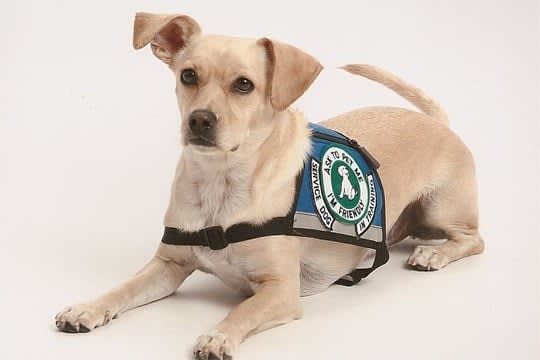
A service animal, typically a dog, though miniature horses may also be used, can help students with a wide range of conditions, such as by guiding a student with a visual impairment, alerting a student when they are about to have a seizure, or comforting a child who is having an anxiety attack. Photo by Crjs452, via Wikimedia Commons
3. Communication is key.
The Newport-Mesa transportation department contacted all of the other riders’ families to ensure that none of them is allergic to or scared of animals. Luckily, none of the other riders had either of these issues, Large says.
The transportation department also created for drivers a bus plan, including the service animal’s pet name and command name, where the dog rides (underneath the student’s seat), the student’s responsibility for the dog, and the need to explain to other students that the dog is there for work, not play.
Meanwhile, at the beginning of fall 2015, parents of a new student at Dripping Springs ISD sent out a flier to educate students and the transportation staff about Flint, their child’s seizure-detection dog. The flier described how Flint helps her, and requested that students and staff not play with or feed him, Swanks says.
4. Changes can be made, but not to the special-needs student’s arrangements.
If a staff member or student has a fear of dogs or an allergy, they can be placed on another route or bus, but the special-needs student and his or her service animal may not, according to the ADA, Furneaux says.
“A student with a service animal cannot be put on a different route,” she explains. “Accommodation changes have to happen for the staff or student with the phobia or allergy.”
If that leads to a bus driver being switched to a different route with fewer hours, Furneaux suggests adding hours to the shorter route with tasks such as washing buses.
5. Hold a practice run, review concerns.
Every effort should be made to bring the bus staff, the student and their service animal together beforehand to help them become comfortable with each other, Furneaux advises.
Large agrees. She enlisted the help of the district’s special-education department and arranged for the bus drivers to meet a student’s service dog.
The bus staff should be trained on the tasks the service animal performs to meet the student’s needs, any signals it gives and what they mean, commands they will need to give for loading and unloading, and toileting and feeding schedules for the animal. They should also discuss with the handler or parents any unique information that would make the ride safe and comfortable for the student and the service dog.
Practicing boarding is important, too. The safest way to load a service dog is to have them climb the bus steps, Furneaux says. The design of the school bus lift makes it difficult for a dog to ride on it because they can be skittish, and when the lift makes noise, the dog might become fearful.
However, the dog may become anxious about being separated from the student. If the tasks it provides for the student come into play during loading, the dog can be loaded onto the bus and brought to the lift door so it can see the student during the loading process.
A concern from Swanks’ staff was about the securement of the dog for its safety in the event of a collision. The ADA prohibits controlling the movement of service animals, because they must be able to move at will to assist the student, Furneaux says. She recommends a pad, similar to rubbery shelf material designed to prohibit sliding, to prevent the dog from sliding on the floor.
More Special Needs Transportation
BraunAbility Introduces New Safety Barrier for Wheelchair Lifts
LiftSentinel is designed to add another layer of protection during wheelchair loading and unloading and can be retrofitted to many existing commercial lift installations.
Read More →
HopSkipDrive Launches New Safety, Driver Consistency Features for 2026-27 School Year
The company’s free ride recording, live ride tracking, and consistent driver assignments aim to improve safety and continuity for diverse student transportation needs.
Read More →
The Most Common Wheelchair Securement Mistakes on School Buses (and How to Fix Them)
Small missteps in wheelchair securement can have serious consequences. Here are 32 tips from experts to reduce risk and increase student safety on the bus.
Read More →
Inside AMF Bruns’ New Showroom: School Bus Securement Solutions Explained
Go inside AMF Bruns America’s new Ohio showroom with Maritza Valentin to see its FutureSafe technology, driver training tools, securement systems, and seating innovations.
Read More →
What AMF Bruns’ New Facility Means for Customers [Video]
Inside AMF Bruns’ new Stow, Ohio, operations: See how expanded space and innovation will enhance customer support and operations.
Read More →
AMF Bruns Expands in Ohio, Investing in Growth and Community
With expanded production space, local investment, and a growing workforce, AMF Bruns is scaling its U.S. presence. Here’s an exclusive first look inside the new Stow, Ohio, HQ.
Read More →
Inside AMF Bruns of America’s New Ohio Manufacturing Facility [Photos]
Take a behind-the-scenes look at AMF Bruns of America’s new 41,000-square-foot Stow, Ohio, headquarters, featuring advanced manufacturing, expanded space, and future-ready mobility solutions.
Read More →
First Student Boosts Student Support in Wichita & Texas
First Student and Wichita Public Schools are using behavioral support strategies to improve student ride experiences, while a separate initiative expands access to after-school programs through a bus donation.
Read More →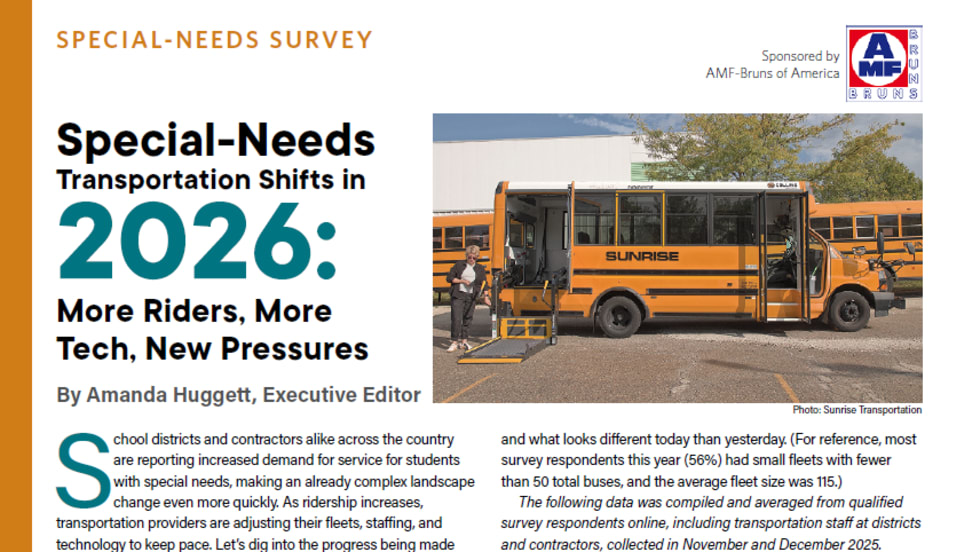
2026 Special-Needs Transportation Survey
What’s changing in special-needs transportation? This year, student transportation operators report a rising need, easing driver shortages, growing tech adoption, and evolving challenges. Sponsored by AMF Bruns of America.
Read More →
The Lived-Experience Gap in Mobility Tech: An Expert Take on Safe Student Transportation
Brianna Pauwee, a product application specialist at AMF Bruns of America and a wheelchair user, drops in to The Route to share practical securement and training insights, plus the story behind the new “Beyond Mobility” podcast. The Route is sponsored by IC Bus.
Read More →