




5 Sure-Fire Classroom Training Tactics
An effective safety training program for students usually accomplishes a number of goals. It covers all of the key school bus rules while keeping the ...
An effective safety training program for students usually accomplishes a number of goals. It covers all of the key school bus rules while keeping the kids engaged and getting them excited about riding the bus properly. It instills in them a respect for their driver. And most importantly, it trains kids to remember the rules while riding the bus. How you go about achieving these goals, however, is up to you. Some operators conduct question-and-answer sessions in the classroom, others take the kids out to the bus for evacuation drills and hands-on training. There are a number of innovative activities that can be included in a safety training program. And with so many options, you can pick and choose the activities you include and customize a program that will best suit the needs of your riders. The following are some proven activities used by operators across the country. 1. Build upon a video
Quite a few entertaining, instructional videos are available that cover the basics on riding a bus: how to board, how to get off, how to cross the road, discipline on the bus and more. These videos provide a good foundation upon which to build a presentation. Flemington-Raritan (N.J.) School District uses four different videos to teach safety to kindergarten through third-graders and reinforces the messages from the videos via interactive time with the kids. "We always show a film, do an oral review and give a handout, and the whole presentation is always tied to the video. The least of our problems is getting the kids' interest," says Linda Yenzer, supervisor of transportation for Flemington-Raritan. Kindergartners watch "Pooh's Great School Bus Adventure," produced by Disney. The instructor starts the presentation with an attention-grabbing prop - a three-foot carrot. The curious kids are then told to watch for three things in the video: What goes out the window? Who do you look to see? What does the carrot have to do with school bus safety? After playing the video, the instructor asks the questions again so the kids can answer based on what they saw. The students immediately know what went out the window - a feather. The instructor then reinforces the first lesson in the video, which is "no body parts out the window." The class repeats the rule a few times. The students are also quick to answer the second question, knowing from the video that it is the driver they should look to see. And the kids always know what happened to Rabbit's carrot - he dropped it and it rolled under the bus' front wheel. Owl's advice to Rabbit was, "Never, ever go back," and in this way the kids remember they should never go back into the danger zone. "When the students are in first grade and they see one of the safety instructors walking down the hall with a carrot, they know exactly what it means. It's absolutely fascinating," Yenzer says. 2. Put on a variety show
Last year, the Springfield, Ohio, manufacturing facility for International Truck and Engine Corp. partnered with a ventriloquist and magician to put together "International School Bus Safety Stars," an educational variety show for kids. The puppet and magic show is a 40-minute program for first- through third-graders, with a simplified version for kindergartners and preschoolers. It includes a quiz show, magic tricks, sing-along songs and plays on classic nursery rhymes. "As of this summer, we have reached nearly 14,000 children with important school bus safety messages," says Kyle Rose, communications manager for the Springfield facility. A variety show is a great way to dazzle students and make the learning process an exciting one. 3. Give a guided bus tour
Although many districts conduct bus evacuation drills throughout the year, it is a good idea to include some actual practice time inside the bus during a safety program. Students can see for themselves where the emergency features and danger zones of the bus are. Richard Adams, a driver and instructor for Seminole County (Fla.) Public Schools, takes students onto the bus at the end of his safety presentation. He shows students the bus' features and how to properly ride the bus. He also conducts an evacuation out the front door. Drivers from Johnson School Bus Service in Campbellsport, Wis., also take the kids for a bus ride. The driver takes students to an area with no traffic so they can practice sitting properly, getting off the bus, crossing in front of the bus, waiting for the driver's signal and reloading. The students learn to take the driver's cues. "The bus ride is probably the most time-consuming part of our program, but there are a lot of kids who don't ride the bus to and from school and will not have a lot of chances to actually ride the bus. We think it's important for them," says Judy Holzmann, vice president of Johnson School Bus Service. Frank Misner, director of transportation at Clay (Ind.) Community Schools, says his district lets students sit in the driver's seat of the bus while the driver explains the Ten Foot Rule. "We usually set a short student from their class in front of the bus and ask students if they can see the student from the driver's seat," Misner explains. Students can experience for themselves how hard it is to see a student in the danger zone. Back-to-school training can be a chance for staff members who don't normally interact with students to get out and work with kids. Hillsborough County (Fla.) Schools had a mechanic with a passion for educating kids who would take a bus out to the schools himself. That mechanic passed away this year, but fellow mechanic Michael Wood is continuing the tradition. He shows the bus to preschoolers. "I show them all the rules — how to wait until the bus stops and the arm comes out, how to board using the handrail and the 12 rules posted inside the bus," says Wood. "I walk them around the outside to see the stop arm, the lights and the backup alarm." Wood also opened the hood for the students so they can see inside the engine compartment. "They seem to think I might know more about the bus because I'm a mechanic. I think they probably have a slightly different reaction to me than to a bus driver," he says. 4. Bolster Buster
No doubt, operators who own the robotic Buster the Bus, manufactured by Robotronics in Springfield, Utah, incorporate him into their programs year after year. Buster is always a hit with the students. To keep the students excited about Buster, districts can change their Buster presentation and do something fresh each year. Instructors can perform a "Buster monologue" and have Buster review the rules, a "Buster question-and-answer session" where Buster and the students in the audience ask safety questions to each other, or a skit where instructors interact with Buster. Buster is the star of Brevard County (Fla.) School District's safety presentation. The "Buster Team" of four instructors gathers a large group of pre-kindergartners and kindergartners in the school cafeteria or auditorium. One male driver hides behind the scenes to be the voice of Buster. When the curtains open, Buster is sound asleep and snoring. The other instructors onstage ask the audience very quietly, "Will you help wake up Buster? When I count to three, yell his name - Buster!" The kids excitedly scream his name. Buster's eyes open and he says good morning to the students. Buster drives up and down the stage, commenting on this girl's cute dress and that boy's cool T-shirt, to give the students a more personal interaction with Buster. The instructors ask the kids what safety rules they know, and as soon as the hands come up, Buster calls on students to offer their answers. Finally, one of the instructors has an entertaining conversation with Buster, asking him questions about what she can and can't do on the bus. The safety rules are taught through this conversation. The presentation usually lasts between 20 and 30 minutes, depending on how focused the students are. "We play it by ear. The children in each school are different, so we let them be our guide," says driver Laurie Wheeler. "If we have over-stimulated them or not stimulated them enough, we lose them and it's time to pack up and go home. Especially with the pre-kindergartners and kindergartners, you have to be sensitive to that." Brevard County lets students as young as infants and toddlers in the daycare program meet Buster. "It's just a little introduction into what's coming down the road for them," says Wheeler. The little kids are fascinated with Buster, wanting to poke his eyes and open up his back door to look inside. Robotronics has also developed Barney the Bus, a modern, snub-nose robotic bus with the same features as Buster. 5. Offer parting gifts
Almost every school district and contractor hands out something to students at the end of the presentation for them to take home. Materials like stickers, posters, activity sheets and coloring books serve as fun, tangible reminders of what was learned about school bus safety. Holzmann of Johnson School Bus Service gives students coloring books provided by the state of Minnesota. With the coloring books, "it's really easy to understand and follow all the rules," says Holzmann. Students also receive a certificate for completing the safety program. Hillsborough County Schools designed its own coloring book for kids, using safety posters, says Karen Strickland, general director for the district's transportation department. Her district also designs word searches for upper-grade students. The Flemington-Raritan School District gives third-graders a paper bus that they can cut out, fold and assemble. Many districts and contractors will take their safety programs to community centers and local events, where students come with their parents. The Northeast regional team at Student Transportation of America, based in Howell, N.J., put on a safety program at a community safety event in New Jersey in June. Along with coloring books and crayons, they handed out Frisbees as safety reminders. Because students were in attendance with their parents, they were able to send safety flyers and tips home with parents as well. John Fay, director of school bus marketing for International and IC Corp., often goes to schools and puts on the "Be Cool, Follow the Rules" safety program developed by the National PTA. At the end of his program, Fay gives the kids beanie buses and tells them to remember the school bus safety rules every time they look at the bus.
Web Resources for Classroom Training Materials
Disney Education Productions — provides classroom resources like "Pooh's Great School Bus Adventure" video, which can be purchased at http://asp.disney.go.com/Educational/TeacherStore/db/detailed_view.asp?product_id=68795
National Assn. for Pupil Transportation — official organizer of National School Bus Safety Week and the National Poster Contest. www.napt.org
National Highway Traffic Safety Administration — provides downloadable safety handouts and "Gus' get to school (and back again) safely" game through its Website www.nhtsa.dot.gov/people/outreach/kidsPage/bussafety/ bckschool_safely/index.html
National PTA — the PTA's "Be Cool, Follow the Rules," safety program is available at www.pta.org/parentinvolvement/healthsafety/hs_bus_safety.asp
Pupil Transportation Safety Institute — offers a Student Training System that can include a classroom curriculum, video, activity book, stickers, storybook, decals, posters and handouts. See catalog at www.ptsi.org/catalog.htm
Robotronics — offers animated robots Buster and Barney the Bus, which can be used to teach safety. http://robotronics.com/index.html
The Safety Stop — offers a variety of products and programs to promote and enhance school bus safety while making the learning experience fun for students. Shop the online store at www.bussafetystop.com
Strategies Training Systems — the School Bus Safety Series comes with four age-appropriate videos, instructor's guide, and reproducible handouts, and can be purchased online at www.strategiestraining.com
Toby Tire Safety — the Toby Tire line includes storybook, coloring book, activity book, work book and video. www.tobytire.org/index.htm
More Management
The Right Ride for Every Student: Navigating the New Student Transportation Ecosystem
How should districts blend school buses with small-vehicle transportation and other options? EverDriven CEO Mitch Bowling discusses safety, costs, partnerships, and strategy.
Read More →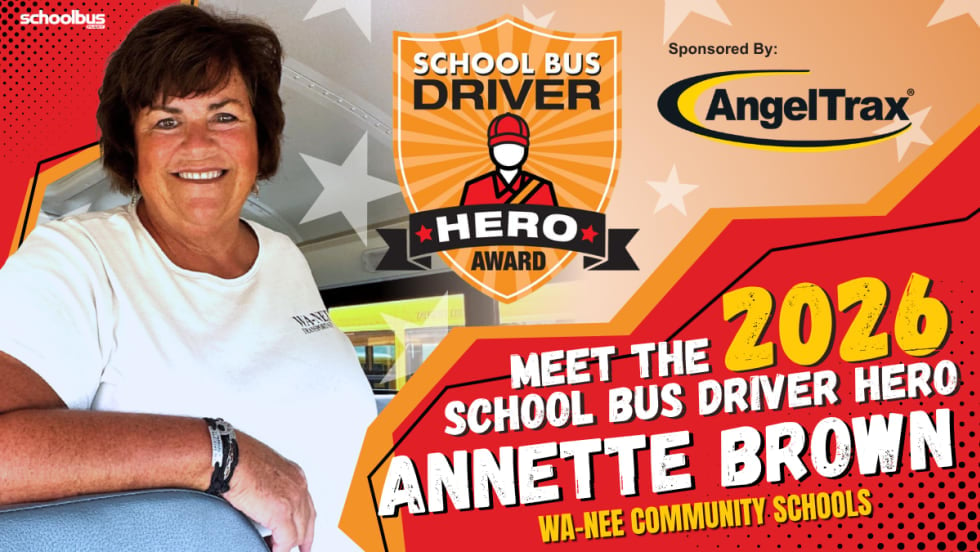
Annette Brown Always Takes the Extra Time: Meet Our 2026 School Bus Driver Hero
For more than 30 years, the Wa-Nee Community Schools driver has treated students like family, combining safety, compassion, and servant leadership to make a lasting difference on and beyond the school bus.
Read More →
How to Build a Better Driver Training Program
Ready to boost up your school bus instructor training? Here’s how to pick the right talent and improve recruitment, retention, and safety.
Read More →


CALSTART and Forth Combine to Form Catalyst Mobility
The new name represents a renewed vision for the nonprofit focused on advancing clean, equitable, and affordable transportation solutions that move people and goods.
Read More →
What Makes a Great School Bus Driver Trainer?
Choosing the right school bus driver trainer takes more than experience. Learn six keys to selecting and developing trainers and evaluating program effectiveness.
Read More →
School Bus Contractors Expand Through New Deals, Acquisitions & Partnerships
STA's Canadian division acquires Ontario-based G&L Stevenson Transport; Durham School Services adds a new district in California; First Student expands in New Jersey; and Minnesota Coaches rebrands and acquires Halo Transportation.
Read More →
Logan Bus Company Rolls Out AI Phone System for NYC School Bus Families
A summer pilot found that AI agents could handle most routine calls, freeing up time for customer service staff to focus on emergencies and complex family concerns.
Read More →
From Intent to Impact: What I Learned About Leadership from TAPT
A Texas transportation supervisor shares lessons on self-awareness, accountability, managing stress and building trust — and why investing in leadership development matters at every stage of your career.
Read More →
NAPT Names 2026 Award Recipients, Hall of Fame Inductee
Who earned national recognition for their work in student transportation? This year, NAPT named five recipients of its 2026 awards for service, safety, and leadership, plus its newest Hall of Famer.
Read More →
2026 State of Student Transportation Report
Driver shortages. Rising costs. Growing safety expectations. More data, but not enough time to act on it. The 2026 State of Student Transportation Report reveals what transportation leaders say is putting the most pressure on their operations—and where they’re investing next. See how your priorities compare.
Read More →