




Related: Maine Considering New Physical Fitness Standards for School Bus Drivers
As Performance Testing Recommendation Is Handed Down, A New York District Shares Success
A fatal Iowa school bus fire spurred the NTSB to recommend that physical performance tests be mandated for all school bus drivers. A New York school district details the success it has seen as a result of requiring the testing.
by Hal Mattern
January 22, 2020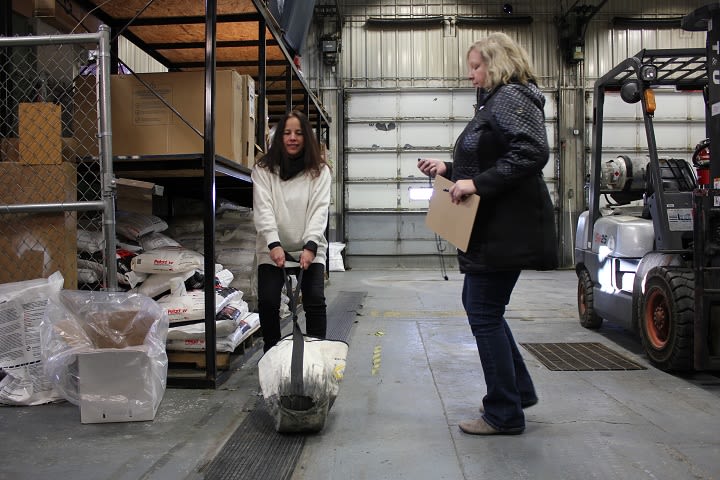
One of the requirements of the New York PPT, which is mandatory for all school bus drivers, is dragging 125 pounds over 30 feet of bus flooring in 30 seconds. Photo courtesy Alfred Karam
6 min to read

One of the requirements of the New York PPT, which is mandatory for all school bus drivers, is dragging 125 pounds over 30 feet of bus flooring in 30 seconds. Photo courtesy Alfred Karam
School bus drivers who are otherwise healthy and capable of safely operating a bus could nonetheless suffer from physical impairments that would make it difficult or impossible for them to evacuate students in an emergency.
Such impairment was considered a prime contributor to the death of a driver and a student in a school bus accident and fire more than two years ago in Oakland, Iowa. The driver suffered from chronic back pain that could have prevented him from getting off the bus or helping the student, according to a report by the National Transportation Safety Board (NTSB).
The accident spurred the NTSB to recommend in June that 44 states, the District of Columbia, and Puerto Rico mandate physical performance tests (PPTs) for all school bus drivers to identify issues that could affect their ability to physically perform their duties, including helping to evacuate passengers.
Requiring PPTs
Six states — New York, Arizona, Florida, Indiana, South Carolina, and West Virginia — already have mandatory PPTs for school bus drivers. About 10 other states make such testing voluntary for school districts.
And although the NTSB lacks the authority to mandate that the other states adopt PPTs, industry officials say the recommendation does carry some weight and could result in other states implementing testing requirements.
“The NTSB can only recommend and make you feel bad, but something like this does have some bearing,” says Ted Finlayson-Schueler, president of Safety Rules in Syracuse, N.Y., and pupil transportation safety consultant and expert witness. “If something happens that could have been prevented by a regulation, it puts you in a bad light. The Iowa accident pushed the issue over the edge.”
Tragedy Spurs Call for Testing
The Dec. 12, 2017, Iowa school bus fire occurred when 74-year-old bus driver Donald Hendricks turned from a rural gravel road onto a driveway to pick up 16-year-old Megan Klindt at the farm where she lived. According to a preliminary report released by the NTSB in January 2018, as Hendricks reversed out of the driveway, the bus’s rear wheels dropped into a 3-foot-deep ditch. While he attempted to drive the bus out of the ditch, a fire began in the engine compartment and spread throughout the school bus.
The NTSB’s final report, released last June, says the passenger “was possibly attempting to assist the school bus driver, whose limited mobility due to medical conditions might have prevented him from evacuating the bus, and she did not perceive the immediate danger before being overcome by smoke and superheated gases as a result of the fire.”
“It is likely that the bus driver’s progressive chronic back disease, which caused severe chronic pain, impaired his ability to evacuate the school bus himself or to assist the passenger to evacuate,” the report says.
The finding led the NTSB to recommend that states adopt mandatory physical performance testing for all bus drivers.
“The use of physical performance tests on both a routine and an as-needed basis can help identify physically unfit drivers who have a valid medical certificate but who might not be able to perform required safety duties, especially in an emergency,” the report states.
The NTSB hasn’t recommended any specific testing procedures that states should use, instead saying they should look at existing programs in other states as models for designing their own PPTs. The agency also offers research and guidance to states.
“We don’t give specifics because the folks in the states know what is best for their drivers,” says Michele Beckjord, the investigator in charge of the NTSB’s Office of Highway Safety. “They can look at the best practices in states that have testing requirements. The goal is to make sure drivers are able to assist passengers in emergencies.”
Beckjord says most school districts focus on drivers getting their commercial driver’s licenses and passing required medical exams, not on physical performance testing. But the NTSB report on the Iowa accident “has been an eye opener for states and school districts,” she said. “Quite a few have contacted us. They are paying more attention to it.”
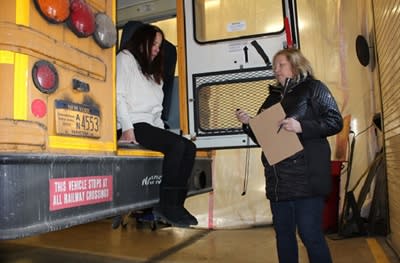
Fewer than 1% of people taking the PPT at Shenendehowa (N.Y.) Central Schools have not passed the test. Photo courtesy Alfred Karam
New York PPT Success
Oregon was the first state to implement physical performance testing, in 1971, but made the tests voluntary, not mandatory. In 1997, New York became the first state to mandate PPTs.
The New York test requires drivers to walk up and down the bus steps three times in 30 seconds; move their foot from the throttle to the brake and back 10 times in 10 seconds; depress the brake pedal or clutch fully and hold it for three seconds, five times in a row; manually open and close the entrance door three times; operate various hand controls such as light and heater switches while keeping one hand on the steering wheel; exit their seat and slide out the rear emergency door within 20 seconds; and drag 125 pounds over 30 feet of bus flooring in 30 seconds.
The test is required of all new hires and every two years for existing drivers. Drivers who are off the job for more than 60 days also have to retake the test before returning to driving.
Since the test was implemented, the passing rate has been 95% or above, with some drivers occasionally failing one or two of the challenges but passing them upon retesting. Drivers can take the test as many times as they want, but few continue if they fail it more than two or three times.
“The failure rate isn’t very high because people decide not to continue,” says Pete James of Chautauqua Transportation Services Inc., a New York firm that contracts with school districts to provide training and consulting. James was a member of the committee that developed New York’s PPT.
“The test is similar to drug and alcohol testing because people who know they won’t pass will not even bother to take it,” he says. “Existing drivers who are suffering from a physical problem and are struggling to pass the test decide to hang it up and retire.”
James adds that the testing has been successful in identifying drivers who are medically qualified to receive commercial driver’s licenses (CDLs) but who have physical problems that could prevent them from helping evacuate passengers.
“Before this test, people could pass medical exams to drive but could barely walk,” he says. “This kind of took care of that for us. It has been successful in keeping out people who shouldn’t drive a school bus.”
New York also requires that monitors riding on school buses pass three of the driver physical tests: walking up and down the bus steps three times in 30 seconds; exiting their seat and sliding out the rear emergency door within 20 seconds; and dragging the weight.
Alfred Karam, the director of transportation for Shenendehowa (N.Y.) Central Schools, says that fewer than 1% of the people taking the PPT in the district fail, with the hardest part of the test being the weight drag, followed by sliding out the rear emergency exit.
Karam adds that early concerns that the PPT would scare off applicants and exacerbate the driver shortage never materialized.
“Honestly, it has not been a detriment to finding drivers and getting them through the training pipeline,” he says.
Subscribe to Our Newsletter
More Management

How to Build a Better Driver Training Program
Ready to boost up your school bus instructor training? Here’s how to pick the right talent and improve recruitment, retention, and safety.
Read More →
CALSTART and Forth Combine to Form Catalyst Mobility
The new name represents a renewed vision for the nonprofit focused on advancing clean, equitable, and affordable transportation solutions that move people and goods.
Read More →
What Makes a Great School Bus Driver Trainer?
Choosing the right school bus driver trainer takes more than experience. Learn six keys to selecting and developing trainers and evaluating program effectiveness.
Read More →


School Bus Contractors Expand Through New Deals, Acquisitions & Partnerships
STA's Canadian division acquires Ontario-based G&L Stevenson Transport while Durham School Services adds a new district contract in California, First Student adds a New Jersey contract, and Minnesota Coaches acquires Halo Transportation.
Read More →
Logan Bus Company Rolls Out AI Phone System for NYC School Bus Families
A summer pilot found that AI agents could handle most routine calls, freeing up time for customer service staff to focus on emergencies and complex family concerns.
Read More →
From Intent to Impact: What I Learned About Leadership from TAPT
A Texas transportation supervisor shares lessons on self-awareness, accountability, managing stress and building trust — and why investing in leadership development matters at every stage of your career.
Read More →
NAPT Names 2026 Award Recipients, Hall of Fame Inductee
Who earned national recognition for their work in student transportation? This year, NAPT named five recipients of its 2026 awards for service, safety, and leadership, plus its newest Hall of Famer.
Read More →
Sponsored•September 2, 2026
2026 State of Student Transportation Report
Driver shortages. Rising costs. Growing safety expectations. More data, but not enough time to act on it. The 2026 State of Student Transportation Report reveals what transportation leaders say is putting the most pressure on their operations—and where they’re investing next. See how your priorities compare.
Read More →
How to De-Escalate an Angry Person: 5 Steps for Handling Workplace Conflict
What makes emotions run high, and how should you handle an angry colleague or parent? Follow these steps for staying calm, listening, showing empathy, and resolving conflict.
Read More →
Sponsored•September 1, 2026
What Readiness Looks Like This School Year
Learn about the challenges shaping the 2026–2027 school year, from persistent driver shortages and budget pressure to technology and readiness gaps. See how school districts are responding and adapting in Zonar’s 2026 Back-to-School Readiness Report.
Read More →