




Safety First: Iowa to Require Seat Belts on All New School Buses
Targeting Seat Belts, Driver Oversight, States Respond to Fatal Crashes
As New Jersey considers a lap-shoulder belt requirement and reviews several new school bus safety bills, one district equips new buses with the three-point belts and bolsters training. Meanwhile, Tennessee establishes a grant program to fund seat belts on school buses.

Nicole Schlosser・Former Executive Editor
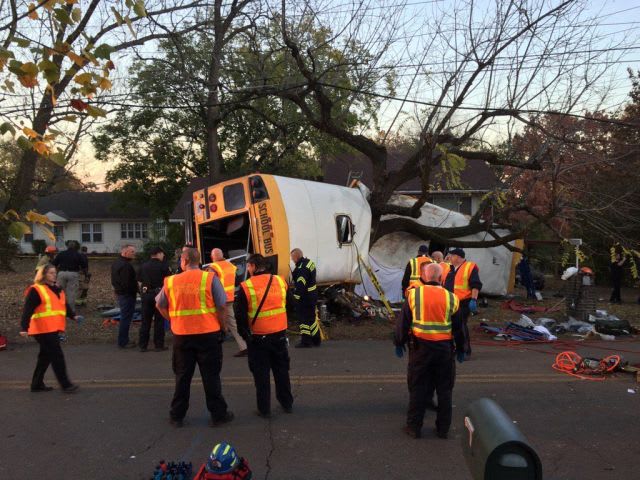
One response to the fatal school bus crash in Chattanooga, Tennessee, in 2016 is a grant to help school transportation providers in the state pay for buses equipped with seat belts.
Photo: Chattanooga Fire Department
7 min to read
The school bus had separated cleanly into two parts — its body and chassis — with the body lying on its side in a highway median, and the chassis blocking lanes of highway. A student and a teacher were killed in the Mount Olive, New Jersey, crash between the bus and a dump truck on May 17, and all of the 45 other passengers aboard were injured, some seriously.
The bus driver involved in the crash, Hudy Muldrow Sr., 77, was apparently attempting to make a U-turn. He was charged with two counts of reckless vehicular homicide/death by auto.
Just on the heels of this tragic event came recommendations from the National Transportation Safety Board (NTSB), based on other fatal crashes in Chattanooga, Tennessee, and in Baltimore, Maryland, in 2016. Two primary recommendations were for states to mandate lap-shoulder belts, and for states such as New Jersey to upgrade their requirement from lap-only belts to lap-shoulder belts. That recommendation has spurred legislation in Congress that would require seat belts on school buses nationwide. U.S. Rep. Josh Gottheimer (D-N.J.) announced a bill that calls for a new federal rulemaking on school bus seat belts.
Meanwhile, state lawmakers are looking at preventive measures against any similar crashes. New Jersey — especially one district in particular — and Tennessee are focusing some of their efforts on seat belts, with the former considering an upgrade from lap-only to lap-shoulder belts, and the latter offering a grant program to make adding buses equipped with seat belts more affordable. The New Jersey Legislature is also reviewing nearly a dozen new school bus safety bills, many of which address driver training and oversight.
Seat-Belt Switch
Paramus Public Schools, the New Jersey school district that had the bus involved in the fatal May 17 crash, is transitioning toward requiring lap-shoulder belts instead of lap-only belts, which the state currently requires, on its school buses. (As of press time, the governor may soon sign a bill that would change the state requirement from lap-only belts to lap-shoulder belts.)
Paramus Public Schools’ Board of Education voted in June to add three-point belts to an order of four buses it had planned to purchase before the crash. (The additional cost is $5,300 a bus.) The district was looking to improve student safety and supported Gottheimer’s bill to require lap-shoulder belts nationally, says Steve Cea, former business administrator and board secretary for Paramus Public Schools. (Cea retired at the end of July.)
The district then looked into retrofitting six more large school buses in its fleet, since it was already planning to replace them within the next two years. However, that turned out to be cost-prohibitive.
“It was about $10,000 more to retrofit than the cost would be of getting the new belts [by] purchasing the buses,” Cea says.
Another factor that influenced the district’s decision to replace instead of retrofit: The New Jersey Department of Motor Vehicles is putting a hold on retrofits until they can inspect them, Cea says.
The district is now looking at replacing two Type A buses with models that include lap-shoulder belts.
“We are trying to take steps to either retrofit or replace the vehicles. In cases where they can’t be retrofitted, we may have to keep them in service for a little while longer, but that is our goal,” Cea adds.
Since it contracts out some student transportation, the district is going out to bid for the 2020-21 school year and is requiring contractors to have lap-shoulder belts in their vehicles while it works to include lap-shoulder belts in all the vehicles it uses to transport students.
Additional Responses
The Paramus district’s transportation department has taken other steps to enhance safety since the crash. Drivers have received additional training from the department’s mechanic on seat belt inspection, and inspection of the belts will now be required daily instead of quarterly, Cea says.
Additionally, the transportation department is working with law enforcement to gain access to driver records from the New Jersey Department of Motor Vehicles for current drivers and new hires beyond the currently required most recent five years.
“We are working with the police, who can look at the whole history, to expand the time horizon, so we can do a more thorough review of our existing drivers and any new hires,” Cea says.
The transportation department also purchased Garman navigation systems to provide trip directions. The buses are currently equipped with GPS, which the department uses to email and text the transportation coordinator if a driver is traveling above the speed limit.
Legislative Crackdown
Meanwhile, in response to a handful of other recent school bus accidents — including a crash on the New Jersey Turnpike in which a school bus overturned with dozens of students on board, injuring five; a chain-reaction crash between five school buses that sent dozens of passengers to the hospital; and a collision between two school buses that injured seven passengers — a New Jersey Senate committee advanced a package of school bus safety measures in July.
The 10 bills aim to improve school bus safety and accident response by addressing driver qualifications and knowledge of how to handle a bus and accident procedures, transportation staffing, and toughening accountability measures.
The bills, sponsored by Sen. Joseph Lagana and Sen. Patrick J. Diegnan Jr., the chair of the Senate Transportation Committee, were voted through the committee unanimously, according to a news release from Diegnan’s office.
Highlights of requirements in the bill package include:
All school buses must have a phone number or website displayed on the rear of the bus so motorists can report bus driver misconduct.
District transportation supervisors with less than 11 years of experience and newly hired transportation directors would complete a certification program as a condition of employment.
School bus drivers who are 70 years of age or older would submit proof of physical fitness annually, and drivers over the age of 75 would submit proof every six months. (Muldrow was 77 at the time of the Mount Olive bus crash.)
A school district’s board of education and its school bus contractor would provide a statement to the Department of Education within 24 hours with notification of the suspension or revocation of a school bus driver’s license.
School bus safety personnel must be employed to ensure the compliance of state and federal laws, rules, and regulations, training in emergency equipment, and that accident prevention practices are followed.
School districts would require all students to carry a district-issued school identification card while the student is at any school-sponsored, off-campus activity.
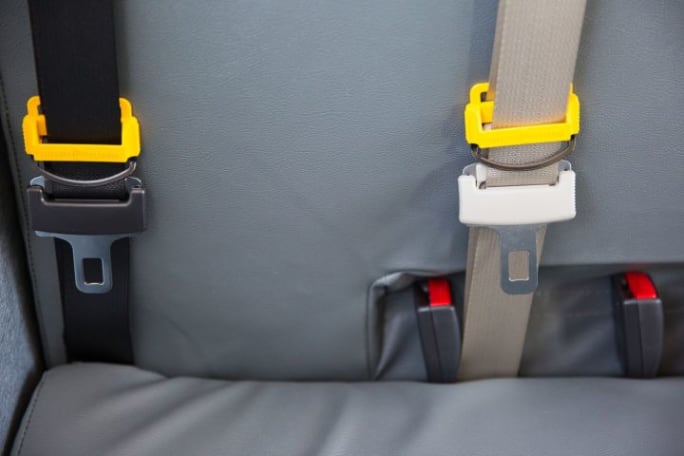
Paramus (N.J.) Public Schools, which had a bus involved in a fatal May 17 crash, is moving toward requiring lap-shoulder belts instead of lap-only belts, which the state now requires, on its school buses.
Photo: Des Moines (Iowa) Public Schools
Seat-Belt Funding
In one response to the Chattanooga, Tennessee, crash, Gov. Bill Haslam included a 2018-19 budget amendment that provides $3 million in nonrecurring funds for three-point seat belts on buses.
The School Bus Seat Restraint Grant Program aims to help school districts shoulder the extra costs of buying buses equipped with the belts. The Tennessee Department of Education’s student transportation office will oversee the program.
The program will reimburse a school district or school bus contractor that purchases approved seat restraints.
As of the June 29 application deadline, 20 school districts and three charter schools applied for funding from the program, says Larry Riggsbee, executive director for the Tennessee Association of Pupil Transportation.
Because of the publicity associated with the crashes in Chattanooga in 2016 and in Knoxville in 2014, in which two students and a bus aide were killed (police said that the driver was texting while driving), the state Legislature will likely support seat belts on all school buses, but will leave the final decision to each local school board, Riggsbee adds.
Riggsbee also says that the Legislature is not likely to pass a law requiring passenger restraints because of funding hurdles.
However, he thinks that the majority of Tennessee school districts and school boards will support seat belts, since several school districts have already added them to their new bus specifications.
He is also optimistic that some type of state grant funding for passenger restraints will be made available each year.
New Tennessee school buses are likely to include seat belts, but buses currently in fleets most likely will not, Riggsbee says.
“Unless a binding federal mandate becomes law, it will take at least 15 years to replace the state bus fleet with buses equipped with seat belts, unless parents in each district demand a change and are willing to accept tax increases,” he adds.
The state also passed a law in 2017 requiring school bus drivers to be at least 25 years old (the driver in the Chattanooga crash was 24 at the time), and requiring standards for driver and transportation manager training.
Subscribe to Our Newsletter
More Safety

How to Build a Better School Bus Driver Training Program
Is it time to strengthen your driver training? Here’s how to pick the right talent and improve recruitment, retention, and safety. This video is brought to you by IC Bus.
Read More →
Recent School Bus Accidents Leave 2 Dead, 2 Injured
Four school bus crashes in Florida, Illinois, and Georgia highlight risks in transportation lots, at bus stops, and during student loading and unloading.
Read More →
Sponsored•September 8, 2026
When Every Second Matters, Clarity Keeps Routes Moving
From routine delays to urgent incidents, strong communication practices help drivers, dispatchers, schools, and families respond with confidence.
Read More →

What Happens When a School Bus Catches Fire — and What Can Help
School bus fires are rare but can be devastating. Learn how advances in fire suppression and asset protection help fleets detect fires earlier, reduce damage, and improve safety.
Read More →
Geotab Launches Tool to Help Fleets Investigate Road Incidents
Geotab Investigations combines telematics data, video, documents, and other evidence to help fleets reconstruct incidents, resolve claims, and determine what happened.
Read More →
Texas Sixth Grader Wins 2026 National School Bus Safety Poster Contest
Sai Darshana Yekolu of Moseley Middle School in Prosper, Texas, was named the newest winner for her artwork, bringing the theme of “Safe Rides, Everyday Heroes” to life.
Read More →
Sponsored•August 27, 2026
Doing More With Less: How Transportation Directors Can Prioritize Safety Amid Budget Uncertainty
With diesel prices soaring and nearly one-third of transportation directors expecting budget cuts, maintaining student safety has never been more challenging. Download this guide to learn how leading districts are prioritizing risk, funding critical safety technology, and building stronger budget cases with data.
Read More →
Walton County Schools Adds Gatekeeper Stop-Arm Enforcement System
The Florida district will deploy Gatekeeper’s updated Student Protector technology, which now incorporates AI to improve video evidence.
Read More →
How To Build a More Secure School Bus Yard During and After Hours
As thefts and overnight security threats continue, school transportation leaders are combining stronger operational practices with AI-enabled surveillance to better protect buses, facilities, and staff.
Read More →
FMCSA Names New Chief Safety Officer: What School Bus Operators Should Know
Steve Dowling is set to lead the federal agency's efforts to advance commercial motor vehicle safety and reduce crashes, fatalities, and injuries on the nation's roadways.
Read More →