




How to Solve Common Problems With Wheelchair Lifts
Misuse and everyday wear and tear on wheelchair lifts can keep them from running smoothly. Make lift checks a part of pre-trip inspections, and train drivers to recognize mechanical problems.
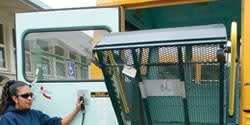
The chance of a wheelchair lift failure increases with every push of a button or pull of a lever, and that potential failure can lead to unfortunate consequences for wheelchair passengers, bus drivers, districts, and contractors.
While wheelchair lift manufacturers take all possible precautions to ensure the safety of their users, everyday wear and tear, as well as other unforeseen issues, is bound to take its toll on the lift’s effectiveness.
Here are some common problems to watch out for and solutions from the experts — lift manufacturers and school bus mechanics around the nation.
Outboard Stop Flaps
Problems with wheelchair lifts are often caused by drivers operating them improperly. One of the more prominent issues is damage to stop flaps.
“I have a lot of drivers who tend to bend the actual mechanism that puts the flap down, and it’s a real issue,” says Michael Kurtz, a mechanic with the Lake Washington School District in Redmond, Wash., who works on the district’s special-needs vehicles and wheelchair lifts.
While the damage to the flap isn’t detrimental to riders, it’s important to fix it before it leads to any other problems.
Instead of repairing the existing outboard stop flap, many mechanics replace the part completely. Kurtz has earned certification through Ricon Corp., a lift manufacturer based in Panorama City, Calif., which requires him to replace the part instead of fixing it.
Mark Egan, shop supervisor at CommTrans in Pittsburgh, says that he has run into some problems with the new sensor magnets that mount for the outboard stop flaps.
“It seems that some of the wheelchairs were hitting the sensors, so we did a retrofit by welding a flat washer around the magnet,” Egan says. “This prevents the washer from getting smashed.”
Damaged Parts
John Prahl, vice president of sales for Maxon Mobility in Santa Fe Springs, Calif., says damaged parts is one of the two most frequent problems Maxon technicians have to deal with in the field.
“It’s very difficult to troubleshoot a lift over the phone when mechanics call, because all of our people are assuming they’ve got a lift that’s operating normally,” he says. “They’re not going to tell us that they hit something, so we have to dispatch a lot of technicians who end up saying, 'Hey, you hit something.’”
Kurtz says he tries to train as many of his drivers as possible on the proper operation of a wheelchair lift.
Egan says his operation is also trying to prevent this kind of damage through driver training.
“We just recently decided to implement re-training on lift operation — what to do if the lift quits, how to operate the back-up pump system, etc. — for all our drivers,” he says. “We hope this will cut down on our parts bills.”
Ground Connections
Prahl says the other problem he hears about most frequently is a bad ground connection.
When a wheelchair lift is installed it must be grounded to the vehicle to establish a safe and strong electrical connection. When the ground connection is inadequate, the lift usually fails to operate.
“In the past I’ve seen very poor grounds,” says Larry McNutt, director of customer support for Ricon. “I’ve even seen lifts grounded to exhaust systems — not often, but I have seen it — and the ground is very important.”
To ensure the electrical system operates properly, mechanics should make sure the lift is securely grounded after installation.
“The lift should be grounded to the frame of the vehicle,” McNutt says. “Makes sure to remove any undercoating, rust or anything else that would prevent good contact, and run the ground cable directly to that area.”
McNutt emphasizes that ground connection problems aren’t as frequent as they used to be, but they can still occur.
“Most lifts today are installed by the OEMs, and we work with them to train them on the install,” he says. “Whenever I hear about somebody having an intermittent problem, though, normally it is a ground-related issue.”
Lift Springs, Hydraulics
The springs installed in the arms of wheelchair lifts can cause problems during lift operation, breaking if they’re not well taken care of.
While broken lift springs may not cause harm to wheelchair users or lift operators, they can cause the lift to run less smoothly and can eventually cause leveling problems. In most cases, the springs eventually rust out and must be replaced.
“We usually get a good four to five years out of the springs,” says Kurtz.
The most effective way to extend the life of these springs is to keep them lubricated. Egan suggests using a Teflon-based lubrication. “We service our vehicles every 45 days or 3,000 miles, and this includes lubrication of the lift and checking everything on it,” he says.
McNutt stresses the importance of using the correct hydraulic fluid on the lift.
“We use a special aircraft hydraulic fluid, and it’s somewhat impervious to temperature change,” he says. “It will operate in a similar fashion in 100-degree weather as it will in zero-degree weather, so it’s very important with our product to use this aircraft hydraulic oil.”
McNutt adds that other fluids should not be substituted for this particular lubricant.
“The thing you don’t want to do is put automatic transmission fluid in your lift,” he says. “It may look the same, but it has completely different characteristics and will cause seal problems.”
McNutt says the fluid can be purchased through Ricon, at local airports or through a variety of fuel companies.
Wear and Tear
Brad Barker of Park City (Utah) School District says that his most serious lift-related problems are with platform latching lock mechanisms, with one needing to be replaced and a few more needing minor adjustments.
“This mechanism, being on the floor level, remains wet much of the time during winter operation, and corrosion has been an issue,” Barker says.
Egan of CommTrans says he replaces the newer-style hand controllers — when they need replacing — with an older style, because he feels that they’re built stronger.
Each of these problems can be caused by everyday wear and tear. Egan says that some of his issues are just due to the number of cycles the lift has been through.
Preventive Maintenance
Manufacturers and mechanics agree that the easiest way to prevent serious problems from occurring is to do proper preventive maintenance on wheelchair lifts and vehicles. A key part of making sure that a lift is operating up to par every day is checking it during pre-trip inspections.
“Most of the time, the lift goes down the first time [a driver uses] it during the day,” Maxon’s Prahl says. “So we recommend that they operate the lift as part of their pre-trip inspection to make sure that they catch anything wrong prior to the lift going out into service. It’s easier to fix it in a facility than it is to have people on board and have a problem when they’re out on the road.”
Prahl adds that repairing lifts in the garage also saves time, frustration, and money.
“A mechanic can usually fix a problem in a couple of minutes, whereas if the bus is out and you have people on it, you’re going to have to transfer them to another bus,” Prahl says. “And what would’ve cost them $25 for a maintenance item is now going to cost them $500 because of the time and everything else involved.”
More Maintenance
ASE Highlights School Bus Technician Certification Requirements
ASE is encouraging school bus maintenance professionals to maintain their certifications, highlighting seven specialized tests and five-year renewal requirements.
Read More →
International Adds E-Commerce Capabilities to Fleetrite.com
IC Bus customers can now browse, buy, and track shipments for more than 400,000 aftermarket parts online.
Read More →
The Most Expensive Thing You Do Before Selling a School Bus: Wait
When should you sell an aging school bus? Learn how maintenance, mileage, corrosion, specifications, and timing can affect resale value long before the auction.
Read More →
The Evolution of DEF Header Technology: What School Bus Operations Should Know at Replacement Time
See what school bus fleets should consider when replacing DEF headers to improve reliability, reduce repeat repairs, and control maintenance costs.
Read More →
The Essential Guide to School Bus Maintenance and Student Safety
Your district's buses carry students to school every day. This guide shows how predictive maintenance powered by fleet data helps keep buses reliable, drivers accountable and students safer from the first bell to the last stop.
Read More →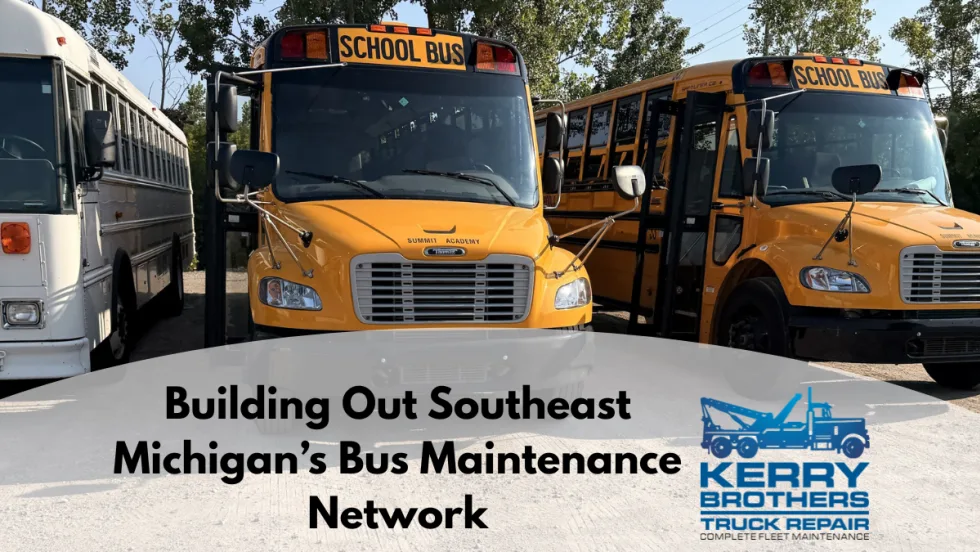
Kerry Brothers Grows Michigan School Bus Repair Network
The acquisition of Downriver Truck and Bus expands Kerry Brothers’ school bus maintenance footprint across southeast Michigan, adding repair capacity, diagnostic resources, and state inspection support.
Read More →
Noregon Introduces CAN Bus Diagnostic Tool, Expands JPRO Features
CAN Mentor and the latest JPRO update aim to simplify vehicle network diagnostics and improve repair efficiency for technicians of all experience levels.
Read More →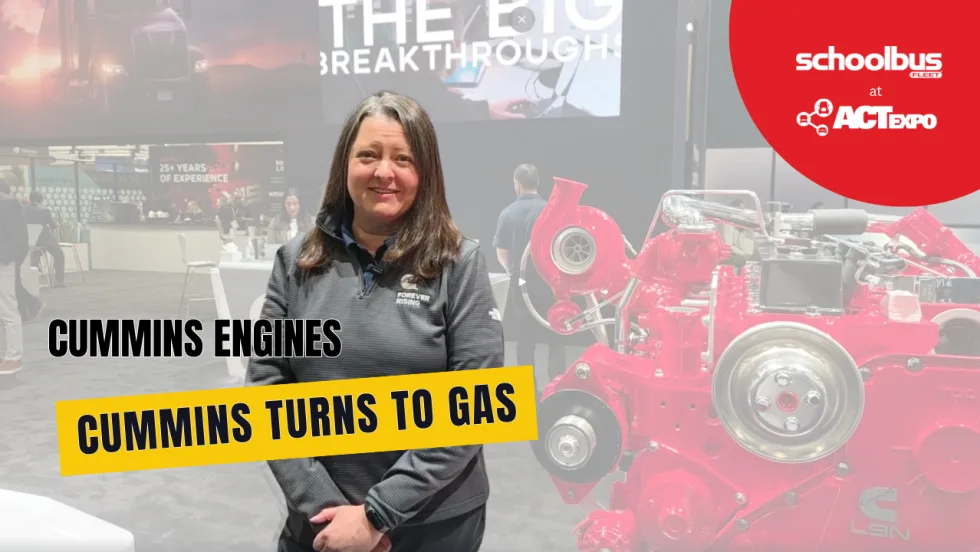
Cummins on Smarter, Simpler Engine Innovation
Cummins discusses its first-ever gasoline engine for school buses, EPA 2027, and why bus fleets still want durable, simpler internal combustion options.
Read More →
Report: 72% of Diesel School Buses Now Use Advanced Low-Emission Engines
New data shows advanced low-emission diesel technology continues expanding across school bus fleets, even as electric bus adoption gains momentum.
Read More →
Vampire Tools' CAIMAN 7.5-Inch Multi-Purpose Screw Extractor Long-Nose Pliers with Crimper
Vampire Tools introduced the VAMPLIERS Caiman 7.5-inch multi-purpose pliers, combining screw extraction, cutting, crimping, and gripping functions into a single tool designed for fleet maintenance professionals.
Read More →