




Post-accident Procedures Committees Key in Prevention
Whether using a committee or more informal arrangement, selecting the right members, having procedures in place in advance for determining preventable measures and driver retraining are crucial.

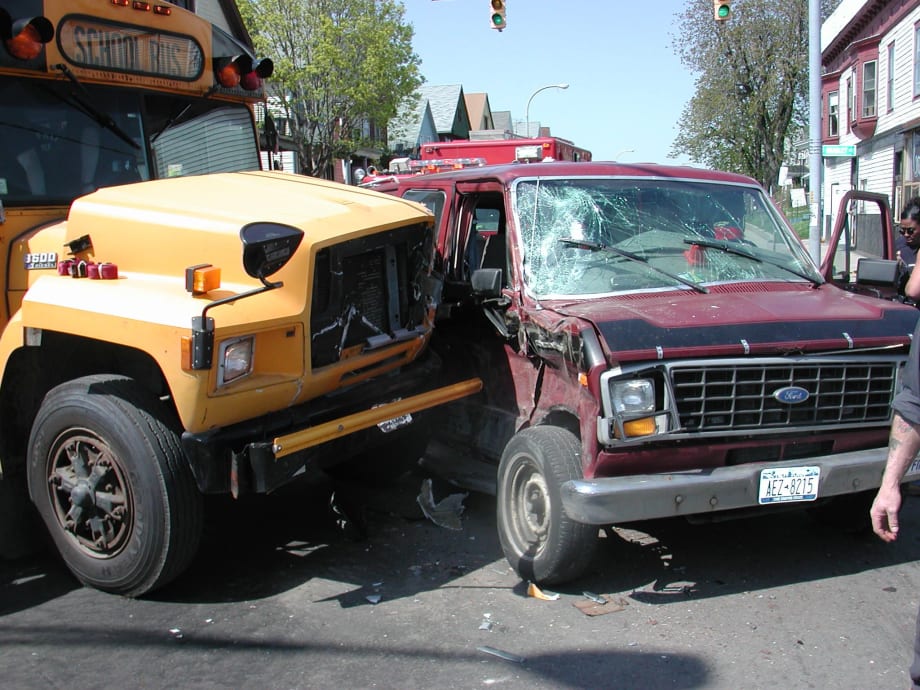
Post-accident procedure committees and team members typically take pictures of the scene, review related reports and create a plan to prevent future similar incidents.
In the unfortunate event of an accident, no one wants to be caught unprepared. There are the police reports and insurance reports to deal with as well as working with the driver involved on training or retraining, or revising policies.
Some districts ensure they are prepared for such incidents by establishing post-accident procedures committees or teams. These groups typically take pictures of the scene, analyze the data that were gathered after the incident — the police report, photographs, interviews and insurance reports — and the routes, if applicable. Then, they consider alternative routes or examine driver practices and create a plan to prevent future similar incidents.
That plan often includes looking for a training gap in the organization that can be addressed through retraining or revising a policy. Alternately, if the problem was related to driver performance, they will identify the training topic or policy that he or she missed and retrain them, or reevaluate a best practice. Communicating to the driver involved how the accident could have been prevented and using the details of the incident to train all drivers are key.
Proactive measures essential
A post-accident committee or team must be established before it is needed, says Michael Dallessandro, a school transportation consultant and human resources manager for Rural/Metro Medical Services in Buffalo, New York, and former transportation supervisor at Lake Shore Central School District in Angola, New York. Without it, directors may miss gathering valuable data.
Participants should be clearly identified, and a response checklist should be developed, covering what data, such as accident photos, the copy of the drug test, and police and insurance reports, to gather after an accident.
“If you have all that mapped out up front, your committee will be very productive going forward,” Dallessandro says.
Selecting committee members
To get a well-rounded perspective, many committees include a union representative; an employee from the business office or safety risk department; a superintendent or assistant superintendent; a local government representative; fire chief or a police department representative and an insurance company representative.
Although bringing a variety of perspectives and expertise to the table is beneficial, committee or group members have to make a point to work together to overcome the barriers from that expertise, come to some common ground and reach a workable solution. Dallessandro says that sometimes members only look at the accident from the perspective of their background. For instance, he explains, an insurance representative may only review the scenario from the standpoint of risk and preventing loss, and how it will impact insurance coverage, while a transportation director may mainly focus on route changes.
The biggest challenge, says Edd Hennerley, director of transportation at Queen Creek (Ariz.) Unified School District #95, is selecting the right people to conduct the investigations and the follow-up.
Hennerley formed a response team that includes the district’s transportation supervisor, fleet service manager, an office staff member and two technicians, which he says works well. He does not include bus drivers in the team, because he doesn’t think they should be placed in a position to judge their peers.
“[Most] bus drivers are good at what they do, but that doesn’t qualify them to sit in judgment over other [drivers],” Hennerley says. “The challenge is to be impartial, zero in on what happened, because you can’t have a solution until you find the problem.”
Kathleen Furneaux, executive director of the Pupil Transportation Safety Institute, agrees.
“Some committees are structured as a punitive board,” she explains. “There are other venues [that] take care of the punitive aspects of an accident. The review committee needs to fill a different space.”
Fairness is another crucial factor, she adds. “I have been involved in accident review committees where the organizations were not holding themselves accountable for their potential contribution to the issues leading up to the accident. If we are to hold drivers accountable, management must be accountable as well.”
Most importantly, Furneaux says, post-accident reviews should be focused on “learning what happened, trying to determine why it happened and then training so it does not happen again.”
[PAGEBREAK]Training opportunity reduces future incidents
An additional benefit of the committee is that it serves as an effective training tool for drivers, says Steve Vales, supervisor of transportation at St. John the Baptist Parish Public Schools in Reserve, Louisiana. Vales started a post-accident review committee at Tangipahoa Parish School System in Amite, Louisiana, when he was transportation supervisor there.
The committee can provide all drivers, not just those involved in the accidents, with information on what preventive actions could have been taken in certain situations, such as being prepared for unusual weather, road conditions and traffic. This helps them understand how and why they will be held accountable in a preventable accident. As a result, most drivers respond by changing their behavior, Vales says.
“In reviewing the collisions [with them], you’re promoting preventability, especially if there is some type of reward and consequence,” he adds.
The committee started by Vales also recognized drivers who took preventive actions during group meetings by awarding them with certificates, to encourage the behavior.
“By eliminating unsafe or less safe behaviors, you’ll reduce your rate of accidents,” he says.
To provide meaningful remediation that keeps drivers from having another offense, Vales adds that drivers were rotated through the committee to give them a better understanding of their job expectations and the consequence of having an accident.
Like Vales, Edmund Treadaway, former transportation manager of Perth Amboy (N.J.) Public Schools, who worked on forming a post-accident committee, sees the value in using it to help drivers learn from their mistakes.
“We can train the driver [at fault] better and point out to the other drivers what not to do,” he explains.
Treadaway; Perth Amboy’s head of security, who’s a former state policeman; and the driver trainer ensured that the children were safe in the event of an accident and took care of the post-accident checklist tasks. To further their ability to effectively respond to accidents, the transportation team also recently conducted a full-scale accident drill with fire and police department personnel, pupil transportation staff, the district’s security team, a camera crew, an EMS team and students. The drill was based on the scenario of a bus full of students being hit by a drunken driver.
“If we can prevent [accidents], and keep the kids safer, that’s a good thing,” he says.
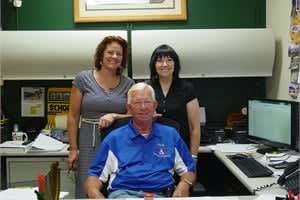
Edd Hennerley, director of transportation at Queen Creek (Ariz.) Unified School District #95 (shown center), formed a post-accident response team that includes the fleet service manager, Chanie Passerby (shown left), transportation supervisor, Marcia Stones (shown right), an office staff member and two technicians.
Post-accident checklist tips:
1. A good resource for putting a response checklist together is the National Safety Council, which covers different types of accidents and what factors committees should review in determining preventability, says Steve Vales, supervisor of transportation at St. John the Baptist Parish Public Schools in Reserve, Louisiana. http://www.nsc.org/news_resources/Resources/Pages/SafetyHealthFactSheets.aspx
2. Make sure your committee has these documents to review: a preliminary accident report from the driver, a copy of the police report, witness statements, an estimate for vehicle repairs and photos of the scene.
3. Edd Hennerley, director of transportation at Queen Creek (Ariz.) Unified School District #95, says that he keeps a digital camera always charged and at the ready for when he needs to go to the scene of an accident.
More Management

How to Build a Better Driver Training Program
Ready to boost up your school bus instructor training? Here’s how to pick the right talent and improve recruitment, retention, and safety.
Read More →
CALSTART and Forth Combine to Form Catalyst Mobility
The new name represents a renewed vision for the nonprofit focused on advancing clean, equitable, and affordable transportation solutions that move people and goods.
Read More →
What Makes a Great School Bus Driver Trainer?
Choosing the right school bus driver trainer takes more than experience. Learn six keys to selecting and developing trainers and evaluating program effectiveness.
Read More →


School Bus Contractors Expand Through New Deals, Acquisitions & Partnerships
STA's Canadian division acquires Ontario-based G&L Stevenson Transport while Durham School Services adds a new district contract in California, First Student adds a New Jersey contract, and Minnesota Coaches acquires Halo Transportation.
Read More →
Logan Bus Company Rolls Out AI Phone System for NYC School Bus Families
A summer pilot found that AI agents could handle most routine calls, freeing up time for customer service staff to focus on emergencies and complex family concerns.
Read More →
From Intent to Impact: What I Learned About Leadership from TAPT
A Texas transportation supervisor shares lessons on self-awareness, accountability, managing stress and building trust — and why investing in leadership development matters at every stage of your career.
Read More →
NAPT Names 2026 Award Recipients, Hall of Fame Inductee
Who earned national recognition for their work in student transportation? This year, NAPT named five recipients of its 2026 awards for service, safety, and leadership, plus its newest Hall of Famer.
Read More →
2026 State of Student Transportation Report
Driver shortages. Rising costs. Growing safety expectations. More data, but not enough time to act on it. The 2026 State of Student Transportation Report reveals what transportation leaders say is putting the most pressure on their operations—and where they’re investing next. See how your priorities compare.
Read More →
How to De-Escalate an Angry Person: 5 Steps for Handling Workplace Conflict
What makes emotions run high, and how should you handle an angry colleague or parent? Follow these steps for staying calm, listening, showing empathy, and resolving conflict.
Read More →
What Readiness Looks Like This School Year
Learn about the challenges shaping the 2026–2027 school year, from persistent driver shortages and budget pressure to technology and readiness gaps. See how school districts are responding and adapting in Zonar’s 2026 Back-to-School Readiness Report.
Read More →