




Don't Miss: 5 Factors to Consider with Electric Buses
NSTA Advocacy in Action: Regenerative Braking and Market Forces Can Change the EV Dynamic
There are 500,000 ICE school buses in the United States that need to be replaced. Currently there are 33,000 ICE and electric school buses produced each year. At the current production rate, it will take a minimum of 15 years to turn over the school bus fleet to electric.
by Dan Kobussen, NSTA President
January 2, 2024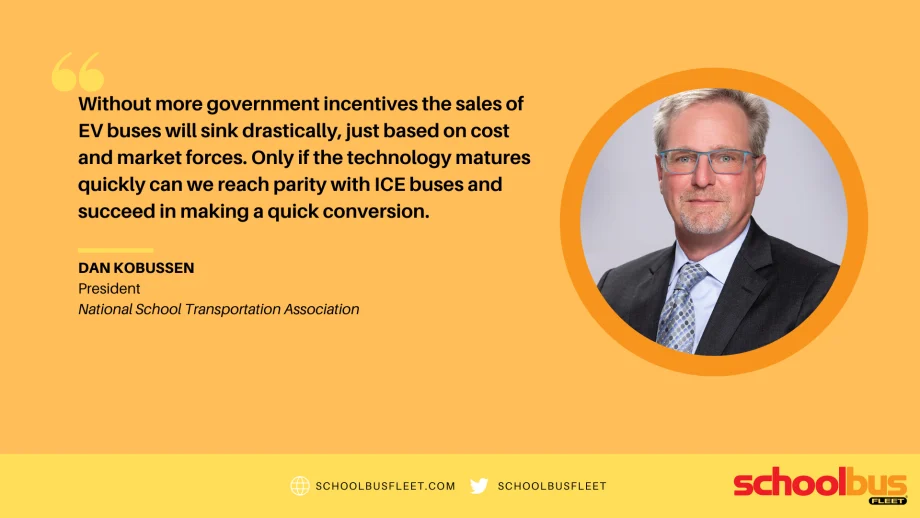
NSTA President Dan Kobussen delves deeper into the topic of school bus fleets making the transition to electric vehicles.
Photo: School Bus Fleet
4 min to read
Last column, I talked about several challenges and impediments to moving forward with electric school buses (ESBs). For this column, I would like to focus on a couple of the more positive aspects of this evolution.
The electric/drivetrain represents as much as 50% of the total cost of an ESB. This increased cost may force manufacturers to cut costs of other parts of the vehicle - possibly deleting items like knobs and switches (Tesla will soon eliminate turn signals and wiper stalks). Some of these items/options will be engineered around, but others will just be eliminated. How will this play out in a school bus world that has many different rules and options for each state? Will we see school buses with one large screen and no buttons?
As most people reading this column know, the school bus is the most regulated vehicle on the road, so this will be a difficult and slow shift. Soon, the National Congress on School Transportation (NCST) and ultimately the states will have to grapple with this new technology. Will this be the beginning of a single standard spec for all states? Perhaps this could help the manufacturers reduce their costs and offset the cost of the electric drivetrains.
As I mentioned last column, new, and more efficient battery technologies are on the horizon, which could change where and what type of metals are mined. With economics of scale, current battery technology costs should decrease over time. Lithium is down 20% over the past year, due to oversupply. Mining and refining these materials may ultimately go down in price but that cost only represents 20% of the total price tag of the battery. Approximately 80% of the cost of the battery is in the manufacturing process, which will only slowly decrease once a stable battery technology is established.
Batteries can be recycled, in laymen’s terms, when batteries no longer work, they are clogged up, not used up, about 85% of the metals can be reused for new batteries. Recycling used batteries or the metal in them could become a commodity like used steel and aluminum. Currently, batteries have $4,000k-$10,000 worth of materials for every ton of battery cell weight. So, battery recycling companies like Cirba and Li-cycle could replace significant amounts of raw material mining in the next couple decades and possibly reduce the cost of future batteries and environmental impact of mining.
Finally, regenerative brakes are the Holy Grail of why the transition to vehicle electrification should take place. This simple dynamic could possibly be the largest financial reason to move forward with electric vehicles, especially when you consider a heavy school bus that starts and stops often. A normal Internal Combustion Engine (ICE) bus with conventional brakes wastes all the energy when the driver steps on the brakes. In an EV or hybrid vehicle, this formerly unwanted energy, created by the simple act of braking, gets recaptured and stored in the batteries. The impact is so great that climbing a mountain in an EV doesn’t greatly affect mileage rates because the power to go up is recaptured when the vehicle comes back down.
There are 500,000 ICE school buses in the United States that need to be replaced. Currently there are 33,000 ICE and electric school buses produced each year. At the current production rate, it will take a minimum of 15 years to turn over the school bus fleet to electric. The Clean School Bus Program provides $5 billion over five years, which equates to 13,698 buses. That leaves 486,302 unfunded buses that cost approximately three times more than the average ICE bus that will rely on the open market to control pricing. Without more government incentives the sales of EV buses will sink drastically, just based on cost and market forces. Only if the technology matures quickly can we reach parity with ICE buses and succeed in making a quick conversion. With the current Clean School Bus program and with manufacturers investing millions into battery technology - we cannot turn back at this point. I hope we can get there sooner rather than later because it is going to be a painful conversion for those of us in the trenches.
I welcome your feedback. Please reach out to me at president@yellowbuses.orgon this or any other matter.
Subscribe to Our Newsletter
More Blog Posts

Student Transportation Leaders Gather at NSTA Annual Meeting & Convention
Patrick Dean recaps key moments from NSTA’s 2026 Annual Meeting & Convention, including advocacy efforts, AI discussions, OEM insights, and federal policy updates.
Read More →
School Bus Contractor Association Brings Key Policy Issues to FMCSA
Federal policy, CDL testing, insurance, and compliance were among the key topics as NSTA leaders met with FMCSA to advance priorities for school bus contractors.
Read More →
NSTA Engages School Boards on Outsourcing Student Transportation Services at COSSBA Conference
What benefits does using contracted providers bring to districts and students? That’s what NSTA shared at a recent conference for education leaders. Here are the highlights.
Read More →
NSTA Advances Legislative Priorities During 2026 Capitol Hill Bus-In
Members of the industry’s contractor’s association traveled to Washington, D.C. to advocate for two key initiatives during congressional meetings.
Read More →
NSTA Emphasizes School Transportation at the Midwest Commercial Vehicle Safety Summit
From NHTSA safety data to NCST standards and stop-arm passing prevention, NSTA reinforces the role of school buses in protecting students and improving traffic safety.
Read More →
NSTA Participates in National School Bus Safety Week Event with Pennsylvania Congressman
The industry's contractor association and Rep. Brian Fitzpatrick spotlight rising dangers from illegal school bus passings and outline new legislative efforts.
Read More →
Senate Introduction of Brake for Kids Act Marks School Bus Safety Milestone
The legislation seeks to launch a national awareness campaign reminding motorists to stop for school buses. With millions of violations each year, it’s time to make school bus safety a national priority.
Read More →
From Steel to Semiconductors: How Tariff Policy May Impact School Transportation
Tariffs may feel far from the yellow bus, but they affect costs, supply chains, and technology in student transportation. Here’s what you need to know.
Read More →
Building the Future of Student Transportation: Highlights from NSTA’s 2025 Annual Meeting and Convention
From drivers to contractor-member companies, NSTA’s 2025 Annual Meeting in Boston celebrated school bus excellence while spotlighting trends shaping student transportation.
Read More →
Inside the Process: School Bus Safety Subcommittee's Review of FMCSA Proposals
New FMCSA proposals could reshape school bus operations. Here’s how the national contractor’s association is responding to possible changes on railroad crossings and inspection and medical reports.
Read More →