




Violence Prevention Is a Top Concern for Special-Needs Transporters
Transporting Students with Disabilities Conference focuses on violence prediction and prevention, which comes through understanding students' needs, treating them with respect and enforcing rules.
With school violence gaining in frequency and severity, it’s not surprising that school transportation officials are hungry for strategies to reduce violence and maintain discipline on the school bus — especially those transporting students with behavioral or emotional disabilities or other types of special needs. More than a day’s worth of sessions was devoted to this topic at the 9th Annual National Conference on Transporting Students with Disabilities and the Preschool Population, held March 3-8 in Orlando, Fla. According to conference organizer Roseann Schwaderer of Serif Press in Arlington, Va., the conference drew 585 people from 43 states, Puerto Rico, Guam, the U.S. Virgin Islands, Canada, Japan, South Korea, Okinawa, Germany and the United Kingdom.
Predicting violence
Frema Engel, president of Engel and Associates, a Montreal-based company that promotes healthy workplace environments, told attendees that violence is largely predictable, and as such, largely preventable. In a session called “Peace on Board – Preparing Drivers to Prevent Abusive Behavior,” Engel explained the importance of maintaining control on the school bus and paying attention to the early signs of violent behavior. “You need to know what the behaviors are and how they escalate, because they do if we don’t deal with them,” she said. “Screaming and vandalism are forms of violence,” noted Engel, whose recent book Taming the Beast: Getting Violence Out of the Workplace, provides early warning signs and prevention methods. Engel advocates several days of driver training focused exclusively on behavior management. Not only will these sessions reduce incident levels, she said, but they may also lower insurance rates. In addition, they will help reduce drivers’ stress and make their jobs more enjoyable. The first lesson for drivers, she said, must be to learn to control their own tempers. “If I don’t know how to handle my anger, I cannot intervene successfully and handle someone else’s,” she said. “Your behavior management program must include that component to be successful.”
Filling the need is key
In “Characteristics of Behavior and Management Techniques,” Gail Black, behavior support consultant for the Capitol Area Intermediate Unit in Summerdale, Pa., stressed that children act out because they have a need that isn’t being fulfilled. “When a student misbehaves,” she said, “ask yourself, ‘What is the basic need that isn’t being met?’” If you help the student to fulfill that need, she said, you will not only decrease the inappropriate behavior, but you will also help to increase his self-esteem. Black explained that we must teach students new, acceptable behaviors to replace the unacceptable ones. If you take something away from a child, give him something in exchange, she said. For example, if a student is playing with something that is sharp and dangerous, take it from him and give him something soft to play with in return. Black also recommends adding visual icons to posted bus rules, to facilitate comprehension and compliance. In managing students, Black suggests giving them choices, such as “Do you want to sit down and buckle your seat belt yourself or do you want me to help you?” Try to phrase commands such that you are telling a student what to do, rather than what not to do, said Black. For example, say “quiet voice,” instead of “don’t shout,” to focus on the behavior you wish to accomplish (quiet) rather than that which is forbidden (shout).
Responding to violence
Patricia Guthrie, former assistant superintendent of Warren County (Ky.) Schools, explained how her district responds to violence in a presentation titled “Threats of Violence: If We Know, What Do We Do?” In reaction to a high school shooting incident in her home state of Kentucky, her district developed a crisis response team. “We can’t expect one person [usually the principal] to carry the burden of deciding whether a student is dangerous or not,” said Guthrie. Instead, a team of professionals meets to evaluate potentially dangerous cases. The student evaluation involves filling out a “threat of violence” rating form to help determine the level of danger posed and the appropriate course of action to take — return to school, extended suspension for further evaluation or transfer to an alternative school. Decisions are made by the principal and the school staff involved in the team, rather than by the principal alone.
Judging restraint systems
The topic of school bus safety focused on the seat belt issue at the opening session, where Charles Gauthier, executive director of the National Association of State Directors of Pupil Transportation Services, discussed studies being conducted by the National Highway Traffic Safety Administration (NHTSA). The tests, said Gauthier, are being done in three phases, the first and second of which are complete. So far, NHTSA has defined the problem based on real-world crashes, identified possible restraint systems, developed a procedure for testing the systems and conducted full-scale crash tests. According to Gauthier, NHTSA is looking primarily at three-point systems. As part of Phase 3, NHTSA is currently testing various safety systems and comparing lab results to real-world situations. “There’s no doubt in my mind that when NHTSA completes its lab testing, lap/shoulder belts will prove to be the most effective form of passenger protection in school buses,” said Gauthier. He admits, however, to having reservations about real-world applications of lap/shoulder belts, primarily because the implementation of a three-point system may decrease the effectiveness of compartmentalization. If compartmentalization is weakened, he suggests, then a student who doesn’t wear a belt, for whatever reason, will be vulnerable to harm. “The question in my mind,” said Gauthier, “is, ‘What is the effect on the children who don’t wear a belt or who wear it incorrectly?’ Are we helping or hurting that small percentage of kids?” That, he said, is the key question in deciding whether lap/shoulder belts are the best choice in occupant protection for school buses.
Pro-belt arguments
Dr. Phyllis Agran of the Department of Pediatrics at the University of California, Irvine, responded to Gauthier, saying, “Use should not be an argument against restraint systems.” Agran posited that lap/shoulder belts or even lap belts alone are better than no belts at all, and that use should be mandatory. She rebutted the argument that belts may impede emergency evacuation by saying that it is better for a child to be in the seat, even if knocked unconscious, than to be thrown about the bus or onto the floor. Someone can help that child out of the belt and off the bus, she said. To those who suggest that lap belts may cause abdominal or neck injuries to a child in a collision, Agran challenged, “If you can tell me of a case where a lap belt caused more harm than would have occurred without it, I would like to hear it.” All such injuries are speculative, she said, based on lab tests. There have been no critical, real-life incidents. Agran responded to concerns that children might use seat belts as weapons to injure other students by saying that she has never seen this happen and does not think such a possibility is a reason to reject seat belts. Even cost-effectiveness, she said, should not be an issue, as the cost of a single trip to the emergency room following a school bus crash could cost more than half the price of fitting an entire bus with belts. Agran suggested that it’s time we stopped judging the safety record of school buses by the number of fatalities each year. The injuries, even those as small as a lost tooth, can be tremendous hardships for a child, she said. Policies can be written so that drivers and adult supervisors are not liable for a student’s failure to use seat belts that are provided, said Agran.
Updates from NHTSA
Diane Wigle, highway safety specialist at NHTSA, explained a series of safety vest crash tests conducted by the safety agency. The first set of tests was done using cam-wraps and the second set using tethers. The results of the tests are on NHTSA’s Website at www.nhtsa.dot.gov. NHTSA has not yet released an analysis paper, but Wigle said that one of the vest manufacturers did what NHTSA is calling “a good analysis” of the tests. That manufacturer, she said, recommends that when a child is wearing a safety vest, the child in the seat behind him must wear some type of safety restraint as well, or the seat must remain empty. By mid-June a brochure on restraints, with photos, should be available, Wigle said. NHTSA will also be putting out a new brochure late this summer on proper spec’ing of a school bus for children with special needs (evaluating aisle width, seat spacing, anchors, step height and so on). In addition, NHTSA is writing a safety technician training course (currently available for passenger vehicles) that will focus on school bus transportation, due to be released sometime this fall.
More Special Needs Transportation
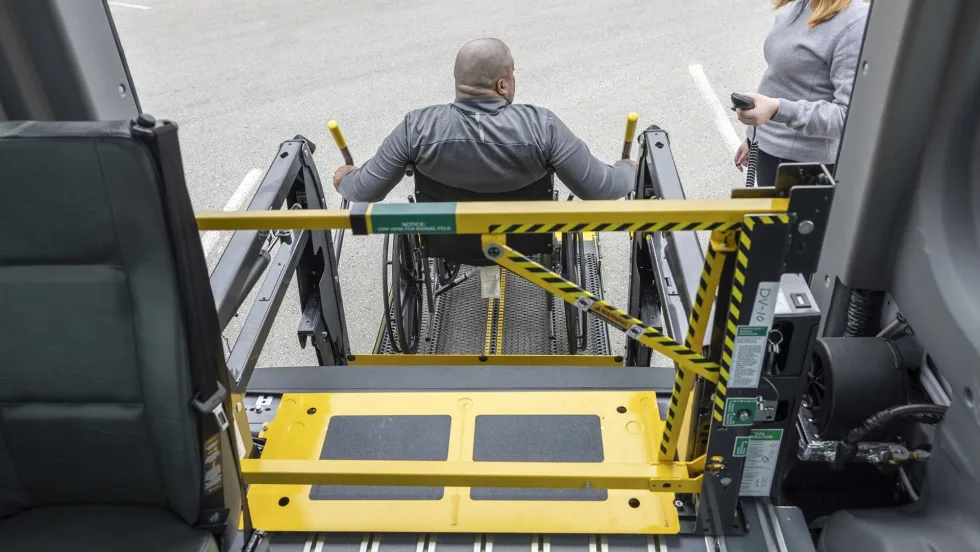
BraunAbility Introduces New Safety Barrier for Wheelchair Lifts
LiftSentinel is designed to add another layer of protection during wheelchair loading and unloading and can be retrofitted to many existing commercial lift installations.
Read More →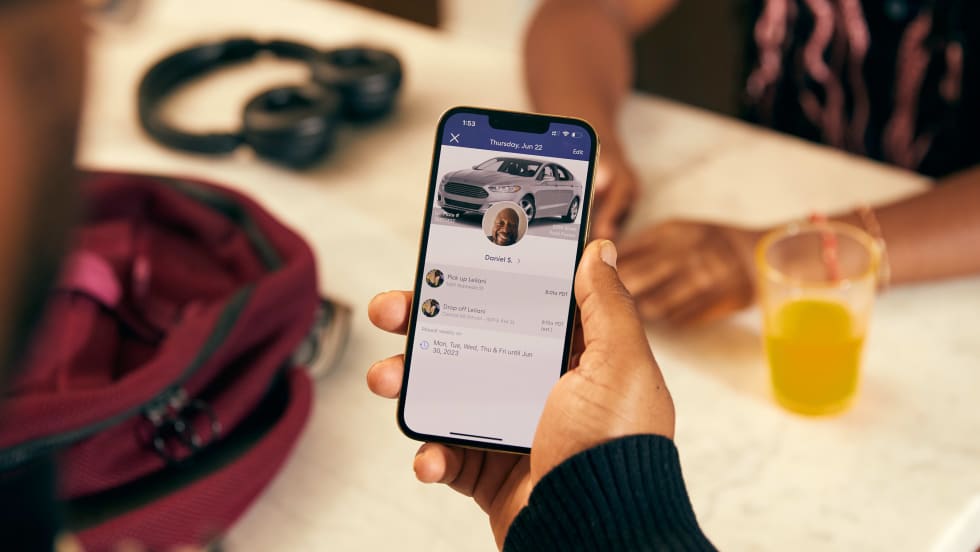
HopSkipDrive Launches New Safety, Driver Consistency Features for 2026-27 School Year
The company’s free ride recording, live ride tracking, and consistent driver assignments aim to improve safety and continuity for diverse student transportation needs.
Read More →
The Most Common Wheelchair Securement Mistakes on School Buses (and How to Fix Them)
Small missteps in wheelchair securement can have serious consequences. Here are 32 tips from experts to reduce risk and increase student safety on the bus.
Read More →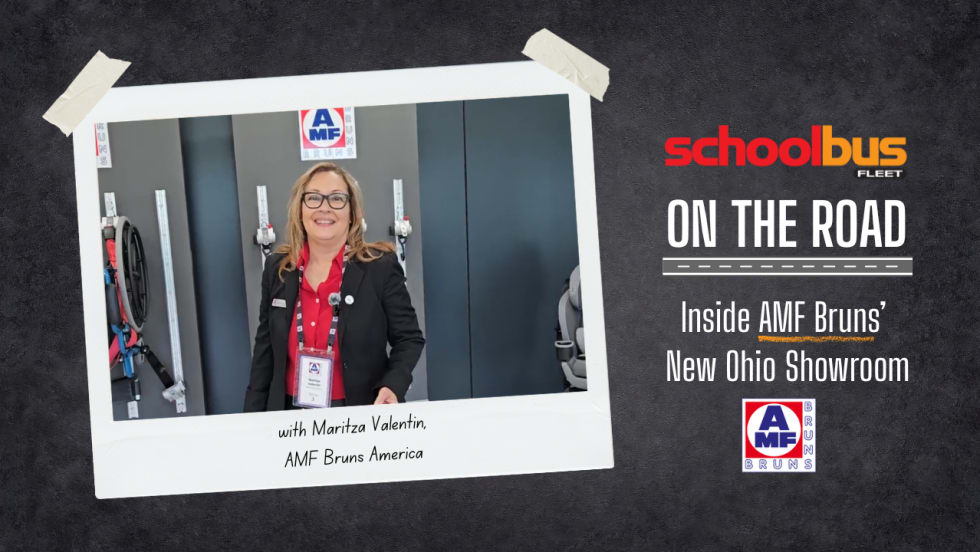
Inside AMF Bruns’ New Showroom: School Bus Securement Solutions Explained
Go inside AMF Bruns America’s new Ohio showroom with Maritza Valentin to see its FutureSafe technology, driver training tools, securement systems, and seating innovations.
Read More →
What AMF Bruns’ New Facility Means for Customers [Video]
Inside AMF Bruns’ new Stow, Ohio, operations: See how expanded space and innovation will enhance customer support and operations.
Read More →
AMF Bruns Expands in Ohio, Investing in Growth and Community
With expanded production space, local investment, and a growing workforce, AMF Bruns is scaling its U.S. presence. Here’s an exclusive first look inside the new Stow, Ohio, HQ.
Read More →
Inside AMF Bruns of America’s New Ohio Manufacturing Facility [Photos]
Take a behind-the-scenes look at AMF Bruns of America’s new 41,000-square-foot Stow, Ohio, headquarters, featuring advanced manufacturing, expanded space, and future-ready mobility solutions.
Read More →
First Student Boosts Student Support in Wichita & Texas
First Student and Wichita Public Schools are using behavioral support strategies to improve student ride experiences, while a separate initiative expands access to after-school programs through a bus donation.
Read More →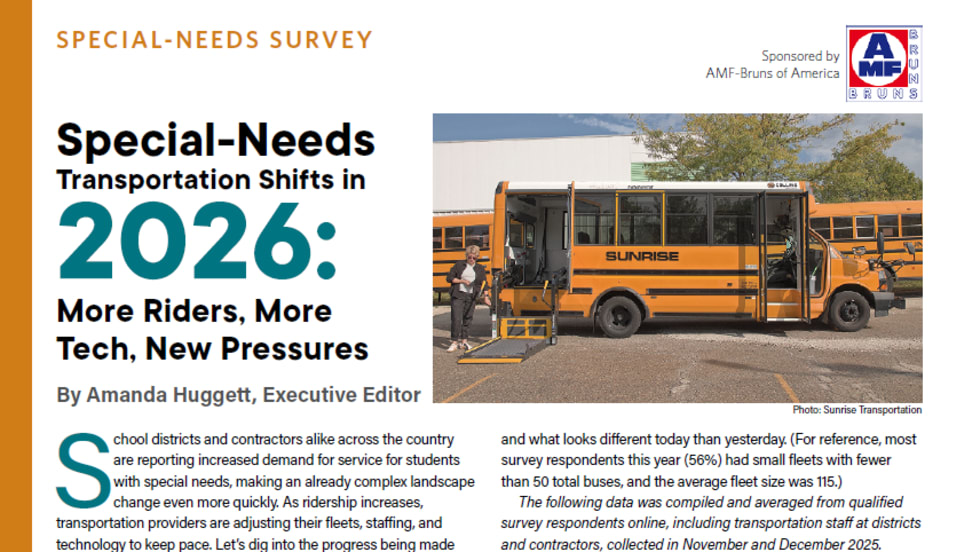
2026 Special-Needs Transportation Survey
What’s changing in special-needs transportation? This year, student transportation operators report a rising need, easing driver shortages, growing tech adoption, and evolving challenges. Sponsored by AMF Bruns of America.
Read More →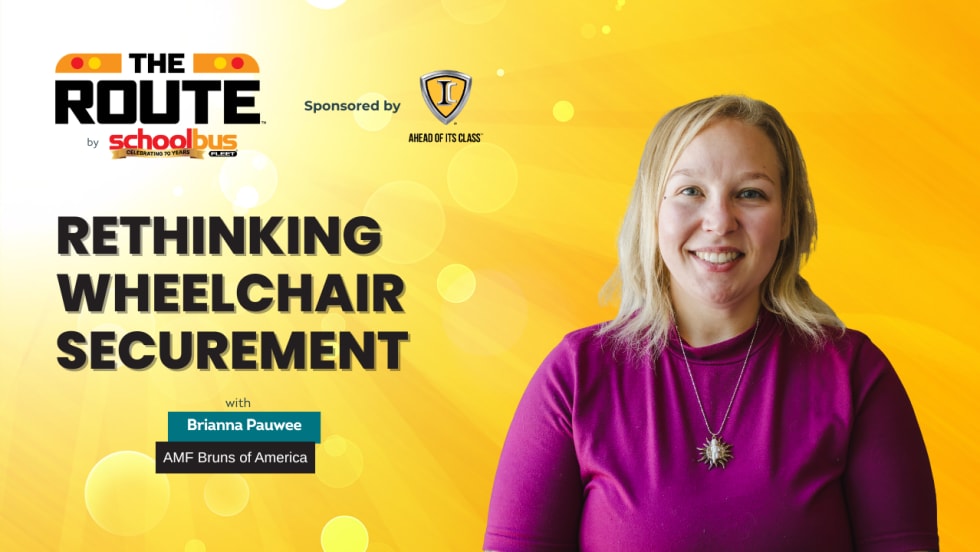
The Lived-Experience Gap in Mobility Tech: An Expert Take on Safe Student Transportation
Brianna Pauwee, a product application specialist at AMF Bruns of America and a wheelchair user, drops in to The Route to share practical securement and training insights, plus the story behind the new “Beyond Mobility” podcast. The Route is sponsored by IC Bus.
Read More →