




School Bus eXchange Drills Down on Keys for Success
At the inaugural SBX event, school transportation officials share ideas on such topics as efficiency, technology and identifying the outputs of a successful operation.

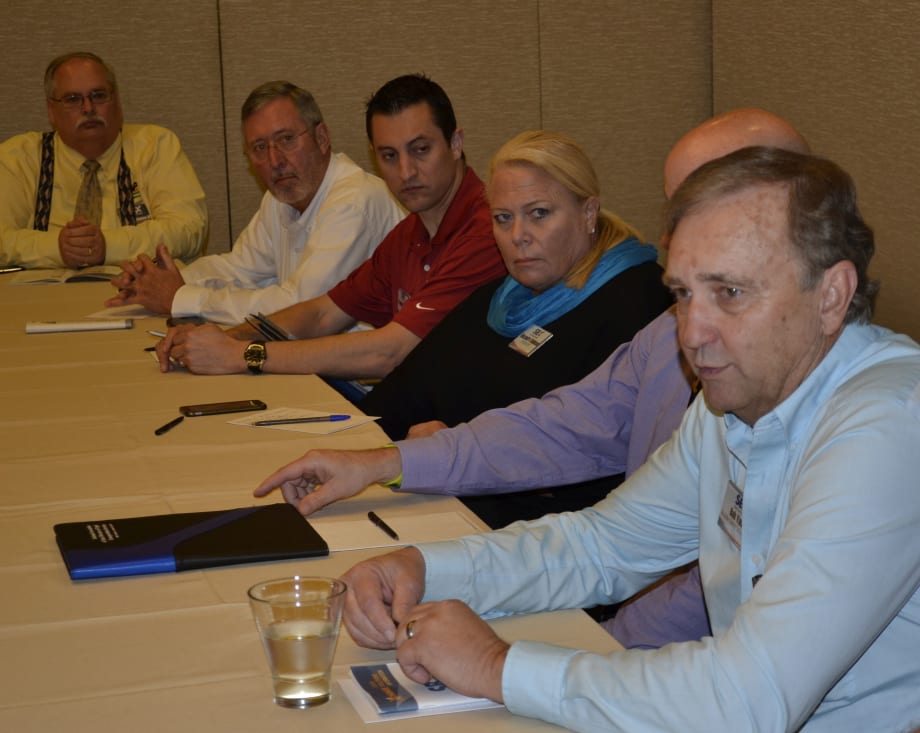
Bob Young (right), director of transportation at Boulder (Colo.) Valley School District, talks with other SBX attendees during a roundtable on operational efficiency.
More than two dozen school transportation officials from across the country gathered near Dallas in April to share ideas and to network during the inaugural School Bus eXchange (SBX).
The groundbreaking event, held by the National Association for Pupil Transportation and School Bus Fleet, focused on connecting public and private school bus operators and industry suppliers to discuss solutions for common challenges in the industry.
The event took place April 6-8 at the Hilton Dallas/Rockwall Lakefront hotel. The school bus operators received full scholarships to attend SBX for free, while suppliers served as hosts.
Defining success
Keynote speaker Mark Aesch set the tone by encouraging attendees to identify the outputs of success for their operations. Examples for school transportation might include standards like 95% on-time school drop-offs, no preventable accidents, 90% parent/student satisfaction and operating within budget.
“If we don’t define success, guess who does: everybody else,” said Aesch, who is the CEO of consulting firm TransPro. “We have to define success.”
He recommended making “a transition to where we’re measuring the things that matters,” and developing a scorecard with various factors that boil down to one number. The goal, he said, is to “demonstrate that taxpayers are getting a return on their investment.”
One of the keys to a successful operation, Aesch said, is creating a culture of ownership among the staff. To illustrate that point, he told an anecdote about President John F. Kennedy visiting NASA in 1962. As the story goes, during a tour of the space center, Kennedy noticed a janitor and asked him what he was doing. The janitor’s reply: “I’m helping put a man on the moon, Mr. President.”
Aesch identified four types of employees:
• Rock stars demonstrate high performance and high alignment to the organization’s values.
• Rotten apples demonstrate low performance and low alignment to values.
• Investments demonstrate low performance but high alignment to values.
• Saboteurs demonstrate high performance but low alignment to values (e.g., gossiping at the water cooler).
Aesch recommended promoting the rock star employees to help the organization succeed in the long term. Investment employees should be given additional training to align their skills to help the agency succeed. Rotten apples and saboteurs should be terminated, Aesch said.
[PAGEBREAK]
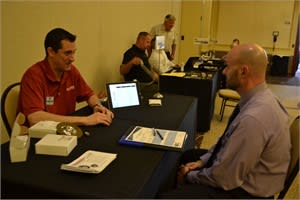
David Koskelowski (right), program manager for traffic safety and pupil transportation at the Wyoming Department of Education, meets with Branden Smeltzer, general manager of UltraLED.
Monitoring fleet metrics
The SBX agenda included a series of roundtables. Attendees discussed challenges and solutions in four areas: operational efficiency, fleet metrics, school bus driver shortage, and technology and software.
Brian Weisinger, who recently retired as director of transportation at Spring (Texas) Independent School District, facilitated the roundtable on fleet metrics.
“We’re here from all over the country, but we have a lot of the same problems,” Weisinger said. “One is keeping buses under 15 years. How do you get rid of these old buses? How do you justify getting new ones?”
Walter Prothro, director of transportation for Georgetown (Texas) Independent School District, pointed to a term he learned in the military: “uneconomically repairable,” meaning that a vehicle has gotten to the point in which maintenance has become too expensive. He suggested using data from a fleet management system to show the school board when a bus has become uneconomically repairable.
The fleet metrics discussion also touched on tracking the frequency and cost of road calls, trying to develop a sustainable fleet replacement program, and assessing the advantages of buying or leasing buses.
Driver shortage solutions
Peter Mannella, an NAPT board member and executive director of the New York Association for Pupil Transportation, led the roundtable on driver shortage. Attendees shared a variety of ideas, such as implementing hiring bonuses, recruiting retirees and holding an event to let prospective drivers get behind the wheel of a bus.
The driver shortage conversation also covered a related issue: driver attendance.
“I don’t have a driver shortage — I have an attendance problem,” said John “Jay” Cotthaus, director of transportation services at Virginia Beach (Va.) City Public Schools. “If all my drivers came to work, I wouldn’t need subs.”
Bob Young, director of transportation at Boulder (Colo.) Valley School District, mentioned a program that has helped boost school bus driver attendance at his operation. “If you have perfect attendance this year, you get an assigned parking spot next year,” Young explained.
Kim Crabtree, director of transportation at Greater Albany (Ore.) Public Schools, said that her operation has a similar program that gives drivers assigned parking spots for perfect attendance. Also helping with attendance at Greater Albany: Crabtree requires her drivers to call her house in the morning if they are going to be absent. Previously, drivers had to call dispatch, so “they were speaking to a person that didn’t have authority over them.”
Crabtree said that the requirement to call her house has significantly improved driver attendance, although she acknowledged that “it’s a big undertaking to take all those calls.”
Tackling technology
Steve Simmons, another NAPT board member and the director of transportation at Columbus (Ohio) City Schools, facilitated the roundtable on technology. He began by asking attendees about the types of technology that they’ve implemented at their operations.
Most or all of the school bus operators in the room said that they have both GPS and video surveillance on their buses. Most said that they don’t have an electronic child check reminder system on their buses, but they discussed other practices to help make sure that drivers check for sleeping children, such as signs to hang in the rear window and termination/suspension policies for leaving a child on board.
The conversation also delved into tracking of school bus passengers — particularly what to call it. Simmons said that because of “Big Brother” associations with the term “student tracking,” his district dubbed its program “EasyPass.” The program, which uses Zonar’s Z Pass system, provides the district’s students with RFID cards that automatically log when they enter or exit a bus.
Other roundtable participants suggested using terms like “student accountability” and “ridership reporting” rather than “student tracking.”
Attendees also discussed the challenges of trying to stay up to date on technology. As Simmons summed it up, “The technology is changing so fast that none of us can keep up with it.”
[PAGEBREAK]
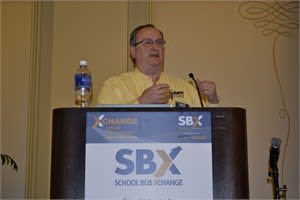
Peter Mannella, an NAPT board member and executive director of the New York Association for Pupil Transportation, sums up a roundtable discussion on driver shortage.
Enhancing efficiency
Steven Kalmes, owner of JSK Consulting and an NAPT board member, led the roundtable on operational efficiency. Participants talked about some of the challenges in optimizing efficiency, such as aging school bus fleets, growth in the student population, driver shortage and decreased funding.
Alex Robinson, executive director of the Office of Pupil Transportation at the New York City Department of Education, pointed to the need to tie school transportation efficiency and other initiatives to success in the classroom. At her department, “Anything we suggest has to be aligned with instructional goals,” she said.
As examples: Could vehicle tracking technology increase the on-time rate for buses arriving at schools? Could air conditioning in a bus positively impact a medically fragile student’s school day?
Some attendees noted that vendor input is important in making a case to purchase products that can enhance efficiency.
Prothro of Georgetown Independent School District suggested that vendors work to “come up with strategies for us to use, that we could present to the board to save money.”
Kalmes added that school transportation officials themselves need to sharpen their sales skills to get approval for efficiency-related initiatives.
“If you can improve your efficiency by changing school start times or calendars, you need to be a good salesman,” Kalmes said.
Building relationships
Another element of SBX was one-on-one consultations, in which school bus operators were given scheduled times to meet with school bus manufacturers and equipment suppliers. The idea was to help attendees learn about potential solutions for the challenges that their operations are facing.
Supplier input was a recurring theme during the event. The supplier representatives were encouraged to participate in all of the roundtable discussions.
SBX organizers also sought to provide ongoing networking opportunities, including during receptions and meals. Seats were assigned during some meals to encourage attendees to meet new people.
There were also several surprises for attendees throughout SBX. During the opening night reception, as school bus operators and suppliers mingled and sipped beverages, a magician made his way around the room and showed off some mind-boggling card tricks.
NAPT Executive Director Mike Martin served as the SBX emcee, keeping attendees focused on the event’s central theme of data-driven decision making. He also adopted some Texas flair, at one point taking the stage wearing a cowboy hat, red bandana and boots, bearing a striking resemblance — by his own admission — to Woody from the Toy Story movies.
Valuable experience
With a relatively small group of attendees, scheduled one-on-one consultations and increased supplier participation, SBX was different from most other industry conferences. Attendees seemed to appreciate the innovative format.
“One of the things that stood out the most for me was including the vendors in the roundtable discussions,” said Veronica Schmidt, transportation supervisor at Snohomish (Wash.) School District. “It was nice that they were able to give us input, perspective and feedback on some of the topics we were discussing.”
David Koskelowski, program manager for traffic safety and pupil transportation at the Wyoming Department of Education, described SBX as “fast-paced, focused and very well organized. Every attendee had a voice, and I learned I am not the only one having problems. It was an incredible group of professionals and a valuable event to attend.”
More Management
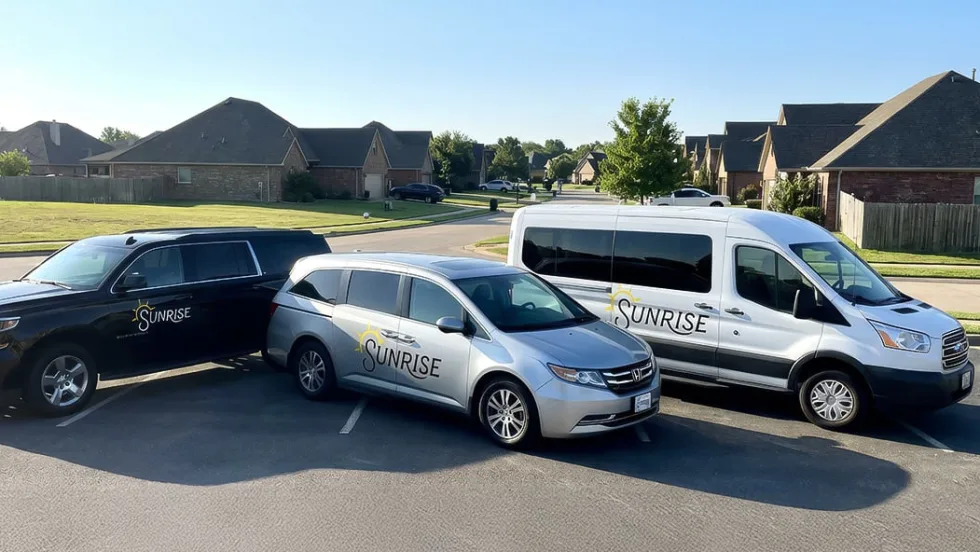
STA Acquires Sunrise Transportation
Student Transportation of America expands in Illinois and Connecticut through Sunrise's fleet of nearly 1,000 vehicles.
Read More →
EPA Opens $180M DERA Funding Round for Diesel Upgrades
The 2026 Diesel Emissions Reduction Act program seeks applications from eligible organizations to accelerate the retirement of legacy diesel vehicles.
Read More →
HopSkipDrive’s CareEngine Targets the ‘Exceptions’ in Student Transportation
The new platform works alongside districts’ existing transportation management systems to coordinate specialized rides, automate last-minute changes, and turn ride data into operational improvements.
Read More →


The Right Ride for Every Student: Navigating the New Student Transportation Ecosystem
How should districts blend school buses with small-vehicle transportation and other options? EverDriven CEO Mitch Bowling discusses safety, costs, partnerships, and strategy.
Read More →
Annette Brown Always Takes the Extra Time: Meet Our 2026 School Bus Driver Hero
For more than 30 years, the Wa-Nee Community Schools driver has treated students like family, combining safety, compassion, and servant leadership to make a lasting difference on and beyond the school bus.
Read More →
How to Build a Better Driver Training Program
Ready to boost up your school bus instructor training? Here’s how to pick the right talent and improve recruitment, retention, and safety.
Read More →
CALSTART and Forth Combine to Form Catalyst Mobility
The new name represents a renewed vision for the nonprofit focused on advancing clean, equitable, and affordable transportation solutions that move people and goods.
Read More →
What Makes a Great School Bus Driver Trainer?
Choosing the right school bus driver trainer takes more than experience. Learn six keys to selecting and developing trainers and evaluating program effectiveness.
Read More →
School Bus Contractors Expand Through New Deals, Acquisitions & Partnerships
STA's Canadian division acquires Ontario-based G&L Stevenson Transport; Durham School Services adds a new district in California; First Student expands in New Jersey; and Minnesota Coaches rebrands and acquires Halo Transportation.
Read More →
Logan Bus Company Rolls Out AI Phone System for NYC School Bus Families
A summer pilot found that AI agents could handle most routine calls, freeing up time for customer service staff to focus on emergencies and complex family concerns.
Read More →