




Maintain Exits in Case of Emergency
Door, hatch and window exit systems should be inspected regularly and lubricated and cleaned as necessary. Here are tips for keeping their various parts moving.
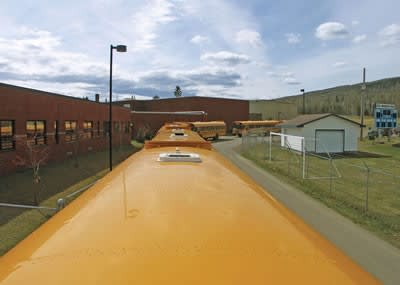
You’ll probably never need to use the emergency exits in your school bus, whether it’s a door, window or roof hatch. But in certain crises, such as a bus submerged in water or engulfed in flames, these portals can be lifesavers.
School bus emergency exits must be in full working order at all times in case they are needed in an evacuation. Here is some advice from the pros on how to maintain the systems.
Keep things moving
The first factor in taking care of emergency exit systems is general maintenance. Any part on the bus that is meant to move should do so effortlessly. Hinges and other moving parts should be lubricated and checked for freedom of movement. Switches must be clean. Latches should be checked for tightness and mounting.
“Hinge lubrication, switch cleaning and general housekeeping are the basics,” says Thomas Spellman, a shop supervisor at Lake Washington School District in Redmond, Wash. Check emergency doors to be sure that they open smoothly. Spellman says that cleaning buildup from seals helps.
Mark Hillman, garage manager at Norwalk-La Mirada Unified School District in Norwalk, Calif., also recommends checking the seals around the doors. “[A problem] we have had is the doors sticking shut and being hard to open from the outside,” he says. “This usually happens in hot weather when the rubber seal sticks to the door.” Hillman recommends rubbing talc on the seal.
Lifting fold-up seats by the side emergency exit can help to ensure they’ll fold up easily and quickly during an emergency. If a fold-up seat does have problems, it should be relatively simple to repair.
Robert Monberg, fleet maintenance supervisor for Gilbert (Ariz.) Public Schools, says, “We have had seats by the side emergency doors that would get stuck in the down position and would not rise. It was fixed by a recall.” Monberg says that a new cylinder usually fixes seats that don’t fold up by themselves.
Use cleaners carefully
Amy Williams of Specialty Mfg. in Pineville, N.C., says that while Specialty’s roof hatches are maintenance friendly, they “may need an occasional wipe with a cleaner.”
But be careful of the chemicals in the cleaners, warns James Giovanni, director of sales and marketing for Transpec Worldwide in Sterling Heights, Mich. “Chemical cleaners that contain a solvent can deteriorate plastic parts,” he says.
Both companies’ roof hatches are low profile. Transpec’s hatches protrude over the roof from 0.62 to 1.5 inches. Specialty’s hatches protrude 0.75 inch above the roof. They both also offer roof hatches with vents — Transpec’s Safety Vent and Specialty’s Static Vent ProLo — and their roof hatches are nearly maintenance free.
[PAGEBREAK]
“For our products, we use stainless steel and Teflon-coated moving parts, so there are no lubricants required,” Giovanni says. To protect the hatches from weather conditions, Giovanni says, each lid of Transpec’s roof hatches has a rubber seal on the underside that seals the lid against the frame.
Sights and sounds
The lights and buzzers of emergency exits must work properly. After all, what good is a warning system that doesn’t warn anyone?
Eric Ahlsen, garage foreman for Cape Elizabeth (Maine) Public Works, says, “The No. 1 reason for the failure of a window buzzer to function is lack of use. Daily activation would eliminate the problem.”
Buzzer problems can be due to the switch being stuck, a disconnected wire or a switch that’s just plain defective.
Water can damage a school bus emergency exit system. If there are any roof leaks near buzzers, repair them immediately. Roof hatches left open during rain can cause their switches to short out.
Jerry Cataldo, shop foreman for Trussville (Ala.) City Schools, says that his operation has “replaced emergency window switches that were stuck due to rain getting in through open windows.”
When it rains, drivers should make sure that all windows are up and roof hatches are closed.
Check regularly
So how often should emergency exit systems be maintained? Technicians commonly see buses about once a month, or every 5,000 miles. In the meantime, drivers should be expected to check the systems daily during their pre-trip evaluations.
“That rarely happens in the real world,” says John Gislason, a mechanic of 20 years in Minnesota. It’s easy for a driver to simply skip the inspection, he says.
But Justin Wilczynski, assistant director of transportation for Clark-Pleasant Community School Corp. in Whiteland, Ind., is confident when he says that his district’s drivers check daily that the systems operate correctly, are properly labeled and have no visible defects. “The drivers fill out a defect report every morning before leaving the yard,” he says.
Easier for the kids
In case an emergency does occur, it’s important to have exits situated so that students can easily find them. Wilczynski says that on Clark-Pleasant buses, the roof hatches are lined up with a side window. “This makes it easier for the students to find the hatches and windows in the event the bus fills with smoke or rolls over,” he says.
Even if an emergency exit is easily found, it won’t do much good if the children are unable to open it. Be sure to have easily understood instructions with arrows and any other visuals that show the students how to open the exits. Drivers and technicians should regularly check that the instructions remain clear because students may vandalize over them.
Above all, as Gilbert Public Schools’ Monberg says, “Many problems can be corrected by properly training drivers on the correct operation of doors, windows and hatches.”
More Maintenance
Kerry Brothers Grows Michigan School Bus Repair Network
The acquisition of Downriver Truck and Bus expands Kerry Brothers’ school bus maintenance footprint across southeast Michigan, adding repair capacity, diagnostic resources, and state inspection support.
Read More →
Noregon Introduces CAN Bus Diagnostic Tool, Expands JPRO Features
CAN Mentor and the latest JPRO update aim to simplify vehicle network diagnostics and improve repair efficiency for technicians of all experience levels.
Read More →
Cummins on Smarter, Simpler Engine Innovation
Cummins discusses its first-ever gasoline engine for school buses, EPA 2027, and why bus fleets still want durable, simpler internal combustion options.
Read More →
Report: 72% of Diesel School Buses Now Use Advanced Low-Emission Engines
New data shows advanced low-emission diesel technology continues expanding across school bus fleets, even as electric bus adoption gains momentum.
Read More →
Vampire Tools' CAIMAN 7.5-Inch Multi-Purpose Screw Extractor Long-Nose Pliers with Crimper
Vampire Tools introduced the VAMPLIERS Caiman 7.5-inch multi-purpose pliers, combining screw extraction, cutting, crimping, and gripping functions into a single tool designed for fleet maintenance professionals.
Read More →
How Advanced Diagnostics Helps Bus Fleets Stay Ahead of Repairs
Chat with Noregon’s Kevin Smallhorn at ACT Expo about bus diagnostic tools, telematics integration, CNG maintenance support, and strategies to help reduce downtime and improve uptime.
Read More →
How School Bus Fleets are Getting Ahead of Breakdowns
Don’t let bus downtime wear you down. Here’s how bus operators are shifting from manual processes to AI-powered, data-driven maintenance systems for improved reliability and safety.
Read More →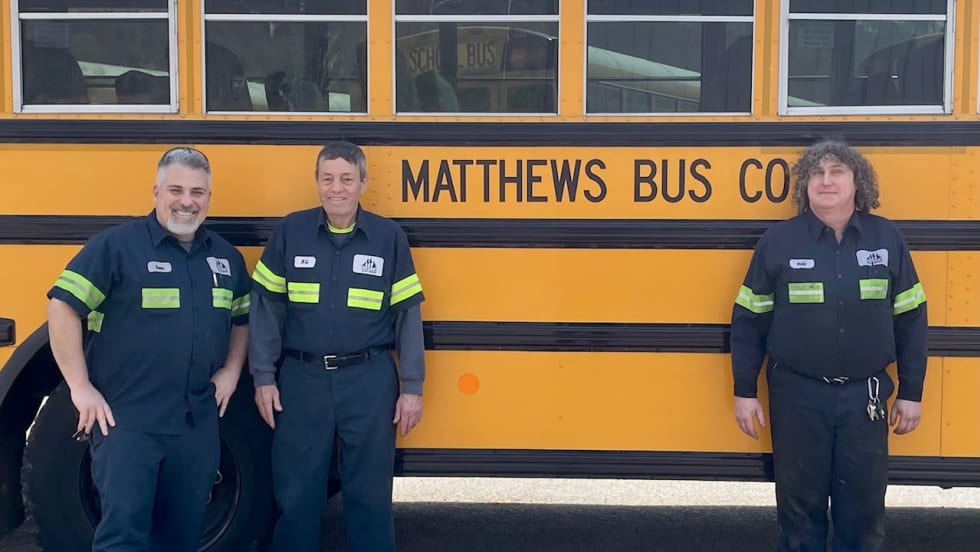
Pennsylvania School Bus Maintenance Team Praised for Dedication to Safety
Matthews Bus Company’s West Jefferson received a letter of commendation from the Pennsylvania State Police for their fleet inspections.
Read More →
From Chaos to Clarity: How School Districts Are Running Leaner Transportation Operations
Covering 38 routes on a Friday afternoon. Buses idling while routes overlap. Parents calling nonstop about late arrivals. Sound familiar? This whitepaper explores how district transportation leaders solved these exact problems — and what measurable results followed.
Read More →
2026 School Bus Fleet Vendor Directory & Buyer's Guide
Searching for the right equipment, technology, or services for your school transportation program? This industry guide brings together manufacturers and suppliers across the entire school bus market, all in one place. Download it to find the partners who can help move your operation forward.
Read More →