




Industry News
Driving instructors fix mirror problem with homemade grid BEL AIR, Md. — When Kathie Mayor couldn’t see the rear bumper in the m...

Driving instructors fix mirror problem with homemade grid
BEL AIR, Md. — When Kathie Mayor couldn’t see the rear bumper in the mirror of a Harford County Public Schools bus, she asked why. When the response was, "Well, that's the way they came from the factory," Mayor knew some adjustments would have to be made.
"I decided to adjust all the mirrors on 423 buses in the county," says Mayor, an 11-year veteran driving instructor for the district. Though the task seemed daunting, a bright idea made it feasible.
Mayor and three other Harford driving instructors — Diane Ormrod, Joyce Levee and Trish Cannaday — watched a video produced by Rosco Inc., called "Field of Vision," that shows how to paint a mirror adjustment grid on parking lots. By positioning a bus with the grid, each mirror can be lined up with certain colored dots.
Inspired by the video, Mayor designed a simplified portable grid with indoor/outdoor carpet that would allow quick and precise mirror alignment. With three of the 19-foot devices in tow, the four instructors traversed the county and set up stations at each stop where the buses could drive right up for a mirror job.
To ease the process, Mayor had the mechanics lubricate the mirrors and loosen the nuts and bolts beforehand. The project wasn’t completely free of difficulty, though. "We had some broken mirrors and people cussing," she said. But after six weeks, the team had combed the county.
"It was a big undertaking but a real positive thing," said Norm Seidel, transportation director for Harford County. Seidel says the accident rate in the district dropped from 54 in the previous year to 40 in the year after adjusting the mirrors.
For their efforts, Mayor, Ormrod, Levee and Cannaday received the Navistar Driver Training Award at the NAPT Convention in Greensboro, N.C., last November. Their grid is still used to train every new driver in the county on proper mirror adjustment.
"The one thing we always say is, 'If you don't know, don't go,'" says Mayor. "So if you see something in the mirror, you have to examine it — you don't just assume the mirror was correct."
For more information on Rosco Inc.'s "Field of Vision" video, call (800) 227-2095 or visitwww.roscomirrors.com.
Interior ads OK'd by Florida district
PALATKA, Fla. — As cash-strapped school districts across the country search for ways to reduce their budget pain, some are beginning to look at their school buses as revenue sources.
Putnam County School District in Florida has taken a giant stride in that direction by signing a contract that allows advertisements to grace the interiors of its buses. The district is the first in Florida to agree to such an arrangement.
Terry McCool, Putnam’s associate superintendent, said the contract, signed on Feb. 24, is with School Bus Advertising in Miami. Under the pact, School Bus Advertising will sign up the advertisers, collect the money and forward 25 percent of the revenue to the school district.
McCool emphasized that the school district will have control over the content of the advertising. "We have full discretion to disapprove anything that we feel is inappropriate to show in our buses," he said.
McCool estimated that the school district’s take in the first year could be as much as $35,000 but admitted that no one knows how successful the program will be. "If we have advertising in 50 percent of our buses, it would be more than worthwhile," he said.
The money will go into the District’s general account. District officials would then decide how to earmark the funds. "It could go to offset transportation needs or supplement after-school programs and field trips," he said. "It's flexible money for us."
As a bonus, Putnam County will also receive a commission for revenue generated by other Florida school districts that piggyback off its contract. "There are several other districts in the state that are interested in this program," he said. "We would get 1 percent of the gross advertising revenue if they come on board through our contract."
'Surprise' luncheon for snow heroes
NASHVILLE, Tenn. — More than 400 members of the transportation department at Metro Nashville Public Schools received a surprise luncheon on Feb. 7. The event, sponsored by Emerald Specialty Vehicles and Thomas Built Buses, was organized as a special “thank you” to drivers, monitors and other staff for the dedication to children they displayed during a January snowstorm.
The party was thrown as a surprise after employees gathered at the Tennessee State Fairgrounds in anticipation of an in-service training day. In-service days for Metro school bus drivers usually consist of extensive classroom training sessions and meetings, but on this day, there was a buffet lunch, games and prizes.
Metro bus drivers are credited with spending hours getting students home during an intense snowstorm on Jan. 16. Part of the thank you was a $6,000 Italian buffet lunch underwritten by Emerald and Thomas Built.
“I think it’s absolutely wonderful. I feel like we deserve it after that day in the snow,” said bus driver Penny Sandlin.
“Makes me feel special,” said driver Larry McMasters. “Makes me feel like I was appreciated. Most of them wouldn’t have even said anything.”
IC to introduce advanced multiplexing in 2004
WARRENVILLE, Ill. — Multiplexing seems to be a hot new industry term, but what many people don’t realize is that it’s not actually new. The industry has been multiplexing buses since 1994 with electronic engines, and many drivers have been piloting these vehicles for nearly a decade.
What is new is that manufacturers are taking it farther than they have in the past, putting more and more into vehicles and transferring knowledge among the different electronic processes (engine, ABS, transmission). Now it is being introduced into IC Corp.'s new bus chassis and body.
In 2004, IC will introduce an advanced multiplexing architecture to the school bus industry. The next generation of IC buses will utilize a system controller, which provides the logic capability necessary to make the driver’s job easier and more productive while reducing maintenance and diagnostic time for the technician, increasing up-time and providing more comfort and safety for the passenger.
In the new buses, the system controller will allow approximately eight wires to run the entire gauge cluster, which used to operate with more than 40 wires. A frame-by-frame videotape analysis of drivers revealed that with this technology IC has significantly reduced the average number of steps per stop, preventing drivers from ever taking both hands off the wheel and making all controls more accessible.
"What we doing in our next generation of buses is adding a computer processor to the chassis that will be tied into the body. While multiplexing is not new, it is new to this area," said Tom Cellitti, general manager of IC Corp.
FMCSA introduces school-charter bus safety initiative
WASHINGTON, D.C. — The Federal Motor Carrier Safety Administration (FMCSA) announced Moving Kids Safely, a nationwide effort to increase the use of safe charter bus companies for transporting students to sporting events, field trips and other extracurricular activities.
The announcement was made late last year by FMCSA Administrator Joseph Clapp, who has since retired, at a special event at West Potomac High School in Alexandria, Va.
"Even though traveling by bus is the safest form of transportation, we must not take for granted the safety records of the individual bus companies we hire to carry our children to various activities away from home and school," Clapp said.
One of the inciting factors behind the initiative occurred in June 2002, when drug use, fatigue and inattention contributed to a charter bus crash that killed the driver and four teenagers and injured dozens of others traveling to a church camp outside of Dallas. The FMCSA fined the bus company for violating federal motor carrier safety and placed it out of service for being unsafe.
Moving Kids Safely promotes the identification and use of safe bus companies for extra-curricular school activities. It encourages administrators searching for charter bus companies to find answers to important safety questions, including the following:
Does the company have authority to transport passengers in interstate commerce?
What are the company’s accident history, safety rating and insurance status?
Do company drivers possess current commercial driver’s licenses with a "passenger" endorsement and valid medical certificates?
Will the trip be completed within legal driving time limits?
The FMCSA plans to implement this initiative through its field offices, forming partnerships with organizations such as the National Association of State Directors of Pupil Transportation Services, the Pupil Transportation Safety Institute and the motorcoach industry.
For more information, go to FMCSA's Website at www.fmcsa.dot.gov. Additionally, safety data on bus companies is available through a search function by entering a company’s USDOT number or company name in FMCSA's "Safer System" at www.safersys.org.
Ohio district curtails transportation services
MOUNT HEALTHY, Ohio — School bus transportation services were curtailed for high school students at the Mount Healthy City School District, including those who attend private schools. The school district eliminated busing to save money after two operating levies were defeated by voters last year.
About 670 of the district’s 950 high school students rely on school buses. Assistant principals, teachers, the school resource officer and local police were needed to help direct traffic caused by the cuts on nearby streets and on school property.
Steve Telinda, transportation supervisor for the Mount Healthy School District, said approximately 23 bus routes were cut, and staff members lost about an hour of work per day.
However, Telinda said the district is optimistic about the return of busing for the high school. "If our levy passes — and we're having good feedback on the possibility of that — busing would be reinstated on February 10," he said.
Mount Healthy Supt. David Horine said initial attendance figures would not be an accurate reflection of the effect of canceled school bus routes.
To accommodate students and parents, the school district has been opening buildings at 7 a.m., a half-hour earlier than usual. In the afternoon, however, the district does not plan to keep students until parents can pick them up.
This isn’t the first time busing has been cut in the 3,800-student school district. Busing was also cut in 1998 after the district lost three funding levies. It was restored a month later.
The Mount Healthy district is expected to save about $40,000 through the end of this school year by cutting its transportation services.
NYC driver strike averted
NEW YORK CITY — School bus drivers and a coalition of bus companies reached a tentative contract agreement last month, eliminating the threat of a strike in the nation’s largest school district, according to the union and bus companies.
The drivers, who carry about 220,000 students to New York City Public Schools and other districts around Long Island, Westchester County and Connecticut, had been without contracts since June.
Though the new deal was not ratified by union members at press time, a spokesperson for the New York City Bus Contractors Coalition confirmed that the threat of a strike is over.
Few details of the agreement were released, but a spokesperson for Amalgamated Transit Union 1181, the driver’s union, said that the issue of raises for chaperones, which had been highly disputed, was resolved as part of the settlement.
New wheelchair lift standards increase size limits, require handrails
WASHINGTON, D.C. — Two new standards for wheelchair lifts are to go into effect on Dec. 27, 2004. The new regulations, established by the National Highway Traffic Safety Administration (NHTSA) increase the minimum requirements for platform dimensions and set maximum size limits on platform protrusions and gaps between the platform and the vehicle floor and ground. The new standards also require handrails, a threshold-warning signal and retaining barriers for lifts, along with performance standards.
"We pulled requirements that existed in other existing standards that are basically voluntary, like [from] the Society of Automotive Engineers and the Federal Transit Administration," said a safety specialist from NHTSA. "We figure manufacturers are adhering to a lot of these standards already. So we just brought these standards together into one, and we figure it’s something that everyone should be familiar with. We know that if it’s a voluntary standard, they’re not completely adhering to it, but they’re probably doing some of the things."
The rulemaking, which addresses Federal Motor Vehicle Safety Standards (FMVSS) 403 and 404, is applicable to school buses, transit buses, paratransit buses, vans, over-the-road buses and any vehicle with a wheelchair lift. NHTSA's Federal Register document states that the responsibility for lift design and performance ultimately rests with the lift manufacturer. The document says that the lift manufacturer must provide directions for installation that comply with FMVSS 403. It is the vehicle manufacturer’s responsibility to install a lift in a manner that is consistent with FMVSS 404.
"Additionally, they are responsible for making sure that only public use lifts are installed on buses, school buses and multi-purpose vehicles, other than motor homes, with a GVWR greater than or equal to 10,000 pounds," the document read.
"It's probably going to take a little bit of time before the real knowledgeable people, mainly the engineers of coach companies and of the wheelchair and lift manufacturers, have an opportunity to know what the impact is going to be," said Peter Pantuso, president and CEO of the American Bus Association. "They don't have to be in place until 2004 so there's a little bit of time to get to understand them and comply with them."
The new standards also specify weight limits needed to activate interlocks and alerts. The weight for determining when a lift must meet the public use requirements was increased to 10,000 pounds. The standard load for private use lifts also changed from 600 pounds to the manufacturer’s specified load of 400 pounds.
For a complete list of the new standards, go to www.nhtsa.dot.gov and click on Docket Management System, type in the document number 13917 and click search.
School bus service helps Guam overcome 'super typhoon'
By Mark Kelley
GUAM — On Friday, Dec. 6, 2002, weather reports for the Marianas Islands warned residents to expect Tropical Storm Pongsona to intensify and become a typhoon as it approached the island chain. Winds were expected to be 20 mph with gusts of 35 mph by the end of the weekend. Pongsona was expected to pass Guam 142 miles to the east. Island residents were told to maintain vigilance and be prepared for an increase in wind speed and rain.By Sunday, Dec. 8, the forecast called for Pongsona to pass directly over Guam with sustained winds of 132 mph and gusts of 165 mph. That morning, my wife and I heard on the radio that anyone not in a concrete structure should move to a shelter immediately. Typhoon Pongsona was slowing down and gaining strength. Around 5 p.m., the only radio station left on the air reported that Guam was taking a direct hit from a "super typhoon" with sustained winds of at least 165 mph and gusts exceeding 200 mph. I looked outside and saw an eerie orange glow in the direction of the harbor.
I ventured out of our house the next day to check the school buses at the Navy Base, and one of them had its hood ripped off, exposing the engine to the elements. The orange glow in the harbor was a fuel terminal next to the harbor with a tank on fire. The school superintendent and I drove to the high school and found that the new gym had lost part of a wall and a glass door.
As I checked the buses and facilities at Andersen Air Force Base, I noted a tour bus flipped on its side in a parking lot on the way. When I reached the Air Force base, I saw that many of the buses had roof hatches blown off and windows broken. The superintendent decided to close the schools through Jan. 7, starting winter break two weeks early.
On Dec. 10, gasoline sales were suspended due to the fire at the fuel terminal. The fire destroyed at least two multimillion-gallon tanks, and recovery efforts were threatened because workers couldn’t get to their job sites. The Navy said diesel fuel supplies were more than adequate, and a solution had to be developed for workers to be able to ride diesel vehicles to and from work.
Department of Defense Education Activity (DoDEA) school buses were the solution. We have a fleet of 35 buses, but five were being repaired at the time and unavailable. DoDEA's working agreement with the Navy provided bus drivers, dispatchers and a supervisor for the transportation service.
It was decided to have the buses make stops in all the villages starting at 6:30 a.m. One shuttle route was to move workers around the main Navy base, as well as family members needing transportation to purchase essential supplies. Two main routes and eight feeder routes from the villages with more than 65 stops and three transfer points completed the system. Five temporary parking locations were found, and drivers living near the parking locations for the buses were designated to pick up the rest of the drivers in their area to take them to the lots.
Over the next week more than 1,200 people were brought in and out of the Naval offices using school buses. The "Typhoon Transit System" operated for only one week, but nearly 38,000 miles were traveled in support of the military activities on Guam and for personnel performing recovery operations. Clearly, the school bus drivers were a critical and essential part of the initial recovery effort, and had it not been for their diligence and devotion, the effort would have been brought to a standstill. They lived up to the motto of the DoDEA student transportation office — "Safe, efficient, and reliable transportation."
Author Mark Kelley is student transportation specialist for the Department of Defense Education Activity school district in Guam.
More Management

The Most Expensive Thing You Do Before Selling a School Bus: Wait
When should you sell an aging school bus? Learn how maintenance, mileage, corrosion, specifications, and timing can affect resale value long before the auction.
Read More →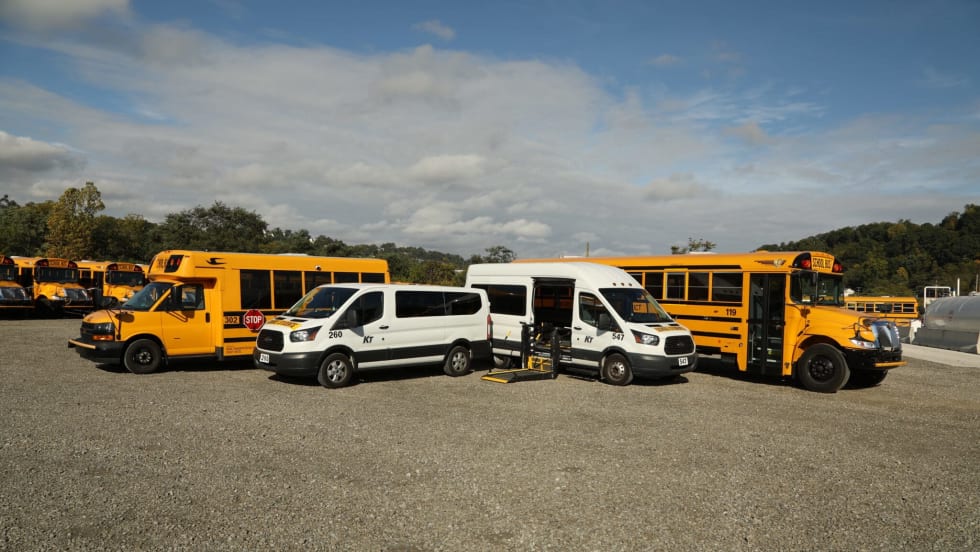
American Student Transportation Partners Acquires AJ Myers and Sons
A new deal brings a 75-year Pennsylvania student transportation provider into one of the nation’s largest private school bus contracting groups.
Read More →
What I Brought Home From SBFX: Relationships, Leadership, and Preparing What's Next
Who could lead your transportation operation tomorrow if you couldn't? Bernando Brown explores succession planning, mentorship, and preparing emerging leaders to step up.
Read More →
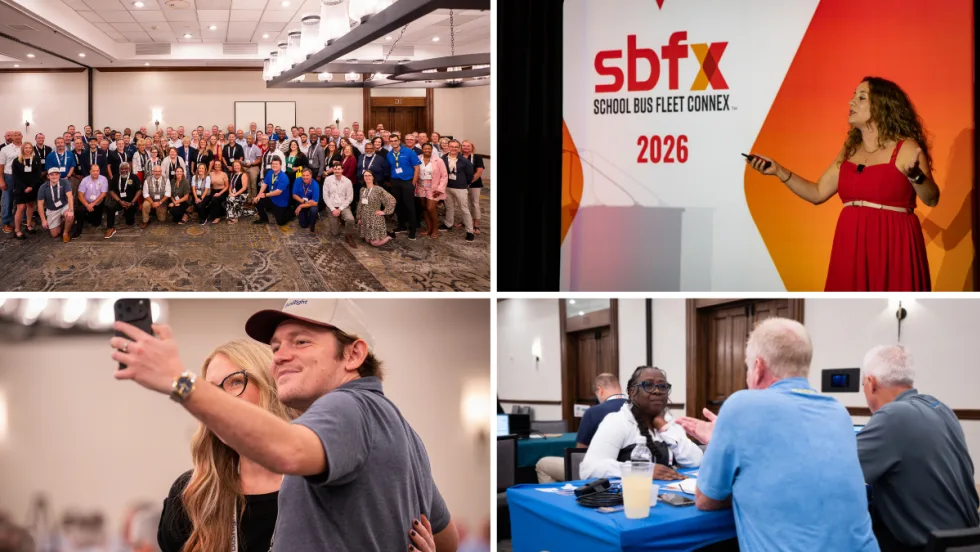
Inside School Bus Fleet ConneX 2026: Industry Leaders Connect in Scottsdale [Photos]
See highlights from SBFX 2026 in Arizona, where school bus operators and suppliers gathered for meetings, education, networking, awards, and more.
Read More →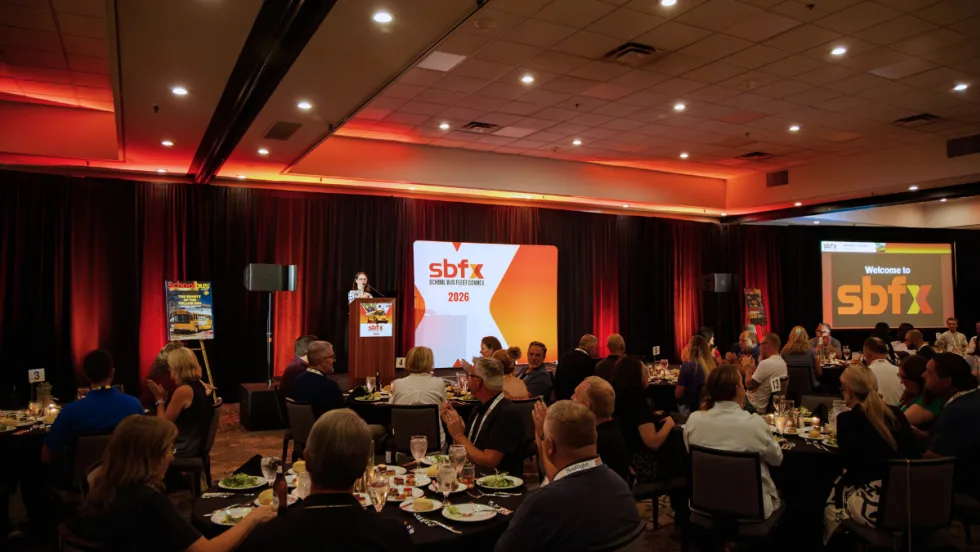
School Transportation’s Biggest Pressures and Opportunities: SBFX Attendees Weigh In
School bus operators point to rising costs, staffing, and vehicle prices as immediate pressures while identifying technology, training, and routing as opportunities for growth.
Read More →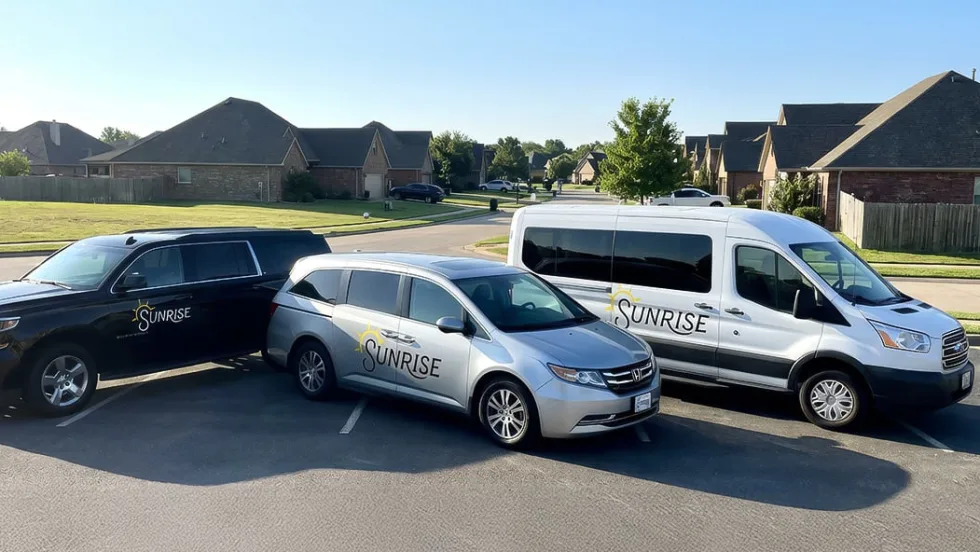
STA Acquires Sunrise Transportation
Student Transportation of America expands in Illinois and Connecticut through Sunrise's fleet of nearly 1,000 vehicles.
Read More →
EPA Opens $180M DERA Funding Round for Diesel Upgrades
The 2026 Diesel Emissions Reduction Act program seeks applications from eligible organizations to accelerate the retirement of legacy diesel vehicles.
Read More →
HopSkipDrive’s CareEngine Targets the ‘Exceptions’ in Student Transportation
The new platform works alongside districts’ existing transportation management systems to coordinate specialized rides, automate last-minute changes, and turn ride data into operational improvements.
Read More →
The Right Ride for Every Student: Navigating the New Student Transportation Ecosystem
How should districts blend school buses with small-vehicle transportation and other options? EverDriven CEO Mitch Bowling discusses safety, costs, partnerships, and strategy.
Read More →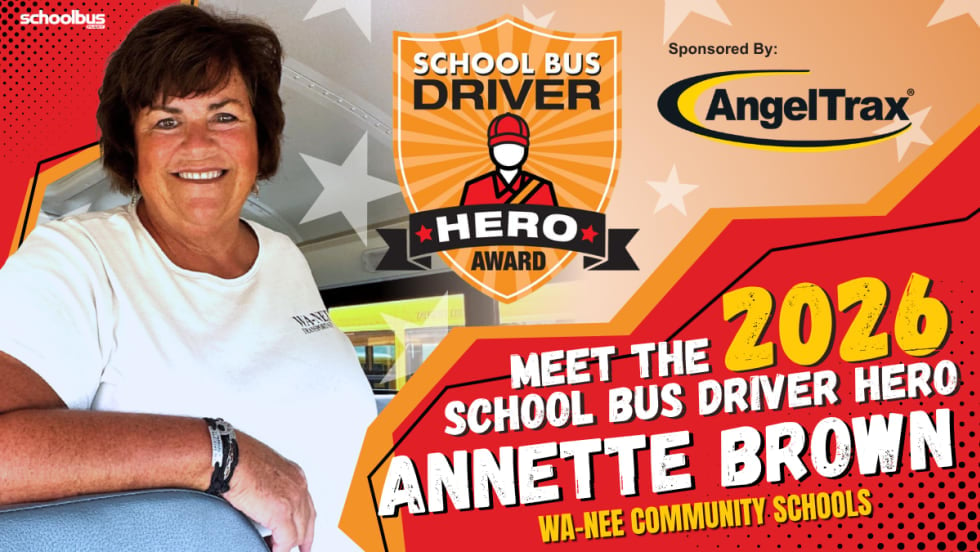
Annette Brown Always Takes the Extra Time: Meet Our 2026 School Bus Driver Hero
For more than 30 years, the Wa-Nee Community Schools driver has treated students like family, combining safety, compassion, and servant leadership to make a lasting difference on and beyond the school bus.
Read More →