




How to Spice Up Your School Bus Driver Training Menu
Training is only effective when participants are tuned in. Adding new topics, identifying current safety issues, and incorporating games and videos can add pizzazz to your presentations.
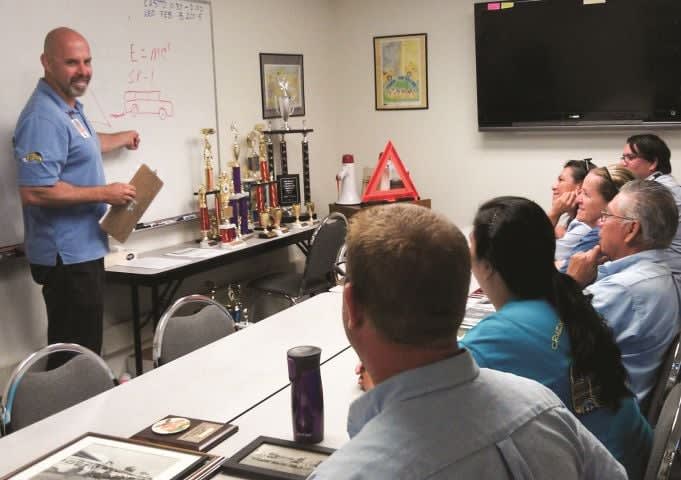
Pictured is Victor Garza, driver instructor at Newport-Mesa Unified School District (USD). Photo courtesy Newport-Mesa USD
Pictured is Victor Garza, driver instructor at Newport-Mesa Unified School District (USD). Photo courtesy Newport-Mesa USD
Presenting important information to student transportation personnel often can be a challenge for the presenter, especially when the audience consists of well-trained, experienced veterans.
As a presenter, has your attention ever been drawn to the guy sitting with folded arms, a stern expression on his face, his body language suggesting that “You can’t tell me anything I don’t already know!”?
Have you counted the ways that participants have tried to conceal their texting during a presentation?
Did you see the lady who frequently puts her head on the table, sneaking a “doze” now and then?
And what about that shop technician whose expression suggests that he is wondering, “Why do I have to be here?” (Is he aware of FMVSSs, of EPA regulations and the like?)
If you have experienced these and other distractions, you may need to add some pizzazz to your presentations.
Topic selection
Begin with topic selection. Besides driving maneuvers, proper inspection and use of equipment, first aid/CPR, loading/unloading and emergency procedures, what other information should trainers make available to employees?
Here are some examples of topics that need to be addressed from time to time during training sessions: appropriate child-specific training for students with disabilities, confidentiality, listening and communication skills, dealing with difficult parents, cultural diversity and cultural sensitivity, personal appearance, personal attitude and behavior, documentation skills, problem-solving techniques, and use of resources.
How does one know which topics to address? First, presenters must be familiar with the requirements imposed by specific regulatory authorities that apply to attendees. What is required for specific employee groups?
Other, more subjective sources are available. Here are a few examples:
• Be observant of the operation of school buses on routes, of loading/unloading procedures, of safety issues at bus stops, etc.
• Review complaints to ascertain whether or not certain issues tend to be repeated among employees.
• Review accident reports and note frequencies of specific situations that are deemed to be “preventable.”
• Engage school-based staff, special educators and other employees who may interact with or observe the transporters and may offer suggestions for improvements.
• Employ evaluation instruments and check the results.
• Keep up to date with changes in vehicle construction, technology, regulations, etc.
Presentation methods
In some cases, training content is dictated by regulations. Take Head Start, for example: 45 CR 1310 lists specific topics that must be included in annual in-service training. In some states, legal mandates, department of education policies or other regulations dictate training content. The same information has to be presented over and over. So the key to unlocking the door to successful training may not be which topics you must include, but how you present the topics.
That proved to be true for John Spilsbury, a British cartographer in the 18th century. Seeking a method to teach students how to recognize the many English counties and their relationships, Spilsbury became creative.
Circa 1760, he mounted a map of England on a board and used a fretsaw to cut around the counties so that they could be reassembled. Hence, the birth of the jigsaw puzzle. Soon others adopted this presentation method in other countries, and the jigsaw puzzle became famous.
In a similar fashion, I have developed alternatives to the usual lecture, which often is aided only by PowerPoint and videos. Specific activities engage everyone in one way or another. Space constraints prohibit my explaining each one here, but I will email them to anyone who wishes to have copies.
I use a variety of games and other activities: “Acronyms,” “The Numbers Game” and “What Do I Know?” (hidden words) are a few examples. “A Fantasy Trip” is an activity trip that requires participants in small groups to respond to all aspects of an activity trip: pre-trip planning, pre-trip inspection, loading passengers and equipment, driving techniques, emergency procedures, etc. — nearly every topic that is covered in a typical school bus driver instructional program.
Two additional presentation schemes that I have found to be effective follow. First, begin with a written examination (not to be graded). After participants complete the exam, orally review correct or preferred responses, and let each response launch discussions of related topics.

Author George Horne, shown presenting at a National Association for Pupil Transportation conference, notes that being creative with training ingredients and with presentation “can turn on those participants who may enter the session turned off.”
Finally, I use the tragedy of the August 2010 four-vehicle (including two Type D school buses) crash in Missouri and the subsequent National Transportation Safety Board investigative findings to reinforce the importance of adequate preventive maintenance, performing pre-trip inspections and applying defensive driving techniques for school bus drivers.
Resources abound
Numerous resources for training material are available if one just searches:
• state and national associations
• government agencies
• rail crossing safety organization Operation Lifesaver
• cartoons and jokes you may receive via the Internet (with edits, of course)
Also, check out YouTube! Learn to download videos that relate to your topics (student being dragged by a school bus, bullying on school buses, CPR procedures, etc.). Special software is not required for downloading, if the video is not protected. (You can email a request to me, and I will respond with the downloading formula.)
On the soapbox
Training is an essential part of safe student transportation. Topics should address specific needs, and sessions can be fun as well as informative. Being creative not only with ingredients, but also with presentation, can turn on those participants who may enter the session turned off.
As I have often stated, “Like an elegant meal, training should be nourishing, flavorful and temptingly presented.” We want our trainees to leave well-nourished and eager to return to our tables for more.
George F. Horne is president of Horne Enterprises in Metairie, Louisiana. He is a Louisiana Department of Education master instructor. He can be reached atchestnut38@aol.com.
More Management

STA Acquires Sunrise Transportation
Student Transportation of America expands in Illinois and Connecticut through Sunrise's fleet of nearly 1,000 vehicles.
Read More →
EPA Opens $180M DERA Funding Round for Diesel Upgrades
The 2026 Diesel Emissions Reduction Act program seeks applications from eligible organizations to accelerate the retirement of legacy diesel vehicles.
Read More →
HopSkipDrive’s CareEngine Targets the ‘Exceptions’ in Student Transportation
The new platform works alongside districts’ existing transportation management systems to coordinate specialized rides, automate last-minute changes, and turn ride data into operational improvements.
Read More →


The Right Ride for Every Student: Navigating the New Student Transportation Ecosystem
How should districts blend school buses with small-vehicle transportation and other options? EverDriven CEO Mitch Bowling discusses safety, costs, partnerships, and strategy.
Read More →
Annette Brown Always Takes the Extra Time: Meet Our 2026 School Bus Driver Hero
For more than 30 years, the Wa-Nee Community Schools driver has treated students like family, combining safety, compassion, and servant leadership to make a lasting difference on and beyond the school bus.
Read More →
How to Build a Better Driver Training Program
Ready to boost up your school bus instructor training? Here’s how to pick the right talent and improve recruitment, retention, and safety.
Read More →
CALSTART and Forth Combine to Form Catalyst Mobility
The new name represents a renewed vision for the nonprofit focused on advancing clean, equitable, and affordable transportation solutions that move people and goods.
Read More →
What Makes a Great School Bus Driver Trainer?
Choosing the right school bus driver trainer takes more than experience. Learn six keys to selecting and developing trainers and evaluating program effectiveness.
Read More →
School Bus Contractors Expand Through New Deals, Acquisitions & Partnerships
STA's Canadian division acquires Ontario-based G&L Stevenson Transport; Durham School Services adds a new district in California; First Student expands in New Jersey; and Minnesota Coaches rebrands and acquires Halo Transportation.
Read More →
Logan Bus Company Rolls Out AI Phone System for NYC School Bus Families
A summer pilot found that AI agents could handle most routine calls, freeing up time for customer service staff to focus on emergencies and complex family concerns.
Read More →