




How to Keep High Fuel Prices from Throttling Your Budget
You can't control the marketplace, but there are a few things you can do to keep fuel costs down, such as monitoring fuel efficiency, minimizing idling time and purchasing in volume.
No one knows where fuel prices will be in the next few months, much less in the next several years or decades. But the recent spike in oil prices has focused considerable attention on the escalating cost of fuel and how it’s affecting the country’s transportation programs. Although some school transportation managers have taken a fatalistic approach to the problem (“It doesn’t matter how much we pay for fuel, the buses still are going to run.”), others are investigating practical methods of reducing fuel costs. After all, every dollar saved reduces the chance that other components of the transportation program will be pared during the budget process. Gary Thomsen, transportation manager at Evergreen School District in Vancouver, Wash., says he’s budgeted $350,000 for fuel this year, compared to $250,000 in 1999-2000. He manages a fleet of 213 school buses that travel approximately 2 million miles per year to transport 16,000 students. A $100,000 hike in the fuel budget means a cut somewhere else, but Thomsen isn’t sure where the ax will land. One possibility is to increase the walking distance beyond a half mile, not a move that would be welcomed by the community. “We’re going to have to look at all of our options,” Thomsen says. Although Thomsen believes that he’s already running his 200-plus buses at near peak efficiency, he will push for continued improvements to ease the burden of sky-high diesel fuel prices. This article discusses some of Thomsen’s ideas as well as strategies adopted by other transportation managers across the country.
Volume discounts
Buying fuel in bulk quantities can result in significant savings. Large school districts and contractor operations can take best advantage of volume discounts because they tend to purchase greater quantities of fuel at more frequent intervals than their smaller counterparts. Thomsen says his district buys more than 250,000 gallons of diesel fuel per year. He purchases a 10,000-gallon truckload of diesel fuel through a weekly bid and estimates his savings at 15 to 20 cents per gallon compared to fleets that buy smaller allotments. “If there’s any way for smaller operations to join a co-op or at least be able to order a tankerload of fuel, maybe with a neighboring school district, they should explore that,” Thomsen says. “Some of the smaller districts in our area are taking it in the shorts, so to speak, because they just can’t order the volume that we can.” Vancouver School District, adjacent to the Evergreen School District, has been saving money for several years by purchasing fuel from a cooperative, according to Joe Schoenlein, the district’s procurement manager. The Vancouver district operates 160 school buses and purchased 207,000 gallons of diesel fuel during the 1999-2000 school year. Schoenlein says the district purchases fuel in cooperation with Clark County, the city of Vancouver, Clark Public Utilities, the Port of Vancouver, three local fire districts and two other local school districts. “We feel the cooperative approach [to buying fuel] best serves not only the school district but also the other public agencies by maximizing the size of our orders and increasing our buying power,” Schoenlein says. Bidding for the fuel is done by the purchasing division of Clark County, relieving the school district of that responsibility. “Likewise, we do bidding for other school districts and public agencies in other areas,” Schoenlein says. “We share. We think that’s the right approach in the public arena.” Like the Evergreen School District, Vancouver buys its fuel in large quantities, approximately 9,000 gallons per delivery. “We will not take short deliveries because we would sacrifice a substantial discount,” Schoenlein says. With a 10,000-gallon tank, the timing of the re-ordering can get tricky. Waiting too long increases the risk of running the tank dry. “The timeline can be tight,” Schoenlein concedes. At Crestview Local Schools in Columbiana, Ohio, bus fuel is purchased monthly through a bidding process. “This keeps everyone honest and competitive at a local level,” says Transportation Supervisor Kenneth Floor. “Usually, I get a spread of 10 cents per gallon.” The district goes through approximately 4,000 gallons per month, a much smaller volume than the Evergreen or Vancouver school systems, but Floor believes that he’s getting a good price for his fuel. “We have been doing this for the past eight years, and we believe we are saving a good deal of money,” he says.
No idle chatter
It’s estimated that a diesel engine burns half a gallon of fuel per hour idling at 600 rpm. Although that doesn’t sound like much, when you multiply that half gallon by dozens or perhaps hundreds of buses, it becomes significant, especially over several months or years. The most obvious way to minimize fuel usage is to reduce the amount of time the bus burns fuel unnecessarily. That means curtailing needless idling. “We’ll keep the warm-up time at five minutes,” Thomsen says. “Some of the drivers do their pre-trip inspection, start the bus and go off and get some coffee. We never wanted them to do that, but now we’ll really enforce it.” Richard Hansen, transportation director at School Districts 47 and 155 in Crystal Lake, Ill., says he finished 28 percent over what had been budgeted for fuel for the 1999-2000 school year. To keep his costs down this year, he is going to stress the importance of minimizing engine idle time during his driver education. As an example, he says drivers could huddle together in cold weather. “If several drivers are waiting at a school for dismissal or their next route and it’s cold outside, we ask them to congregate in one bus instead of letting all the buses run,” he says. ½ R.J. Bast, owner of Safe Line LLC, a school bus contractor in Milwaukee, echoes Hansen’s suggestions about reducing idling time, especially during the winter. “We tell our drivers not to idle their buses for too long in the morning and to turn their engines off when they’re waiting at school,” he says. But whether the drivers abide by these recommendations is another matter. “Since we operate more than 200 school buses, it’s pretty hard to track fuel usage in all of our buses,” he says. Another unknown is whether drivers are burning fuel for unauthorized trips. “They can take their bus home between routes but are not supposed to go anywhere else except their home,” Bast says. “It’s tough to monitor this policy though.”
Stay tuned for more
Buses that are poorly maintained, especially in the area of engine efficiency, will rapidly drain the dollars from your fuel fund. Brad Barker, head mechanic at Park City (Utah) School District, says he tracks the miles-per-gallon (mpg) efficiency of each bus in his fleet on a monthly basis. “I use this as a flag to tell me if a problem exists,” Barker says. “If a bus starts dropping mpg by more than 0.5 from the trendline, I start doing some checking.” Alerted to a possible problem, Barker first talks to the driver. If that conversation doesn’t explain the problem, he takes the bus on a test drive. If that, too, doesn’t produce an answer, he begins checking for the following problems:
Plugged fuel tank vents
Contaminated fuel
Plugged air filters
Lift pumps with a bad seal
Exhaust systems with a leak
Problems with the turbo boost
Out-of-adjustment automatic transmission “If all else fails, I send my bus to the engine dealer for a dyno test of horsepower,” Barker says. He also recommends buying fuel only from a trusted vendor.
Other tips and tactics
Routing should always be optimized, but when fuel prices are high, it’s more important than ever to ensure that buses are traveling the most efficient routes. Rick Temple, transportation supervisor at Cedar Springs School District in Michigan, recently restructured his routes, enabling him to park some of his fleet of 41 buses. Although the route changes were not sparked by high fuel prices, “the added benefit is that they reduced our fuel consumption,” Temple says. Fuel consumption can also be minimized by ensuring that tires are properly inflated. Underinflated tires not only wear faster, but also produce lower fuel mileage than properly inflated tires. According to tire manufacturers, underinflation by 10 psi will translate into about 0.5 percent decrease in fuel economy. That means that a bus getting 6 mpg would only get 5.97 mpg with underinflated tires. Although that doesn’t sound like much, a fleet of buses that lost 0.03 mpg over 1 million miles would burn an extra 840 gallons of diesel fuel. Taking a different approach, fleet managers might want to think about converting their buses to a non-petroleum fuel. John Farr, transportation director at Oceanside (Calif.) Unified School District, said his transportation program is partially insulated from rising diesel fuel costs because 23 of his 80 buses are powered by compressed natural gas (CNG). “Our goal is to have the entire fleet on alternative fuels by 2015,” Farr says. His reasoning is fairly obvious. “CNG is not subject to the vagaries of outside influences, such as OPEC.”
More Maintenance
The Essential Guide to School Bus Maintenance and Student Safety
Your district's buses carry students to school every day. This guide shows how predictive maintenance powered by fleet data helps keep buses reliable, drivers accountable and students safer from the first bell to the last stop.
Read More →
Kerry Brothers Grows Michigan School Bus Repair Network
The acquisition of Downriver Truck and Bus expands Kerry Brothers’ school bus maintenance footprint across southeast Michigan, adding repair capacity, diagnostic resources, and state inspection support.
Read More →
Noregon Introduces CAN Bus Diagnostic Tool, Expands JPRO Features
CAN Mentor and the latest JPRO update aim to simplify vehicle network diagnostics and improve repair efficiency for technicians of all experience levels.
Read More →
Cummins on Smarter, Simpler Engine Innovation
Cummins discusses its first-ever gasoline engine for school buses, EPA 2027, and why bus fleets still want durable, simpler internal combustion options.
Read More →
Report: 72% of Diesel School Buses Now Use Advanced Low-Emission Engines
New data shows advanced low-emission diesel technology continues expanding across school bus fleets, even as electric bus adoption gains momentum.
Read More →
Vampire Tools' CAIMAN 7.5-Inch Multi-Purpose Screw Extractor Long-Nose Pliers with Crimper
Vampire Tools introduced the VAMPLIERS Caiman 7.5-inch multi-purpose pliers, combining screw extraction, cutting, crimping, and gripping functions into a single tool designed for fleet maintenance professionals.
Read More →
How Advanced Diagnostics Helps Bus Fleets Stay Ahead of Repairs
Chat with Noregon’s Kevin Smallhorn at ACT Expo about bus diagnostic tools, telematics integration, CNG maintenance support, and strategies to help reduce downtime and improve uptime.
Read More →
How School Bus Fleets are Getting Ahead of Breakdowns
Don’t let bus downtime wear you down. Here’s how bus operators are shifting from manual processes to AI-powered, data-driven maintenance systems for improved reliability and safety.
Read More →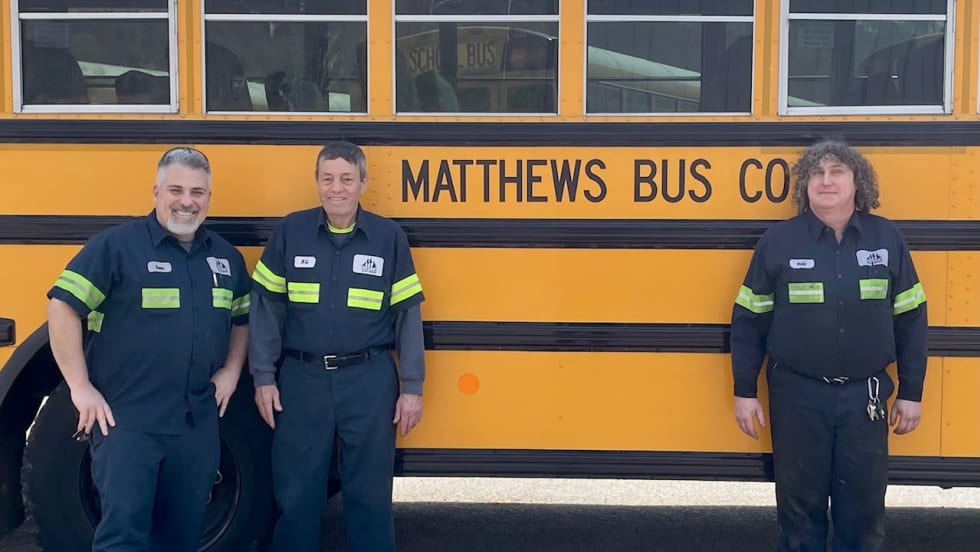
Pennsylvania School Bus Maintenance Team Praised for Dedication to Safety
Matthews Bus Company’s West Jefferson received a letter of commendation from the Pennsylvania State Police for their fleet inspections.
Read More →
From Chaos to Clarity: How School Districts Are Running Leaner Transportation Operations
Covering 38 routes on a Friday afternoon. Buses idling while routes overlap. Parents calling nonstop about late arrivals. Sound familiar? This whitepaper explores how district transportation leaders solved these exact problems — and what measurable results followed.
Read More →