




Drilling Down on Fleet Maintenance: Part 2 of 3
In the July issue of SBF, I discussed what is involved with maintaining a fleet of vehicles and introduced you to 10 sources that a...
In the July issue of SBF, I discussed what is involved with maintaining a fleet of vehicles and introduced you to 10 sources that are used to identify how work is generated.
In this installment, I want to move forward by illustrating how to figure labor costs, explain desirable and undesirable work sources and get into the essentials of data gathering.
Accurate hourly shop rate
In order to understand how to figure actual repair costs, you have to know your average hourly labor rate. If you do not understand all involved in computing this, your business manager could be a good source for help.
Actual hourly shop rate includes all benefits given or paid to each employee in addition to the hourly wage. This combination of costs gives you a more accurate measure of actual hourly rate.
Total the hourly wages of all vehicle maintenance personnel (including clerical staff and shop foreman), double that figure (to account for insurance and other benefits), calculate the average and then add 10 percent to cover unknowns. This is the rate you should use for all repair work.
When using this rate, you learn fast what is affordable to perform in your shop and what is more economical to purchase from an outside vendor.
Some shops like to perform engine rebuilds or transmission rebuilds in-house and stock spare engines for quick replacements, but if you arrange with the OEM engine company or factory authorized rebuilder to stock these items, you gain three things: One, you gain extra manpower for other duties in the shop. Two, your parts expenses may be reduced. And three, you now receive a warranty with each engine rebuild.
This may not apply to all circumstances. I have heard it said and at one time said myself that, “We can do that a lot cheaper ourselves.” When your actual hourly rate is factored in, you may be surprised to the contrary.
Desirable or not
Of the 10 work sources I listed in the last installment, some are desirable and some are not. Regardless, all need to be recorded accurately.
When completing your paperwork, organize your forms — either written or electronic — so the source of work has a spot to be recorded. I strongly recommend the electronic format for record keeping, and most canned programs come with report building capability built in.
Work generated by accident, road call and drive-in are least desirable. They may indicate that components are failing due to lack of inspection, lubrication, adjustment, replacement, etc., or perhaps a driver failed to properly record and report a problem found on a pre-trip or post-trip inspection. These work sources may also indicate a failure of the technician to act on a Vehicle Condition Report (VCR).
Accidents will always happen, but a high rate of occurrence may indicate that further driver training needs to take place. Accidents should never be caused by a failed component. If this happens, your preventive maintenance (PM) inspection program is at fault and you should be prepared for legal actions against you.
Accidents are a source of unnecessary vehicle down time. This takes technicians out of the shop and out of the normal routine, and it causes money to be spent that could be utilized elsewhere.
What is the normal routine? Or, what should the normal routine be? Performing PM and scheduled repairs from the sources of VCR or inspection are what I consider to be normal and are the most desirable.
A higher percentage of these desirable sources indicates that your personnel are performing the job they have been hired to do, and your expenses will be much less. Those desirable sources should account for 75 percent or more of the repair work in a properly operating maintenance program.
Gathering data
As I mentioned earlier, data gathering begins with the source. Source data should be recorded in two methods: by the operator of the vehicle and by the technician on the work order. The only exception to this is when a problem is discovered during a PM inspection and the operator had no knowledge of it.
As an example, let’s say that while a technician is performing a PM inspection on a bus, he finds a worn driveline support bearing. This additional work would then be classified under the “inspection” work source classification.
When a driver notices a deficiency, it should be recorded on a VCR form or some other document if the driver witnesses it either while operating the vehicle or during a pre-trip or post-trip inspection.
This form then follows specific channels. It may go to a clerical person but should eventually end up in the hands of the shop foreman or lead technician — and the sooner the better. This information needs to be included in the final repair record, either by attaching the original form to a shop repair order or by transcribing the original information from the driver onto a new form used by shop personnel.
This leads us to the work order form. The work order should include specific data about the work performed, the vehicle, parts and labor, and findings from the technician during the inspection.
In the data recording process on the work order, it is essential to record what I call the Three Cs. There are actually four, but the fourth is usually not recorded but rather an action that takes place.
The Three Cs
The Three Cs are complaint, cause and correction. The fourth is coverage, meaning that before any repairs begin, the vehicle warranty is checked to see if coverage exists.
1. The “complaint” comes from the driver’s VCR form. Although this can be a verbal complaint to a technician, it is best to have all complaints written down by the person who first notices something isn’t right.
If one of our drivers brings in a bus and it can be repaired while the driver waits, I ask the technician to go ahead and make the repair but have the driver fill out the complaint on a VCR form while the repair is being made. When the repair is completed, the technician will have first-person documentation to attach to the work order or enter into the computer as it was spelled out by the driver.
This provides you with a legal standing in case an incident occurs later on relating to the original issue. Having a first-person record also helps the technician diagnose the complaint.
2. The “cause” is determined by the technician in most cases and is recorded on the work order. This gives you direction in which to go to prevent it from happening again. Some things just happen and cannot be prevented, but it is still important to record why it happened even if it just says, “Light burned out.”
You may think that this is insignificant to record, but if you have multiple lights burning out on a vehicle within a short time frame, you might want to look at the alternator voltage output or another electrical issue. Too high a voltage output will cause lights to start burning out.
3. The “correction” may be a simple explanation or it may be two or three paragraphs. All work performed — regardless of how insignificant something may seem — should be recorded.
I tell my technicians not to write a book, but give an explanation in enough detail so if it was read by an attorney in a court of law he would be able to have a clear view of what was actually done without raising a lot of questions. I recommend abbreviating words as much as possible.
Building reports
Electronic maintenance programs can organize data and simplify report building. I like to build custom reports by transferring my stored data into a spreadsheet.
The necessary data to gather include vehicle ID number, repair date, meter readings, job source, job code, technician ID, labor time, part number, part description, part quantity and part cost. This gives enough information to build reports on cost, parts usage, labor hours per job, etc.
I also build custom reports that reflect specific tire data, which tells me which tires work best for my fleet. You can also track specific parts this way to see what brands work best for your application. Report building with an electronic format has endless possibilities.
In the next installment, I will get into some actual data analysis.
Brad Barker is shop manager at Park City (Utah) School District and a member of SBF’s editorial advisory board.
More Maintenance

Noregon Introduces CAN Bus Diagnostic Tool, Expands JPRO Features
CAN Mentor and the latest JPRO update aim to simplify vehicle network diagnostics and improve repair efficiency for technicians of all experience levels.
Read More →
Cummins on Smarter, Simpler Engine Innovation
Cummins discusses its first-ever gasoline engine for school buses, EPA 2027, and why bus fleets still want durable, simpler internal combustion options.
Read More →
Report: 72% of Diesel School Buses Now Use Advanced Low-Emission Engines
New data shows advanced low-emission diesel technology continues expanding across school bus fleets, even as electric bus adoption gains momentum.
Read More →
Vampire Tools' CAIMAN 7.5-Inch Multi-Purpose Screw Extractor Long-Nose Pliers with Crimper
Vampire Tools introduced the VAMPLIERS Caiman 7.5-inch multi-purpose pliers, combining screw extraction, cutting, crimping, and gripping functions into a single tool designed for fleet maintenance professionals.
Read More →
How Advanced Diagnostics Helps Bus Fleets Stay Ahead of Repairs
Chat with Noregon’s Kevin Smallhorn at ACT Expo about bus diagnostic tools, telematics integration, CNG maintenance support, and strategies to help reduce downtime and improve uptime.
Read More →
How School Bus Fleets are Getting Ahead of Breakdowns
Don’t let bus downtime wear you down. Here’s how bus operators are shifting from manual processes to AI-powered, data-driven maintenance systems for improved reliability and safety.
Read More →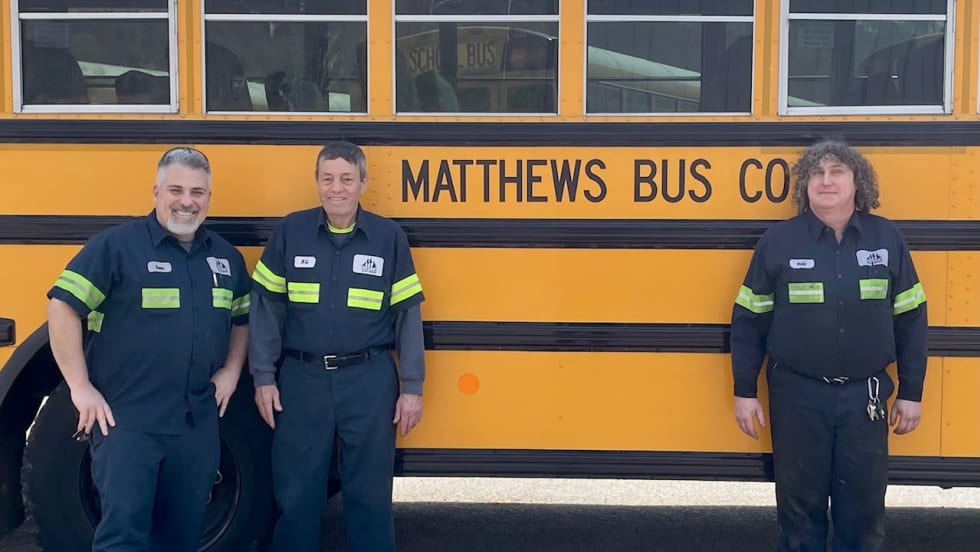
Pennsylvania School Bus Maintenance Team Praised for Dedication to Safety
Matthews Bus Company’s West Jefferson received a letter of commendation from the Pennsylvania State Police for their fleet inspections.
Read More →
From Chaos to Clarity: How School Districts Are Running Leaner Transportation Operations
Covering 38 routes on a Friday afternoon. Buses idling while routes overlap. Parents calling nonstop about late arrivals. Sound familiar? This whitepaper explores how district transportation leaders solved these exact problems — and what measurable results followed.
Read More →
2026 School Bus Fleet Vendor Directory & Buyer's Guide
Searching for the right equipment, technology, or services for your school transportation program? This industry guide brings together manufacturers and suppliers across the entire school bus market, all in one place. Download it to find the partners who can help move your operation forward.
Read More →
2026 School Bus Maintenance Survey
What top challenges are school bus maintenance teams facing in 2026? Explore new trends from School Bus Fleet’s annual maintenance survey covering fleet composition and age, fuel types, used vs. new purchasing patterns, technician pay and certifications, and the impact of the driver shortage. Survey sponsor: Dayton Parts.
Read More →