




6 Low-Cost Ways to Boost Driver Recruitment
With a critical need for more school bus drivers, a New York district implemented these recruiting ideas with minimal investment but a sizable return in applicants.
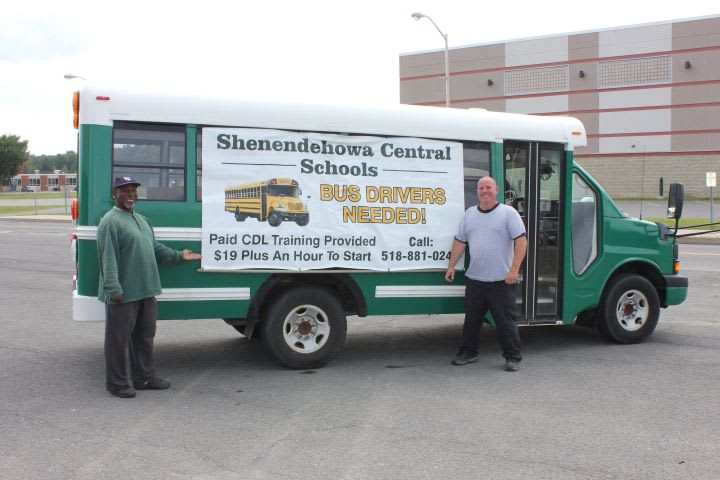
Drivers Hershell Allen Jr. (left) and Donald Barnes Jr. show off Shenendehowa’s “advertisement bus.”
Drivers Hershell Allen Jr. (left) and Donald Barnes Jr. show off Shenendehowa’s “advertisement bus.”
As with many other operations across the country, school bus driver shortage has been a critical issue for the past three years here at Shenendehowa Central School District in New York.
I have researched driver shortage extensively, looking for solutions to this very perplexing problem. For me, as director of transportation, solutions that my team and I come up with must not result in a huge outlay of dollars.
Offering sign-up bonuses is not something that would work for our operation; I needed to find solutions that would require minimal investment but have a huge payout.
Substitutes Needed
Shenendehowa’s need for substitute school bus drivers became acute several years ago. When I took the helm as director of transportation in 2014, I was shocked to learn that we had only seven substitute drivers on hand when we finished our August bidding and geared up for the start of the school year.
The Shenendehowa transportation department has 195 school bus drivers on its rolls. To staff our daily home-to-school/school-to-home routes, we need 179 permanent drivers. To support this number of permanent drivers, we calculated a need for 30 substitute drivers. This number is necessary because we average about 15 drivers out on any single day, and we also average about 15 sports trips daily during the fall and spring sports seasons.
Working with only seven substitute school bus drivers created a nightmare scenario for our dispatchers, as well as a lot of friction between the athletic department and our operation, since we were not able to meet the athletic department’s needs. We had to contract out many one-way sports team drop-offs, which is a very costly way of conducting business.
The applicants told us that the advertisement bus was something they noticed every day, and it got them thinking about the profession. Eventually, it caused them to stop by and inquire about the position.
Stepping Up Efforts
Finding, recruiting, hiring, training, and maintaining quality school bus drivers requires a focused, concerted, and ongoing effort at the transportation department level. It also requires support from the district administration.
As the director of transportation for Shenendehowa, I quickly realized that we needed to up our game in order to entice prospective school bus driver applicants. The traditional model of advertising in newspapers had not worked for us at all.
There are numerous reasons why transportation operations continue to experience school bus driver shortages. These reasons vary from region to region, and I will not delve into what I believe the reasons are. Instead, I will share strategies that we’ve employed to attract quality people to at least come in for an application.
Here’s how our efforts unfolded, in six parts.
1. Getting the Word Out With a Bus Banner
The first strategy we employed was to use an older Type A model as an “advertisement bus.” We had a “help wanted” banner created for $580 and attached it to the side of the bus.
I directed our team to take the bus with the banner and park it at our local Walmart. This business is located on one of the busiest roads in our district, and we parked the bus there for a week at a time.
I then had the team park the bus in front of our school campus and two other locations that we felt were good places to communicate our needs to the motoring public. This tactic has worked for us to a certain degree.
During our interviews with potential drivers, we learned that the bus with the banner was 100% better than newspaper advertisements. The applicants told us that the advertisement bus was something they noticed every day, and it got them thinking about the profession. Eventually, it caused them to stop by and inquire about the position.
Once the effect of the bus/banner combo started to wear off, I had our body shop repaint the bus with a different color scheme. We opted for green and white, which are Shenendehowa Central School District’s colors. This strategy worked for about a year and a half, but again we noticed a drop in foot traffic of potential applicants.
As another low-cost approach to getting the word out, we placed flyers with tear-off telephone numbers at businesses throughout the district.
2. Holding School Bus Test Drives
Another strategy we implemented was inviting community members to test-drive a school bus. This is a great way to drum up interest in the job while letting people get a feel for what it’s like behind the wheel of a bus.
In July 2015, we held our first “Come Drive the Bus” event on the Shenendehowa Central School District main campus. For this event, we spend about $352 in labor and minimal operating costs, with five buses running back and forth over a 3-mile course for about three hours.
The event has shown more promise than just using the advertisement bus with the banner. We’ve been inviting prospective applicants to “Come Drive the Bus” every July since 2015.
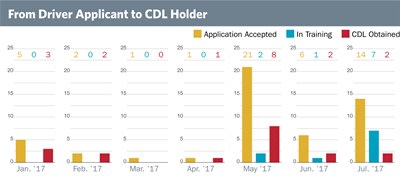
This chart shows how many driver applicants Shenendehowa has accepted in recent months, followed by how many are still in training or have obtained a CDL. The district has found that it typically takes at least 2.5 accepted applicants to get one CDL holder.
3. Promoting the Job in the Media
This past May, I decided that we needed to up our game even more. My team and I brainstormed different strategies to increase foot traffic of prospective applicants.
I sat down with my secretary, Judy Mayfield, and we drafted an op-ed letter extolling the benefits of driving a school bus. We highlighted three drivers, asking them to tell their stories about why they chose to do this job and why they like it.
I then asked our district public affairs (PA) officer to shop the op-ed piece around to see if the local print and television media would pick it up. The PA officer asked us to chop our 1,200-word op-ed to 800 words, and then again down to 500 words in order for it to meet media guidelines.
One of the local print outlets picked up on it and published a story. We also had one television station visit our school bus compound to do a live piece.
4. Utilizing Social Media, Email Blasts
To continue this momentum, I asked our PA officer to put our original 1,200-word op-ed on our district’s website, Twitter, and Facebook. I also asked her to create an email blast of this letter to send to every community member who had an email address in the district database.
The email blast, in addition to the story in the print media and on television, netted us over 30 prospective applicants from May 8 to June 23 this year. From the 30 interviews conducted, we accepted 24 applicants. Of the 24 applicants, we currently have eight undergoing training, and we are waiting for the rest of them to get their permits.
Not wanting to rest on our laurels, we again tapped into the district’s social media platforms and sent another email blast about our third annual “Come Drive the Bus” event.
5. Producing a Recruitment Video
As part of our campaign to attract school bus drivers, we hired a videographer to put together a three-minute video promoting the school transportation profession and its benefits. At $3,800, this was a bigger investment than our other initiatives, but it’s a one-time cost.
In the video, Shenendehowa school bus drivers and other transportation team members describe why they like working for the department. We also note the pay range for our drivers and other details of the job.
The video can be shared via social media. Check it out here.
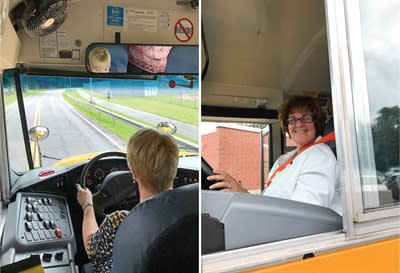
Shenendehowa invited New York Assemblywoman Mary Beth Walsh (left) and Sen. Kathleen Marchione to a “Come Drive the Bus” event, which generated media interest.
6. Inviting Officials to Highlight the Issue
As another step in our recruitment efforts, we reached out to our local New York State Assembly representative and our state senator. We invited them to join us for our third annual “Come Drive the Bus” event with the promise that they could drive a bus on our campus.
Assemblywoman Mary Beth Walsh and Sen. Kathleen Marchione both agreed to come. Soon, television and print media caught wind of our event and the fact that the lawmakers were going to be present. One of the television stations ran news of the event on the ticker banner at the bottom of their newscast.
As mentioned earlier, the email blast and the use of social media also generated much interest in the event. Our department received 47 calls from people who said they would like to attend.

Alfred Karam is director of transportation for Shenendehowa Central School District in Clifton Park, New York. He can be reached at karaalfr@shenet.org.
Results of Recruiting Efforts
On July 11, the day of our latest “Come Drive the Bus” event, 37 people showed up to participate. Of those 37 participants, 30 came back to our office and asked for applications. Three of the applicants were interviewed the very next day, four more were scheduled for the day after that, and we continue to schedule more applicants for interviews.
We hope to be able to retain at least 15 of the 30 applicants, and to train and license them by mid-to-late September. This would enable us to meet our stated goal of having 30 substitute school bus drivers to support our 179 board-appointed permanent drivers.
After expending all of these efforts and applying the strategies over the past couple of years, we are well on our way to achieving our goal.
The lesson for me and our team is to not rest on our laurels, but to continue our efforts with laser focus, looking for the best applicants we can find to keep our driver pool healthy.
More Management
STA Acquires Sunrise Transportation
Student Transportation of America expands in Illinois and Connecticut through Sunrise's fleet of nearly 1,000 vehicles.
Read More →
EPA Opens $180M DERA Funding Round for Diesel Upgrades
The 2026 Diesel Emissions Reduction Act program seeks applications from eligible organizations to accelerate the retirement of legacy diesel vehicles.
Read More →
HopSkipDrive’s CareEngine Targets the ‘Exceptions’ in Student Transportation
The new platform works alongside districts’ existing transportation management systems to coordinate specialized rides, automate last-minute changes, and turn ride data into operational improvements.
Read More →


The Right Ride for Every Student: Navigating the New Student Transportation Ecosystem
How should districts blend school buses with small-vehicle transportation and other options? EverDriven CEO Mitch Bowling discusses safety, costs, partnerships, and strategy.
Read More →
Annette Brown Always Takes the Extra Time: Meet Our 2026 School Bus Driver Hero
For more than 30 years, the Wa-Nee Community Schools driver has treated students like family, combining safety, compassion, and servant leadership to make a lasting difference on and beyond the school bus.
Read More →
How to Build a Better Driver Training Program
Ready to boost up your school bus instructor training? Here’s how to pick the right talent and improve recruitment, retention, and safety.
Read More →
CALSTART and Forth Combine to Form Catalyst Mobility
The new name represents a renewed vision for the nonprofit focused on advancing clean, equitable, and affordable transportation solutions that move people and goods.
Read More →
What Makes a Great School Bus Driver Trainer?
Choosing the right school bus driver trainer takes more than experience. Learn six keys to selecting and developing trainers and evaluating program effectiveness.
Read More →
School Bus Contractors Expand Through New Deals, Acquisitions & Partnerships
STA's Canadian division acquires Ontario-based G&L Stevenson Transport; Durham School Services adds a new district in California; First Student expands in New Jersey; and Minnesota Coaches rebrands and acquires Halo Transportation.
Read More →
Logan Bus Company Rolls Out AI Phone System for NYC School Bus Families
A summer pilot found that AI agents could handle most routine calls, freeing up time for customer service staff to focus on emergencies and complex family concerns.
Read More →