SBF 70 years logo
MenuMENU
SearchSEARCH

Creating guidelines requires strong commitment (and coffee)

California officials have often been asked questions regarding school transportation to which there were no concrete answers and no “best practices” manual to which they could refer.

by Alexandra H. Robinson
June 1, 1999
5 min to read


What is the best practice for securing wheelchairs? Should drivers transport medication on school buses? How long is too long for a child with a disability to ride a bus? How do I write specifications for a vehicle transporting students with medical needs? These are just some of the questions that prompted the California Association of School Transportation Officials (CASTO) to pursue the development of statewide guidelines for transporting students with disabilities. With more than 1,000 school districts — 85 percent of which operate 10 buses or fewer — California officials have often been asked questions regarding school transportation to which there were no concrete answers and no “best practices” manual to which they could refer.

First, find the funding
CASTO began this process of guideline development with the securement of a $54,000 grant from the Fiscal Crisis Management Assistance Team (FCMAT), a resource group put into place by the California legislature to assist districts through management studies and professional development. Although FCMAT may be unique to California, there are similar funding sources in every state that could provide other transportation providers access to such monies. The grant specified that a manual be developed to assist every transportation department in California. A two-year production timeline was established as well as an agreement on CASTO’s part to distribute the manual through at least six regional meetings throughout the state. The CASTO process continued by appointing a core group or steering committee to direct the project. A chairperson and three other directors of transportation became this steering committee, and it was now our job to create the full committee. The steering committee immediately secured a technical writer to attend all meetings and chronicle our discussions. We thought it best to leave the draft writing to an unbiased party who could also maintain consistency in writing style.

Ad Loading...

Then, appoint a committee
It seemed obvious to us that the full committee would need to represent the diversity of the state as well as those with whom collaboration was essential. In addition to the steering committee it was determined that the following identified positions were needed:

  • Parent

  • Special-education/curriculum specialist

  • School bus manufacturer

  • Private contractor

Ad Loading...
  • Department of Education representative

  • Risk manager

  • Certified driver instructor

  • Maintenance/operations/transportation director

  • Small school association superintendent

Ad Loading...


The representatives above were based in California, so it was also determined that six technical advisers, or “experts in their field,” from around the country should be part of the review team. The advisers appointed were an attorney, a state compliance representative, a physical therapist, a wheelchair expert, a car seat specialist and a journalist/editor. All of us who committed our time to this project didn’t anticipate the learning curve we would soon experience. It was quickly apparent that the “best practices” in transporting students with disabilities involve many non-transportation issues. For example, many transporters feared that the best practices could create “standards” to which they could be held liable, even though the guidelines were not state law. Consensus within our diverse group was not always easy to obtain, and the topic of “guide compliance” was often discussed. However, the committee did reach the following consensus: Best practices for the safety of students transported are necessary and should be documented and put into local operating procedure. Ignoring known safe practices is a decision that school districts and transportation providers make in a vacuum. Long-term liability should be considered. Brainstorming played the largest role in outlining topics to be covered in the manual. These were narrowed down and combined into subsections over several meetings. Once the topics and table of contents were finalized, work began on analyzing and summarizing each subject. Heated discussions between large and small districts, as well as between transportation and other instructional personnel, or a parent and a risk manager, always ended in a stronger understanding and appreciation for the other team members.

You’ll need a title, too
Reaching consensus on the title of the manual required two meetings! It was a new concept for many of us to work with printing companies. (The cost of duplication isn’t cheap!) The committee from the start knew that this was not going to be another three-ring binder manual that collected dust on the shelves of transportation and special-education directors around the state. Rather, this should be a working manual — portable, colorful and concise enough to use as a resource at every Individualized Education Program (IEP) or staff meeting. Since its inception, the steering committee has met monthly and the full committee has met every other month, often working through meals and bedtimes. There is finally a fourth “final draft,” and the excitement is building. "Access and Mobility" will be published by CASTO in August. Regional meetings throughout the state will begin in October. Here are the basic premises:


  • A clear understanding of the law as it applies to students with disabilities is necessary.

  • The students needs should be the driving force behind the type of transportation provided.

  • Parental involvement is not just suggested; it is required by the Individuals with Disabilities Education Act (IDEA).

Ad Loading...
  • Communication and collaboration among special-education and transportation providers should be constant.

  • Vehicles should be configured to appropriately serve the student population transported.

  • Frequent and meaningful pre-training and in-service should be an operational priority.

  • Procedures for safe transportation including emergencies, evacuation and operational efficiency should be written and referenced constantly. It is our hope that transporters, parents and educators in California will now have more of the basic knowledge in order to make smart and safe decisions.


    Alexandra Robinson is transportation director for San Diego Unified School District and chairperson of the committee that developed "Access and Mobility," California's guidelines for transporting students with disabilities.

Subscribe to Our Newsletter

More Special Needs Transportation

school bus driver
SponsoredMarch 2, 2026

7 Key Criteria for Choosing a School Bus Fleet Technology Partner

Selecting a fleet technology partner can be complex, especially with evolving operational demands and limited resources. This white paper outlines seven key criteria to help school transportation leaders evaluate options and align technology with their needs. It offers a practical framework to support more informed decision-making.

Read More →
Infographic showing a yellow school bus with a wheelchair lift and charts highlighting 2026 special-needs transportation statistics, including ridership changes and driver pay comparisons.
SponsoredFebruary 27, 2026

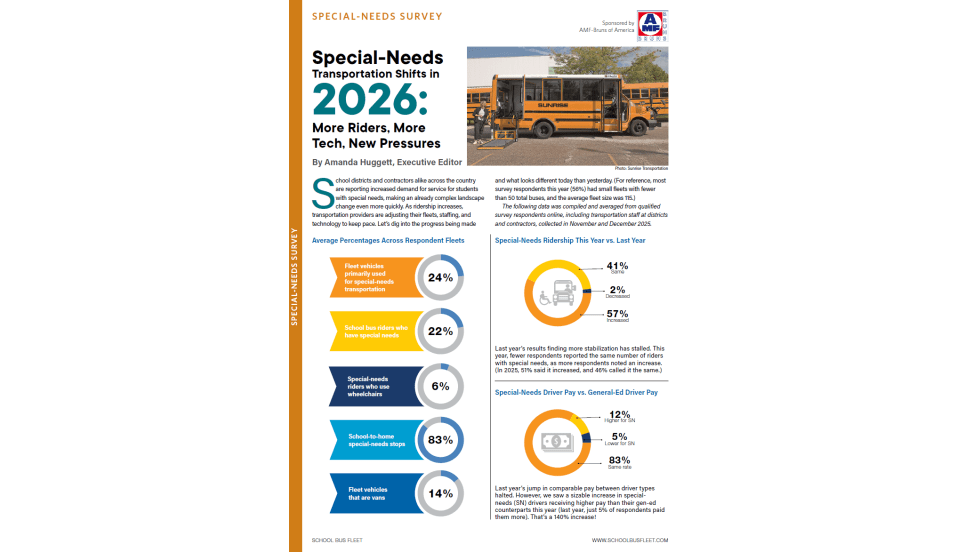
2026 Special-Needs Transportation Survey

What’s changing in special-needs transportation? This year, student transportation operators report a rising need, easing driver shortages, growing tech adoption, and evolving challenges. Sponsored by AMF Bruns of America.

Read More →
the route thumbnail with the SBF logo and a photo of Brianna Pauwee
Sponsoredby Amanda HuggettFebruary 13, 2026

The Lived-Experience Gap in Mobility Tech: An Expert Take on Safe Student Transportation

Brianna Pauwee, a product application specialist at AMF Bruns of America and a wheelchair user, drops in to The Route to share practical securement and training insights, plus the story behind the new “Beyond Mobility” podcast. The Route is sponsored by IC Bus.

Read More →
Ad Loading...
The Route thumbnail with school bus fleet logo
SponsoredFebruary 11, 2026

What Transportation Gets Wrong About Wheelchair Securement (And How to Fix It)

Brianna Pauwee, product application specialist at AMF Bruns of America and a wheelchair user shares practical securement and training insights, plus why she launched the “Beyond Mobility” podcast. The Route is sponsored by IC Bus.

Read More →
Composite image showing school transportation professionals participating in special-needs training sessions, including hands-on demonstrations and classroom instruction, with a school bus visible in

Keeping Up With Special-Needs Training & Standards: What Districts Need To Know in 2026

As the number of students with disabilities and IEPs rises nationwide, transportation teams face growing pressure to stay compliant, confident, and trained. Explore what’s evolving and how to stay on top of it all.

Read More →
School Transportation
SponsoredFebruary 9, 2026

How Supplemental Transportation Helps Close Driver Gaps

Ongoing driver shortages nationwide are forcing tough transportation decisions. See how districts are using supplemental transportation to maintain coverage for high-needs students.

Read More →
Ad Loading...
driver of the year award logo against a dark blue backdrop with text that says "Nominations Now Open" and the AMF Bruns and School Bus Fleet logos
Special Needs Transportationby StaffFebruary 5, 2026

Announcing 2026 Special-Needs Driver of the Year Nominations

Honoring the exemplary accomplishments of school bus drivers transporting students with disabilities, AMF Bruns of America’s ninth annual National Special-Needs School Bus Driver of the Year Award series is open for nominations!

Read More →
Graphic showing a school bus with a wheelchair lift deployed and the headline “Special Needs Ridership Rises & More Trends,” highlighting 2026 School Bus Fleet special-needs survey results.

Special-Needs Transportation Shifts in 2026: More Riders, More Tech, New Pressures [Survey Report]

What’s changing in special-needs transportation? Operators report a rising need, easing driver shortages, growing tech adoption, and emerging challenges. Details here! Survey sponsor: AMF Bruns of America.

Read More →
An aerial photograph of Jersey City, New Jersey, during the day.

New Jersey Legislature Approves Special Education Transportation Task Force

The state moves to review special education transportation policies following safety concerns raised by families and advocates.

Read More →
Ad Loading...
SponsoredJanuary 19, 2026

Fleet Software ROI: Transforming School Transportation

Keeping buses safe, reliable, and on schedule requires more than manual processes. This eBook explores how modern fleet software supports school transportation teams with automated maintenance scheduling, smarter video safety tools, and integrated data systems. Discover practical ways fleets are reducing breakdowns, improving safety, and saving valuable staff time.

Read More →