




Wheelchair Lifts Boast High-Tech Innovations
Today’s wheelchair lift manufacturers are in tune with pupil transporters’ mission to ensure the safety of students, particularly if the children...
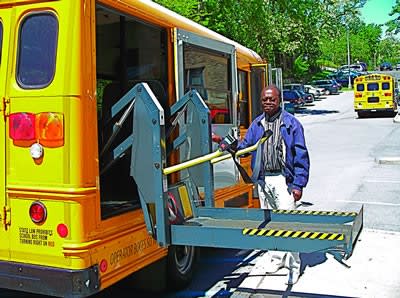
Photo by Sam Brown
Today’s wheelchair lift manufacturers are in tune with pupil transporters’ mission to ensure the safety of students, particularly if the children have special needs.
With such components as folding platforms, hydraulic rollstops, handrails and restraint belts, their lifts increase driver visibility and passenger security to provide a comfortable ride for everyone on the bus.
The following outlines product specifi cations from wheelchair lifts designed by The Braun Corp., Maxon Mobility and Ricon Corp.
Vista-2 Series
The Braun Corp.
Winamac, Ind.
www.braunability.com/commercial
Contact: Greg Cook, VP sales and mktg.
The Braun Corp.'s Vista-2 Series is equipped with a stacking platform that offers a clear view of the lift door window when the unit is stowed.
Power: 12 volts DC
Pump rating: 2,495 psi
Rated load capacity: 800 lbs.
Lift weight: 384 to 397 lbs.
Installation depth: 18 inches
Usable platform length: 51 inches
Usable platform width: 33 or 34 inches
Floor-to-ground travel: 48 inches
Warranty: five years
The Vista-2 Series is one of three wheelchair lifts manufactured by The Braun Corp. that can be installed in special-needs buses. All three models include a locking mechanical inboard barrier (IB) that folds up as the lift descends to prevent the passenger from rolling forward or stepping between the bus and the lift. When the platform reaches the ground, the IB flattens and serves as a transition plate.
Each lift is also equipped with dual handrails, and a bridging feature allows the wheelchair user to board from sidewalks or inclines.
Unlike the two other lifts, however, the Vista-2 Series includes a stacking platform — when it folds, one half slides on top of the other.
Greg Cook, vice president of sales and marketing, says this feature improves driver and passenger visibility when the unit is stowed. “You’re not looking through the grating of the lift in the doorway; there’s a clear view,” Cook explains.
Century-2 Series
Power: 12 volts DC
Pump rating: 2,495 psi
Rated load capacity: 800 lbs.
Lift weight: 358 lbs.
Installation depth: 18 inches
Usable platform length: 51 inches
Usable platform width: 33 or 34 inches
Floor-to-ground travel: 48 inches
Warranty: five years
Like the Vista-2 Series unit, The Braun Corp.’s Century-2 Series wheelchair lift has a mechanically-operated outboard barrier that transitions to a fully upright position as the platform ascends.
The company’s units also feature visual and audible warning signals to notify end users of unsafe operating conditions.
Millennium-2 Series
Power: 12 volts DC
Pump rating: 2,495 psi
Rated load capacity: 800 lbs.
Lift weight: 356 to 408 lbs.
Installation depth: 18 inches
Usable platform length: 51 inches
Usable platform width: 33, 34 or 37 inches
Floor-to-ground travel: 48 inches
Warranty: five years
While The Braun Corp.’s Millennium- 2 Series wheelchair lift includes the same components as the Vista-2 Series and the Century-2 Series, its hydraulic outboard barrier differentiates it.
This rollstop transitions to a fully upright position before the platform leaves the ground, enhancing passenger safety.
“The powered rollstop is, we feel, the best safety feature of all,” Cook says. “The platform cannot leave the ground until that rollstop is up and latched.”
WL7 Smart Lift
Maxon Mobility
Santa Fe Springs, Calif.
www.maxonmobility.com
Contact: John Prahl, VP sales
Maxon Mobility's WL7 Smart Lift features the Brain Box, a lift status indicator and diagnostic device, on the top of its pump.Power: 12 volts, 60-amp draw
Pump rating: less than 1,200 psi
Rated load capacity: 800 lbs.
Lift weight: 450 lbs.
Installation depth: 18¾ inches
Usable platform length: 52 inches
Usable platform width: 33 or 34 inches
Floor-to-ground travel: up to 48 inches
Warranty: three years, parts and labor
Maxon Mobility’s WL7 Smart Lift has an efficient, computer-generated geometrical design to provide more cycles with less power. The lift can support up to 800 pounds with less than 1,200 psi (pounds per square inch). Furthermore, the adjustable microswitches that are responsible for the timing of the lift have been removed, which John Prahl, vice president of sales, says reduces downtime.
Prahl adds that the unit utilizes advanced technology, thereby eliminating many of the wires and switches that have become troublesome on wheelchair lifts.
The WL7 features Maxon’s exclusive Brain Box on the top of its pump. This device displays the lift status and also monitors voltage and current draw, warns of improper grounding and includes status indicators for a variety of safety interlock functions.
“The LCD screen on the Brain Box tells the operator what he or she did wrong when an error occurs,” Prahl says. “It also tells the technician what part or wire has failed when there is a component failure.”
The Brain Box also includes a mechanism to stop platform drifting. Prahl says that if the lift begins to rattle in transit due to drifting, the Brain Box activates the unit’s hydraulic system to slowly re-energize it.
The WL7’s platform is made of mesh to promote visibility for the driver, and the lift can be outfitted with several optional accessories, including a retractable seat belt and foam padding.
The K-Series KlearVue
Ricon Corp.
Panorama City, Calif.
www.riconcorp.com
Contact: Larry McNutt, western regl. sales mgr.
The folding platform on Ricon Corp.'s K-Series KlearVue wheelchair lift provides an unobstructed view for the driver.Power: 12/24 volt DC
Pump rating: 1,250 psi
Rated load capacity: 800 lbs.
Lift weight: 340 to 370 lbs.
Installation depth: 17.432 inches
Usable platform length: 54 inches
Usable platform width: 33.5 inches
Floor-to-ground travel: up to 51 inches
Warranty: five years
The K-Series KlearVue wheelchair lift is equipped with a platform that automatically folds in half. Larry Mc- Nutt, western regional sales manager, says this benefits the driver, particularly when the lift is forward-mounted in the bus, because the platform does not block his or her vision.
To ensure that a passenger is secure, the lift includes a fully interlocked restraint belt. “The belt must be fastened before the lift will operate,” McNutt explains.
The components of the “Ricon Safety Zone” enhance passenger safety. The automatic inboard rollstop features Ricon’s Sto-Loc technology, which is a latch at the base plate of the lift that secures it.
Standee handrails are on each side of the lift, and its outboard rollstop has a durable one-piece aluminum design with a “quiet-touch” edge.
Moreover, McNutt says end users can reach over the platform and unlatch the bus lift door if necessary, which cannot be done with Ricon’s S-Series lift.
Additional features include on-board LED diagnostics and a manual backup system.
The S-Series
The specifications and components of Ricon Corp.’s S-Series wheelchair lift are identical to those of the K-Series unit, with a few exceptions.The S-Series lift has a solid platform, and there are differences in the lifts’ installation depths and usable platform widths. The installation depth for the S-Series is 14.356 inches compared to 17.432 inches for the K-Series. McNutt says more space is needed to accommodate the thickness of the latter’s folding platform. Furthermore, at 34 inches, the usable platform width of the S-Series lift is half an inch larger than that of the K-Series. The added linkage on the K-Series platform accounts for the difference.
More Special Needs Transportation
HopSkipDrive Launches New Safety, Driver Consistency Features for 2026-27 School Year
The company’s free ride recording, live ride tracking, and consistent driver assignments aim to improve safety and continuity for diverse student transportation needs.
Read More →
The Most Common Wheelchair Securement Mistakes on School Buses (and How to Fix Them)
Small missteps in wheelchair securement can have serious consequences. Here are 32 tips from experts to reduce risk and increase student safety on the bus.
Read More →
Inside AMF Bruns’ New Showroom: School Bus Securement Solutions Explained
Go inside AMF Bruns America’s new Ohio showroom with Maritza Valentin to see its FutureSafe technology, driver training tools, securement systems, and seating innovations.
Read More →
What AMF Bruns’ New Facility Means for Customers [Video]
Inside AMF Bruns’ new Stow, Ohio, operations: See how expanded space and innovation will enhance customer support and operations.
Read More →
2026 State of Student Transportation Report
Student transportation teams are being asked to do more with less, facing driver shortages, rising costs, and increasing safety expectations. This report uncovers how fleets are adapting, where technology is making the biggest impact, and why student ridership tracking is emerging as a top priority. Download the report to explore the key trends shaping 2026 and what they mean for your operation.
Read More →
AMF Bruns Expands in Ohio, Investing in Growth and Community
With expanded production space, local investment, and a growing workforce, AMF Bruns is scaling its U.S. presence. Here’s an exclusive first look inside the new Stow, Ohio, HQ.
Read More →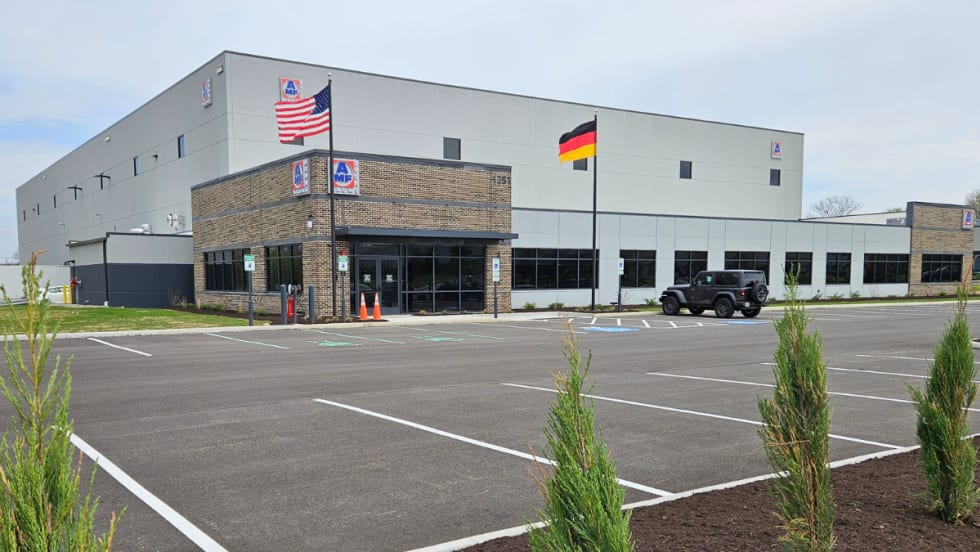
Inside AMF Bruns of America’s New Ohio Manufacturing Facility [Photos]
Take a behind-the-scenes look at AMF Bruns of America’s new 41,000-square-foot Stow, Ohio, headquarters, featuring advanced manufacturing, expanded space, and future-ready mobility solutions.
Read More →
First Student Boosts Student Support in Wichita & Texas
First Student and Wichita Public Schools are using behavioral support strategies to improve student ride experiences, while a separate initiative expands access to after-school programs through a bus donation.
Read More →
2026 Special-Needs Transportation Survey
What’s changing in special-needs transportation? This year, student transportation operators report a rising need, easing driver shortages, growing tech adoption, and evolving challenges. Sponsored by AMF Bruns of America.
Read More →
The Lived-Experience Gap in Mobility Tech: An Expert Take on Safe Student Transportation
Brianna Pauwee, a product application specialist at AMF Bruns of America and a wheelchair user, drops in to The Route to share practical securement and training insights, plus the story behind the new “Beyond Mobility” podcast. The Route is sponsored by IC Bus.
Read More →