




North Carolina District Highlights School Bus Garage Team
Winston-Salem/Forsyth County Schools informs the community about how its maintenance team prepared the fleet for the new school year.

During the summer, mechanics at Winston-Salem/Forsyth County Schools were busy repairing and inspecting buses and getting them ready for the new school year.
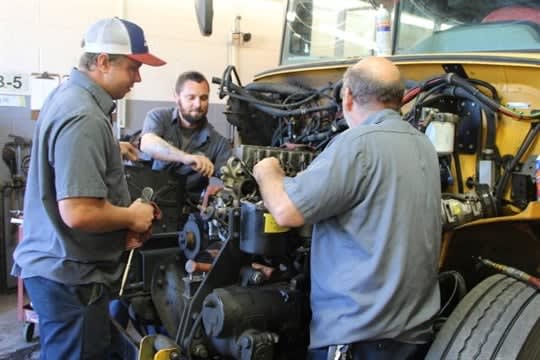
During the summer, mechanics at Winston-Salem/Forsyth County Schools were busy repairing and inspecting buses and getting them ready for the new school year.
Editor’s note: As families prepared to send their kids back to school, Winston-Salem/Forsyth County Schools informed the community about how the district’s maintenance team was preparing school buses for the new year. The article, reprinted here with permission, was written by Kim Underwood, the district’s communications specialist.
WINSTON-SALEM, N.C. — During the summer months, mechanics at the school bus garage continue their work.
As mechanics, said Shop Foreman Alan Loflin, it’s their responsibility to see that students are transported to and from school safely.
During the summer, the 35 mechanics at the bus garage on Carver School Road have been repairing buses, inspecting buses, taking care of the buses being used for summer programs, and readying buses for the new school year, which began Aug. 27.
The school district’s buses have to be inspected every month. That includes buses parked for the summer. The bus inspection list has about 50 items on it, Loflin said. Altogether, though, there are more than 400 issues that could mean that a bus cannot be driven until the problem is fixed. It could be as simple as a bolt missing from a seat.
When a bus is in service, preventive maintenance is done every 15,000 miles.
On an early August morning, Darrell Taylor, the executive director of transportation for Winston-Salem/Forsyth County Schools, gave an informal tour of the bus garage that included a stop at the parts department, which contains about 3,000 different parts.
The required documentation is quite extensive, Taylor said. If, say, an alternator is replaced on a bus, records have to be kept showing which alternator went on which bus.
The men in the parts department also have to keep track of such things as the samples of oil taken from buses that are being sent for analysis.
“These guys keep up with all of that,” Assistant Director of Transportation Cris Cox said.
Summer responsibilities for the men in the garage also include taking care of such things as cleaning the integrated seats that enable young children attending such programs as EC (Exceptional Children) pre-kindergarten to ride a school bus. With the district’s newer buses, seats at the front can be used as integrated seats.
During the regular school year, to ensure that mechanics are available throughout the times that buses are on the road, the first shift of mechanics comes in at 5 a.m. and works until about 2 p.m., and the second shift comes in at 9 a.m. and stays until the final bus is parked about 6 p.m.
School buses continued to roll during the summer months. Each school day, 93 buses went out to pick up students participating in the RISE (Reaching Incredible Success Every day) Summer Camp and the rising first-graders who participated in Pathway to One, a new program that helps prepare students for first grade.
Driving a school bus is quite a challenge. The district’s new buses come with back-up cameras, which are a helpful tool. Also, with buses extending about 11 feet beyond the rear tire, drivers have to take care when making turns.
And, while they’re driving, bus drivers have to be aware of all the student riders. On an elementary school route, a bus could have up to 72 riders.
“It’s a hard and difficult job at times,” Taylor said.
With the start of the school year, many more buses will be going out each school day. During the 2017-18 school year, 404 regular buses carried about 37,000 students — roughly two-thirds of the students enrolled in the school system — to and from school each day.
Most bus drivers have three routes in the morning — one middle, one elementary, one high school — and another three in the afternoon. With buses going to and from the district’s career center during the day, and activity buses taking students on field trips and such, school buses are running throughout the day.
Including activity buses, Winston-Salem/Forsyth County Schools had 514 buses in service last school year.
During the course of the school year, the yellow buses drove a total of 6,057,668 miles, and activity buses drove another 535,433 miles.
These days, buses get 6 to 7 miles a gallon, and, on any given day, the Winston-Salem/Forsyth County Schools buses use about 6,000 gallons of fuel.
After 20 years, a school bus is retired if it has more than 150,000 miles on it. Buses that are 15 to 20 years old are retired if they have 250,000 miles on them.
Taylor also talked about the importance of drivers stopping when buses have the stop arm out.
Passing a bus with its stop arm out endangers students, Taylor said. “No one wants to see a child injured by a motorist passing a stopped school bus.”
During the 2017-18 school year, the district’s school bus drivers reported 187 instances of drivers in the community driving past a bus that had its stop arm extended. In 127 cases, the bus drivers were able to take down such information as a license plate and report the violation to authorities.
With 400 route buses, Winston-Salem/Forsyth County Schools is ranked No. 50 in this year’s Top 100 School District Fleets list, which will appear in the upcoming October issue of SBF.
More Maintenance
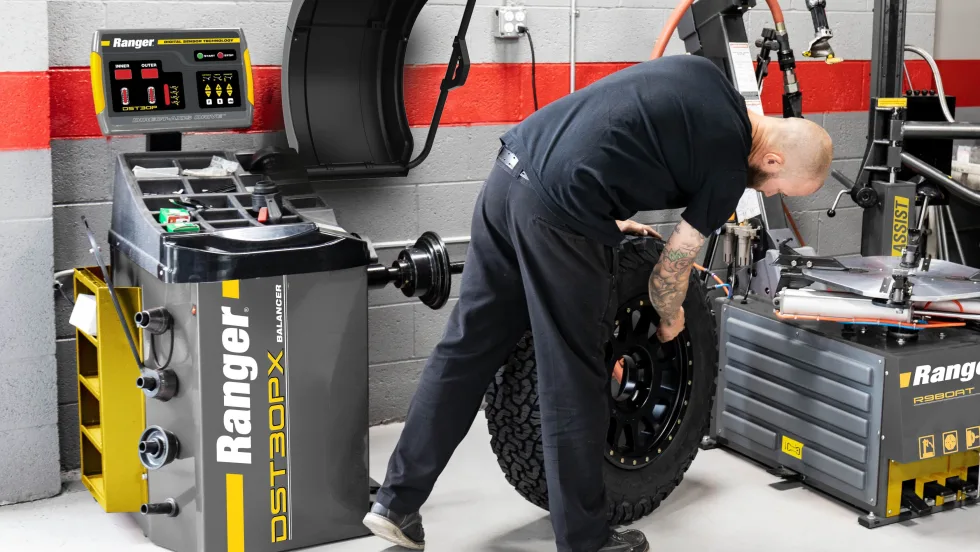
BendPak Launches Ranger DST30PX Wheel Balancer
BendPak's new wheel balancer handles tires up to 43 inches in diameter, with a reinforced design, precise weight placement, and faster service cycles.
Read More →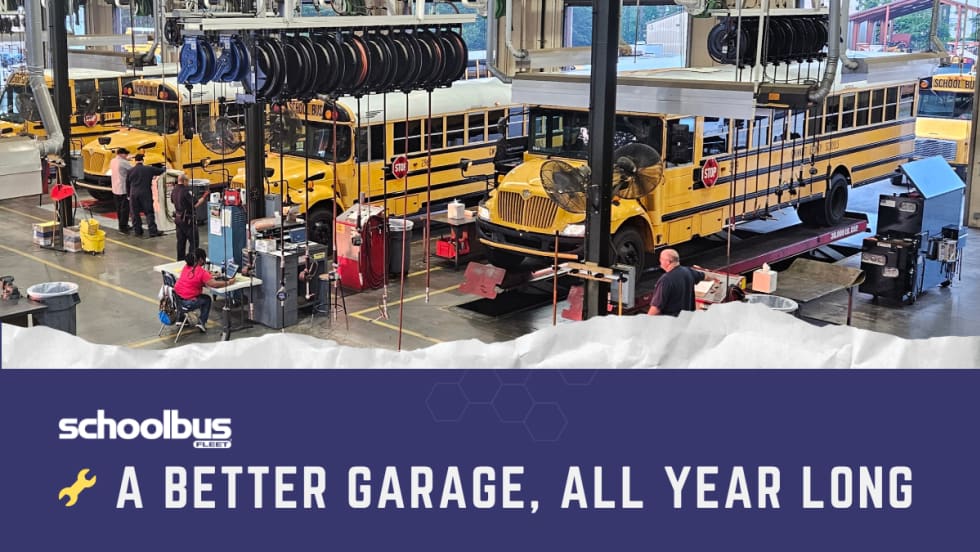
Tips for Ensuring School Bus Garages Are Safe and Warm Year-Round
Cold maintenance bays and rising heating costs? Learn how school bus garages can improve comfort with targeted heating, better airflow, and winter preparation.
Read More →
ASE Highlights School Bus Technician Certification Requirements
ASE is encouraging school bus maintenance professionals to maintain their certifications, highlighting seven specialized tests and five-year renewal requirements.
Read More →
International Adds E-Commerce Capabilities to Fleetrite.com
IC Bus customers can now browse, buy, and track shipments for more than 400,000 aftermarket parts online.
Read More →
The Most Expensive Thing You Do Before Selling a School Bus: Wait
When should you sell an aging school bus? Learn how maintenance, mileage, corrosion, specifications, and timing can affect resale value long before the auction.
Read More →
The Evolution of DEF Header Technology: What School Bus Operations Should Know at Replacement Time
See what school bus fleets should consider when replacing DEF headers to improve reliability, reduce repeat repairs, and control maintenance costs.
Read More →
The Essential Guide to School Bus Maintenance and Student Safety
Your district's buses carry students to school every day. This guide shows how predictive maintenance powered by fleet data helps keep buses reliable, drivers accountable and students safer from the first bell to the last stop.
Read More →
Kerry Brothers Grows Michigan School Bus Repair Network
The acquisition of Downriver Truck and Bus expands Kerry Brothers’ school bus maintenance footprint across southeast Michigan, adding repair capacity, diagnostic resources, and state inspection support.
Read More →
Noregon Introduces CAN Bus Diagnostic Tool, Expands JPRO Features
CAN Mentor and the latest JPRO update aim to simplify vehicle network diagnostics and improve repair efficiency for technicians of all experience levels.
Read More →
Cummins on Smarter, Simpler Engine Innovation
Cummins discusses its first-ever gasoline engine for school buses, EPA 2027, and why bus fleets still want durable, simpler internal combustion options.
Read More →