




Tire Maintenance Best Practices
Officials at tire companies, along with technicians, say that checking for proper inflation, axle alignment and tread depth helps keep tires in good condition. They also provide tips on mounting, inspection, repair and replacement.

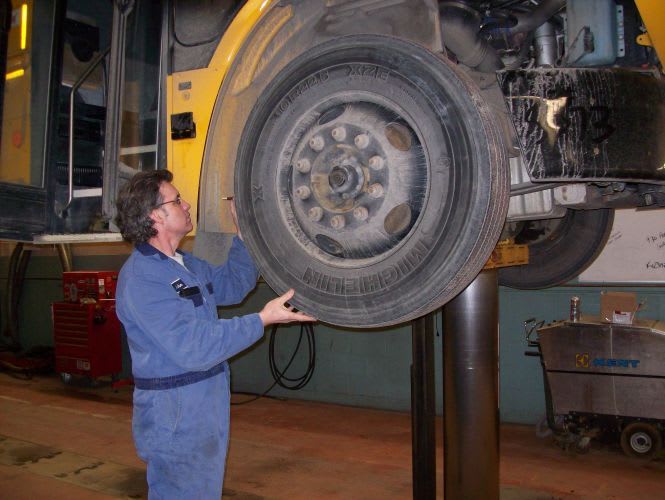
Ensuring that the tires on a fleet of school buses are in good condition should be an essential component of an operation’s maintenance program for the buses to run smoothly.
“Every school district or bus fleet should have some kind of tire management program,” says Doug Jones, customer engineering support manager for Michelin Americas Truck Tires. “A good program includes cradle-to-grave tracking, analysis, preventive maintenance and more.”
Industry professionals offer numerous tips specific to tire maintenance, touching on inflation and pressure, axle alignment, tread depth and mounting. They also offer insight on how often tires should be inspected and signs that a tire needs to be replaced or repaired.
Taking into consideration this information will equip both drivers and technicians with the knowledge to help prolong the life of a tire and avoid problems when buses are on the road.
Establish proper inflation and pressure
Determining whether tires are properly inflated is the first item technicians should check for. Scott McNamara, a trainer for Bridgestone Bandag Tire Solutions, says that the air pressure of all tires should be checked and corrected weekly with an accurate inflation pressure gauge.
“Tire pressure should be checked while the tires are cold,” he adds. “Do not bleed air from tires while they’re hot as this will result in under inflation. Operating on an improperly inflated tire will create severe tire damage.”
Thomas Kenny, manager at Hankook Tire America Corp., elaborates, saying that improper tire inflation can result in shorter tread life, irregular tread wear and degraded durability, along with decreased fuel economy and degraded vehicle handling.
Moreover, Timothy Miller, senior marketing specialist for Goodyear Tire & Rubber Co., notes that the pressure in tires should be kept at a level that will support the load that the bus is carrying.
Officials at Double Coin suggest reviewing a bus’ owner’s manual or the vehicle load and tire information placard. These items provide data on the weight of the vehicle and the standard load, helping to determine the air pressure level.
Monitor axle alignment and tread depth
Miller says that attention should also be given to a bus’ axle alignment. If tires come in contact with curbs with the potential to knock the axles out of alignment, the alignment should be checked at each tire change. Steer axles should be checked for proper camber, caster and toe settings. Drive axles should be checked to determine whether they are perpendicular to the chassis’ centerline so that the bus will travel straight.
“Technicians should establish a minimum tread depth allowed before tires are changed,” Miller adds. “This could vary from location to location. Buses in northern Michigan might require deeper tread depths to travel in snow and slush, but buses in Miami might be able to run until the tread is down to 4/32nds without any problems.”
Avoid mixing tire types, brands
Manufacturers and technicians also have suggestions for mounting tires on a bus. Officials at Double Coin and Brad Barker, shop supervisor at Park City (Utah) School District, both caution against mixing tires. “Try to match brands, types and tread designs on each axle and avoid mixing tire brands and types. Each tire has its own flex characteristics,” Barker explains.
John Whelan, heavy-duty mechanic/lead hand at School District #73 in Kamloops, British Columbia, offers specific advice on dual tires, saying that these tires should be the same size and have the same tread pattern.
“Irregular duals will cause one tire to work harder and heat up, causing premature wear and possible failure on the highway,” Whelan says. “A rule of thumb is that the diameter of both tires must not have more than half an inch difference, while there should be no more than a three-fourths inch difference in the circumference of the two tires.”
[PAGEBREAK]
Inspections
Drivers and technicians have a shared responsibility to inspect tires for possible damage and to make certain that they are in a state to function properly while the bus is in operation.
Manufacturers’ recommendations vary on the frequency with which tires should be inspected, but each recommends a daily check during the driver’s pre-trip inspection. Beyond that, Double Coin encourages technicians to inspect tires during an operation’s required preventive maintenance tasks or at the appearance of irregular wear.
McNamara agrees, and recommends checking tire pressure during inspections. “It is a known fact that medium tires can lose up to 2 psi per month from heat, cold and leakage,” he reveals. (By the same token, Jones notes that time spent checking inflation pressure is a good time to inspect the tires.)
Miller and Kenny encourage an inspection of tires daily, weekly and monthly. Kenny emphasizes the importance of a daily inspection by bus drivers, but he also believes that the tires’ inflation, as well as a visual inspection of the tires’ tread and sidewall should be performed every week. Technicians should measure tires’ tread depth monthly.
When is repair or replacement necessary?
When drivers and technicians inspect tires, they should look for signs that the tires need to be repaired or replaced.
Kenny says the signs include the failure of a tire to maintain consistent air pressure in between pressure checks. This may indicate a leak or a rim seal problem. Bulging or evidence of a separation within the carcass of the tire is another sign that repair or replacement is needed.
“Watch for excessive vibration during the operation of the vehicle,” Kenny adds. “This may indicate that a tire has a separation or has sustained impact damage.”
McNamara as well as officials at Double Coin urge technicians to check tires for holes, bubbles or bumps caused by imbedded objects, sidewall cuts and irregular wear.
They also recommend looking for the following:
• Tires with tread depths of 4/32nds on the steer position and 2/32nds on all other positions. These tires should be replaced.
• Tread cuts that extend into the steel cords.
• Sidewall snags that show exposed body cables.
• A sidewall that has a bulge that is greater than 3/8 of an inch.
• Flat spots on the dual rear tires (indicates brake lock or skid).
• Bent or damaged wheels; cracked, broken or elongated bolt holes; and loose, missing, broken, cracked, stripped or otherwise ineffective fasteners.
• Loose or missing lug nuts.
“Most fleets have a spec they use when deciding to replace a tire. Using a tread depth gauge is a quick way during a service to monitor tire condition,” Whelan says. “Usually 6/32-inch tread depth will allow recycling the tire casing as a recap.”
For information on how to find tires that are right for your operation, click here.
[IMAGE]482[/IMAGE]
Battery maintenance tips
Along with tires, a vehicle’s battery should be regularly inspected. Technicians Brad Barker and John Whelan offer their expertise for maintaining batteries and their components.
Barker says that battery grounds, cable connections throughout the entire system and battery boxes should always be clean. All batteries should be washed off and their terminals tightened periodically, preferably during each preventive maintenance session.
“Keeping batteries clean with a battery cleaner spray or baking soda will neutralize any acid buildup that causes voltage leakage,” Whelan adds. “These products combined with water will neutralize the acid and even detect acid buildup.”
Barker notes, however, that if your shop is not using maintenance-free batteries, do not add untreated water to the battery cell. De-ionized water should be used. (City water contains contaminates that will destroy the plates in the battery.)
Battery cables should be removed and the battery should be load-tested annually, with weak batteries replaced. “A weak battery under load will not hold a voltage,” Whelan explains. “The average battery can be load-tested by drawing 30 to 40 percent of its cold cranking amp rating. This load is held for 10 seconds and the battery must not drop below 9.6 volts. Today’s digital battery testers automatically run a test with the push of a button.”
Whelan says battery cable routing is also important, particularly with the positive battery cable. Once a positive cable rubs through to the frame, a direct short with this much amperage potential will cause arching and major damage to electrical components.
Finally, check for clean connections — any resistance will cause a “no-start” situation and electrical accessory problems.
More Maintenance
BendPak Launches Ranger DST30PX Wheel Balancer
BendPak's new wheel balancer handles tires up to 43 inches in diameter, with a reinforced design, precise weight placement, and faster service cycles.
Read More →
Tips for Ensuring School Bus Garages Are Safe and Warm Year-Round
Cold maintenance bays and rising heating costs? Learn how school bus garages can improve comfort with targeted heating, better airflow, and winter preparation.
Read More →
ASE Highlights School Bus Technician Certification Requirements
ASE is encouraging school bus maintenance professionals to maintain their certifications, highlighting seven specialized tests and five-year renewal requirements.
Read More →
International Adds E-Commerce Capabilities to Fleetrite.com
IC Bus customers can now browse, buy, and track shipments for more than 400,000 aftermarket parts online.
Read More →
The Most Expensive Thing You Do Before Selling a School Bus: Wait
When should you sell an aging school bus? Learn how maintenance, mileage, corrosion, specifications, and timing can affect resale value long before the auction.
Read More →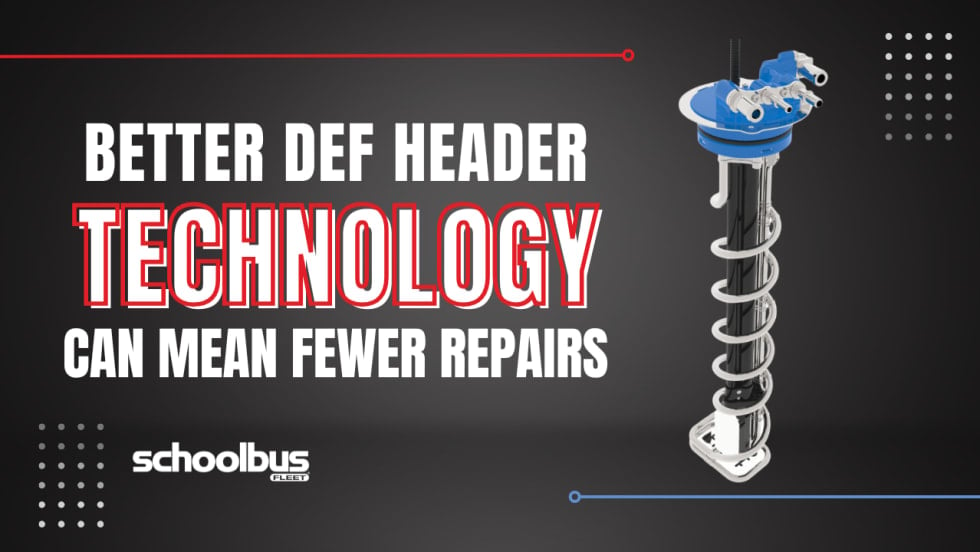
The Evolution of DEF Header Technology: What School Bus Operations Should Know at Replacement Time
See what school bus fleets should consider when replacing DEF headers to improve reliability, reduce repeat repairs, and control maintenance costs.
Read More →
The Essential Guide to School Bus Maintenance and Student Safety
Your district's buses carry students to school every day. This guide shows how predictive maintenance powered by fleet data helps keep buses reliable, drivers accountable and students safer from the first bell to the last stop.
Read More →
Kerry Brothers Grows Michigan School Bus Repair Network
The acquisition of Downriver Truck and Bus expands Kerry Brothers’ school bus maintenance footprint across southeast Michigan, adding repair capacity, diagnostic resources, and state inspection support.
Read More →
Noregon Introduces CAN Bus Diagnostic Tool, Expands JPRO Features
CAN Mentor and the latest JPRO update aim to simplify vehicle network diagnostics and improve repair efficiency for technicians of all experience levels.
Read More →
Cummins on Smarter, Simpler Engine Innovation
Cummins discusses its first-ever gasoline engine for school buses, EPA 2027, and why bus fleets still want durable, simpler internal combustion options.
Read More →