




Streamlining the Maintenance Process in 6 Steps
Maintaining a workable ratio, making the proper tools and training available, and tracking operation costs are some steps that will help make the process more efficient.
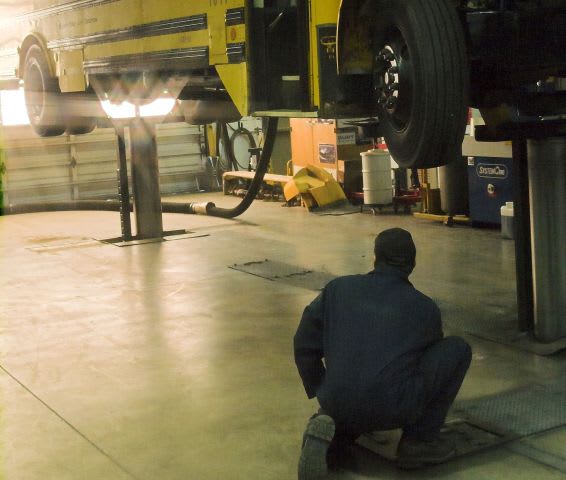
File photo courtesy John Horton
File photo courtesy John Horton
It seems to me with the ever increasing system complexity designed into school bus construction, the maintenance process becomes equally complex. Gone are the days of basic routine maintenance.
Today, routine service can include inspection, diagnosing, and adjustment of complex electronic systems before the job is complete. Even with the additional time and the skills and knowledge required to perform these tasks, it is not impossible to streamline the process. That can only be accomplished by a fair amount of scrutiny of your existing process.
1. Maintain a Workable Ratio.
Using last year’s national average ratio of school buses per mechanic from School Bus Fleet’s Maintenance Survey, the first step to streamlining should be aiming to reach a ratio near to 20 buses per mechanic. Lessening the workload allows for more focus on accuracy of work, whereas increasing work load — as with a higher ratio — puts pressure on technicians to hurry and get the job done.
2. Follow Specific Guidelines.
What guidelines am I referring to? Each shop must have a very specific “must inspect list” of items organized in a systematic manner which are to be inspected on each bus during the routine service process. This creates consistency in the inspection process. Consistency creates accuracy and accuracy reduces down time in the long run. The time allowed to perform routine service depends on your “must inspect list.” A copy of my list is available for free download at schoolbusfleet.com/PMchecklist.
I have determined that the basic thorough preventive maintenance (PM) can be completed in two-and-a-half to three hours using my list. Add one hour if changing fluids and filters.
3. Technician Training is a Must.
Communicating expectations cannot by itself achieve the required expectations without training each tech individually. Teach them how you expect and what you expect them to perform. Make sure each tech performs the job the same way and as you designate with your “must inspect checklist.” This again improves consistency and accuracy.
The goal is to have a smoothly running, efficient operation that produces reliable repairs and safe buses.
4. Make the Proper Tools, Resources Available.
No work can be consistently and accurately completed in an acceptable time frame if your staff is not equipped with the proper tools and resources to get the job done. Skimping on tools and resources gets you nowhere fast. These can be costly, though, and I recommend obtaining the very best tools available. Make an effort to budget for high-quality tools even if you have to spread these purchases out over a few years. Buying from import stores is not the answer in most instances, since these tools wear out or break frequently. Having the proper tools, diagnostic information, and service and parts manuals is a must.

Brad Barker is a veteran shop manager and technician.
5. Take Advantage of Bus Warranties.
Utilizing the dealerships for warrantable repairs will reduce your repair costs as long as you relay expectations to the dealerships before work is done. Never accept a job as completed if you do not make a thorough inspection of the work before receiving and signing off on the repair. When dealing with dealers, relay ahead of time your expectations of the work and let them know that you will make a personal inspection before the completed work is accepted.
6. Track Operation Costs.
Last of all, track all the costs of your operation, including the PM process in order to justify your actions. Tracking costs tells you if your program is benefiting from your efforts to streamline the process.
I have often said to make changes in small steps, not big steps. This allows you to tweak changes more easily, whereas big steps forward may cause you to take a big step backward to correct a poor decision. This will cause confusion in your shop. The goal is to have a smoothly running, efficient operation that produces reliable repairs and safe buses.
Brad Barker has more than 40 years of experience in school bus maintenance as a shop manager and technician. He has written numerous articles for SBF. He can be reached at schoolbuspm@outlook.com.
More Maintenance
Kerry Brothers Grows Michigan School Bus Repair Network
The acquisition of Downriver Truck and Bus expands Kerry Brothers’ school bus maintenance footprint across southeast Michigan, adding repair capacity, diagnostic resources, and state inspection support.
Read More →
Noregon Introduces CAN Bus Diagnostic Tool, Expands JPRO Features
CAN Mentor and the latest JPRO update aim to simplify vehicle network diagnostics and improve repair efficiency for technicians of all experience levels.
Read More →
Cummins on Smarter, Simpler Engine Innovation
Cummins discusses its first-ever gasoline engine for school buses, EPA 2027, and why bus fleets still want durable, simpler internal combustion options.
Read More →
Report: 72% of Diesel School Buses Now Use Advanced Low-Emission Engines
New data shows advanced low-emission diesel technology continues expanding across school bus fleets, even as electric bus adoption gains momentum.
Read More →
Vampire Tools' CAIMAN 7.5-Inch Multi-Purpose Screw Extractor Long-Nose Pliers with Crimper
Vampire Tools introduced the VAMPLIERS Caiman 7.5-inch multi-purpose pliers, combining screw extraction, cutting, crimping, and gripping functions into a single tool designed for fleet maintenance professionals.
Read More →
How Advanced Diagnostics Helps Bus Fleets Stay Ahead of Repairs
Chat with Noregon’s Kevin Smallhorn at ACT Expo about bus diagnostic tools, telematics integration, CNG maintenance support, and strategies to help reduce downtime and improve uptime.
Read More →
How School Bus Fleets are Getting Ahead of Breakdowns
Don’t let bus downtime wear you down. Here’s how bus operators are shifting from manual processes to AI-powered, data-driven maintenance systems for improved reliability and safety.
Read More →
Pennsylvania School Bus Maintenance Team Praised for Dedication to Safety
Matthews Bus Company’s West Jefferson received a letter of commendation from the Pennsylvania State Police for their fleet inspections.
Read More →
From Chaos to Clarity: How School Districts Are Running Leaner Transportation Operations
Covering 38 routes on a Friday afternoon. Buses idling while routes overlap. Parents calling nonstop about late arrivals. Sound familiar? This whitepaper explores how district transportation leaders solved these exact problems — and what measurable results followed.
Read More →
2026 School Bus Fleet Vendor Directory & Buyer's Guide
Searching for the right equipment, technology, or services for your school transportation program? This industry guide brings together manufacturers and suppliers across the entire school bus market, all in one place. Download it to find the partners who can help move your operation forward.
Read More →