




Is Your Fleet Ripe for Computerized Brake Testing?
Sophisticated brake-testing systems may require a significant investment, but the potential rewards include improved efficiency and record tracking.
Performance testing of brake systems is a preventive measure that can mean the difference between an injury crash and a narrow miss. But this testing can be time-consuming and labor-intensive. Computerized brake testing speeds up the process and simplifies record-keeping. However, computerized brake testing can be an expensive proposition. A single testing station can set you back as much as $60,000. Less expensive alternatives are available, with some requiring only a $3,000 investment. The question is whether computerized brake testing makes sense for your operation.
Liability concerns allayed?
At Quincy Public Schools in Quincy, Ill., the transportation department operates approximately 100 school buses. John Mason, Quincy's maintenance superintendent, says computerized brake testing not only improves the safety profile of the fleet but also produces service records that can be helpful if there's an accident and subsequent investigation. "If you have something go out and the brakes were to fail, you could go back and show that every six months this vehicle has been put through a test and at this time, this is what [the test] showed," Mason says. Mason uses the B400T brake-testing unit manufactured by Hunter Engineering in Bridgeton, Mo. Testing involves driving the bus onto test plates and braking. The plates are wired to a computer that measures brake balance on each axle and helps isolate braking problems.
The old-fashioned method
Before switching to the B400T, Mason says he tested his buses the old-fashioned way, by rolling them onto a bare plate tester, which was situated on rollers. Springs were located underneath the plates and were attached to a pressure gauge, which would be used to measure the reading. The reading would then be multiplied by the vehicle's weight to measure the brake force and the deceleration factor. Computerized brake testing can take less than a minute, and cuts down significantly on the amount of time and energy spent by mechanics in filling out paperwork. Mason, who has been using the Hunter brake tester for seven years, says some early glitches in the system have been ironed out, but the growing presence of antilock braking systems (ABS) on school buses can create problems for his brake-testing unit. "New buses coming out this year have ABS, which is required by federal law, but there's a problem with the ABS and our brake-testing system because if you're too excessive on the brakes, the ABS kicks in and scrambles the test results," Mason says. "To avoid this, I have the mechanics go steady on the brake during testing."
New unit uses heat sensor
Not all computerized brake-testing systems are created equal. Like Hunter's B400T, the TBT 1000 Thermal Brake Tester by Nu-Tech Industries in Brookfield, Wis., tests for brake imbalances and potential brake problems, but it accomplishes its objectives quite differently. The TBT 1000, which costs approximately $3,000 per unit, includes a handset and base station, software and a CD-ROM tutorial. The handset is used to detect temperature differences between left and right brakes on the same axle. A significant difference would indicate a problem. According to the manufacturer, the testing can be done in two minutes. However, the device only works when the brakes are warmed up, requiring that the vehicle be tested after a circuit on the highway. Frank Walter, vice president of safety, compliance and risk management for ATC Leasing Co. in Kenosha, Wis., has been using the TBT 1000 on his fleet of 70 tractor-trailer semis for about four months. So far, he's impressed with the unit's diagnostic capabilities. "Recently, a driver complained that the brakes on one of the vehicles were hard to use," Walter says. "By using the tester, we figured out which axle had the problem and discovered a bent copper line."
Data can be analyzed, too
With the TBT 1000, transportation managers can keep track of vehicle information by downloading it into a sortable spreadsheet. They can track an entire fleet or individual vehicles. Exception reports can also be created, allowing technicians to print out records only of vehicles showing "check" or "fail" conditions. But even with all of its efficiencies, computerized brake testing may not make sense for small school districts, which could accomplish the same objective by taking their buses to an outside garage. Brake-testing equipment manufacturers say the school bus industry has yet to embrace this technology, but Mason is a true believer. He says Hunter's computerized brake-testing equipment is worth the close to the $80,000 his district put into it. "It works, it's accurate and it does the job for us," he says.
More Maintenance
The Essential Guide to School Bus Maintenance and Student Safety
Your district's buses carry students to school every day. This guide shows how predictive maintenance powered by fleet data helps keep buses reliable, drivers accountable and students safer from the first bell to the last stop.
Read More →
Kerry Brothers Grows Michigan School Bus Repair Network
The acquisition of Downriver Truck and Bus expands Kerry Brothers’ school bus maintenance footprint across southeast Michigan, adding repair capacity, diagnostic resources, and state inspection support.
Read More →
Noregon Introduces CAN Bus Diagnostic Tool, Expands JPRO Features
CAN Mentor and the latest JPRO update aim to simplify vehicle network diagnostics and improve repair efficiency for technicians of all experience levels.
Read More →
Cummins on Smarter, Simpler Engine Innovation
Cummins discusses its first-ever gasoline engine for school buses, EPA 2027, and why bus fleets still want durable, simpler internal combustion options.
Read More →
Report: 72% of Diesel School Buses Now Use Advanced Low-Emission Engines
New data shows advanced low-emission diesel technology continues expanding across school bus fleets, even as electric bus adoption gains momentum.
Read More →
Vampire Tools' CAIMAN 7.5-Inch Multi-Purpose Screw Extractor Long-Nose Pliers with Crimper
Vampire Tools introduced the VAMPLIERS Caiman 7.5-inch multi-purpose pliers, combining screw extraction, cutting, crimping, and gripping functions into a single tool designed for fleet maintenance professionals.
Read More →
How Advanced Diagnostics Helps Bus Fleets Stay Ahead of Repairs
Chat with Noregon’s Kevin Smallhorn at ACT Expo about bus diagnostic tools, telematics integration, CNG maintenance support, and strategies to help reduce downtime and improve uptime.
Read More →
How School Bus Fleets are Getting Ahead of Breakdowns
Don’t let bus downtime wear you down. Here’s how bus operators are shifting from manual processes to AI-powered, data-driven maintenance systems for improved reliability and safety.
Read More →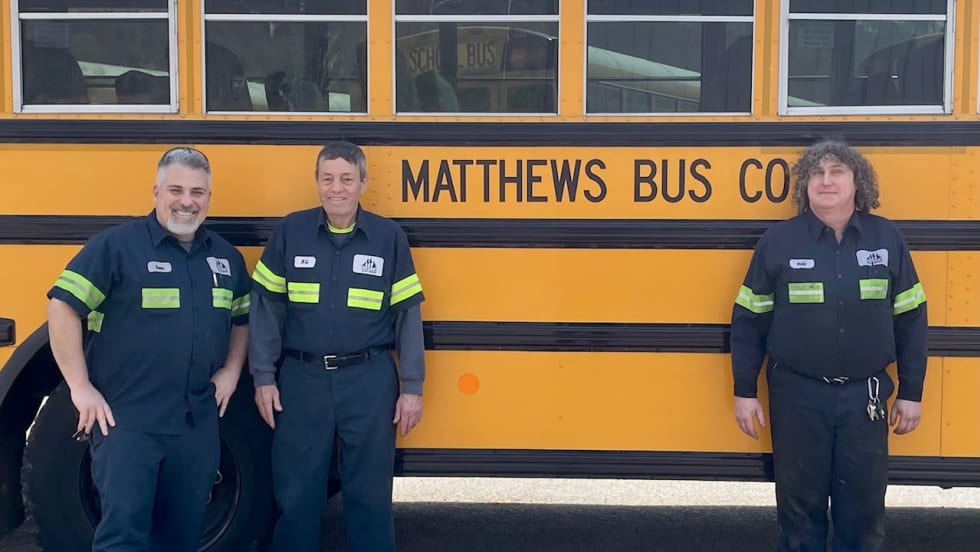
Pennsylvania School Bus Maintenance Team Praised for Dedication to Safety
Matthews Bus Company’s West Jefferson received a letter of commendation from the Pennsylvania State Police for their fleet inspections.
Read More →
From Chaos to Clarity: How School Districts Are Running Leaner Transportation Operations
Covering 38 routes on a Friday afternoon. Buses idling while routes overlap. Parents calling nonstop about late arrivals. Sound familiar? This whitepaper explores how district transportation leaders solved these exact problems — and what measurable results followed.
Read More →