




6 Strategies for Avoiding Common State Inspection Violations
Technicians and state patrol inspectors agree that clear communication and routine maintenance lower the rate of violations cited during safety inspections.

Communication between all transportation departments is essential. Tracy Williams (left), the safety director for VAT Inc., along with bus specialist Cheri Butts and Brian Hamlin, shop manager, review a safety checklist at the company’s bus lot.
Exhaust leaks, rust, loose emergency door seals, and brakes out of adjustment are some examples of common violations found during state inspections.
Michigan State Police Sgt. Mike McLaughlin, who serves with the Commercial Vehicle Enforcement Division School Bus Inspection Unit, says the top school bus violations in his state, from Sept. 1, 2015, to May 9, 2016, were corrosion or a non-manufacturer hole larger than a nickel (the top violation); ABS problems, exhaust leaks, other body component rust, emergency door seals, loose or not making contact, “and — strangely enough — the fuel system with evidence of an unrepaired leak.”
Operating vehicles with defects can put bus drivers, monitors, and students in danger. To avoid such risk, Mel Philbrook, the fleet maintenance supervisor for Portland (Ore.) School District, lists reasons to make repairs as soon as possible.
“I don’t want to be in trouble. I don’t want the driver or the students on the bus to get hurt,” he says. “Our main thing is safety, safety, safety.”
Tracy Williams, safety director for VAT Inc., a school bus contractor based in Ohio, understands challenges faced by both state inspectors and fleet supervisors. Before joining VAT, Williams spent 24 years with the Ohio State Highway Patrol. He also crafted the state’s current construction standards — which school bus operators must meet to operate in Ohio — before retiring as a state commander. In his position, he found the most common violations to be brakes out of adjustment, tire and exhaust violations, and miscellaneous seat problems, he says.
Red-tag violations are the most serious and need to be repaired before the bus can be used for pupil transportation. Time allotted for repairs varies by state. In Michigan, 60 days are allotted to repair a less serious, yellow-tag violation, McLaughlin notes.
Oregon expects a yellow-tag repair to be completed within 30 days, according to Philbrook.
Despite it being serious business, when annual state inspections roll around, McLaughlin says that school transportation staff shouldn’t be afraid of the process.
“We’re all working together toward the same goal, which is pupil transportation safety,” he says.
Violations like the ones previously listed can often be caught beforehand or prevented entirely with proactive measures, such as practicing routine preventive maintenance, becoming familiar with state requirements, strengthening staff communication, and building relationships with inspectors and vendors.
1. Prioritize preventive maintenance
McLaughlin’s best advice to shop technicians gearing up for state inspections is to have an effective preventive maintenance program in place.
Routine maintenance is also a top priority at Philbrook’s shop. “It makes more sense to take care of a problem now rather than have a bus red-tagged for a violation, because I can keep that bus in service.”
With a crew of five experienced mechanics, Philbrook maintains 91 buses and nearly 40 other school vehicles. Their diligent maintenance pays off when he files his key performance indicator (KPI) reports.
“[The report] asks how many buses are down on inspection, and I always have to put zero, because we do [all] our own inspections and make any repairs,” Philbrook says.
2. Know your state's requirements
McLaughlin also advises that mechanics familiarize themselves with the equipment requirements specific to their state.
“Don’t wait until we show up to [explain] what’s wrong,” he says.
Williams agrees. “One thing I saw too often when I still wore my highway patrol hat to a garage is too many facilities rely on the highway patrol inspector to tell them what’s wrong. Then they come in and fix it.”
That approach is common with shops that have too few mechanics or those undergoing budget cuts, Williams says. “That tells you two things: One, they’re running unsafe buses. And two, they’re wasting everybody’s time because by law when the highway patrol inspectors come in, those buses should be ready to go.”
Williams says VAT trained all of its mechanics on the standards for Ohio.
“I’ve taken them through everything that gets inspected on the bus,” he explains. “We have our own inspection process where our mechanics do a full inspection.”
3. Strengthen inter-staff communication
The biggest key to a successful shop, Williams says, is communication between drivers, mechanics, inspectors, and management.
“You can have everything else, but if those four groups aren’t sharing information, the program usually fails somewhere,” he notes.
For example, drivers are required to conduct daily pre-trip and post-trip inspections, and if they find anything wrong and don’t share it with the mechanic, it doesn’t get fixed.
“Then, we’re running buses that are in violation,” Williams adds.
In particular, mechanics need to have good communication with drivers, especially in cases such as a
driver writing up a work order and not clearly describing the problem with their bus.
“That mechanic needs to find that driver and share information to make sure the problem gets fixed,” he says.
Encouraging open dialogue, Williams conducts quarterly meetings in which drivers and mechanics share information about “what’s new, what mechanics are seeing, and what drivers are experiencing.”
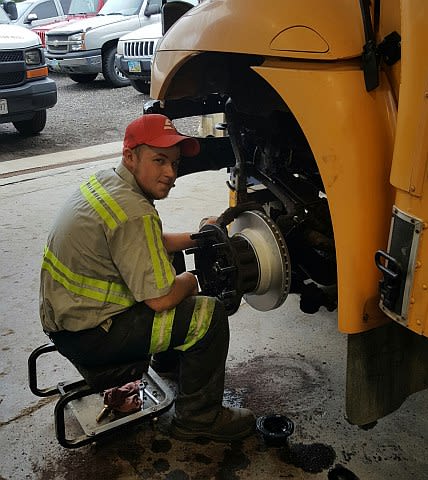
Prioritizing routine maintenance can prevent inspection violations. Austin Hamlin, a mechanic for school bus contractor VAT, performs routine brake service.
4. Build relationships with inspectors, vendors
Building strong relationships and communication with inspectors is equally important, Williams points out.
VAT’s annual school bus inspections are scheduled in advance, and the company has taken that opportunity to foster teamwork. At least two bus drivers prep the buses before the inspector arrives. The drivers also double check for cleanliness and do a quick pre-trip to make sure all the lights work before presenting buses for inspection.
Meanwhile, a mechanic helps the inspectors during the inspection, not only to assist them if they need anything, but also to learn what the inspector is checking, Williams says.
“Sometimes within our inspection process we might not understand what the requirement is, and if you don’t have that relationship built with your inspectors, you’re losing a really good resource, because they’re here to help,” he adds. “They shouldn’t be your enemy.”
It also pays to develop a solid relationship with vendors, who can be a good source of education and training, benefiting the overall operation and success of the shop.
Eighteen months ago, when Williams stepped into his current position at VAT, he reviewed the contractor’s suppliers and, as a result of his assessment, the company replaced several vendors. Building relationships with the new vendors proved an asset to the monthly safety training he holds for mechanics because vendors volunteered to come in and teach specific classes on their products.
As part of this change, Williams also negotiated regular tire inspections with one vendor.
“Our tire company comes out once a month at no charge and inspects all the tires on the buses,” he says.
5. Management support is crucial
As with any effective business, support from management is another key component.
“Of course management has to be willing, one, to know what’s going on with the buses,” Williams explains. “And two, to understand that you have to spend money to support the operation of the buses.”
On VAT’s bus lot, Williams performs his own spot checks, looking over the emergency equipment, and checking the overall cleanliness and appearance of vehicles and the emergency exits.
“You can’t throw all that responsibility on one specific work group,” he points out.
6. Join state organizations
Both McLaughlin and Williams recommend that all drivers and mechanics become members of their state’s organization. This keeps them informed of changes in regulations and up to date on new technology, Williams says.
Most states have organizations such as the Michigan Association for Pupil Transportation (MAPT) or the Ohio School Bus Mechanics Association.
Founded in 1965, MAPT provides information, education, and training to school transportation providers. The association also holds an annual technicians’ conference.
More Maintenance
The Essential Guide to School Bus Maintenance and Student Safety
Your district's buses carry students to school every day. This guide shows how predictive maintenance powered by fleet data helps keep buses reliable, drivers accountable and students safer from the first bell to the last stop.
Read More →
Kerry Brothers Grows Michigan School Bus Repair Network
The acquisition of Downriver Truck and Bus expands Kerry Brothers’ school bus maintenance footprint across southeast Michigan, adding repair capacity, diagnostic resources, and state inspection support.
Read More →
Noregon Introduces CAN Bus Diagnostic Tool, Expands JPRO Features
CAN Mentor and the latest JPRO update aim to simplify vehicle network diagnostics and improve repair efficiency for technicians of all experience levels.
Read More →
Cummins on Smarter, Simpler Engine Innovation
Cummins discusses its first-ever gasoline engine for school buses, EPA 2027, and why bus fleets still want durable, simpler internal combustion options.
Read More →
Report: 72% of Diesel School Buses Now Use Advanced Low-Emission Engines
New data shows advanced low-emission diesel technology continues expanding across school bus fleets, even as electric bus adoption gains momentum.
Read More →
Vampire Tools' CAIMAN 7.5-Inch Multi-Purpose Screw Extractor Long-Nose Pliers with Crimper
Vampire Tools introduced the VAMPLIERS Caiman 7.5-inch multi-purpose pliers, combining screw extraction, cutting, crimping, and gripping functions into a single tool designed for fleet maintenance professionals.
Read More →
How Advanced Diagnostics Helps Bus Fleets Stay Ahead of Repairs
Chat with Noregon’s Kevin Smallhorn at ACT Expo about bus diagnostic tools, telematics integration, CNG maintenance support, and strategies to help reduce downtime and improve uptime.
Read More →
How School Bus Fleets are Getting Ahead of Breakdowns
Don’t let bus downtime wear you down. Here’s how bus operators are shifting from manual processes to AI-powered, data-driven maintenance systems for improved reliability and safety.
Read More →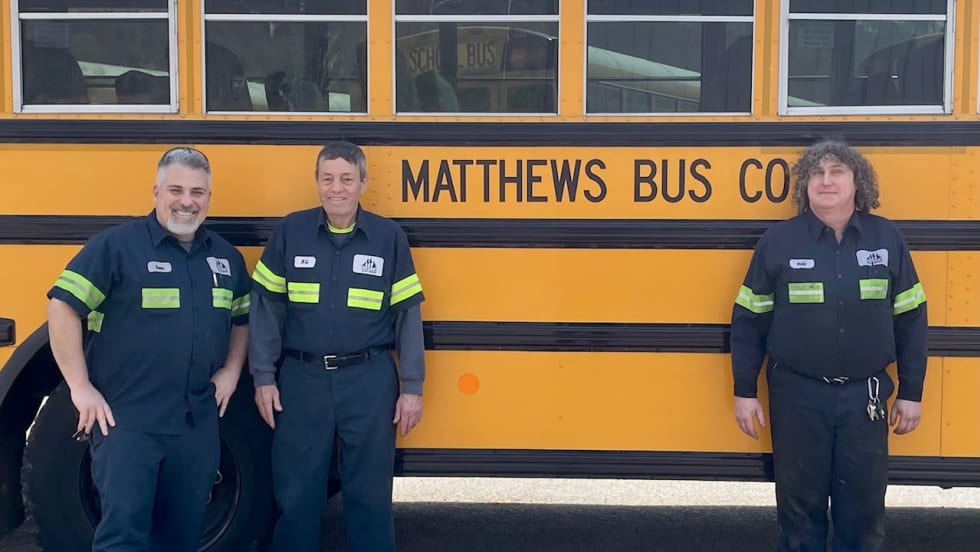
Pennsylvania School Bus Maintenance Team Praised for Dedication to Safety
Matthews Bus Company’s West Jefferson received a letter of commendation from the Pennsylvania State Police for their fleet inspections.
Read More →
From Chaos to Clarity: How School Districts Are Running Leaner Transportation Operations
Covering 38 routes on a Friday afternoon. Buses idling while routes overlap. Parents calling nonstop about late arrivals. Sound familiar? This whitepaper explores how district transportation leaders solved these exact problems — and what measurable results followed.
Read More →