




Stop-Arm Cameras Can Now Be Used for Civil Fines in North Carolina
For stop-arm running cases in which the driver can’t be identified in camera footage, a new state law allows for civil penalties for the owner of the vehicle.

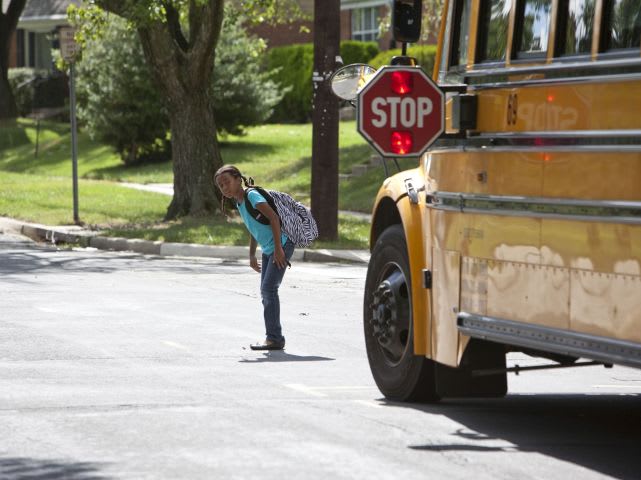
Counties in North Carolina can now pass local ordinances that authorize stop-arm cameras to be used for civil enforcement of school bus passing violations. File photo courtesy NHTSA
Counties in North Carolina can now pass local ordinances that authorize stop-arm cameras to be used for civil enforcement of school bus passing violations. File photo courtesy NHTSA
RALEIGH, N.C. — A new law in North Carolina provides another path for stop-arm violation enforcement based on camera footage.
Gov. Roy Cooper signed the legislation, Senate Bill 55, into law on Tuesday.
“Speeding past a stopped school bus puts children’s lives at risk, sometimes with tragic results,” Cooper said in a press release. “With this new law in place, we have another tool to help children who ride the school bus travel safely.”
Until now, stop-arm camera footage in North Carolina could only be used for criminal proceedings when the driver of a passing vehicle can be identified. The new law allows for civil penalties to be assessed to the owner of the vehicle if the driver can’t be identified in camera footage but the license plate can.
Counties in the state can now pass local ordinances that authorize the cameras to be used for civil enforcement of stop-arm violations. The new law sets the civil penalties at $400 for a first offense, $750 for a second offense, and $1,000 for any subsequent offense.
Kevin Harrison, North Carolina’s state director of pupil transportation, told SBF that the new law provides an additional avenue for citing stop-arm runners, which could help deter those who do it intentionally.
“I think it will result in being able to use more of this footage for enforcement,” Harrison said. “It’s one more way to say, ‘If you’ve got [footage] and it’s a violation, we can do something with it.' … Putting that video and images in front of law enforcement, that’s the critical piece.”
Annual school bus stop-arm surveys in North Carolina have consistently counted more than 3,000 violations per day. In some cases, students have been injured or killed by passing motorists.
Cooper began pushing for school bus stop-arm cameras in 2014, when he was North Carolina’s attorney general.
“This is a proven way to deter motorists from passing stopped school buses without cost to the taxpayers,” Cooper said in November 2014. “It will definitely make our kids safer when they ride the bus to school.”
Harrison told SBF that there are currently about 1,900 stop-arm camera systems installed on school buses in North Carolina.
In addition to cameras, the state has taken other steps to bolster student safety at school bus stops, including public awareness efforts and a required school bus driver hand signal to let students know when it is safe to cross the street in front of the bus.
Also, the North Carolina Department of Public Instruction is conducting a pilot project in which more than 300 extended stop arms are being tested on school buses in the state.
More Safety
School's Back. Here's What Happened to Traffic, Speeding & Distraction
What happens to traffic when school resumes? New data analysis examines changes in distracted driving, congestion, and speeding around schools.
Read More →
Geotab Expands Fleet Safety Tools With Video Coaching, Risk Insights
New safety and video capabilities aim to help fleet managers assess risk, support drivers, and take targeted action through video coaching, red-light violation detection, and more.
Read More →
How to Build a Better School Bus Driver Training Program
Is it time to strengthen your driver training? Here’s how to pick the right talent and improve recruitment, retention, and safety. This video is brought to you by IC Bus.
Read More →

Recent School Bus Accidents Leave 2 Dead, 2 Injured
Four school bus crashes in Florida, Illinois, and Georgia highlight risks in transportation lots, at bus stops, and during student loading and unloading.
Read More →
When Every Second Matters, Clarity Keeps Routes Moving
From routine delays to urgent incidents, strong communication practices help drivers, dispatchers, schools, and families respond with confidence.
Read More →
What Happens When a School Bus Catches Fire — and What Can Help
School bus fires are rare but can be devastating. Learn how advances in fire suppression and asset protection help fleets detect fires earlier, reduce damage, and improve safety.
Read More →
Geotab Launches Tool to Help Fleets Investigate Road Incidents
Geotab Investigations combines telematics data, video, documents, and other evidence to help fleets reconstruct incidents, resolve claims, and determine what happened.
Read More →
Texas Sixth Grader Wins 2026 National School Bus Safety Poster Contest
Sai Darshana Yekolu of Moseley Middle School in Prosper, Texas, was named the newest winner for her artwork, bringing the theme of “Safe Rides, Everyday Heroes” to life.
Read More →
Doing More With Less: How Transportation Directors Can Prioritize Safety Amid Budget Uncertainty
With diesel prices soaring and nearly one-third of transportation directors expecting budget cuts, maintaining student safety has never been more challenging. Download this guide to learn how leading districts are prioritizing risk, funding critical safety technology, and building stronger budget cases with data.
Read More →
Walton County Schools Adds Gatekeeper Stop-Arm Enforcement System
The Florida district will deploy Gatekeeper’s updated Student Protector technology, which now incorporates AI to improve video evidence.
Read More →