




Blue Bird, Bendix demonstrate electronic stability control
A thrilling test ride on a school bus showed how ESC technology can help the driver maintain control on slippery surfaces and sharp turns.

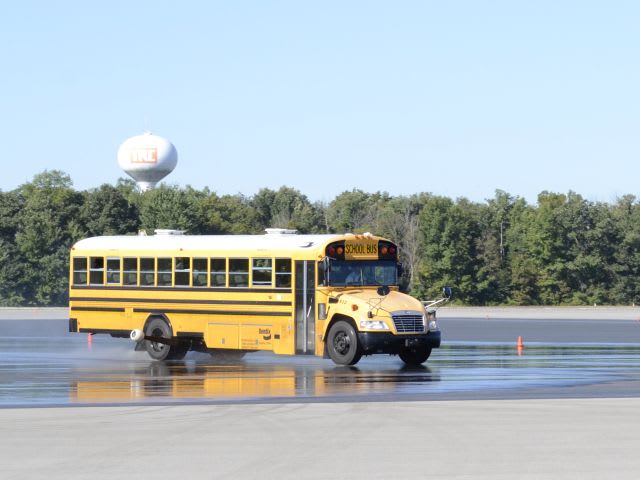
In a demonstration event, stability control technology helped keep a school bus from sliding out of its intended path while turning on a slippery surface — an epoxy-coated area that was sprayed with water.
EAST LIBERTY, Ohio — The safety benefits of electronic stability control (ESC) were brought to life in a thrilling test ride on a school bus here in late September.
Blue Bird dealers and trade journalists climbed aboard and held on tight as the bus — with outriggers extending from the side — was driven through a series of maneuvers with and without the aid of ESC.
Blue Bird and Bendix conducted the demonstration at the Transportation Research Center in East Liberty, Ohio, about 50 miles outside of Columbus.
Blue Bird introduced factory-installed ESC as an option for its All American and Vision school buses in December of last year. The Bendix system, branded ESP, is an anti-lock brake system-based technology that works to enhance stability and control during under- and over-steer driving situations.
The technology is designed to mitigate rollovers and loss of control, including slides and skids. It uses sensors throughout the chassis of the bus to monitor various vehicle parameters: the yaw rate, steering angle, brake pressure and lateral acceleration. To help keep the bus stable, the system can apply the brakes separately on the four wheels in a specific pattern.
Michael Uszak, account manager for Bendix, said that while the ESP system can enhance safety in hazardous situations, it doesn't take any responsibility away from the driver.
"The driver is always responsible for control of the vehicle," Uszak said. "The driver should intervene before the system does."
But out on a test lot for the demonstration, attendees got to experience the full effect of the ESP system intervening.
Scott Szymczak, an engineer for Bendix, drove the bus through several turning maneuvers, first with ESP off, then with ESP on.
For example, when the bus took a sharp turn too fast with no stability control assistance, Szymczak had to work hard at the wheel to keep the bus on the correct path (designated by cones) and passengers had to hold on to the seats in front of them.
With ESP activated and the bus going into the turn at the same speed — about 35 mph — the system recognized the risk and intervened by applying the brakes and de-throttling the engine. The result was that the bus automatically slowed down to about 25 mph, and the turn became more controlled and comfortable for the driver and passengers.
Another part of the demonstration was on a slippery surface — an epoxy-coated area that was sprayed with water. In this case, the ESP system helped keep the bus from sliding out of its intended path while turning on the wet roadway.
While stability control technology is new to the school bus market, it has more experience on the road in trucks and other vehicles. More than 300,000 commercial vehicles in the U.S., Canada and Mexico are equipped with Bendix ESP.
In June, the National Highway Traffic Safety Administration finalized a rulemaking that requires electronic stability control systems on heavy trucks and some large buses, such as motorcoaches, but school buses are exempt.
More Safety

How to Build a Better School Bus Driver Training Program
Is it time to strengthen your driver training? Here’s how to pick the right talent and improve recruitment, retention, and safety. This video is brought to you by IC Bus.
Read More →
Recent School Bus Accidents Leave 2 Dead, 2 Injured
Four school bus crashes in Florida, Illinois, and Georgia highlight risks in transportation lots, at bus stops, and during student loading and unloading.
Read More →
When Every Second Matters, Clarity Keeps Routes Moving
From routine delays to urgent incidents, strong communication practices help drivers, dispatchers, schools, and families respond with confidence.
Read More →

What Happens When a School Bus Catches Fire — and What Can Help
School bus fires are rare but can be devastating. Learn how advances in fire suppression and asset protection help fleets detect fires earlier, reduce damage, and improve safety.
Read More →
Geotab Launches Tool to Help Fleets Investigate Road Incidents
Geotab Investigations combines telematics data, video, documents, and other evidence to help fleets reconstruct incidents, resolve claims, and determine what happened.
Read More →
Texas Sixth Grader Wins 2026 National School Bus Safety Poster Contest
Sai Darshana Yekolu of Moseley Middle School in Prosper, Texas, was named the newest winner for her artwork, bringing the theme of “Safe Rides, Everyday Heroes” to life.
Read More →
Doing More With Less: How Transportation Directors Can Prioritize Safety Amid Budget Uncertainty
With diesel prices soaring and nearly one-third of transportation directors expecting budget cuts, maintaining student safety has never been more challenging. Download this guide to learn how leading districts are prioritizing risk, funding critical safety technology, and building stronger budget cases with data.
Read More →
Walton County Schools Adds Gatekeeper Stop-Arm Enforcement System
The Florida district will deploy Gatekeeper’s updated Student Protector technology, which now incorporates AI to improve video evidence.
Read More →
How To Build a More Secure School Bus Yard During and After Hours
As thefts and overnight security threats continue, school transportation leaders are combining stronger operational practices with AI-enabled surveillance to better protect buses, facilities, and staff.
Read More →
FMCSA Names New Chief Safety Officer: What School Bus Operators Should Know
Steve Dowling is set to lead the federal agency's efforts to advance commercial motor vehicle safety and reduce crashes, fatalities, and injuries on the nation's roadways.
Read More →