




Missouri district bus drivers train on dealing with active shooters
A retired Missouri Highway Patrol Trooper conducted the seminar for Parkway School District bus drivers. He discussed being aware of one’s surroundings, never opening the bus door to a stranger, and communication and verbal deflection techniques.

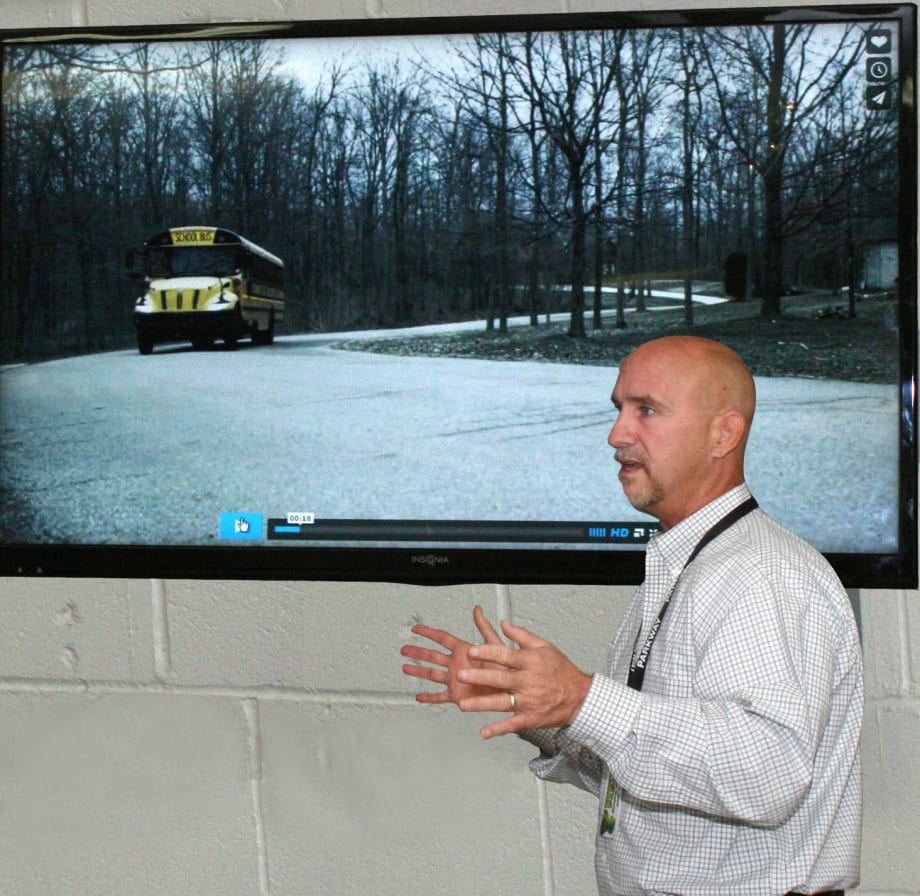
Will Rosa, director of transportation at Parkway School District, gave a recap to drivers, using videos from the Indiana State Police and Indiana Department of Education the week following an active shooter training seminar.
ST. LOUIS — Last month, Parkway School District bus drivers were armed with tools they will hopefully never have to use, as they trained for the first time on how to deal with an active shooter inside or near a school bus.
Will Rosa, director of transportation at Parkway School District, told SBF that the active shooter training seminar was conducted by Gary Moore, a retired Missouri Highway Patrol Trooper, who works as a safety coordinator for the Missouri Center for Education Safety. Moore has also collaborated with the Missouri Association for Pupil Transportation on safety videos.
Last year, the district also held a presentation by Gray Ram Tactical, which more generally covered de-escalation of violence on school buses, Rosa explained. This year, Parkway decided to hold active shooter training because Missouri recently mandated intruder drills in its schools. In response, Parkway teachers and administrators have been trained by the St. Louis County SWAT team.
“It’s a new approach to our alert drills, which encompasses what the district calls 'intruder training,'” Rosa explained. “What do you do if you’re a teacher in a classroom? The old thinking [was], run and hide under a desk. We’ve advanced our thinking [now], with all the things that have happened. It’s more options-based now: maybe you do that, or lock the door, or run.”
The training took place on Aug. 26 and started with Moore reviewing the details of the tragic incident last year in Alabama, in which a man shot and killed school bus driver Charles Poland, then took a boy from the bus and held him hostage in a bunker for six days. Moore talked about how the bus driver was groomed (the shooter befriended Poland through striking up conversations with him, offering him vegetables from his garden, and clearing his driveway so that Poland could use it to turn the bus around on his route), Rosa said. He also went over the 911 call, and stressed that drivers should “understand it does happen and this one did end badly,” Rosa added.
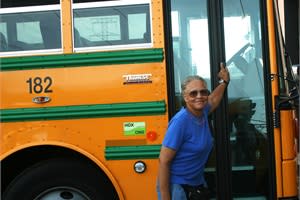
One of the main points covered in the training was to never open the bus door to a stranger, as bus driver Ernestine Carter demonstrates here.
Main take-aways from Moore’s seminar covered what he calls “JDLRs:” things that “Just Don’t Look Right,” in other words, being aware of one’s surroundings, according to Rosa. For example, drivers should take note if they spot someone they have never seen before standing at a bus stop. Additionally, Moore stressed never opening the bus door to a stranger. “In Alabama, I believe [the shooter] got on the bus instead of the driver waving him around to his window,” Rosa said.
Moore also covered communication and verbal deflection techniques that may prevent a shooting, such as showing the attacker you are listening and empathizing with them by paraphrasing their demands; talking at a lower volume and slower speed to calm a situation; and avoid using phrases such as, “You wouldn’t understand” or “what’s your problem?” which may sound antagonistic. Last resort self-defense tactics to incapacitate an attacker even temporarily, providing a chance to disarm them, included gouging the eyes or striking the throat or groin.
One week after the seminar, Rosa held a presentation in which he summarized the main points of the seminar and used shooting scenarios in bus safety training videos put out by the Indiana State Police and the Indiana Department of Education to generate discussion and help drivers apply what they learned.
Because this type of incident rarely occurs and is difficult to think about, it’s the hardest type of training to do, Rosa said.
“When the shooting [in Alabama] happened, I think we were all uncomfortable talking about it because it would scare drivers. It’s not like you’re in a school and can go into a classroom or the staff area where you can lock the door and hide. There’s nowhere to go on a bus. It’s scary when you think about it.”
However, as Rosa solicited feedback on the seminar from drivers, many told him they feel better after the training.
“Maybe just talking about it was enough [to help them] feel like they have some tools. Hopefully they’ll never have to use them. We’re trying to empower drivers to feel confident that they can handle these situations,” he said.
Other news related to active shooter training:
• School bus drivers train to take on active shooters
More Management
STA Acquires Sunrise Transportation
Student Transportation of America expands in Illinois and Connecticut through Sunrise's fleet of nearly 1,000 vehicles.
Read More →
EPA Opens $180M DERA Funding Round for Diesel Upgrades
The 2026 Diesel Emissions Reduction Act program seeks applications from eligible organizations to accelerate the retirement of legacy diesel vehicles.
Read More →
HopSkipDrive’s CareEngine Targets the ‘Exceptions’ in Student Transportation
The new platform works alongside districts’ existing transportation management systems to coordinate specialized rides, automate last-minute changes, and turn ride data into operational improvements.
Read More →


The Right Ride for Every Student: Navigating the New Student Transportation Ecosystem
How should districts blend school buses with small-vehicle transportation and other options? EverDriven CEO Mitch Bowling discusses safety, costs, partnerships, and strategy.
Read More →
Annette Brown Always Takes the Extra Time: Meet Our 2026 School Bus Driver Hero
For more than 30 years, the Wa-Nee Community Schools driver has treated students like family, combining safety, compassion, and servant leadership to make a lasting difference on and beyond the school bus.
Read More →
How to Build a Better Driver Training Program
Ready to boost up your school bus instructor training? Here’s how to pick the right talent and improve recruitment, retention, and safety.
Read More →
CALSTART and Forth Combine to Form Catalyst Mobility
The new name represents a renewed vision for the nonprofit focused on advancing clean, equitable, and affordable transportation solutions that move people and goods.
Read More →
What Makes a Great School Bus Driver Trainer?
Choosing the right school bus driver trainer takes more than experience. Learn six keys to selecting and developing trainers and evaluating program effectiveness.
Read More →
School Bus Contractors Expand Through New Deals, Acquisitions & Partnerships
STA's Canadian division acquires Ontario-based G&L Stevenson Transport; Durham School Services adds a new district in California; First Student expands in New Jersey; and Minnesota Coaches rebrands and acquires Halo Transportation.
Read More →
Logan Bus Company Rolls Out AI Phone System for NYC School Bus Families
A summer pilot found that AI agents could handle most routine calls, freeing up time for customer service staff to focus on emergencies and complex family concerns.
Read More →