Corrado Boosts Accountability in School Bus Contracting
Through his leadership of Suffolk Transportation and his work with industry associations, John J. Corrado has raised the bar for safe and efficient student transportation.
Thomas McMahon・Executive Editor
August 18, 2017
School Bus Fleet has named John Corrado its 2017 Contractor of the Year. He is the 50th recipient of the award, which was presented at the National School Transportation Association’s annual meeting in Indianapolis in July.
7 min to read
School Bus Fleet has named John Corrado its 2017 Contractor of the Year. He is the 50th recipient of the award, which was presented at the National School Transportation Association’s annual meeting in Indianapolis in July.
When John J. Corrado got started in pupil transportation in 1988 after working in public accounting, he was surprised to learn that cost was the only criterion used for awarding school bus service contracts in New York state at the time.
Corrado, now president of Suffolk Transportation Service on Long Island in New York, says this meant that some subpar school bus operators were winning contracts, because school districts had to select the lowest bidder.
“Several companies were running out of gas stations and dirt lots. No training facilities, no road supervision, and in some cases no shop,” Corrado recalls. “This did not sit well with me.”
Tapping Into Technology
Under Corrado’s leadership, Suffolk Transportation Service has invested in technology to enhance safety and efficiency in the company’s fleet and facilities. Here are some highlights:
• GPS system for tracking vehicles, reviewing driver performance, comparing planned vs. actual routes, and managing payroll costs.
• Bus tracking app for parents and supervisors.
• IPads issued to all transportation supervisors for emergency notifications, GPS route review, weather and road conditions, and driver files.
• Onboard tablet system with student tracking software.
• Computerized fuel tracking system and routing software.
• Digital internet-based security system at each terminal.
• Enhanced Child Check-Mate System, with motion sensor and communicating device.
• Third experimental version of a hybrid bus.
• Punch Alert platform for rapid communications between drivers and dispatchers in emergencies.
• Web-based employee portal, My Parking Space, enables staff to register for training classes, review compliance due dates at driver check-in, report safety issues, and fill payroll discrepancy requests.
Through the New York School Bus Contractors Association (NYSBCA), Corrado and the similarly named John Corr of The Trans Group spearheaded a push for a request for proposals (RFP) law that would enable districts to choose a school bus contractor based not only on cost, but also on such factors as safety record, quality of service, fleet condition, and reliability.
“The assignment of moving children was just too important to leave to the lowest bidder, and I knew I could not spend my entire career trying to figure out how to cut corners on safety to win bids,” Corrado says.
In his nearly 30 years in the industry, Corrado has served as a driving force for safe and efficient student transportation at his own company and beyond. For his enduring efforts, School Bus Fleet has named Corrado its 2017 Contractor of the Year. He is the 50th recipient of the award, which was presented at the National School Transportation Association’s (NSTA’s) annual meeting in Indianapolis on July 18.
Ad Loading...
Family Business
John J. Corrado comes from a long line of bus operators. Both of his grandfathers began providing transit service in the boroughs of New York City in 1922.
Corrado’s father, John A. Corrado, started his own bus career with the company that his father and father-in-law helped establish, Green Bus Lines. In 1970, John A. Corrado acquired Suffolk Transportation, which had been transporting schoolchildren in Suffolk County, New York, since 1955.
After graduating from the University of Michigan in 1986, John J. Corrado began a career not in the bus business, but in public accounting. In that line of work, he investigated companies to determine whether their public financial information was entirely accurate.
“As an auditor, I turned over every stone on my accounts to make sure that the public investor could rely on the information being provided,” Corrado recalls.
After about two years as a certified public accountant, Corrado’s family ties to transportation proved too strong to resist.
“My uncle Edward Arrigoni from New York Bus Service invited me to a lunch with my father and convinced me to give the bus business a chance,” Corrado says. “I started with my father in 1988, and I have no regrets.”
Corrado joined Suffolk Transportation as treasurer. Eight years later, he took the reins as president of the family business, which at the time had a fleet of about 800 school buses. Since then, Suffolk has grown to operate 1,300 school buses, transporting 50,000 students daily and employing more than 2,000 people. The company is now ranked No. 15 on School Bus Fleet’s 2017 Top 50 Contractors list, which is based on fleet size.
Under Corrado’s leadership, Suffolk has earned numerous honors and high ratings. Those have included:
• Consistent scores above 95% on New York Department of Transportation bus inspections. • A 100% score on a National Interstate Insurance Company safety report. • 99% on a voluntary security audit by the Transportation Security Administration. • “A” ratings from the New York Public Transportation Safety Board. • Ranked No. 20 for large employers in the 2017 “Best Companies to Work for in New York” list.
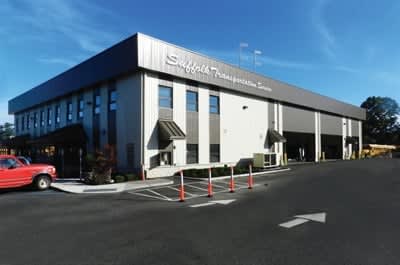
In 2013, Suffolk unveiled a new $6 million school bus transportation hub in the hamlet of Coram. The facility features a bus washing system, a fueling station, solar panels, and LED lighting.
Security Measures
Partly due to the company’s proximity to New York City, security and emergency planning have been top priorities for Corrado and Suffolk Transportation.
The company has provided critical transportation assistance during major crises in the region. Suffolk buses moved first responders after the crash of TWA Flight 800 in 1996 and the terrorist attacks on Sept. 11, 2001. Suffolk also took part in evacuating residents after Hurricane Sandy in 2012.
“These were all big efforts that required many to act selflessly, and they did so with pride in their community and our company,” Corrado says.
Meanwhile, Corrado has led Suffolk’s ongoing investments in training and equipment to bolster safety and security. Based on an assessment by the Transportation Security Administration in 2010, Suffolk developed a quarterly facility audit process and bought and developed several properties — installing drainage, asphalt, lighting, fencing, barbed wire, and security cameras — to provide more secure parking for the company’s buses.
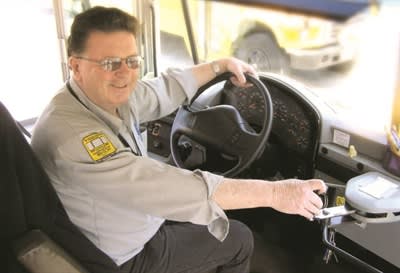
Suffolk transports 50,000 students daily with a fleet of 1,300 school buses. Seen here is one of the company’s drivers, John Simms.
Facility Upgrades
In 2013, Suffolk unveiled a new $6 million school bus transportation hub in the hamlet of Coram. The company bought an existing bus yard, razed an outdated building on the site, and built a new 20,000-square-foot maintenance, dispatch, and training facility. Experience with past construction projects and employee input helped shape the new Coram hub.
“We have built several facilities, and we learned from our mistakes each time,” Corrado says. “The shop at Coram is set up exactly as the shop supervisors and mechanics would have it.”
The facility features a bus washing system, a fueling station, and — to reduce energy costs — solar panels and LED lighting. The building is positioned in the middle of the yard, which Corrado says allows for safe and convenient pedestrian movements.
“Our customers, our employees, and the town all appreciate the investment that was made to bring our service … in that area to a higher level,” he says.
In all, Suffolk has seven locations, three of which have maintenance facilities, throughout its service area in Long Island.
“All of our facilities are strategically located to reduce payroll and fuel [costs] to our customers,” Corrado says, adding that the company is “constantly renovating and upgrading. It is expensive, but our facilities are an important tool [in] delivering safe and efficient service.”
In addition to school bus transportation, Suffolk provides transit and paratransit services. This requires meeting Federal Transit Administration and New York Public Transportation Safety Board regulations, including implementing a system safety procedure plan (SSPP) that has to be approved by the state every three years.
“It is a great process that I feel should be expanded to include school buses in our state,” Corrado says of the SSPP.
For all of its operations, the company uses a six-point checklist, dubbed the “Suffolk Six,” that covers essential training and safety procedures.
Ad Loading...
Corrado’s family has deep roots in the bus business. Seen here is his grandfather, also named John Corrado, who began providing transit service in New York City in 1922.
Ensuring Accountability
Corrado has been a key contributor to industry initiatives, including the aforementioned RFP effort in the ’90s. He and about two dozen other contractors met with then-Gov. George Pataki and convinced him of the proposal’s importance for safe student transportation in New York.
The RFP law passed in 1996, although it had to be reapproved every five years because of a “sunset provision” that allowed the New York State Legislature to determine whether the use of RFPs would actually improve private pupil transportation services.
In 2014, after it had been renewed three times by the Legislature, the RFP law was made permanent, which NYSBCA officials said showed that it was having the intended effect on school bus contracting in the state.
“The RFP process is a very important tool for the school districts and taxpayers,” NYSBCA’s then-President Robert Pape said when the law was made permanent. “It helps keep children safe by effectively excluding fly-by-night operators from pupil transportation services, and it also provides school districts with the ability to hire a pupil transportation contractor that fits their community’s service needs.”
“John Corrado embodies what we all hope to accomplish as contractors.” Todd Monteferrario, past president, National School Transportation Association
Working Together
Corrado says that school transportation associations provide an important forum for discussing issues that face the industry, including safety concerns, taxes, labor regulations, and changing vehicle specifications.
More Award Winners
To see the full list of honorees in NSTA’s awards program, go here. Results from the School Bus Driver International Safety Competition, which NSTA hosted, can be found here.
“We do this professionally and collectively develop effective, coordinated solutions to our problems,” says Corrado, who currently serves as treasurer of the NYSBCA. “This improves safety for our riders and efficiency for our customers.”
Along with his involvement in the New York contractor association, Corrado is a longtime member of NSTA. About 10 years ago, he earned the national association’s Golden Merit Award, which recognizes excellence in service, safety, and community responsibility.
Todd Monteferrario, who concluded his term as president of NSTA at the association’s meeting in July, says that SBF’s Contractor of the Year award is a well-deserved honor for Corrado and his company.
“John Corrado embodies what we all hope to accomplish as contractors,” Monteferrario says. “He and his team at Suffolk Transportation work hard every day to ensure safe transportation for all students and industry-leading specialized training for the drivers. He works tirelessly in his community to ensure it is a better place through the support of dozens of organizations.”
Is it time to strengthen your driver training? Here’s how to pick the right talent and improve recruitment, retention, and safety. This video is brought to you by IC Bus.
Four school bus crashes in Florida, Illinois, and Georgia highlight risks in transportation lots, at bus stops, and during student loading and unloading.
School bus fires are rare but can be devastating. Learn how advances in fire suppression and asset protection help fleets detect fires earlier, reduce damage, and improve safety.
Geotab Investigations combines telematics data, video, documents, and other evidence to help fleets reconstruct incidents, resolve claims, and determine what happened.
Sai Darshana Yekolu of Moseley Middle School in Prosper, Texas, was named the newest winner for her artwork, bringing the theme of “Safe Rides, Everyday Heroes” to life.
With diesel prices soaring and nearly one-third of transportation directors expecting budget cuts, maintaining student safety has never been more challenging. Download this guide to learn how leading districts are prioritizing risk, funding critical safety technology, and building stronger budget cases with data.
As thefts and overnight security threats continue, school transportation leaders are combining stronger operational practices with AI-enabled surveillance to better protect buses, facilities, and staff.
Steve Dowling is set to lead the federal agency's efforts to advance commercial motor vehicle safety and reduce crashes, fatalities, and injuries on the nation's roadways.