




Great Fleets Across America 2010
Our annual series is back as we profile five outstanding pupil transportation operations from around the nation. Find out how their safety practices, innovative training programs and open lines of communication have led them to succeed.
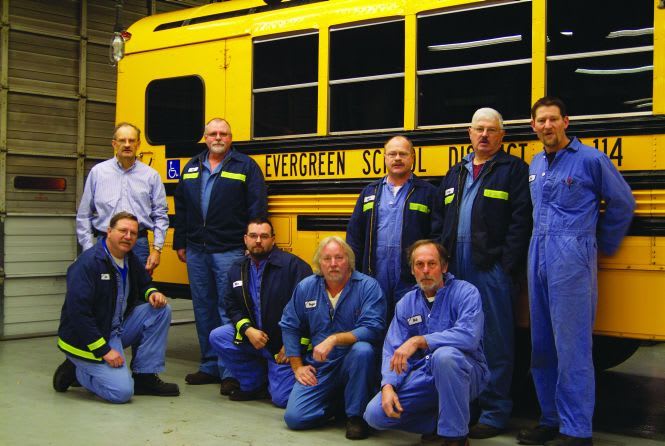
Transportation Manager Gary Thomsen, far left, credits the high state inspection scores of Evergreen School District to a strong preventive maintenance program.
Dare County Schools
Nags Head, N.C.
Staff experience encourages success
Dare County Schools’ transportation staff has had much to celebrate in the past several years.
For two consecutive years, the department has received the best bus safety inspection rating for the state’s eastern region by the North Carolina Department of Public Instruction. Moreover, one of the department’s drivers placed second in the state’s school bus roadeo last year and went on to compete in the International School Bus Driver Safety Competition.
A key to the department’s success, and what Transportation Director David Twiddy believes is its greatest strength, is the staff’s experience. Most of the employees have been with the department for over 10 years, and Twiddy has worked at Dare County Schools for more than 20 years. He served as a student bus driver for the district, and upon graduating high school in 1988, he worked as a fuel truck driver and later as a technician before becoming transportation director in 1999.
Twiddy says he feels that intra-department communication has been the primary contributing factor to the department’s low turnover. He allows all members of the staff to have hands-on roles in day-to-day responsibilities, and he meets with them regularly to discuss impending changes or projects.
Twiddy also offers incentives for employees who exhibit a strong work ethic. “Each month, the drivers who don’t miss a day receive $100,” he reveals, “and the drivers are given $10.50 a day to clean their buses.” Twiddy says this not only creates a sense of pride among drivers toward their buses, it also keeps the buses in good condition.
The staff’s experience has also been instrumental in helping them find solutions to the challenges that they face. Dare County Schools is located on the coast, and Twiddy says they deal with everything from hurricanes to snow. As an example, Twiddy cites a strong storm that passed through the area last year. “It affected our pickups; we couldn’t go down some roads because they were flooded, and we had to reroute buses,” he says.
Another challenge stems from residents who frequently move around the county. Serving students whose addresses and pickup and drop-off points constantly change makes it difficult for the department to keep records up to date, but Twiddy says that utilizing EDULOG’s routing software has helped in this area. The department also began using EDULOG’s GPS solution over two years ago, facilitating bus stop consolidation and more efficient routes.
For the past year, the department has been participating in a pilot program for the state to test the effectiveness of Rosco Vision Systems’ Bright-Vision Safety System. Two of the operation’s school buses and one of its 21 activity buses are equipped with the system, which illuminates the danger zone in low-light situations and allows drivers to more easily see students who might be in the zone.
“Anytime that there’s a chance for us to pilot something that will make riding a school bus safer for students, we like to do it,” Twiddy says.
In addition to serving students, the department aids residents of Dare County and its neighboring county. Twiddy says that the department uses its school buses to assist with evacuations during hurricane season; the buses are also used to assist with emergency management efforts for sick and elderly residents.
On the “green” front, the department recently began recycling its old vehicle filters.
— KELLY ROHER
Fleet Facts
School buses: 46
Students transported daily: 1,910
Schools served: 11
Transportation staff: 55
Area of service: 150 sq. miles
[PAGEBREAK]
[IMAGE]429[/IMAGE]
Evergreen School District
Vancouver, Wash.
A many-angled approach to pupil transport improves safety, morale
Before he became transportation director of the Evergreen School District in Vancouver, Wash., Gary Thomsen worked just about every other job in pupil transportation, including driver, driver trainer, dispatcher, administrator and supervisor.
“When you’ve experienced all the different jobs, it’s better to run the department, supervising people,” he says. “You can better understand what they’re dealing with.”
In his 25 years with the district, Thomsen has helped to improve the transportation department. “We have received outstanding inspections the last 20 years,” he says. Many of those years, the department has had an out-of-service rate of less than 1 percent.
Thomsen says half the buses are on a state-recommended 13-year depreciation schedule, with the rest to follow. Fleet Vision is used to track bus maintenance schedules, and every bus is brought in for a safety inspection at 1,500 miles.
Ten full-time mechanics work in two shifts, and Thomsen says, “I think all of our guys in the shop understand the importance of their job and understand that the priority is always safety.”
Though limited funding usually leads to fewer new technology installations, Thomsen hopes to install video recording equipment on all newly purchased buses. About 20 percent of the regular buses are already equipped with cameras.
In addition, the department was given a grant from the Washington Green Air Agency to retrofit 80 pre-2007 model buses with diesel particulate traps and a crankcase filtration system. This led to significant emissions reductions.
Other green efforts include a no-idle policy at schools, five-minute morning warm-up and recycling of waste oil, antifreeze, tires, metal and dirty bus wash water.
On the personnel side, four full-time driver trainers work closely with the mechanics and drivers to maintain open communications. Since the drivers are the most comfortable and knowledgeable about their buses, they are usually the first ones to realize when something isn’t quite right. “We want our drivers to not feel intimidated at all about going and talking to the shop foreman about a problem on the bus,” Thomsen says.
Thomsen says turnover is low for drivers — less than 2 percent per year from a group of 205 regular drivers — and nearly nonexistent for mechanics, driver trainers, dispatch and other staff. He says Evergreen is one of the higher-paying districts around for drivers, and they average over five hours a day.
In order to keep up morale, programs are in place to acknowledge drivers. Once a year, the office staff makes breakfast for the drivers as they come in. Food is donated, and Thomsen says, “I’ll try to get the superintendent to come over and flip sausages with us, and get various other VIPs to join.”
Moreover, the end-of-the-school-year drivers’ award banquet is where the Driver of the Year is announced. The “Brag Award” is given to a person who goes above and beyond the call of duty. Other awards include perfect attendance honors.
“Our goal is to make drivers successful,” Thomsen says. “That’s the bottom line.”
— THI DAO
Fleet Facts
School buses: 240
Students transported daily: 16,000
Schools served: 33
Transportation staff: 280
Area of service: 55 sq. miles
[PAGEBREAK]
[IMAGE]430[/IMAGE]
Garfield School District Re-2
Rifle, Colo.
Protecting and educating their passengers
The transportation department at Colorado’s Garfield School District Re-2 has always been committed to getting students to school safely. But they wanted to do more than that.
“Several years ago, as a department, we drew up our own mission statement and made a vow to be a bigger part of these kids’ education,” says Sanja Morgan, director of transportation.
The main manifestation of that goal was the development of an innovative reading program for school bus passengers. The transportation department began collecting used books from libraries and other sources, and book bags were placed on each bus.
Students can choose from those selections or bring their own books, or they can opt to do their own homework or help other children in their studies. Whichever option they go with, they get a punch on a special bookmark for that ride (or sometimes two if they’re on the bus a long time). At 25 punches, they can turn in their bookmark for a prize, or they can save up more punches for bigger prizes.
Beyond contributing to the children’s learning, Morgan said that the program reduces noise and disciplinary issues on the buses — which, in turn, enhances safety.
Of course, safety is still the transportation department’s No. 1 priority, and teaching students about school bus safety is a vital part of that mission.
The department has a miniature bus, called Little Bear, that staff members take to the schools to bring safety lessons to life. “It makes it easier to get the point across about school bus safety with the younger kids,” Morgan says.
As an additional training opportunity for staff, the transportation department held a mock school bus accident last summer. The local fire department, EMS and AirLife participated, and children in 4-H portrayed the crash victims.
Morgan says that the event was “very enlightening,” showing how emergency response works and what role transportation staff plays in it.
“We’re hoping to make a video out of it and offer it to all Colorado school districts as a training program,” Morgan says.
Garfield School District Re-2 covers three small towns in a mostly rural, mountainous area in the western side of the state.
Because of the terrain and the substantial snowfall in the winter, the district has automatic snow chains and engine retarders on all of its buses. Newer buses have been spec’ed with heated mirrors and heated stepwells. Two years ago, the video surveillance system was upgraded, and all buses were equipped with cameras.
To bolster safety and aide drivers on the many rural routes, reflective school bus signs are posted at stops. The signs are particularly helpful for substitute bus drivers as well as during inclement weather and low-light conditions.
As with many other school bus operations these days, budget cutbacks are a key challenge for the Garfield transportation department. “We’re being asked all the time to do more with less, and somehow, God willing, we’re getting that done,” Morgan says.
But she notes that the school board is very supportive of transportation and has stayed committed to bus replacement, and although salaries have been frozen for the past two years, they remain competitive.
Also, the district recently secured funding to install engine preheaters and diesel oxidation catalysts on its buses to reduce emissions.
— THOMAS MCMAHON
Fleet Facts
School buses: 43
Students transported daily: 2,000
Schools served: 11
Transportation staff: 44
Area of service: n/a
[PAGEBREAK]
[IMAGE]431[/IMAGE]
Hanover Park Regional High School District
East Hanover, N.J.
Tiered routes lead to top efficiency ratings
While Hanover Park Regional High School District’s transportation department can count many successes, Transportation Director Christopher Bluett says the department’s standout success is its efficiency.
The department, located in East Hanover, N.J., was rated most efficient transportation department in the state for the third year in a row. Scoring is based on the number of students transported as compared to the number of seats in the buses used to transport them.
“When I got here, the question was: How can we be more efficient?” Bluett says. Having served in a committee on school business efficiency, he planned out and implemented school time adjustments and had drivers trained in all aspects of transportation.
By changing school times by about 15 minutes, buses could serve multiple schools, one after another. Dismissals were tweaked as well, and this allowed a two-hour window for routes that average about four schools. In addition, cross-training enables drivers to rotate and cover additional work when needed.
Bluett emphasizes that it’s the cooperation of the staff and everyone involved that has led to the success of the changes. “One person can come up with a plan, but it takes everyone to implement it,” he says. “For this plan to work, you need the cooperation of the driver, of the individual schools and their administrations, as well as our own people in-house.”
Drivers play their part by providing feedback about how a route is working. The schools were flexible with making changes to their schedules, and special-needs schools provided schedules far in advance for routing purposes. The athletic department and schools taking field trips keep bus schedules in mind when planning an event.
Two mechanics service the 40-vehicle fleet, and buses are kept at the maximum 12-year cycle. In addition to twice-yearly inspections by the state, vehicles are inspected quarterly, or every 3,000 miles, whichever comes first.
Green initiatives include the use of synthetic oils. Instead of changing the engine oil every 3,000 miles, mechanics test it at regular intervals and change the oil only when necessary. “The benefits have been two-fold,” Bluett says. “We use about one- third the oil, saving money and reducing waste oil to one-third what it would otherwise be. We can also detect engine problems earlier and prevent catastrophic engine failures.”
The department follows New Jersey’s three-minute idling law, with signs to remind drivers. In addition, block heaters for diesel buses and heated mirrors help warm up the vehicles and defrost windows and mirrors without violating anti-idling regulations. Closed crankcase emission equipment was recently added to buses to cut down on emissions from exhaust.
Bluett says the department’s staff members have a genuine concern for each other, which helps maintain almost no turnover. “When you build up the importance of what’s being done, people value it, and they, in turn, talk to others,” he says. “People want to work here. That’s the best recruitment tool you can ever have, and it’s the best retention tool.”
Bluett stresses that improved efficiency does not mean a lag in safety. In fact, drivers receive a safety bonus for going a full year without a preventable accident, a bonus that nearly all drivers receive. Of efficiency and safety, Bluett says, “We’ve found they’re two sides of the same coin.”
— THI DAO
Fleet Facts
School buses: 40
Students transported daily: 3,000
Schools served: 40
Transportation staff: 42
Area of service: 50 sq. miles
[PAGEBREAK]
[IMAGE]433[/IMAGE]
Stumbo Transportation
Ogden, Iowa
Long service points to strengths
In this day and age of corporate takeovers and economic struggle, there’s a lot to be said for a small family business that has been doing good work for decades and sees nothing extraordinary in simply providing high-quality service, day in and day out.
Stumbo Transportation of Ogden, Iowa, has been around since 1941, when Doug Stumbo’s father, Jack, started taking farmers’ children to the country school in a single bus. “They approached my dad because he had a couple semis, farm trucks and gravel trucks,” he says. “By 1948 he had five routes.” And by 1956, Stumbo Transportation was exclusively a school bus company. Doug remembers making his first school bus purchase for the company — a $9,500 expenditure — and remarks that of all the changes he’s seen in the industry over the years, the evolving construction of school buses is the most notable.
Today, Stumbo Transportation runs seven routes as well as activity trips for the Ogden Community School District. Stumbo says he hadn’t always planned on going into the family business. “I had other ideas growing up — you know how kids are,” he says. But when he got out of the Army in 1969, Stumbo decided to work with his father. He’s now seen six superintendents at the school district and is transporting his third generation of Ogden families.
Stumbo Transportation has long relationships with its drivers, as well. “I have one driver that has been with me since 1974, and a couple that have been here since 1978,” Stumbo says. He describes the employees as a close-knit group. They celebrate holidays, the end of the school year and birthdays together each year. “I don’t know how it ever started, but whoever’s birthday it is, they have to bring in the cake and ice cream to celebrate,” Stumbo says.
Stumbo takes care of all bus maintenance himself, keeping his seven route buses — 65-passenger diesels — and three spares in prime condition. “I just keep things written down and try to stay ahead of anything that might come up,” he says. “My drivers are good about telling me about problems so I can stay on top of things.” He also fills in as a substitute driver as needed.
Among the challenges the operation faces are severe winter weather, like the heavy snow storms that hit the Midwest this past December, and making sure all the routes are covered when activity trips come up, Stumbo says. “Our schools have a policy that each class gets at least one trip during the year, and some get more than that,” he explains. Students regularly take trips to Des Moines to see the state capitol building, and transportation for sports events also keeps Stumbo busy.
He ensures that a certain set of events are attended to each year: the state’s required school bus safety meetings, twice-yearly evacuation drills with students, and attending the Iowa Pupil Transportation Association’s annual summer conference in Des Moines.
What is he most proud of? “I guess just being around for as many years as we have and the personal contact we have with the school district and people in the community,” Stumbo says. “It’s been rewarding just watching the kids grow up over the years and then graduate, and then all of a sudden you’re taking their kids to school too.”
— CLAIRE ATKINSON
Fleet Facts
School buses: 10
Students transported daily: 350
Schools served: 3
Transportation staff: 12
Area of service: 143 sq. miles
More Safety
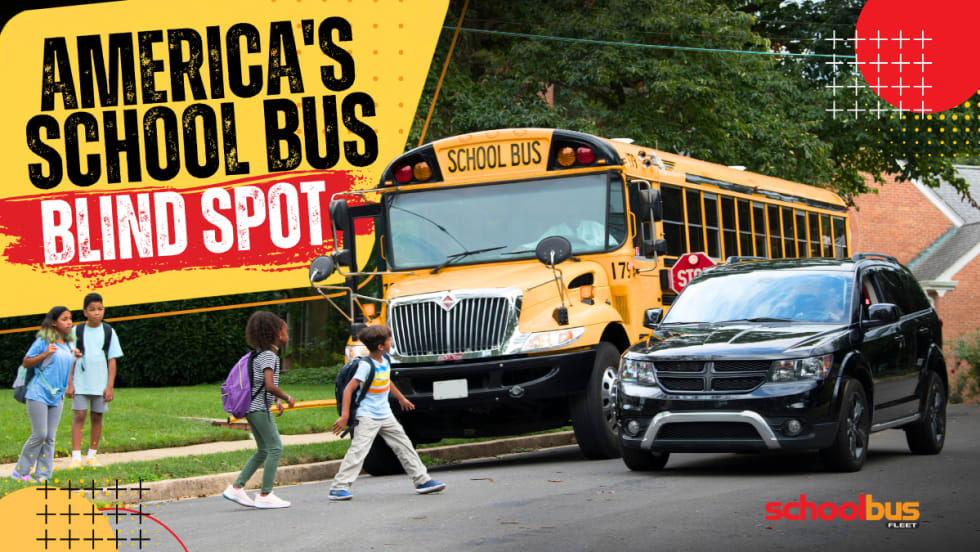
America Has a School Bus Passing Problem — and Distraction Is Making It Worse
Illegal school bus passing remains a major safety threat as distracted driving rises. This op-ed explores why awareness, enforcement, and stop-arm cameras matter more than ever.
Read More →
School Bus Laws to Watch: New York Delays EV Mandate
Plus, federal lawmakers seek new funding for school bus safety as states weigh stop-arm enforcement, disability protections, and education spending.
Read More →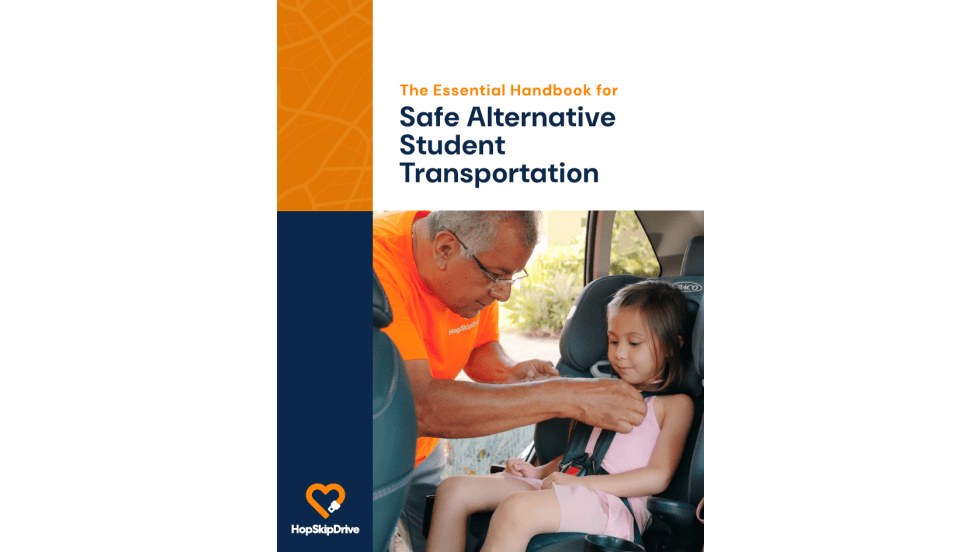
The Essential Handbook for Safe Alternative Student Transportation
Your district's "exception riders" — students with IEPs, those experiencing homelessness, foster care youth — deserve more than a middleman solution. This handbook breaks down exactly what to look for in a supplemental transportation partner: from driver vetting and regulatory compliance to proactive safety technology. Because getting a ride isn't the same as getting a safe one.
Read More →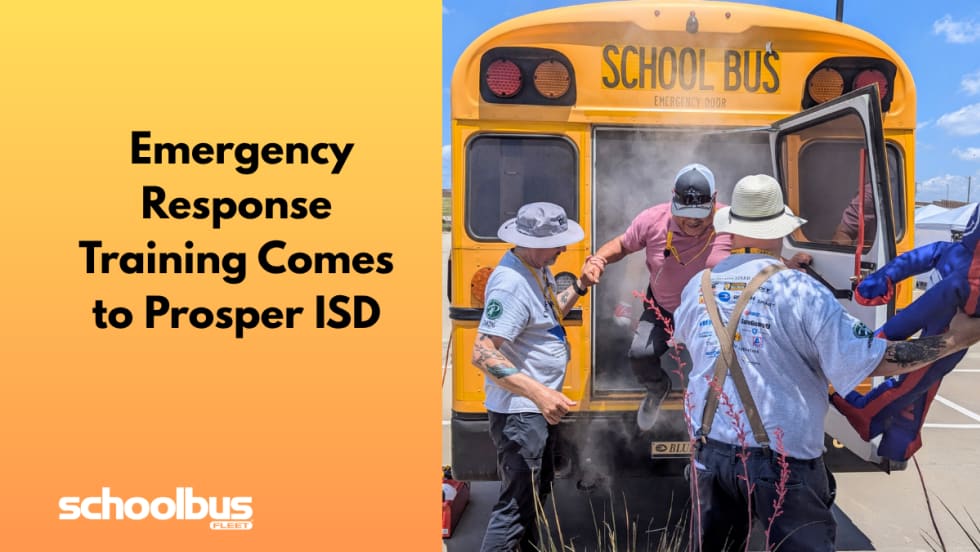
Operation STEER Brings Emergency Response Training to North Texas
Prosper ISD hosted the third annual training for transportation professionals across 67 districts to learn how to respond to emergencies, such as rollovers and evacuations, and proper use of safety equipment.
Read More →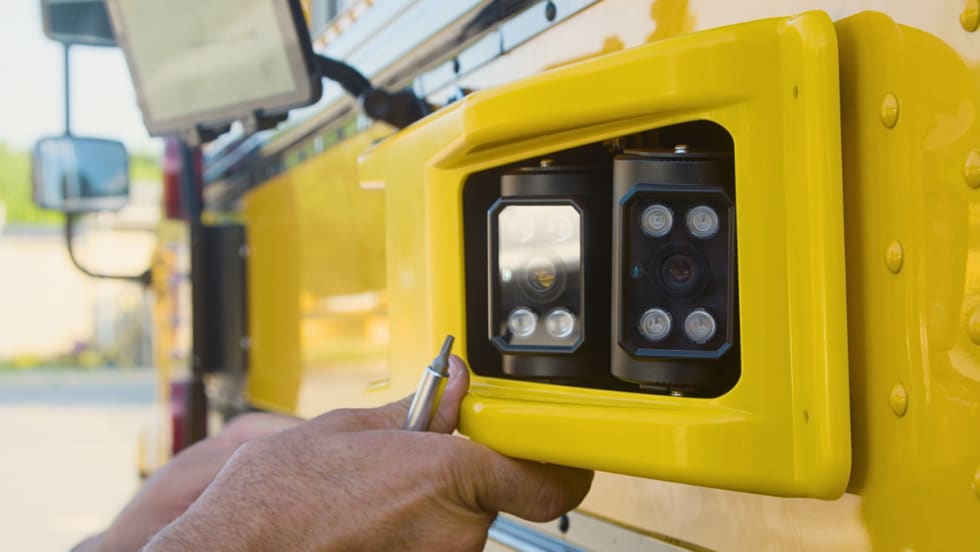
Florida District Relaunches BusPatrol School Bus Camera Program With New Safeguards
After being suspended over due process concerns, Miami-Dade schools and law enforcement are restarting the AI-powered stop-arm camera program with new oversight.
Read More →
School Bus Laws To Watch: Seat Belt Bills, Funding Fights & EV Changes
From national bills on seat belts and driver oversight to driver awareness campaigns referencing “Finn’s Rule” and ongoing transportation funding debates in Alaska, here’s the latest in school bus legislation across the U.S.
Read More →
9-Year-Old Boy Killed by School Bus at Busy Brooklyn Intersection
A Williamsburg community is mourning after a child was fatally struck by a private yeshiva bus, prompting calls for urgent safety improvements at the high-traffic crossing.
Read More →
Does Reliable School Transportation Boost Attendance? EverDriven’s Data Says Yes
The new data shows 99.99% incident-free trips and strong on-time performance, reinforcing how dependable transportation, especially for vulnerable student populations, can help districts combat chronic absenteeism.
Read More →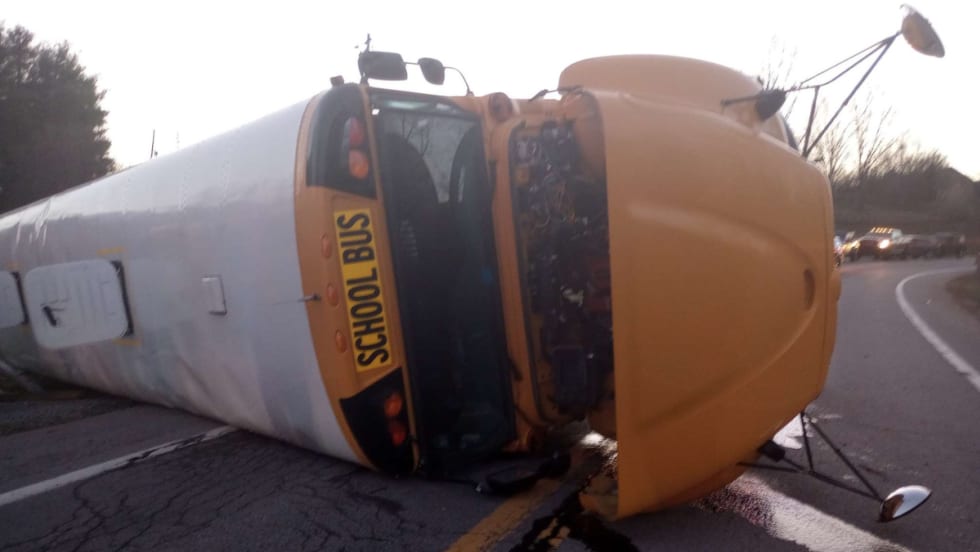
NTSB Calls for Alcohol Impairment Systems, Seat Belts After W.V. Crash Investigation
The federal agency's report asks NHTSA to require all new school buses to be equipped with vehicle-integrated alcohol detection systems and passenger lap-shoulder belts.
Read More →
2026 State of Student Transportation Report
Student transportation teams are being asked to do more with less, facing driver shortages, rising costs, and increasing safety expectations. This report uncovers how fleets are adapting, where technology is making the biggest impact, and why student ridership tracking is emerging as a top priority. Download the report to explore the key trends shaping 2026 and what they mean for your operation.
Read More →