




Approaches to Protect Students in Loading Zones
Recent student fatalities highlight the importance of maximizing safety in and around this area at schools. Pupil transportation industry professionals offer many effective ways to do so, from separating groups of traffic to implementing detailed policies for bus drivers to providing training for students. Communicating with school staff and parents is essential.

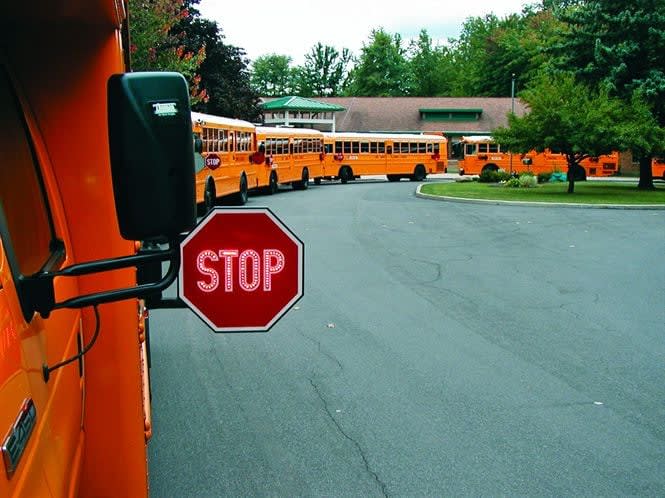
Pictured is the bus loop at Highland Elementary School in Derby, N.Y. Motorists are prohibited from entering the bus loops at all of Lake Shore Central School District’s elementary schools to help prevent students from being injured.
Data published by the Kansas State Department of Education indicate that there have been several student fatalities in bus loading and unloading zones at schools in recent years.
According to the latest National School Bus Loading & Unloading Survey, from 2004 to 2007, one fatality occurred while students were unloading from buses in the morning, and one fatality occurred while students were boarding buses in the afternoon.
This year, School Bus Fleet has learned of two fatal bus drop-off accidents at schools. In January, pre-kindergartner Jameer Woodley was crossing his school's parking lot in Courtland, Va., after disembarking his bus when he was struck by another bus. The Southampton County Sheriff's Office investigated the accident.
The second bus had completed its unloading, and the driver received a signal that the area was clear. The driver pulled the bus out of its parking space and made a right turn into the travel lane of the parking lot. Woodley was crossing the travel lane when he was struck by the bus.
The following month, fourth-grader Christopher Beltz left his bus in the parking lot at Spring Mill Elementary School in Indianapolis' Washington Township. A lieutenant for the Indianapolis Metropolitan Police Department said in a news conference that when Beltz ran out of his bus, he darted between a row of cars parked between where he was dropped off and the school building. There was also a bus there that had just dropped off another student at the curb. As that bus was leaving, Beltz ran in front of it.
These fatalities show that industry officials must remain vigilant and employ every means at their disposal to maintain student safety in bus loading zones to prevent accidents.
"I think the event in Washington Township serves as a reminder that just because you've done your process for umpteen years, it deserves evaluation for the potential of improvement," says Pete Baxter, school transportation director at the Indiana Department of Education (DOE).
Southampton County Public Schools (SCPS) and Metropolitan School District of Washington Township (MSDWT) officials recognized this in the wake of the accidents on their school campuses this year and have changed their loading zone policies.
Pupil transportation industry professionals have numerous suggestions for how to maximize student safety in loading zones, and many practices have been implemented at operations around the country.
Districts Enforce Preventive Measures
Following the accident in Courtland, Va., SCPS changed its bus unloading procedure. Superintendent Charles Turner wrote in a letter to parents that students would be "unloaded directly in front of the entryway at the curb during the morning, one bus at a time."
MSDWT took the fatality at their elementary school very seriously as well. "I'll never get over it," Superintendent James Mervilde says. "We need to do everything we can to make sure this never happens again."
The district's preventive measures are comprehensive. A safety task force that includes transportation officials, school administrators, traffic experts and educators was formed to evaluate transportation practices and associated traffic issues at each school.
Each school now has a schematic drawing created by the task force that displays an approved traffic flow for morning drop-off and afternoon pickup by buses and cars. School maps and the schematics are distributed to the bus drivers and parents and posted on the schools' Websites.
Traffic supervision has also improved. At least one trained security officer is required to be on duty at each school to direct traffic during morning drop-off and afternoon pick-up. In conjunction, more school staff members are assigned outside during arrival and departure times to ensure safety and parent compliance with revised procedures.
To notify parents of the revised procedures, Mervilde taped a back-to-school message asking parents to listen to school officials in regard to where they are allowed to park their cars.
"We have some new principles," he adds. "When kids are moving, the buses can't be moving, and when the drivers are at their stops, they must turn off their buses." The drivers are also required to drop off kids at the curb, preventing them from walking across lanes of traffic.
In addition, MSDWT hired CSO Architects to conduct a district-wide evaluation of the school buildings, paying particular attention to traffic flow by school buses and cars. Upon completion, the company submitted proposal projects to improve safety and traffic flow at all of the schools. Spring Mill Elementary now has concrete barricades that define a crosswalk from a guest parking lot to a sidewalk on the north side of the building. Moreover, all buses must park on the front side of the school, and cars are restricted to a side parking lot.
Analyzing and Separating Traffic Is Encouraged
Pupil transportation professionals agree that analyzing the traffic flow in and around loading zones and separating school buses from other types of traffic are excellent ways to prevent loading zone fatalities.
"Take a step back and look at the design of the loading zone," says Kathy Furneaux, executive director of Syracuse, N.Y.-based Pupil Transportation Safety Institute. "When you have a big melting pot of traffic, it really becomes problematic because of the blind spots around a bus."
Furneaux says separating traffic to increase safety does not always involve a major overhaul. She was recently asked by officials at a school in Liberty, N.Y., to evaluate their loading zone because they were having problems with traffic.
"It was as simple as moving a section of a parking lot over and putting in another lane," Furneaux reveals.
Ted Finlayson-Schueler, president of Safety Rules!, in Syracuse, N.Y., says that one of the best ways to analyze loading zones is to start before the buses arrive and continue until all stragglers have left. He recommends videotaping the process from a location where the entire area can be seen (the school rooftop, for instance) so that each vehicle's movement can be studied.
He also suggests getting a map of the school property and noting all of its entrances as well as parking lot/street entrances and identifying where each group (school buses, parents in their personal vehicles, school staff, students who walk to school, etc.) is currently accessing the building and its surrounding area.
Like Furneaux, Finlayson-Schueler encourages separating each class of traffic. This can be accomplished with space or time. "If parents are not let onto the school grounds in the afternoon until the buses have left, you have two loading zones separated by time instead of one that is dangerous and congested," Finlayson-Schueler explains. "In the same way, driving staff and students can be held in their parking lots until the buses are released, creating space for the buses to leave without having to share the roadway."
Finlayson-Schueler notes that special attention should be given to students who walk to school. "Walkers need to have clear direction about how to access and leave the school, and careful consideration should be given to their ability to do that without having to cross traffic while coming to or leaving the school. If walkers are held in the school until the buses leave, it can significantly reduce congestion," he said.
Operations Relocate Bus Loading Zones, Renovate Parking Lots
Many transportation departments have worked to separate traffic at their districts' school sites.
Vail (Ariz.) School District's transportation department is one such operation. Al Flores, director of transportation and facilities, says separating the traffic at one school site has entailed designating a bus loading zone at the back of the property and directing parent and staff parking to the front of the property.
"We've installed safety rails along all of the loading areas so that when students get off the bus they can't inadvertently step back into the loading areas," Flores adds.
He says that upon analyzing the traffic at another school site, the department found that very few buses dropped off students; there were more walkers than buses, so what used to be the bus loading area was turned into a parent parking lot.
The operation's ability to easily reconfigure its schools' loading zones stems from its participation in determining the layout of the schools.
"We put together a committee, and it usually consists of transportation staff, administrators, principals, additional school staff, parents for students at those grade levels, as well as people from the neighborhood," Flores explains. "We get everyone's input, from the way the buildings are laid out to where the buses drop off. When we all get involved, everyone who's affected by the process buys into it."
The transportation departments at Lake Shore Central School District in Angola, N.Y., and Fayette County School Corp. in Connersville, Ind., have also redirected and separated traffic at their schools.
"Lake Shore's middle school and high schools share a campus, and there is a long service road between the two," explains Michael Dallessandro, transportation supervisor. "We noticed that at peak times there was a ton of traffic congestion, so we limited the direction of travel - kind of a one-way-in, oneway-out situation so that we didn't have cars and buses competing for the entrances and exits. We also put in a student-only entrance and exit."
Transportation Director Jane Oakley says Fayette County School Corp. has completed two construction projects over the last five years. At each of the two schools, parking lots were enlarged at opposite sides of the buildings for parents to drop off their children. Moreover, an additional parking lot was built at each of the schools for other vehicles. Each of the three lots is separate from the schools' loading zones and features signs and pavement markings to direct traffic.
Establish Detailed Policies for Bus Drivers
As exemplified by the incidents at SCPS and MSDWT, of equal importance to separating traffic at school sites is ensuring that school bus drivers follow polices and procedures in loading zones that will keep students out of harm's way.
One common policy among operations is that drivers are not allowed to back their buses in loading zones or anywhere on school property.
In Oregon, this is a statewide policy. Steven Huillet, pupil transportation director at the Oregon DOE, says that backing on school property is prohibited unless there is an adult at the back of the bus (either inside or outside) directing the driver.
A similar policy has been established at Columbia County Schools in Evans, Ga. Transportation Director Dewayne Porter says the drivers are not permitted to back up on school campuses unless it is absolutely necessary, in which case school administrators must assist them.
Meanwhile, at Lewistown (Mont.) Public Schools, Transportation Director Steve Klippenes says backing up is not allowed in loading zones at any time, and under no circumstances.
Rolling V Transportation Services bus drivers in South Fallsburg, N.Y., must follow an equally stringent statewide policy: Company President Phil Vallone says drivers cannot move their buses in a loading zone if students are within 15 feet of them.
Lewistown Public Schools' transportation department also enforces a maximum speed limit of 5 mph in loading zones, and drivers must ensure that all students are seated and check their mirrors thoroughly before they can move the buses to leave.
Being mindful of speed and, more specifically, driving 5 mph or less on school property is something that Baxter feels can improve loading zone safety, because it gives drivers time to respond to pedestrians.
"Drivers should have a designated parking place so that kids aren't wandering around trying to find their buses," he adds.
Fayette County's school bus drivers practice this, and Oakley says the drivers are also required to park their buses chevron-style in the loading zones. (In zones where the layout cannot accommodate buses parked in this position, the drivers park the buses nose to tail.)
Huillet is an advocate for chevron parking, and he encourages operations in his state to use this parking style whenever possible.
"It discourages kids from walking between buses," he says. "Plus, with the buses being as long as they are, it blocks the lane behind them and prevents motorists from driving behind them so that if kids do go between the buses, there's less of a chance that they'll get hit."
For operations that use a route numbering system that varies from the traditional practice of painting the route number on the bus (if, say, operations use animal graphics to represent the routes), Baxter recommends that drivers take down any signs posted in the windows before the buses depart the loading zone.
Columbia County Schools' transportation department has adopted a similar policy and taken it one step further. "We don't allow any signs to be posted in the buses," Porter says. "If the schools want to post signs or logos to help students remember which buses they are supposed to load, we prefer them to use magnetic signs that can be posted on the outside of the bus because signs in the window can block the driver's vision."
Lake Shore Central School District and Phoenix-based Bee Line Bus Transportation LLC have also implemented effective policies to bolster loading zone safety. At Lake Shore, drivers must turn the bus radios down so that they don't become distracted, they must watch the buses in front of and behind them and they must leave enough space in the bus line-up for the emergency exits to be opened if necessary, according to Dallessandro.
Bee Line Bus General Manager Kathy Roadlander says that before drivers can leave the zones in the afternoons, they must do a curb check and communicate with one another via their two-way radios to ensure that all students have boarded. The bus doors are then shut, and only school administrators are authorized to open the doors if necessary.
"At one school that we serve, the drivers are not permitted to close the bus doors and leave after students have unloaded until the school opens its doors," Roadlander adds. "That way, all of the children are supervised as they enter the building."
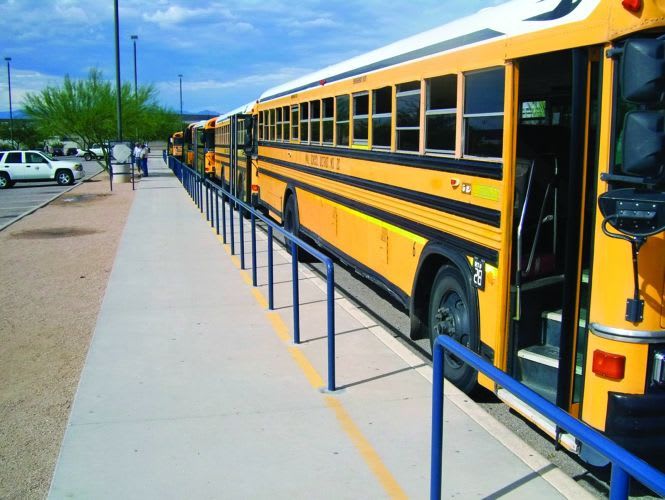
Vail (Ariz.) School District’s transportation department has had railing installed at the district’s bus loading zones to stop students from stepping into the zones prior to boarding or after disembarking their buses.
Train Students on Bus Safety; Convey Behavior Expectations
School bus drivers are not the only individuals who need to follow rules to maximize safety in loading zones. The students themselves must understand how they should behave in and around this area to prevent injuries and fatalities.
Buster the School Bus and Barney the School Bus are popular tools for teaching students about school bus safety. Lewistown Public Schools' transportation staff uses the latter robotic bus, while the Oregon DOE and the Kansas State Department of Education (KSDE) use Buster. Larry Bluthardt, director of the KSDE's School Bus Safety Education Unit, says that an instructor travels to elementary schools and Head Start programs in the state from September to May to educate students.
Operations have also implemented a number of practices and programs to help students remember to use caution around loading zones.
Klippenes says that when students need to cross the street after leaving their buses, the drivers secure the buses and then walk the students across the street, reminding them to look both ways before crossing.
Huillet asks schools in Oregon to employ a similar practice. "If there are any crosswalks that go through a loading loop, I ask the schools to get a crossing guard out there so that kids can get across safely," he says.
In addition to visiting Columbia County Schools' elementary schools with Buster, Porter says a team of drivers use puppets to convey bus safety measures. Each year, the district also hosts a back-to-school safety festival. The transportation department has a bus onsite, and bus drivers give a safety presentation. Students and parents are allowed to board so that students can become familiar with proper loading and unloading procedures.
Dallessandro says his department has established a driver-in-the-classroom program wherein one of Lake Shore's drivers visits each elementary school classroom once a year to discuss bus safety.
"For the last three years, one of our driver trainers has gone to our high school in the summer, and she speaks to the driver's ed class about the school bus environment and what young motorists need to be aware of in the school lots and elsewhere," he adds. "She also has the students sit in the driver's seat of the bus and look in all of the mirrors so that they can see the difference between what our drivers see versus what they, as 16- or 17-year-old motorists, see in their cars."
Transportation Supervisor John Nunes says that Vail School District's transportation staff uses its annual bus evacuation drill sessions to relay its expectations about student behavior. The bus rules and loading and unloading procedures are also posted on the transportation page of the district's Website.
"Each student gets an agenda with a calendar, places for notes, etc., at the beginning of the school year and we put all of our bus rules in the agenda," Flores adds.
Partnering With School Staff Is Crucial
For as much as pupil transportation professionals do to teach students about bus safety and proper behavior around loading zones, Derek Graham, section chief of transportation services for the North Carolina Department of Public Instruction, says school staff members should play a large role in educating students as well.
"It falls on the folks at the schools to help students learn what they need to do to be safe in the loading zones," he says. This includes looking both ways prior to crossing a street and staying orderly on sidewalks because there are vehicle travel lanes beside them.
In order for school administrators and staff to work with students on this issue, it is essential for pupil transporters to share their knowledge and expertise.
"Oftentimes we assume that teachers and administrative types understand what the dangers are in and around the buses in the loading and unloading zones," Furneaux says. "The truth is that teachers and administrators oftentimes know very little about what the safety issues are."
Furneaux emphasizes the importance of having school staff onsite at bus loading zones to supervise students while they board and disembark, and she therefore encourages industry officials to discuss with school staff members what constitutes dangerous behavior around school buses.
Things school staff should be instructed to look for include kids who are running or rough-housing around the loading zone, bullying and harassment prior to loading, students who drop things and try to go under the bus to retrieve the items, and students who try to walk between buses.
Many operations have formed a strong line of communication with school staff and require monitors at loading zones.
Nunes says he and Flores provide school staff members with information at the beginning of the school year to help them supervise the students.
"We outline what routes will be coming into and out of their schools, how many buses we will be bringing into their schools, how many children we expect to be transporting, and we discuss the process necessary to walk the students out of the classrooms and onto the buses safely," Nunes says.
The transportation department also makes a point to have at least one of its own staff members at one of the school's loading zones every day to monitor students and traffic flow, and to work with school personnel to ensure that the students stay behind the safety railing.
Rolling V Transportation Services has implemented a similar effort. Vallone says bus drivers share duties with school staff on the school grounds, and the company's safety team is in constant communication with the administration staff for the schools they serve.
In addition to instructing Fayette County school staff to watch for bullying and students playing around loading zones, Oakley says the staff must make certain that the students stand at least 6 feet back from the curb when buses arrive.
"The kindergarten teachers have learned to tell parents to make sure that their children's backpacks aren't too large and cumbersome," Oakley adds. "Teachers should also make
sure that papers are kept inside backpacks, and loading zone monitors should watch for students carrying loose objects."
John Benish Jr., chief operating officer for Oak Forest, Ill.-based Cook-Illinois Corp., believes that his company and its subsidiaries have a responsibility to work closely with the school districts they serve. "The important thing is to make sure that there's a partnership between the contractor and the school district," he says. "If an issue arises, it's our responsibility to make sure that they understand what the issue is and then work together on a solution."
The subsidiaries' managers must notify school officials and take immediate corrective action if the bus drivers notice problems at the schools. "Being proactive rather than reactive is key," Benish says.
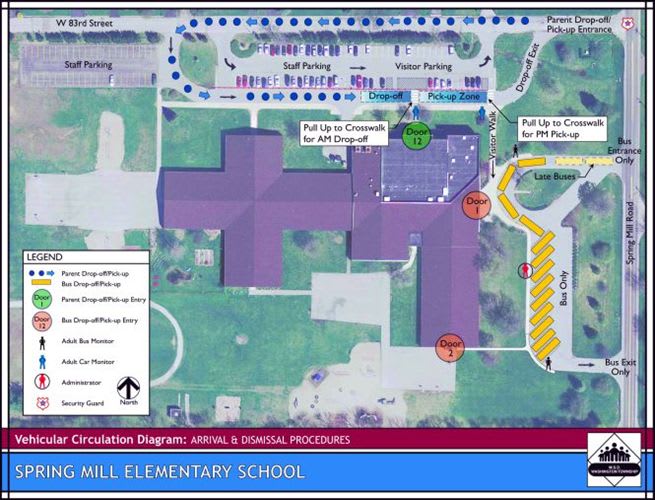
Schematics, like this one for Spring Mill Elementary, that display approved traffic flow for buses and cars have been created for all schools within the Metropolitan School District of Washington Township in Indianapolis to increase safety.
Inform Parents of Loading Zone and Parking Policies
Given the dangers motorists can present around school sites, pupil transporters and school officials also share a responsibility to communicate loading zone and parking policies with parents who transport their children to school.
Graham says that in many cases, school principals will share information with parents, whether it is through a newsletter at the beginning of the school that indicates where parents are allowed to park to pick up or drop off their kids, or through some other means.
Huillet encourages this at Oregon's schools. "If they have a map that they can include in the newsletter that shows the parent pick-up and drop-off area, that's a good thing, too," he says.
Baxter says that schools have a range of options at their disposal to communicate with parents, from connecting with them through their PTA involvement to sending memos home with kids, e-mailing information to them or posting information on the district Website. "Facebook and Twitter may be a couple of other avenues," he adds.
For pupil transportation officials, Finlayson-Schueler says communication with parents entails ensuring that signs and clear pavement markings are present at school sites in order for them to know where they should drop off or pick up their children. "Make sure that a person who had never come to the school before would know where to drive and park," he says.
If changes to school sites are in the works, Finlayson-Schueler recommends sending a notice home with students, putting articles in the district newsletter or talking to the local media about doing a story on the changes before they are implemented.
"On the day that changes are implemented, stand out there and distribute notices to parents and provide answers to questions they may have," he adds.
Furthermore, Dallessandro notes that efforts to communicate with parents, as well as all efforts to maximize student safety in and around bus loading and unloading zones must be continuous.
"Managing loading and unloading zones is not a situation where you can post some signs, set up cones and send out a letter and be done with it," he says. "I think people by nature want to park as close as they can to things, especially during inclement weather, so you have to work year-round in enforcing policies and educating people."
A School Bus Driver's Perspective
Michele Kuhne, a school bus driver for Greater Johnstown (N.Y.) School District, is among the industry professionals who believe that separating school bus loading zones from parent pickup and drop-off areas and student parking lots is a key way to increase student safety.
"We have a couple of schools where, to get to the parent parking lot, the parents drive through the bus loading zone," Kuhne reveals. "If the area was rearranged so that the parents parked on the other side of the school, it would remove all of our problems."
Kuhne also feels it is important for schools, when designing loading zones, to consider the length of a school bus and how much room is needed for a driver to turn and maneuver. She says the larger the zone is, the better it is for bus drivers.
To support her point, Kuhne relays a problem she faced while transporting a student with special needs. "The bus loop for the school where the student needed to be dropped off was a half-circle. There was no way I could pull up to the curb to engage the wheelchair lift without backing up, but I couldn't back up because it's illegal in New York state," she says.
(Kuhne notes that a wheelchair lift does not operate properly if the bus is far away from the curb.)
She also advocates working with outside agencies to bolster safety around schools. Her district's transportation department occasionally conducts Operation Safe Stop. Police officers follow the department's buses and issue tickets to motorists who illegally pass the buses.
"When it's publicized how many tickets they issued, it helps educate the public, which is what we're all about - we need motorists to obey the law," Kuhne says.
"Safe Zones" Bolster Safety Near Schools
Officers at the Odessa (Texas) Police Department designate "safe zones" weekly throughout the city to enhance safety among motorists and the public.
Safe zones are areas in which traffic enforcement is increased to gain voluntary compliance with traffic laws. Police officers work these areas singly or in groups, paying close attention for red light, stop sign, speeding and other moving violations.
The areas include crosswalks, school zones and school buses while students are loading and unloading.
"The officers talk to the motorists they see making violations and let them know that they've had an infraction," Cpl. Danny Yeager explains. "For example, even if the bus' lights aren't flashing, there could be kids who dart out in front of the buses."
Yeager says the officers select the areas where the zones will be designated based on calls from people complaining about traffic congestion, or wherever they notice a potential for problems when they are on patrol.
Safe zones are announced the week prior to enforcement action being taken, and the officers strive to provide as much enforcement as possible each week.
One week they may patrol the zones for five or six hours; another week they may patrol for one hour - it depends on the amount of personnel available.
The safe zones program is not restricted to Odessa. Yeager says the department works with neighboring police departments to establish an intercity effort.
Bus Driver Training Tools
Continuous training to sharpen bus drivers' skills will enhance student safety in loading zones. Larry Bluthardt of the Kansas State Department of Education (KSDE) emphasizes the value of mirror training.
The KSDE utilizes the resources of Dick Fischer, president of Trans-Consult. Bluthardt says Fischer comes in every summer to head a 40-hour class for driver trainers. One of its biggest components is mirror adjustment - specifically, how to properly adjust and use bus mirrors. "It's an excellent and invaluable program," he says.
Bluthardt also recommends a video by the AAA Foundation for Traffic Safety titled "Children in Traffic." "It throws you into a child's world when he or she goes in a street," he explains. "Their peripheral vision is not strong until they're 11 or 12 years old. Their hearing is very acute, but they can't decipher at which direction they hear noises."
Pedal Misapplication Contributes to Loading Zone Accident
In January 2007, a Pennsbury School District driver's bus injured 20 students when it accelerated in a Falls Township, Pa., high school's loading zone and crashed into a retaining wall.
In its investigation of the accident, the National Transportation Safety Board (NTSB) determined that the probable cause was pedal misapplication by the driver. Pedal misapplication occurs when a driver depresses the accelerator instead of, or in addition to, the brake pedal.
A report synopsis indicates that the agency also believes that the driver's unfamiliarity with the bus contributed to the accident (The bus was a substitute, and the pedals were different from what the driver was used to).
In response to its investigation of this accident, as well as several others where pedal misapplication was a factor, the NTSB has asked the National Highway Traffic Safety Administration to require that brake transmission shift interlock devices be installed in heavy vehicles that are susceptible to pedal misapplication. The device requires the driver to apply the brakes in order to shift out of park, thereby preventing unintentional application of the accelerator at vehicle start-up.
In addition to concluding that pedal misapplication was a contributing factor, the Falls Township accident led the agency to conclude that "the nature of bus loading and unloading activities at schools creates a situation where an errant vehicle could easily strike pedestrians" and that a brake transmission shift interlock device would have prevented the accident.
Finally, the NTSB recommended that the National Association of State Directors of Pupil Transportation Services and the National Association for Pupil Transportation advise their members of the dangers of pedal misapplication, and to consider refresher training for drivers and mitigation strategies, such as starting buses only after loading is complete.
More Safety
America Has a School Bus Passing Problem — and Distraction Is Making It Worse
Illegal school bus passing remains a major safety threat as distracted driving rises. This op-ed explores why awareness, enforcement, and stop-arm cameras matter more than ever.
Read More →
School Bus Laws to Watch: New York Delays EV Mandate
Plus, federal lawmakers seek new funding for school bus safety as states weigh stop-arm enforcement, disability protections, and education spending.
Read More →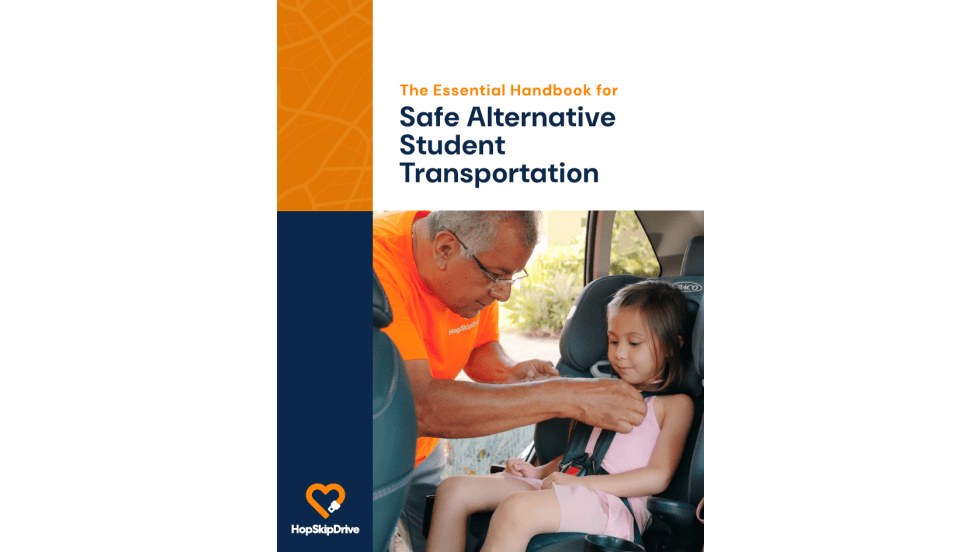
The Essential Handbook for Safe Alternative Student Transportation
Your district's "exception riders" — students with IEPs, those experiencing homelessness, foster care youth — deserve more than a middleman solution. This handbook breaks down exactly what to look for in a supplemental transportation partner: from driver vetting and regulatory compliance to proactive safety technology. Because getting a ride isn't the same as getting a safe one.
Read More →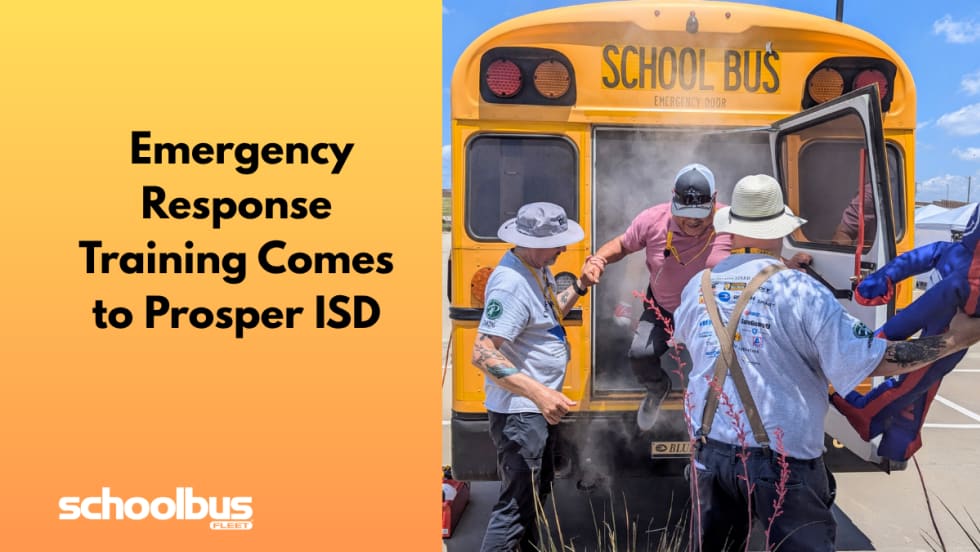
Operation STEER Brings Emergency Response Training to North Texas
Prosper ISD hosted the third annual training for transportation professionals across 67 districts to learn how to respond to emergencies, such as rollovers and evacuations, and proper use of safety equipment.
Read More →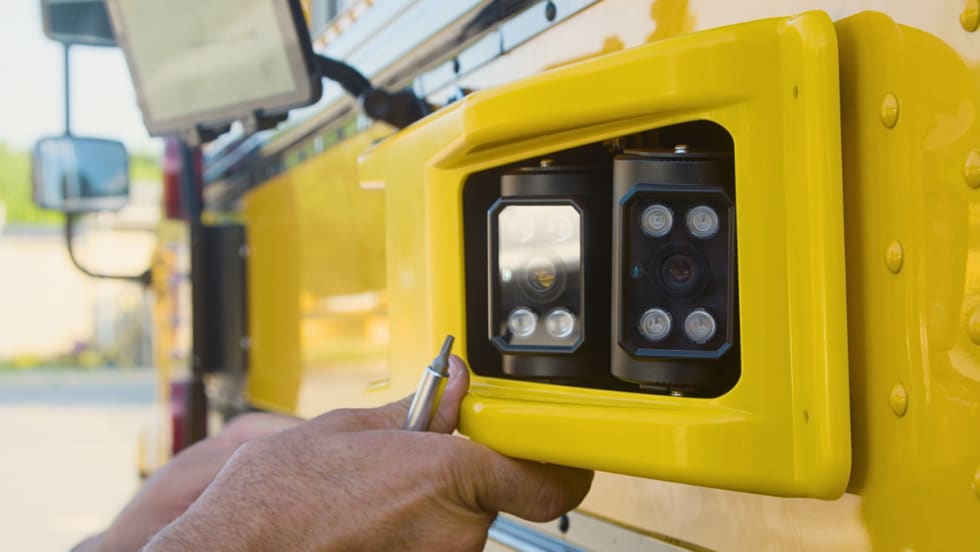
Florida District Relaunches BusPatrol School Bus Camera Program With New Safeguards
After being suspended over due process concerns, Miami-Dade schools and law enforcement are restarting the AI-powered stop-arm camera program with new oversight.
Read More →
School Bus Laws To Watch: Seat Belt Bills, Funding Fights & EV Changes
From national bills on seat belts and driver oversight to driver awareness campaigns referencing “Finn’s Rule” and ongoing transportation funding debates in Alaska, here’s the latest in school bus legislation across the U.S.
Read More →
9-Year-Old Boy Killed by School Bus at Busy Brooklyn Intersection
A Williamsburg community is mourning after a child was fatally struck by a private yeshiva bus, prompting calls for urgent safety improvements at the high-traffic crossing.
Read More →
Does Reliable School Transportation Boost Attendance? EverDriven’s Data Says Yes
The new data shows 99.99% incident-free trips and strong on-time performance, reinforcing how dependable transportation, especially for vulnerable student populations, can help districts combat chronic absenteeism.
Read More →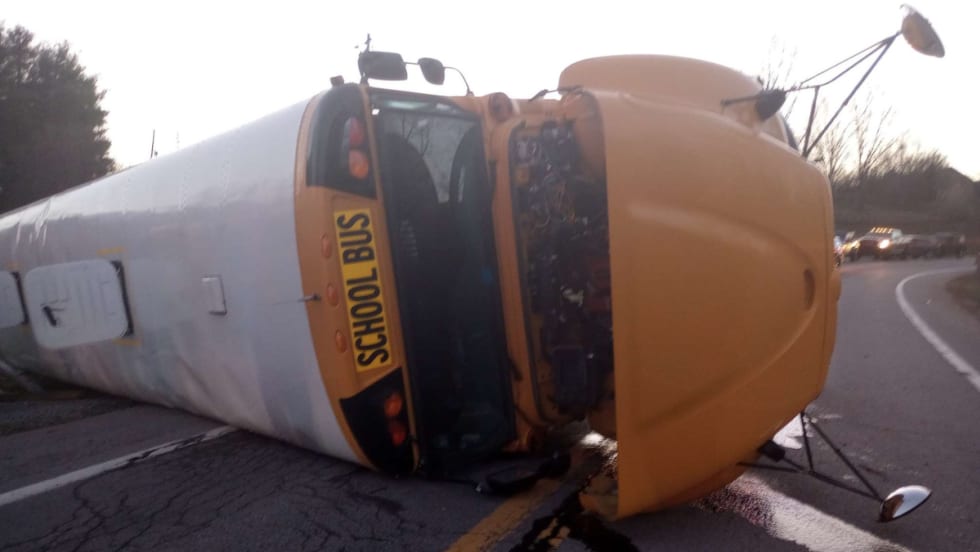
NTSB Calls for Alcohol Impairment Systems, Seat Belts After W.V. Crash Investigation
The federal agency's report asks NHTSA to require all new school buses to be equipped with vehicle-integrated alcohol detection systems and passenger lap-shoulder belts.
Read More →
2026 State of Student Transportation Report
Student transportation teams are being asked to do more with less, facing driver shortages, rising costs, and increasing safety expectations. This report uncovers how fleets are adapting, where technology is making the biggest impact, and why student ridership tracking is emerging as a top priority. Download the report to explore the key trends shaping 2026 and what they mean for your operation.
Read More →