



NASDPTS looks at ways to enhance training, service
From routing strategies to innovative facilities, speakers at the state directors conference share numerous ideas for enhancing school bus service and training. The NASDPTS membership continues to change, with more state directors announcing their retirement.

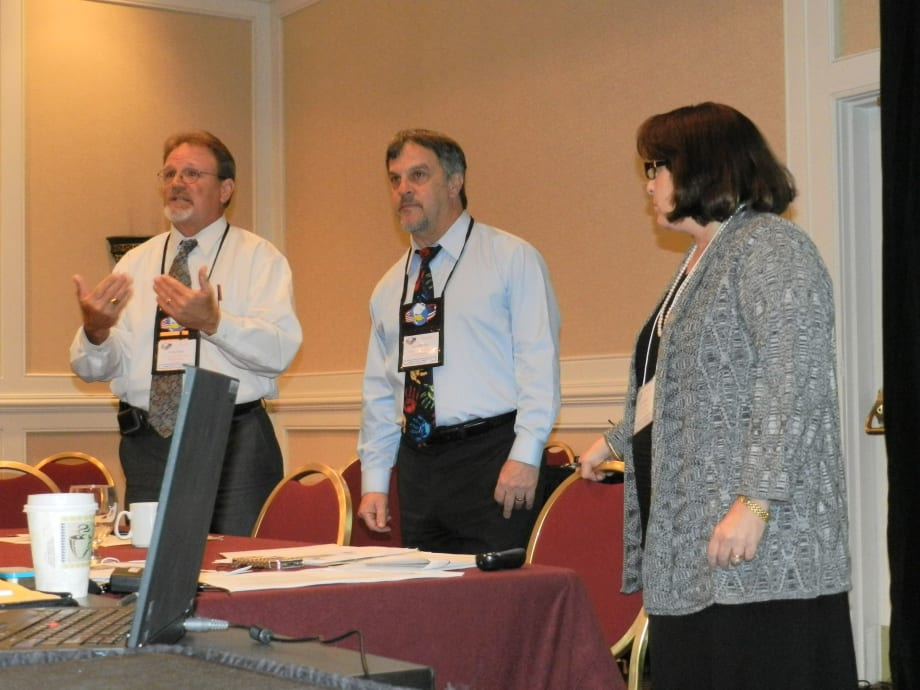
Greg Akin (left) of Volusia County (Fla.) Schools, Pete Meslin of Newport-Mesa Unified School District in Costa Mesa, Calif., and Judy Shanley of Easter Seals
Project ACTION highlighted the benefits of transition planning.
From security awareness to routing strategies to innovative facilities, speakers at the state directors conference in Memphis, Tenn., shared numerous ideas and resources for enhancing school bus service and training.
At the National Association of State Directors of Pupil Transportation Services (NASDPTS) event, held in late October, a mix of federal agency officials, district-level transportation directors, vendors, consultants and researchers gave presentations, many of which challenged the status quo.
Creative training
Monica Coburn of Bartholomew Consolidated School Corp. in Columbus, Ind., and Tim Parker of Fairfax County (Va.) Public Schools shared details on their districts’ innovative driver training facilities.
The Bartholomew transportation department identified a district room that was being used to store paper and other items. They began looking into the logistics of turning it into a training room.
Coburn said that, in particular, they wanted to have a bus on its side to practice emergency evacuations through the roof hatches.
“Opening a roof hatch for air and opening it to escape are completely different things,” she said.
Coburn and her staff determined other details for the training facility and came up with a dollar figure for developing it, but district funding wasn’t available for the project.
The transportation department turned to industry vendors, which provided grants and equipment. For example, Kerlin Bus Sales donated a bus to be used for the training. Also, the district’s school bus drivers pitched in by holding fundraisers.
The result is a facility that is used for various types of training, such as CPR, in addition to the emergency evacuation practice in the tipped-over bus.
At Fairfax, when a space above a warehouse became available, the transportation department developed a training facility that includes a variety of stations for building skills.
There’s a special-needs training area that looks like the inside of a bus and includes a wheelchair lift, mannequins and different types of restraints. There are also stations to practice putting on tire chains, getting fuel, using the radio and more.
“We encourage practice and play,” Parker said.
[PAGEBREAK]Transition planning
In another session, Judy Shanley of Easter Seals Project ACTION, Pete Meslin of Newport-Mesa Unified School District in Costa Mesa, Calif., and Greg Akin of Volusia County (Fla.) Schools highlighted the benefits of transition planning — helping special-needs students to prepare for using public transit and to become more independent.
According to Meslin, “We have to break the habit of every [special-needs] kid getting picked up at the curb.”
Transitioning these students to school bus stops away from their house helps prepare them for the real world and reduces transportation costs, Meslin said.
Shanley even suggested simulating transit elements with the yellow bus by establishing fare cards, developing schedules and route maps, mimicking passenger alert systems and replicating social variance (i.e., changing seats).
The latter point, Shanley said, “is particularly important for students with autism … One district had name cards on the school buses, and they would change the seats daily so students would become comfortable with changing seats.”
At Akin’s district, transition planning and community-based instruction (CBI) have made a significant impact on students and on the transportation system.
“Eight years ago, we had over 1,200 curbside [directly in front of the student’s home] stops,” Akin said. “Now, we have about 200.”
CBI also creates work opportunities for students. Akin said that a student named Drew who started in the CBI program six years ago had a strong interest in school buses. Akin gave him the chance to come to the bus terminal and learn about the parts system.
“He loved it. He’s very good at counting and making sure everything is in the right place,” Akin said. When Drew was 22, “we hired him as a parts assistant.”
Drew takes public transit to the school bus terminal and works about four hours a day.
“I get thank-you cards from his mom all the time,” Akin said. “Now he has something he’s doing, and he enjoys it.”
To see more photos from inside the NASDPTS conference and around Memphis, click here.
Changing of the guard for state directors
The NASDPTS membership has been undergoing change in recent years, with numerous longtime state directors retiring. Ohio’s Pete Japikse and Kansas’ Larry Bluthardt stepped down a few months before the conference.
Colorado state director Bruce Little announced that he will retire in September 2013. Greta Bleau, who has been an equally ranked senior transportation consultant at the Colorado Department of Education (CDE) with Little, has now taken on the state director designation (which Little relinquished in August).

Bleau is a former Air Force crew chief in aircraft maintenance. In the 1990s, she became a school bus driver and later moved up the ranks to driver trainer and transportation manager. She joined the CDE in 2007.
Bleau told SBF that when she was a driver, “I felt like I could affect the safe transportation of students on my bus. Then I moved up, and I felt likeI could affect it for the district.”
Her safety influence expanded to the state level when she joined the CDE. Now, with the state director designation, Bleau said that she hopes to find “ways that we can do things more efficiently. I think you can get stuck in the rut of always doing things the same way. We need to look outside the box.”
In Oregon, state director Steven Huillet was set to retire Jan. 1 with more than 25 years in the school bus industry, which he maintains a passion for.
“If I had my way, all students would be on school buses,” he told SBF. “When you get into [school bus transportation], you believe in it or you don’t. I believe in it.”
Huillet began his school transportation career in 1986 as a mechanic and driver for Central School District in Independence, Ore. In 1998, he took a supervisor position at Sisters School District.
In 2003, Huillet became a program analyst with the Oregon Department of Education (ODE) pupil transportation section. About six years later, he was promoted to the director position for pupil transportation and fingerprinting.

During his tenure at the ODE, Huillet worked on key developments to enhance school bus maintenance and safety in Oregon. He helped write a new maintenance and inspection manual for technicians to use in annual school bus inspections. He also developed a testing program for technicians to become ODE-certified to complete the annual inspection and work on school buses.
“Every technician in Oregon must now be certified to work on and complete the annual inspections,” Huillet said. With no state police inspection of school buses and the ODE only conducting spot inspections every six years, those self-inspections are critical, he added.
In January, Huillet was to begin working for NASDPTS as its administrative support services provider.
More Management
13 Industry Leaders Describe School Transportation in One Word
What word best describes the school bus industry today? We posed that question to over a dozen manufacturers, resulting in a revealing mix of perspectives on the challenges and opportunities ahead.
Read More →
Tyler Technologies Adds New AI, Transactions Leadership Roles
Two company executives are promoted to newly created C-suite positions to accelerate the company's long-term growth in both artificial intelligence and payments.
Read More →
Pro-Vision Acquires Convoy Technologies
The deal aims to broaden customer relationships and adds specialized vehicle video capabilities for commercial fleets.
Read More →


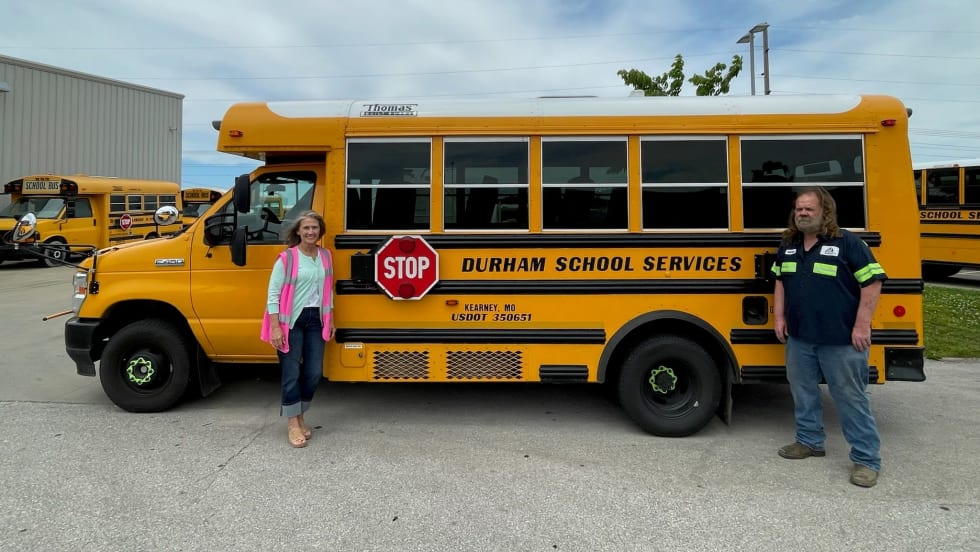
Durham School Services Maintenance Teams Earn Missouri Fleet Excellence Awards
Eight of the contractor’s school bus fleets achieved a distinction few maintenance teams earn during the state’s rigorous annual inspection program.
Read More →
How Incentives, AI, and Energy Markets Are Reshaping School Transportation
Sit down with Joe Annotti of TRC Companies to talk district grant funding, utility challenges, AI, and why school buses are evolving from transportation assets into energy assets.
Read More →
Inside the Contracting Shift: What School Transportation Operators Are Seeing Now
School transportation contractors weigh in on recent trends, costs, driver shortages, and the rise of multimodal student transportation.
Read More →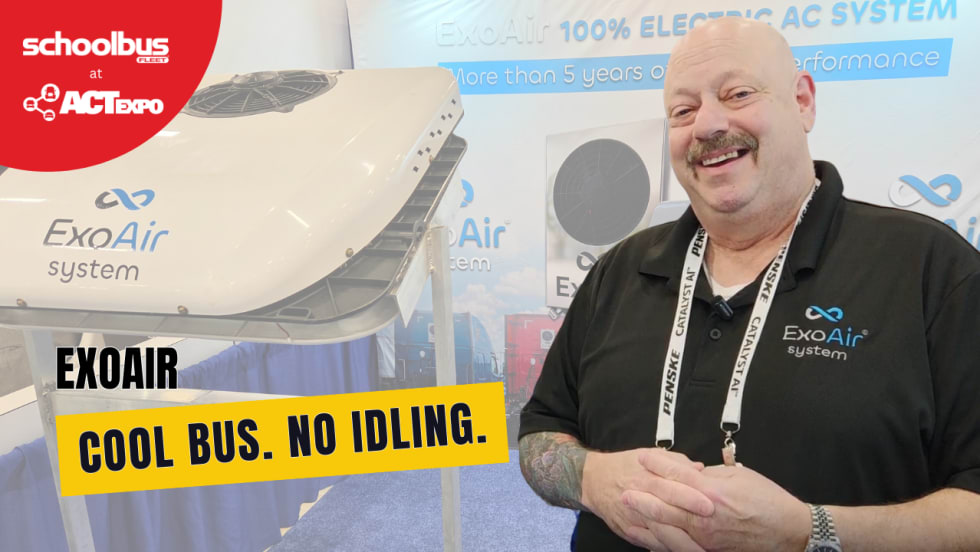
The No-Idling School Bus AC System
Take a peek at ExoAir Systems’ battery-powered cooling solution designed to run for up to 10 hours without the engine on, reducing fuel use and improving comfort for drivers and students.
Read More →
Geotab on Three Major Trends in School Transportation
School bus fleets are becoming more proactive than ever. From AI driver alerts to vehicle-to-grid opportunities, Geotab outlines the biggest technology trends transforming school bus operations.
Read More →
Gatekeeper Lands Major School Bus Deals as Revenue Surges
The video solutions provider announces contracts with Atlanta Public Schools and other fleet operators as it records quarterly revenue growth and expanding subscription business.
Read More →
Building Leaders Who Last: Creating a Successful Mentorship Program in Student Transportation
Discover five strategies for building an effective mentorship program to strengthen leadership development and support staff retention.
Read More →