




Upholding policy: It's not easy being the messenger
Managers often run into trouble and are accused of not being receptive to an individual's needs simply because we are trying to equitably uphold a school transportation policy or law.


Michael Dallessandro is transportation director at Niagara Wheatfield Central School District in Niagara Falls, N.Y.
Photo: Michael Dallessandro
I’ve been hearing a growing number of comments from school transportation managers that their superintendents or board of education members have questioned their “bedside manner” — also known as communication skills — while managing personnel matters, handling parent phone calls or making public presentations.
I have a simple answer: People will like you when you give them what they want.
The coach will love you when you allow him to load the interior of the bus from floor to ceiling with unsecured athletic equipment, coolers, and other gear.
The drivers will love you when you allow them to skip that boring pre-trip inspection when it is pouring rain outside.
Parents want the bus stop in front of their house? Simply move it for them!
Of course, I am using these fictional references to make a point. Transportation managers cannot simply give away the farm, because appropriate boundaries are a vital part of the safety and efficiency chain in our business.
Most of the time, a school transportation manager who is doing his or her job correctly is the gatekeeper and has to be the person who says “no” more than “yes.” And — let’s face it — there is no popular way to say “no.”
Adding to that, societal changes are creating a new generation of aggressive, in-your-face people who refuse to accept “no” for an answer, and you, the transportation manager, are standing squarely in the way of their happiness.
School transportation systems work properly when the rules that are in place to ensure safety are followed to the letter. As you read the various pupil transportation safety regulations, you can almost always link a law back to a high-profile accident, loss of life or other incident that prompted the creation of that particular law.
The key to gaining support for compliance for these regulations is having references available when speaking with drivers or parents about the situation at hand.
When faced with a decision, managers must look at the overall impact on a particular workforce, district or neighborhood, and many of the people we interact with are only thinking about their specific need or issue at that moment.
Managers often run into trouble and are accused of “not being receptive” to an individual’s needs simply because we are trying to equitably uphold a school transportation policy or law for the benefit of all stakeholders.
Sadly, when some employees or citizens do not get their way, they accuse the manager of being rude, difficult, or incompetent. Hopefully, your lead administrators and board members provide support and the benefit of the doubt to the people who make the transportation system work every day.
School transportation managers in 2012 are walking a very fine line, trying to meet the needs of parents, students, labor unions, administrators, boards of education and enforcement agencies — while also dealing with an ever-shrinking budget.
Transportation managers cannot possibly meet the needs of every one of those stakeholders at all times, and we and our bosses must accept that some of them may be unhappy from time to time. District leaders have to recognize the immense responsibility that transportation managers have and the difficulty we face in trying to balance stakeholder needs and input.
Superintendents and boards of education must look at their transportation managers as a valuable resource and a “messenger” for all things positive, legal, and ethical regarding the business of pupil transportation.
Don’t shoot the messenger!
Michael Dallessandro is transportation director at Niagara Wheatfield Central School District in Niagara Falls, N.Y. He is the author of numerous articles and an editorial advisory board member for SCHOOL BUS FLEET. He welcomes comments and feedback at MPDBUS1@aol.com.
More Management

ASTP's Tod Eskra Named an Entrepreneur of the Year
The award from Ernst & Young honors visionary leadership behind one of America's fastest-growing student transportation contracting companies.
Read More →
Drivers and Technicians: Help Benchmark Today's School Bus Manufacturers
If you've spent time behind the wheel or under the hood, we want to hear your perspective on the buses you know best.
Read More →
13 Industry Leaders Describe School Transportation in One Word
What word best describes the school bus industry today? We posed that question to over a dozen manufacturers, resulting in a revealing mix of perspectives on the challenges and opportunities ahead.
Read More →



Tyler Technologies Adds New AI, Transactions Leadership Roles
Two company executives are promoted to newly created C-suite positions to accelerate the company's long-term growth in both artificial intelligence and payments.
Read More →
Pro-Vision Acquires Convoy Technologies
The deal aims to broaden customer relationships and adds specialized vehicle video capabilities for commercial fleets.
Read More →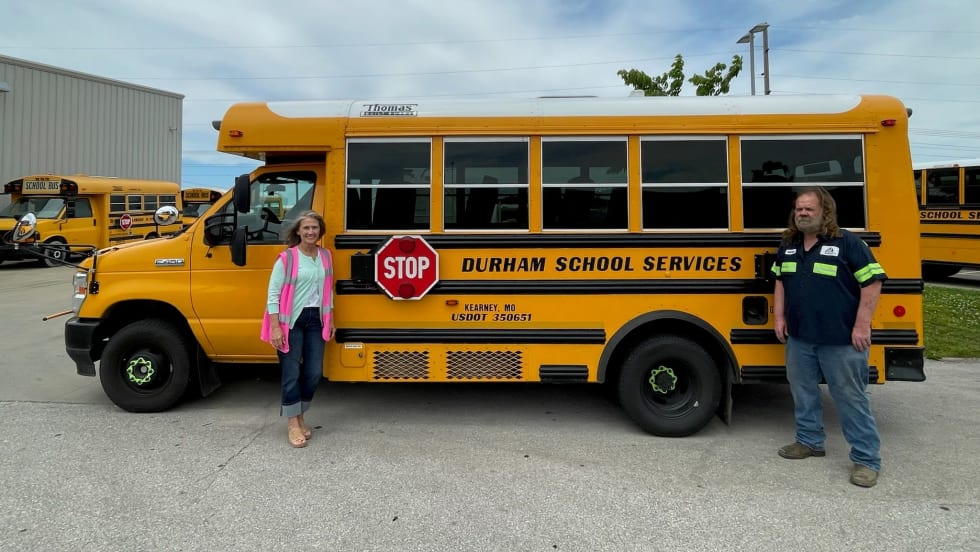
Durham School Services Maintenance Teams Earn Missouri Fleet Excellence Awards
Eight of the contractor’s school bus fleets achieved a distinction few maintenance teams earn during the state’s rigorous annual inspection program.
Read More →
How Incentives, AI, and Energy Markets Are Reshaping School Transportation
Sit down with Joe Annotti of TRC Companies to talk district grant funding, utility challenges, AI, and why school buses are evolving from transportation assets into energy assets.
Read More →
Inside the Contracting Shift: What School Transportation Operators Are Seeing Now
School transportation contractors weigh in on recent trends, costs, driver shortages, and the rise of multimodal student transportation.
Read More →
The No-Idling School Bus AC System
Take a peek at ExoAir Systems’ battery-powered cooling solution designed to run for up to 10 hours without the engine on, reducing fuel use and improving comfort for drivers and students.
Read More →
Geotab on Three Major Trends in School Transportation
School bus fleets are becoming more proactive than ever. From AI driver alerts to vehicle-to-grid opportunities, Geotab outlines the biggest technology trends transforming school bus operations.
Read More →