



Parts Suppliers Meet Customer Demand
Officials from four companies discuss everything from product stock to ordering to shipping in fulfilling pupil transporters’ needs. They also offer suggestions on how to keep one’s shop inventory organized.


Keeping a sufficient number of school bus parts in stock at one’s shop in the event that a technician needs to make a repair will help maintain a smooth running operation. However, parts suppliers recognize the challenges that contractors and school district transportation departments face in today’s economic climate.
“We understand the need to cut inventory costs and the effort school districts and contractors are making to reduce the amount of parts on their shelves,” says Shelle Johnson, sales manager for Bus Parts Warehouse in Manlius, N.Y.
In addition to Johnson, SBF spoke with officials from Unity School Bus Parts, Heavy Duty Bus Parts and Easy Way Safety Services about the practices they have implemented at their companies to meet customers’ needs and provide efficient service.
Companies maintain large inventory, ship orders quickly
Like Bus Parts Warehouse, the team at Easy Way Safety Services, based in Cincinnati, understands that many operations don’t stock large amounts of products, so both companies have a large inventory.
Thomas Sackett, president of Easy Way Safety Services, says he has found that because operations typically have a small parts inventory, they usually need products quickly.
To accommodate this need, he reviews recent years of sales history to determine when peak buying times are.
“We stock up ahead of those times in order to meet demand. We try to stay a couple of months ahead of the curve,” Sackett says.
Fast product shipment is another critical component to effectively serving customers. The companies offer same-day shipping on most orders.
“Orders received that are processed that day usually ship out the same day,” says Ed Mastry, president and owner of Unity School Bus Parts in Marine City, Mich.
[PAGEBREAK]

Multiple ways to order products
Unity School Bus Parts utilizes several forums to spread the word about its products and make ordering easy. A master catalog is available on the company’s website, and ordering can be performed online. Unity will also mail the master catalog and its special-needs catalog upon request.
Moreover, in addition to direct sale, Mastry says Unity has established a direct-mail campaign wherein promotional product fliers are mailed to customers 10 months out of the year.
Bus Parts Warehouse and Heavy Duty Bus Parts (HDBP) in Willis, Texas, also offer online ordering capabilities for their customers.
“Our goal with the online catalog is to enhance the online experience and to maintain a consistency among the images and descriptions for the products,” HDBP CEO Brandon Billingsley says. “We also wanted to be able to give instant notifications of ordering acknowledgement to the customers, notification of shipments, as well as the ability to track shipments.”
The company is also working on a system that would reduce product costs for its customers.
“We’re putting together a way for all of the customers at one time to view an item that there’s a capacity overrun on and then it can be something in-house that Heavy Duty Bus Parts has, or that one of our vendors has that could be drop-shipped from their location,” Billingsley says.
He adds that the company can track how many of a certain item it sold using order management software. With this information, HDBP can order more of those items, which will drop the company’s costs. Then it, in turn, can reduce the cost to the customer.
Easy Way Safety Services’ customers can order products by phone, fax or e-mail.
“We don’t have a store-front online because of the nature of what we sell [child safety restraint systems and bus seats],” Sackett says. “We want to make sure that the person is getting the right product for their needs.”
Tips for effective parts and inventory management
While parts suppliers work to make parts ordering and procurement easy for their customers, there are steps pupil transporters can take to ensure that cost-effective orders are made and that their parts and inventory are organized.
Johnson suggests looking into the option of blanket orders with release dates. This allows Bus Parts Warehouse to purchase larger quantities from its vendors, thus reducing the cost to the end user.
“Another option is to standardize your fleet with one or two bus body types,” she adds. “It reduces the amount of inventory you need to stock.”
Billingsley says using an automated inventory management system can be helpful in keeping track of supplies, and that computerized systems are also useful since they provide tools to measure and fine tune fleet efficiency.
“Beyond that, operational and administrative costs have to be analyzed,” he says. “That includes vehicle costs, labor costs, and parts and inventory costs. By analyzing this information, you can see what can be done to reduce overhead costs.”
More Management
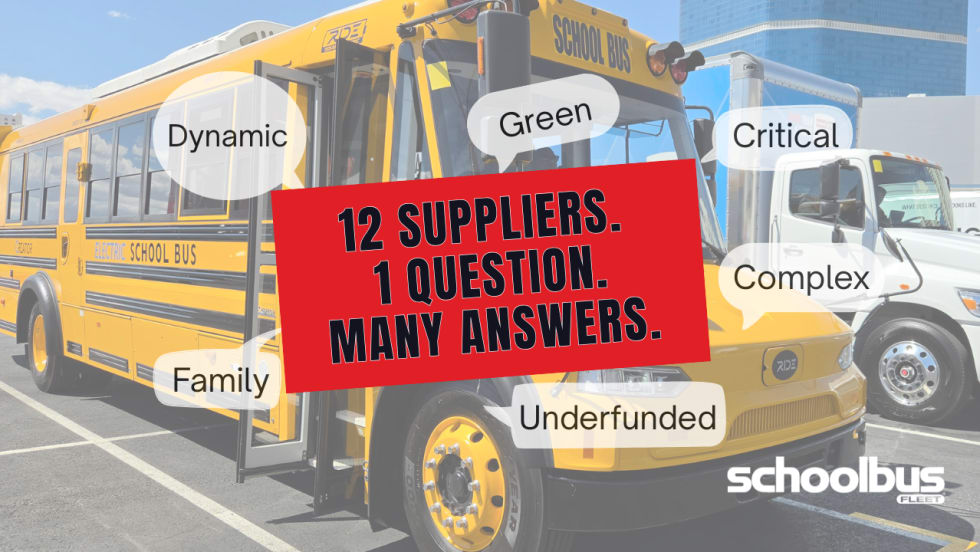
13 Industry Leaders Describe School Transportation in One Word
What word best describes the school bus industry today? We posed that question to over a dozen manufacturers, resulting in a revealing mix of perspectives on the challenges and opportunities ahead.
Read More →
Tyler Technologies Adds New AI, Transactions Leadership Roles
Two company executives are promoted to newly created C-suite positions to accelerate the company's long-term growth in both artificial intelligence and payments.
Read More →
Pro-Vision Acquires Convoy Technologies
The deal aims to broaden customer relationships and adds specialized vehicle video capabilities for commercial fleets.
Read More →



Durham School Services Maintenance Teams Earn Missouri Fleet Excellence Awards
Eight of the contractor’s school bus fleets achieved a distinction few maintenance teams earn during the state’s rigorous annual inspection program.
Read More →
How Incentives, AI, and Energy Markets Are Reshaping School Transportation
Sit down with Joe Annotti of TRC Companies to talk district grant funding, utility challenges, AI, and why school buses are evolving from transportation assets into energy assets.
Read More →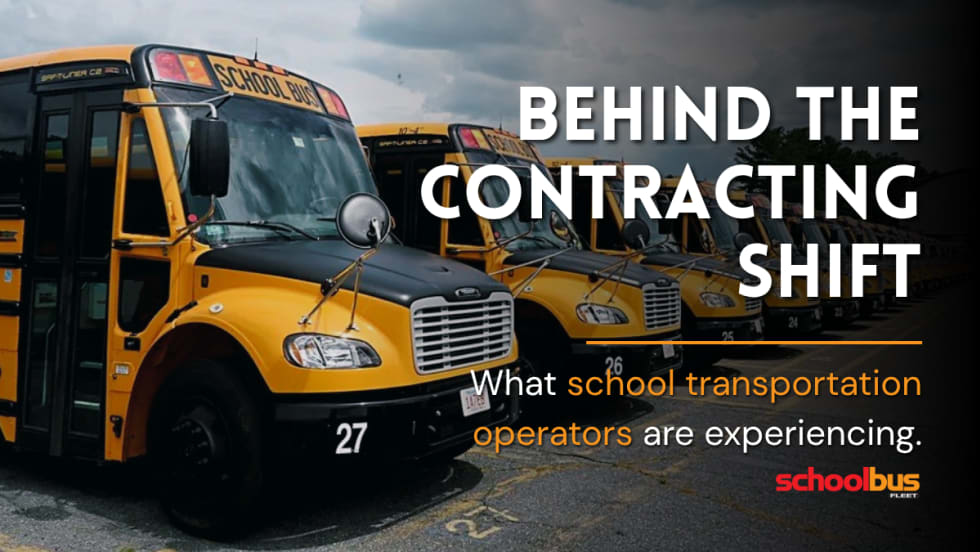
Inside the Contracting Shift: What School Transportation Operators Are Seeing Now
School transportation contractors weigh in on recent trends, costs, driver shortages, and the rise of multimodal student transportation.
Read More →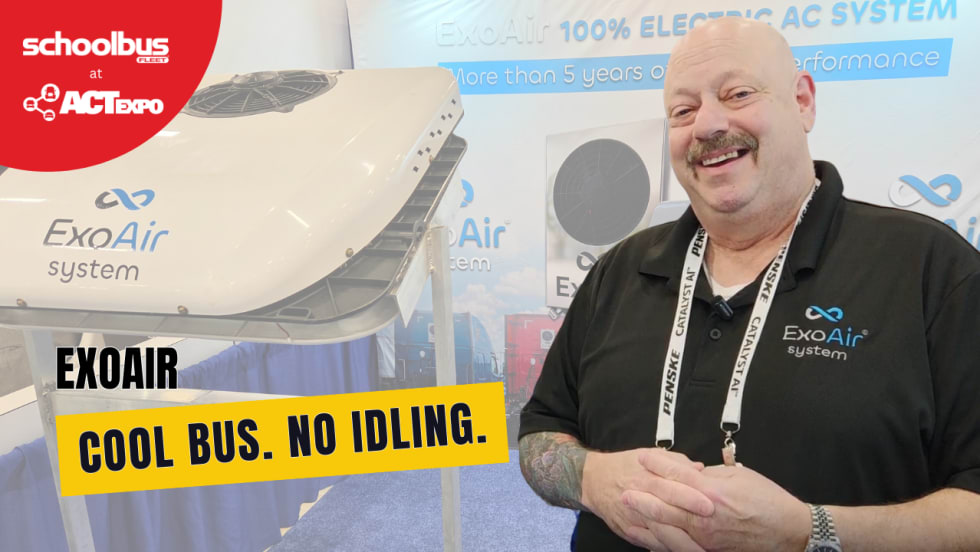
The No-Idling School Bus AC System
Take a peek at ExoAir Systems’ battery-powered cooling solution designed to run for up to 10 hours without the engine on, reducing fuel use and improving comfort for drivers and students.
Read More →
Geotab on Three Major Trends in School Transportation
School bus fleets are becoming more proactive than ever. From AI driver alerts to vehicle-to-grid opportunities, Geotab outlines the biggest technology trends transforming school bus operations.
Read More →
Gatekeeper Lands Major School Bus Deals as Revenue Surges
The video solutions provider announces contracts with Atlanta Public Schools and other fleet operators as it records quarterly revenue growth and expanding subscription business.
Read More →
Building Leaders Who Last: Creating a Successful Mentorship Program in Student Transportation
Discover five strategies for building an effective mentorship program to strengthen leadership development and support staff retention.
Read More →