




Why Won’t They Come to Work?
In these tough economic times, most school bus drivers consistently show up for work — but some still don’t. After monetary incentives failed to tackle absenteeism, one district learned that some employees need another kind of support.

What motivates most employees to come to work every day? And why do some employees never seem to make it, especially on a Friday or Monday?
Is it just that most employees are very conscientious, while others are not? To some degree, this may be true. But for those employees who can’t seem to get to work, something else may be happening behind the scenes.
The thought
In these difficult economic times, when jobs are scarce, we all think that not only would employees come to work every day just to keep their jobs, but most employees would even go the extra mile just to ensure that they stay in front of any potential job contractions. Yet some employees continue to be absent from duty on a regular basis.
If your district is like ours — and most districts these days are in the same boat — you are operating under great budgetary pressures. Facing and/or having already faced cutbacks, you have probably also curtailed the hiring of new drivers. This would mean that any employee that you lose, you are not going to be able to replace — at least not right away.
So what do you do with employees with poor attendance records, especially if firing them means you cannot replace them?
Do you, and can you, motivate this type of employee to come to work regularly?
The experiment
Is money an incentive to get employees to come to work?
Once upon a time, in days well gone by, our South Florida school district had a budget — not unlike many other school districts’ budgets — that was a little more flush than today’s budgets. We were able to convince our school board that an experiment was in order that might have a very positive impact on the district for both employees and students. We wanted to experiment with a very old idea and see if it was true. The old idea was:
Money motivates people.
We decided to put our money “where our people were,” and that meant ultimately into our employees’ pockets. We began what we believed would be an exciting venture.
The experiment was this: Drivers who were present and on time for every reporting shift during an entire pay period would receive a $75 incentive on their following paycheck.
We proposed operating this experiment as a pilot program for four months. We would then compare attendance rates to the same period from the previous year. We were obviously looking to see if monetary incentives would decrease absenteeism.
We hypothesized that a monetary incentive would increase employees’ attendance by 10 percent, and that attendance would also increase in times of typically high absenteeism, such as the days before or after a holiday, pay days, Friday afternoons and Monday mornings.
A financial plan was developed to support this pilot project and allow it to be as budget-neutral as possible. It was projected to be cost–neutral by utilizing fewer substitute drivers to operate the same number of routes, since more regular drivers would be on duty on any given day.
You may have already reacted to this idea in the same manner that our senior staff reacted to this idea, which was to ask, “Why would you pay employees extra to come to work?”
It took a bit of explaining, as you can imagine. However, at the same time we were convincing senior staff, our drivers were complaining that when their co-workers were absent, the burdens of absenteeism fell squarely on their shoulders. They had to double out runs and return to pick up missed students.
Many drivers expressed that they were tired from helping out and that it was unfair to them — especially as they came to work every day and received no extra compensation for their efforts.
Morale was clearly being affected. So, in addition to providing a carrot to those with poor attendance, the incentive became viewed as a reward for those employees who already had good attendance and were steadily helping us out.
A last hurdle had to be overcome with the union. Their initial position was that the program should apply to all their members, which includes custodians, cafeteria workers, maintenance personnel, mailroom employees and the like. They felt it should not be limited to drivers. Ultimately, though, they agreed to a trial program with drivers only.
The results
We ran the program for the four months and tracked attendance. Upon completion of the project, the two calendar periods were analyzed.
The experimental period — the period that included the $75 incentive — showed that, compared with the previous year:
• Attendance had increased by only 1 percent.
• Absenteeism had actually increased on six of the 12 critical days described above.
The program did not achieve the reductions anticipated, and it was discontinued.
[PAGEBREAK]OK, money didn’t work …
No one has money nowadays anyway. And who in their right minds would pay employees extra to come to work? But the study of what motivates employees to come to work, what impacts productivity and morale, is a great field of study in and of itself. It is nothing to scoff at.
If money didn’t or doesn’t motivate employees, one has to ask: What else might be going on?
Our particular school system is a large, multicultural district whose workforce has to contend with a complex lifestyle that some of our employees are not necessarily prepared to cope with adequately. Oddly, money does not always help.
Some employees are in need of other kinds of support to help them deal with various personal situations that occur in their lives — situations that in turn affect their abilities to come to work. Family pressures, such as sick children, lack of family support (single parenthood or no help outside the family), money management problems, aging parents, lack of adequate housing and other socio-emotional factors often come into play.
Even getting to work in order to make the money needed to solve financial problems may be far out of reach for some of these employees at times. When you discuss their plights with them, you can hear such responses as: How do I get to work when I have no one to watch my children? Or, no one to take them to a doctor? Or, I am constantly having difficulties with my child at school — and being called by school officials to meet with them. Or, I do not have the money to repair my car or replace it. And so on.
[IMAGE]525[/IMAGE]
So what does work?
What can be helpful is to meet regularly with employees who are having attendance problems. Track their attendance, and show them what their attendance looks like.
Ask them to examine, along with you, what may be preventing them from coming to work. Solicit the employees’ tacit agreement that there is a problem that needs to be addressed, and that disciplinary action, especially losing a job, is not a solution. Assure the employees that you understand that they do not need “one more thing on their plate.”
Where appropriate, refer them to your employee assistance program. Explain to them what the program does, how it can help them with their personal problems, and that it is confidential. Encourage them to make full use of the program.
As an administrator, you must set limits and take appropriate action. But acting in a supportive manner with employees, and letting them know that you understand some of the problems that they are dealing with, can go a long way in easing some of the pressures that employees face in their personal lives.
In addition to the district’s employee assistance program, just sitting and talking with the employee helps. Working out alternate arrangements, when these can be made, will go a long way in supporting a troubled employee.
Try setting up a time for an employee to come to see you every week. This can help develop a strong emotional incentive for employees, feeling that they have to show up to face you directly each week.
Ask each week if they’ve been coming to work or not. It will help the employees feel how important it is for them to be in attendance, knowing that you expect to see them personally.
Employees can feel invisible, and consequently unsupported, which in turn further reinforces for them that they can stay away from work without suffering consequences. And then when they suffer the consequences, it is often too late.
Weekly meetings provide some measure of positive attention for these employees — some of whom do not get much positive attention in their lives because of all the problems they face. Some don’t come to work because they are nursing their own wounds; they’re tired and needy themselves.
[PAGEBREAK]Are we social workers?
Absolutely not. However, in these tight budgetary times, more so than ever before, it behooves us to do everything that we can to support employees and maintain our workforce. As noted previously, many districts cannot hire new employees. Every employee we lose impacts our children’s ability to get to school and home on time.
Now more than ever, we must do everything we can to support employees whom we may be able to turn around — at least for a temporary period of time.
At no time, though, does this become a reason to not take appropriate action in accordance with each district’s progressive disciplinary plan, when and as appropriate. If the absenteeism continues after you’ve done all that you can to support an employee, then appropriate disciplinary steps must be taken. And when all remedies have been exhausted, termination of employment must be the end result.
We think of money as a motivator (and certainly it can be a big motivator), and it seems very basic to believe that all employees want to keep their jobs. But money may not motivate every employee, and not every employee is able, at times, to overcome all obstacles to maintaining their employment.
With this in mind, we say that those who are able to work will. The rest may need a little extra help.
Randy Mazie is director of the John Schee Transportation Center at Miami-Dade County Public Schools. He and his wife, Debbie, also run a school bus merchandise Website, SchoolBusMart.com.
Special thanks to Jerry Klein, administrative director of the district’s Department of Transportation, for his input.
More Management
13 Industry Leaders Describe School Transportation in One Word
What word best describes the school bus industry today? We posed that question to over a dozen manufacturers, resulting in a revealing mix of perspectives on the challenges and opportunities ahead.
Read More →
Tyler Technologies Adds New AI, Transactions Leadership Roles
Two company executives are promoted to newly created C-suite positions to accelerate the company's long-term growth in both artificial intelligence and payments.
Read More →
Pro-Vision Acquires Convoy Technologies
The deal aims to broaden customer relationships and adds specialized vehicle video capabilities for commercial fleets.
Read More →


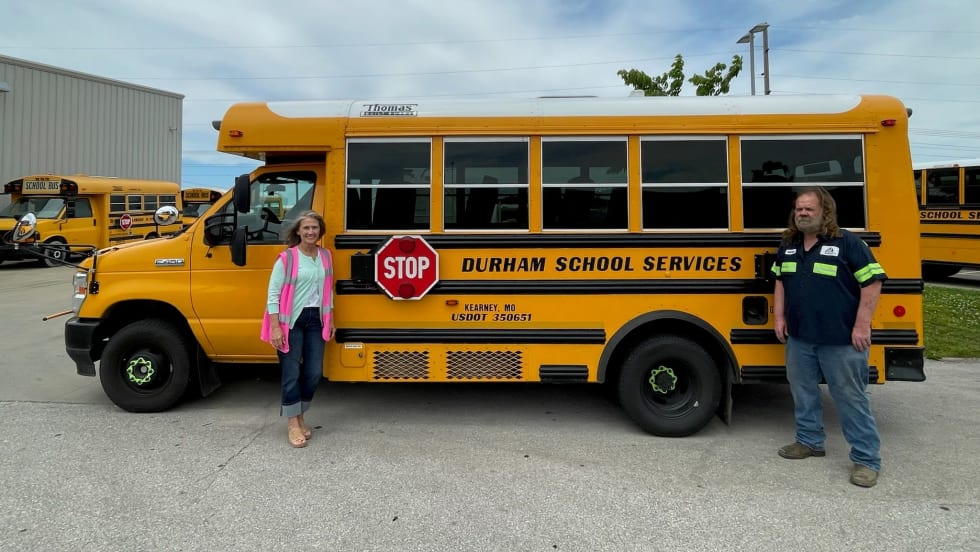
Durham School Services Maintenance Teams Earn Missouri Fleet Excellence Awards
Eight of the contractor’s school bus fleets achieved a distinction few maintenance teams earn during the state’s rigorous annual inspection program.
Read More →
How Incentives, AI, and Energy Markets Are Reshaping School Transportation
Sit down with Joe Annotti of TRC Companies to talk district grant funding, utility challenges, AI, and why school buses are evolving from transportation assets into energy assets.
Read More →
Inside the Contracting Shift: What School Transportation Operators Are Seeing Now
School transportation contractors weigh in on recent trends, costs, driver shortages, and the rise of multimodal student transportation.
Read More →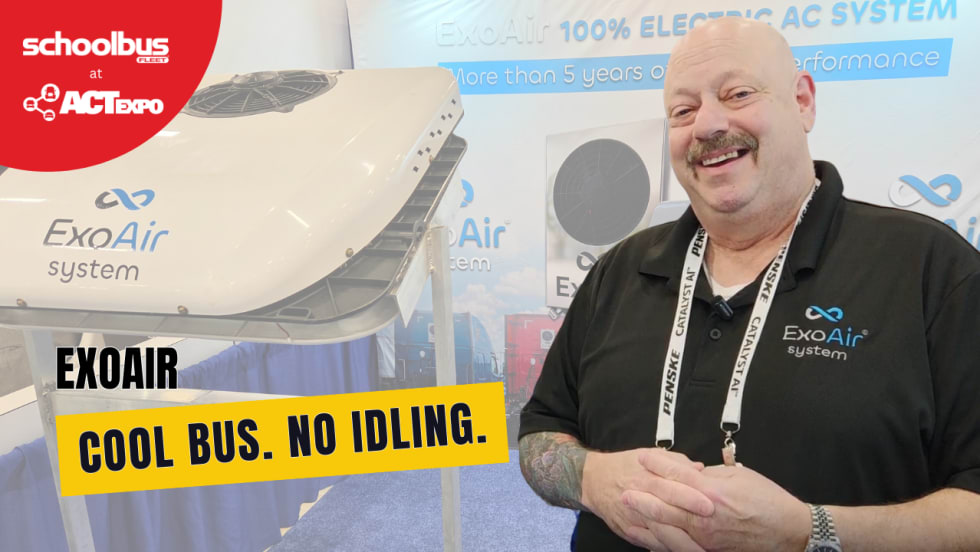
The No-Idling School Bus AC System
Take a peek at ExoAir Systems’ battery-powered cooling solution designed to run for up to 10 hours without the engine on, reducing fuel use and improving comfort for drivers and students.
Read More →
Geotab on Three Major Trends in School Transportation
School bus fleets are becoming more proactive than ever. From AI driver alerts to vehicle-to-grid opportunities, Geotab outlines the biggest technology trends transforming school bus operations.
Read More →
Gatekeeper Lands Major School Bus Deals as Revenue Surges
The video solutions provider announces contracts with Atlanta Public Schools and other fleet operators as it records quarterly revenue growth and expanding subscription business.
Read More →
Building Leaders Who Last: Creating a Successful Mentorship Program in Student Transportation
Discover five strategies for building an effective mentorship program to strengthen leadership development and support staff retention.
Read More →