




Restructuring Transportation for Tight Budgets
Districts across the country are facing budget cuts — sometimes drastic. Pupil transportation professionals are examining innovative ways to maintain current levels of service with significantly fewer dollars.


The American Association of School Administrators has been investigating how the economic downturn has affected schools. The group's most recent study polled 859 respondents from 48 states and found that districts are increasing class sizes, laying off personnel, cutting academic programs and extracurricular activities, and deferring maintenance at rates that have tripled and, in some cases, even quadrupled over the last school year.
In facing these financial conditions, how are school bus operations faring? The majority are dealing with significant budget cuts, forcing some to institute busing fees or reduce service. Most, however, are simply looking more closely than ever before for opportunities to increase efficiency and juggling priorities to make ends meet.
Carol Stamper, director of transportation for Charlotte-Mecklenburg (N.C.) Schools (CMS), saw a reduction of an estimated $3 million to $4 million compared to last year.
School Bus Inc. Manager Jim Shafer, who works with a district that was taking a $1.4-million cut this year, notes, "I've been doing this for 30 years, and transportation's usually the first place they go."
Says Greg Miller, senior vice president of fleet operations for National Express Corp., "The proactive customers are looking not at what is going on right now, but what is it going to look like next year?"
Effective hiring and supplier practices
National Express, based in Downers Grove, Ill., is rolling out company-wide policies aimed at centralizing some procedures and operational activities.
Director of Driver Recruitment Dave DeFalco has been in charge of taking over recruiting efforts for all locations, a process which to be completed by the end of the first quarter of 2010, he says. "It includes advertising, job fairs, working with the chamber of commerce - any creative way we can think of to find driver candidates," DeFalco says.
The company's recruitment staff tracks cost-per-hire at each location and produces forecasts that predict workforce conditions. "We're using scientific methods to look at economic and other factors to that could affect our ability to recruit," DeFalco says. "We have a good idea at least six weeks out what kind of need we can anticipate so we can proactively put together a recruiting plan."
Cost-per-hire data allow National Express to ensure that the company is utilizing the best methods to recruit, a method that could be replicated on a smaller scale for school district operations. "When we have a recurring need at a given location, we can look at the methods that we used to recruit last year and what was most cost-effective," he explains.
In addition to centralizing and standardizing recruitment, the company is also introducing driver care initiatives, such as mentoring and performance management programs. "We're allowing the field sites to be more focused on their current drivers," DeFalco says. "It's still a little early to say for sure, but it appears that so far driver turnover is lower in the locations where changes are taking place."
On the fleet side, Miller has focused on following best practices surrounding fuel purchasing, asset management and working with suppliers.
[IMAGE]385[/IMAGE]
In a recent move, the company has centralized fuel management to maximize purchasing. "We look at variations in a particular market or geographic location, and we are requiring everyone to sell to us at the average daily low for that particular market," Miller explains.
By changing the company's internal behaviors regarding fuel management, they are seeing about a 2.5- to 3-percent price improvement, he reports. "By placing orders based upon the conditions of the market, you can take advantage of upward or downward trends within that week," he says.
Another operational change that's been made is migrating much of the company's workforce to second or third shifts, allowing maintenance staff to work on buses during off hours and reducing the number of buses that need to be purchased to be used as spares - a significant capital outlay.
"Even if you're not doing your own maintenance, by finding suppliers that can work off hours, you can reduce that dependency on spare vehicles," Miller says. "For illustration, compare an hourly rate of a dealership that works 24 hours and it's $4 more per hour, and you say, 'No, I'll use Joe's Auto Repair down the street and save $4.' But in fact, you may need a spare asset costing $65,000 or $70,000 in order to use that service.
"When we're faced with financial challenges, we look at price - it's natural," Miller says. "The tighter the conditions, we tend to gravitate toward that lower number. We have to resist that and look to the total cost."
[PAGEBREAK]
Computerized routing: North Carolina case studies
North Carolina has developed an extensive computer-assisted school bus routing and scheduling system that has helped school districts plan more efficient routes and reduce costs. The Transportation Information Management System (TIMS) compiles student data, street maps, attendance boundary maps and hazard reports to create safe and efficient bus routes.
Under the state's school transportation budget constraints, districts are using TIMS to test the viability of new strategies for cutting costs while serving the same population of students.
At CMS, Carol Stamper reported to the superintendent on changes being made to school bus operations for the 2009-10 school year in order to meet required local and state budget restrictions and to improve efficiency.
[IMAGE]386[/IMAGE]
Among the changes made were bus stop consolidations, which led to the elimination of 11,000 (nearly one third)of the stops routed in the previous year. Despite the drop in bus stops, the average walking distance to stops for students was only 0.12 miles.
In addition, routes for two high schools that had been served by separate buses were combined, bell schedules were adjusted at two schools, grandfathered transportation was eliminated and through a transportation audit, ineligible students were removed from bus assignments.
Collectively, the changes are projected to reduce ridership by 1,000 out of 112,000 students transported daily, reduce the number of routes by 100, and save 11,000 miles daily. "We are always assessing our operation for efficiencies and dollar savings," Stamper says. The operational changes this year are likely to save a great deal in transportation dollars for the district. "However, at this point, the district has not given any indication of potential budget impacts for 2010-11," she explains.
CMS has also equipped its entire fleet - including school buses, activity buses, and service and fuel trucks- with GPS systems over the past 18 months. "Last year, we realized over $1 million in savings by reducing overtime by monitoring and managing driving time," Stamper says. "We also reduced excessive idling time by more than 50 percent. We have not quantified this in dollars just yet, but we know it reduced fuel costs somewhat and, more importantly, improved air quality."
The Cabarrus County Schools transportation office used TIMS software during the summer to create a new transportation plan, which was implemented for the 2009-10 school year. Analysis of the district's school bus runs showed that a three-tiered, staggered bell time schedule and pairing of some runs would allow a reduction of the bus fleet by nearly 25 percent while serving the same geographic area and number of students.
Most buses now make three morning and three afternoon runs instead of two, increasing daily miles by 30 miles per bus. However, 53 buses were taken off the road, and student ride time has gone down across the board. On top of that, an additional 1,545 students are assigned to buses this year over last year.
"The only real challenge has been the routes and schedules are much tighter," Transportation Director George Douglas says. "Everyone has to relax and let things settle down after the first few days. The TIMS information, if well maintained, will prove to be accurate."
Cost benefits of privatizing
Lakota Local School District in Liberty Township, Ohio, privatized transportation with Petermann in 2004. Under tough economic conditions, the transportation program began looking at changes to make to routing for the 2009-10 year and achieved a savings of $1.5 million per year by shifting a bell time, significantly reducing the number of buses needed.
High school students were also required to register for transportation beginning this school year, and preschool and K-1 students who were previously transported on separate buses although their programs are housed in the same building were combined onto the same buses. "The result of those three changes, plus being a little tighter on our routing efforts, was that we were able to reduce from 221 routes last year to 198 routes this year. And we are transporting the same number of students," Petermann Area Manager Mike Miller says.
Bus routes also no longer go into cul-de-sacs or make other types of "sweetheart stops," promoting efficiency.
Privatizing led to another cost-cutting benefit for the school district - the elimination of health care and liability costs for the 280 transportation staff members, not having to spend capital on bus purchases, and significant savings on worker's compensation. "The school district was able to self-fund its worker's compensation for our employees. We couldn't do that when we had transportation as a district responsibility," says Chris Passarge, director of business operations for the district.
Route changes require district teamwork
Sioux Falls (S.D.) School District was facing a budget cut this year of about $1.4 million. Jim Shafer is a manager at School Bus Inc., the company that provides transportation services for the district. "We have a good working relationship, so we sat down and explored different ways of doing things.I think they were looking to cut $250,000 from our budget, and we actually exceeded that by the time we got routed up this year."
Bell time adjustments and route consolidation were key moves for meeting those budget requirements. "I see it being permanent for quite a few years. When the budget gets tight, it's something they'll do, and when it loosens up, they'll move back. It's a way to reduce routes and save the district money."
First, Shafer combined half-full buses serving nearby elementary schools. "The logistics of it are not the best. Some students have to ride a little bit longer because the two schools have the same bell time. Then somebody's got to stay late to watch the students until we can get there from the other school [at the end of the day]," he explains.
To eliminate some middle school routes, Shafer had the school move its bell time back by 15 minutes to allow buses to take longer routes and load more students. "Sioux Falls is still growing, and we've been opening a new elementary about every two to three years," Shafer says. "If the numbers get big enough, it may just force adding another bus."
Lastly, Shafer combined routes for special programs in the district, cutting bus runs to the special-ed preschool and family immersion center by half. "We were covering the same territory serving both schools. It was going to take 16 routes to do the two schools separately, but we were able to reduce eight routes by tying the programs together."
More Management

How to Build a Better Driver Training Program
Ready to boost up your school bus instructor training? Here’s how to pick the right talent and improve recruitment, retention, and safety.
Read More →
CALSTART and Forth Combine to Form Catalyst Mobility
The new name represents a renewed vision for the nonprofit focused on advancing clean, equitable, and affordable transportation solutions that move people and goods.
Read More →
What Makes a Great School Bus Driver Trainer?
Choosing the right school bus driver trainer takes more than experience. Learn six keys to selecting and developing trainers and evaluating program effectiveness.
Read More →

School Bus Contractors Expand Through New Deals, Acquisitions & Partnerships
STA's Canadian division acquires Ontario-based G&L Stevenson Transport; Durham School Services adds a new district in California; First Student expands in New Jersey; and Minnesota Coaches rebrands and acquires Halo Transportation.
Read More →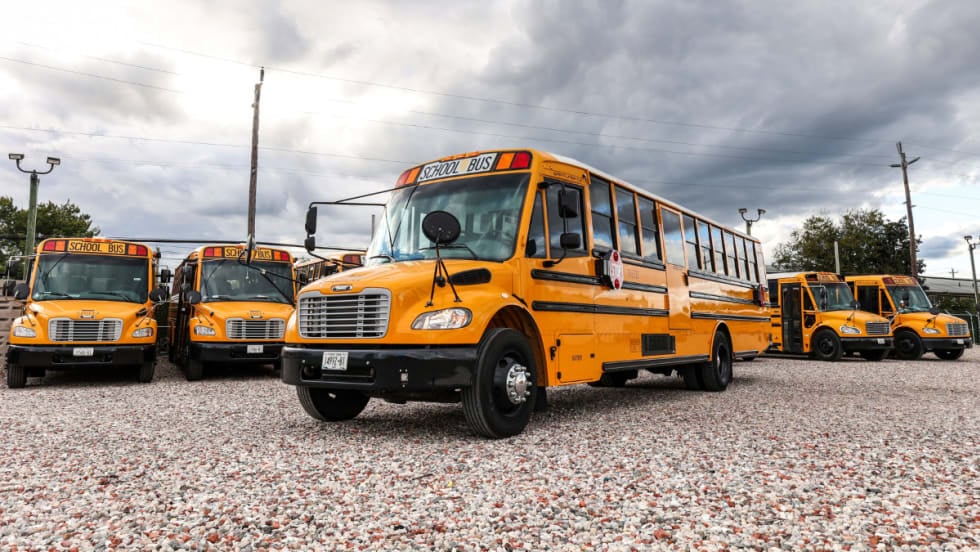
Logan Bus Company Rolls Out AI Phone System for NYC School Bus Families
A summer pilot found that AI agents could handle most routine calls, freeing up time for customer service staff to focus on emergencies and complex family concerns.
Read More →
From Intent to Impact: What I Learned About Leadership from TAPT
A Texas transportation supervisor shares lessons on self-awareness, accountability, managing stress and building trust — and why investing in leadership development matters at every stage of your career.
Read More →
NAPT Names 2026 Award Recipients, Hall of Fame Inductee
Who earned national recognition for their work in student transportation? This year, NAPT named five recipients of its 2026 awards for service, safety, and leadership, plus its newest Hall of Famer.
Read More →
2026 State of Student Transportation Report
Driver shortages. Rising costs. Growing safety expectations. More data, but not enough time to act on it. The 2026 State of Student Transportation Report reveals what transportation leaders say is putting the most pressure on their operations—and where they’re investing next. See how your priorities compare.
Read More →
How to De-Escalate an Angry Person: 5 Steps for Handling Workplace Conflict
What makes emotions run high, and how should you handle an angry colleague or parent? Follow these steps for staying calm, listening, showing empathy, and resolving conflict.
Read More →
What Readiness Looks Like This School Year
Learn about the challenges shaping the 2026–2027 school year, from persistent driver shortages and budget pressure to technology and readiness gaps. See how school districts are responding and adapting in Zonar’s 2026 Back-to-School Readiness Report.
Read More →