




Drivers Respond to Key Ergonomic Changes
Sheryl Ehrlich of Central School District 13J in Independence, Ore., has driven buses for 11 years. Being on the tall side, she found she needed more ...
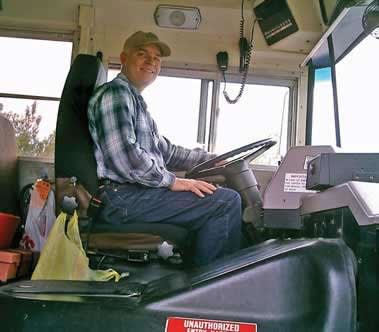
Sheryl Ehrlich of Central School District 13J in Independence, Ore., has driven buses for 11 years. Being on the tall side, she found she needed more legroom in her driver compartment. She “made do” for years but soon started experiencing knee and back pain. It increased to the point where she was no longer able to drive buses. Her employer reviewed the ergonomics of her school bus and moved the seat back five inches, which alleviated her knee pain. Her back pain continued until she started using a back pad with her seat, and that greatly reduced it.
Ergonomics, the science of designing a workspace to fit the worker’s safety needs, is integral to a bus driver’s daily duty. The benefits of an ergonomically correct workspace for bus drivers are far-reaching, producing increased job efficiency, safety and preventive health maintenance. If drivers’ workspaces are designed to meet their ergonomic needs, they will be able to work for longer periods of time, while feeling safe and comfortable.
Conversely, without an adequate ergonomic setup, drivers are vulnerable to serious health conditions and potentially unsafe situations. Every part of the driver compartment, from seat backs to mirror placement, can affect the ability to drive comfortably, as well as cause minor health problems that may grow more serious if left unchecked.
Adequate lumbar (back) support is critical for driving safely, according to Drew Bossen of Atlas Ergonomics. An adjustable seat back setting will provide support and alleviate pain. Appropriate steering wheel adjustment is also necessary for proper posture and optimal road visibility. (For more ergonomic tips, see sidebar.)
Easier, healthier driving
Bus manufacturers have continually worked to meet drivers’ ergonomic needs. In 2004, Thomas Built Buses introduced a new bus model, the Saf-T-Liner C2, adding features ranging from increased visibility to better control accessibility. Additional visibility has been provided by sloping windshields, larger front “A” pillar windows and large side windows. Drivers can also move the steering wheel back or forward and, due to the addition of pedal adjustability, are still able to easily reach the pedals. These changes were also made to help reduce bus driver fatigue.
To ascertain the necessary improvements, Thomas Built used focus groups, 3-D human models and surveyed almost 1,000 professionals — bus drivers, school transportation directors and technicians. It combined advanced technology with this input to create its latest model.
IC Corporation has also enhanced the bus driver compartments in its vehicles. The manufacturer used a “holistic approach” to make improvements to the driver’s compartment.
“We observed and analyzed all the movements drivers make while performing their duties, and developed a complete solution to maximize the driver’s ability to perform those duties,” says IC Marketing Manager Keith Kladder.
Applying the resulting data, the company created the optimal seat position and placement of switches, controls and pedals. IC Corporation is planning to update its driver compartment even further in the near future.
Blue Bird Corp. is constantly trying to “improve driver ergonomics through better seats and seat travel,” says Dennis Whitaker, vice president of new product development.
In response to driver feedback, Blue Bird made improvements to its instrument panels and steering columns. The company has recently employed outside suppliers with automotive and heavy truck and bus experience in ergonomics to help in further developing driver compartments. Blue Bird will soon add new driver’s seats to its buses and plans to “continue making ergonomic improvements as new equipment and strategies become available,” Whitaker adds.
Fitting the driver
The consensus of transportation professionals is that adjustability is key to comfort. Air ride seats were the most favored ergonomic improvement.
“Our seats can be height-adjusted. After a mechanic makes a setting change, [drivers] can use the lever to [move] the seat,” says Annette Hillard, a bus driver of 14 years for Cinnaminson (N.J.) Township Public Schools.
Linda Farbry, director of transportation services for Fairfax County (Va.) Public Schools, notes that combined with adjustable pedals, movable seats have made the compartment safer and more comfortable for drivers due to their flexibility. The seats can be adjusted to accommodate drivers of nearly all sizes.
Steering wheels have changed for the better, too, with standardized sizes. “The change from the larger to the smaller steering wheel for power steering was significant, but now that the diameter is fairly standard, there is no real difference in the steering wheels from one manufacturer to another,” says Brian O’Leary, a bus driver for Pathfinder Regional Vocational Technical High School in Palmer, Mass.
Using a telescoping feature in the steering wheel to better accommodate for height is another driver benefit, says Ehrlich.
New pedal placement and adjustability is another positive for drivers. Making the pedals movable is safer, since they are easier to reach for drivers of different sizes.
Hillard says that the most beneficial compartment difference she has experienced is the change of the emergency brake location. It used to be positioned on the left side in her bus; now that it has been moved to the right, someone else can reach it in an emergency.
Mirror improvements overall have been well received. Geoff Bridgman, a bus driver in Mt. Pocono, Pa., says that on some of his buses, he particularly values “well-placed mirrors that provide good visibility and ease of driving at night.”
Ehrlich is also pleased by changes in mirrors. “On an older bus I used to drive, I had a single mirror for watching traffic coming up beside me on either side. My district retrofitted my bus with one lower mirror, which made objects seem closer, and an upper standard mirror. Having new mirrors adjusted to my height in the seat and to see alongside my bus made it much easier to see when turning my bus around,” she says.
Ehrlich says the new mirrors have an added heating feature, guaranteeing more visibility in cold weather.
Drivers also report better access to many of the controls. In some new buses, manufacturers placed controls directly on the steering wheel, so the driver does not need to remove his or her hands from the wheel to reach them.
Lingering issues
Still, bus drivers have some concerns with their current compartment setups. The seating, for some, could be improved.
“The seats have become the high-backed type [and are] unadjustable, which is a problem,” says Hillard, who has dealt with neck pain as a result of having a seat back that is too high and not adjustable. She describes it as a literal “pain in the neck.”
Some drivers also say that their seat still does not go far back enough for them, indicating that there is possibly still work to be done on seating accommodation for drivers of different sizes and heights.
Lack of positioning flexibility hinders visibility for one bus driver. She comments that her mirrors are positioned too high and are not adjustable. Another driver echoes her input, saying he hopes to have more blind spots eliminated.
Another place in the driver compartment where there are still fewer options is the seat belt. This equipment is critical for safety. However, the shoulder harness has been a potential ergonomic issue for drivers who are shorter or taller than average and cannot modify the length, leaving it either too tight or loose.
Some drivers are not happy with bus dashboards changing from metal to plastic, reporting that it makes them feel less safe. Another problem presented by this is that the replacement of metal with plastic eliminated a place to post route sheets with magnets, which made the sheets easier for drivers to view.
Ehrlich says, “I personally don’t care for the wraparound dashboards; they are too low, and I smack my knees into them.” She adds that she would prefer a “more open compartment” to accommodate for height.
However, Farbry, who as a director often hears feedback from bus drivers in her district, notes that having a wraparound dashboard enables the drivers to have closer access to the controls.
Switches and switch panels also still need attention, Farbry says. Many switches on a bus’ control panel share the same color, shape and texture. Some with completely different functions, like the defogger fan, flashers and stop-arm cancel, look identical and are located on the same side of the steering wheel. While the switches have been angled for differentiation, and for easier readability, drivers still have to choose between looking for the correct switch or keeping their eyes on the road, adds Farbry.
Tips from ergonomics experts
Here are six steps that can be taken to make driver compartments more ergonomically friendly, courtesy of Atlas Ergonomics’ Drew Bossen and Occupational Health Clinics for Ontario Workers Inc.
1. Get support. Lumbar (back) support is critical. Using an adjustable seat back can prevent or alleviate back pain. Without proper lumbar support, we all eventually collapse into what experts refer to as a “flex-rounded posture” — in other words, we slouch. That’s a big back pain culprit. If you do not have access to an adjustable seat back, consider using a back pillow.
2. Angle seat in an upright posture. Ergonomics experts recommend that you tilt your seat back 110 degrees from your legs (tilted slightly downward). Sitting at the correct angle provides better visibility, distributes your weight more evenly and relaxes the back muscles.
3. Clear two to three inches behind your knees. There are many sensitive nerves in the backs of the knees, and cutting off circulation can cause pain and possible nerve damage.
4. Bring steering and controls to you. If you have an adjustable steering wheel column and seat, make sure you are seated as close as possible to prevent having to reach uncomfortably for controls.
5. Make sure your mirrors are adjusted properly.
6. Keep window clean. Lack of visibility is a huge safety hindrance. Be sure your windows are clean before you drive so you don’t struggle to view traffic.
More Management
13 Industry Leaders Describe School Transportation in One Word
What word best describes the school bus industry today? We posed that question to over a dozen manufacturers, resulting in a revealing mix of perspectives on the challenges and opportunities ahead.
Read More →
Tyler Technologies Adds New AI, Transactions Leadership Roles
Two company executives are promoted to newly created C-suite positions to accelerate the company's long-term growth in both artificial intelligence and payments.
Read More →
Pro-Vision Acquires Convoy Technologies
The deal aims to broaden customer relationships and adds specialized vehicle video capabilities for commercial fleets.
Read More →


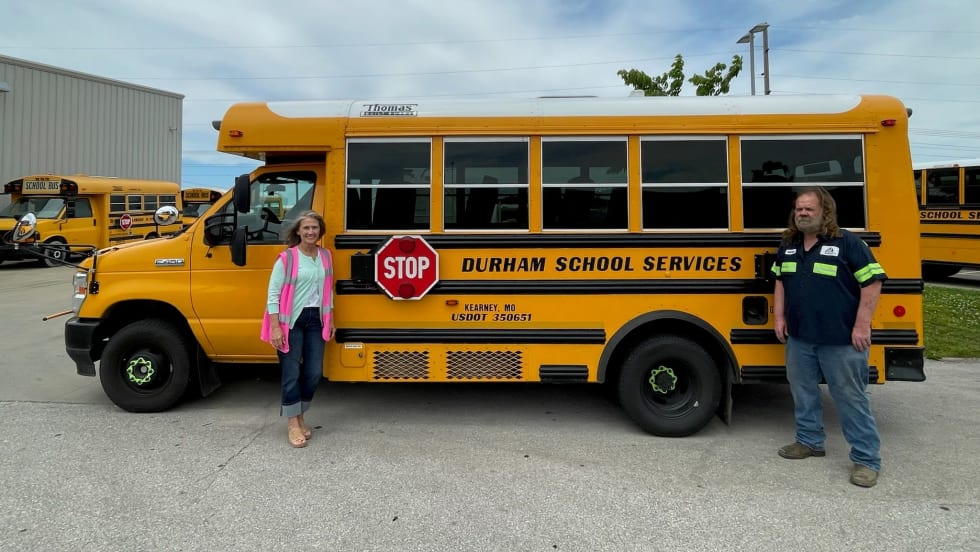
Durham School Services Maintenance Teams Earn Missouri Fleet Excellence Awards
Eight of the contractor’s school bus fleets achieved a distinction few maintenance teams earn during the state’s rigorous annual inspection program.
Read More →
How Incentives, AI, and Energy Markets Are Reshaping School Transportation
Sit down with Joe Annotti of TRC Companies to talk district grant funding, utility challenges, AI, and why school buses are evolving from transportation assets into energy assets.
Read More →
Inside the Contracting Shift: What School Transportation Operators Are Seeing Now
School transportation contractors weigh in on recent trends, costs, driver shortages, and the rise of multimodal student transportation.
Read More →
The No-Idling School Bus AC System
Take a peek at ExoAir Systems’ battery-powered cooling solution designed to run for up to 10 hours without the engine on, reducing fuel use and improving comfort for drivers and students.
Read More →
Geotab on Three Major Trends in School Transportation
School bus fleets are becoming more proactive than ever. From AI driver alerts to vehicle-to-grid opportunities, Geotab outlines the biggest technology trends transforming school bus operations.
Read More →
Gatekeeper Lands Major School Bus Deals as Revenue Surges
The video solutions provider announces contracts with Atlanta Public Schools and other fleet operators as it records quarterly revenue growth and expanding subscription business.
Read More →
Building Leaders Who Last: Creating a Successful Mentorship Program in Student Transportation
Discover five strategies for building an effective mentorship program to strengthen leadership development and support staff retention.
Read More →