




Will School Buses Still Be Around in 2056?
The future of school transportation will be influenced by fuel availability and price, educational funding, social changes and advances in technology.

Is the school bus destined for extinction over the next 50 years?
The answer seems obvious. Of course, not. Well, probably not, anyway.
Currently, about 450,000 school buses transport approximately 24 million American schoolchildren to and from school with a safety record that’s unmatched by any highway carrier.
These 450,000 school buses not only provide safe passage for millions of schoolchildren, but they also reduce traffic congestion around schools during the morning and afternoon commutes. They also help to preserve the environment by reducing the amount of tailpipe emissions into the atmosphere.
What’s more, the school bus has become an icon of the U.S. educational system. Just as McDonald’s is tied to the golden arches, the American school system is wedded to yellow school buses.
So, it’s nearly inconceivable that school buses will not be plying the nation’s highways 50 years from now. The service they provide is too important for them to disappear. Or is it?
Majority is hopeful
To gauge the industry’s belief in the future of the school bus, we asked a group of 82 pupil transportation professionals the following question: “Will school buses, as we know them now, still be around in 50 years?”
More than half say yes. About 56 percent are optimistic about the survival of the school bus. But many of them concede that challenges exist. Here are a few samples of their concerns:
“Funding. Without it, we won’t survive.”
“Overregulation by the government.”
“Technology outpacing training.”
“Funding. We need more state and federal help.”
“Student misbehavior on buses.”
“That it will fade away.”
Meanwhile, nearly three of 10 respondents (29.6 percent) believe that the school bus is doomed. They say it will not be around in 50 years. And nearly one in seven (14.8 percent) also have their doubts, saying they are “uncertain” whether buses will survive. That’s a surprisingly large number of transportation professionals with such a pessimistic view of the industry’s future, but trends suggest that their opinion may have some merit.
Rising costs are concern
The annual cost of transporting those 24 million children is upwards of $12 billion, and that sum has undoubtedly increased in the past year because of record high fuel prices. Many school districts have had to tap into reserves or transfer funds from other accounts to cover higher-than-expected fuel expenses.And it’s not just the cost of fuel that’s going higher. The industry’s bus manufacturers are saying that the costs of their products are also heading higher.
Some of these price increases are caused by rising cost of construction materials such as steel, copper and plywood. And next year’s implementation of stricter diesel emissions standards by the EPA will lead to engine price increases of several thousand dollars. In 2010, those emissions standards will be further tightened, forcing engine manufacturers to invest even more money in cleaner-burning propulsion systems and filters. That will most likely lead to another round of engine price hikes.
Meanwhile, school boards continue to be squeezed by tight budgets and forced to make tough decisions about how to adequately fund classrooms without taking too much away from ancillary services such as transportation. Some have already taken drastic action.
Bitten by the unexpectedly swift rise of diesel fuel prices, one school district canceled school for two days to defray its operational costs. Other districts have reduced service by extending walking distances or discontinuing bus transportation for activity trips. Certainly, a trend is emerging that suggests that transportation services will continue to be whittled away, even as more parents try to put children on buses to reduce their own transportation expenses.
In the short term, it looks like funding issues do not augur well for school bus transportation. But the economy tends to move in cycles, and the next 50 years will likely see a series of troughs and peaks that will create corresponding budget deficits and surpluses. How school districts respond to those cycles will be interesting to watch, especially as it relates to school transportation.
Disappearing fossil fuel
Another interesting factor in the survival of the school bus will be the world’s fossil fuel reserves. More than likely, you’ve never heard of Hubbert’s Peak, but it has a bearing on this story. No, it’s not a peak in a mountain-climbing sense; it’s what geologists call the “halfway point” in global oil production. According to some calculations, we reached that halfway point sometime last year, meaning that half of the world’s oil supply has been exhausted.What does that mean for the school bus industry? It means that in another 30 years or so, the world’s oil production will be cut in half. If Hubbert’s theory is correct, by 2056, global oil production will be approximately a quarter of what it is today. That would not be good news for operators of school buses.
Of course, Hubbert’s conjecture is merely that. Other oil experts, including the U.S. Department of Energy (DOE), predict that world oil production has by no means reached its peak. But even the DOE concedes that peak production could be reached by the year 2050.
The argument for alternative fuels is strengthened by this specter of disappearing fossil fuel. Over the next five decades, school buses should be transitioning to fossil fuel alternatives to maximize their chance of survival.
Hybrids spur enthusiasm
Respondents to the aforementioned survey were asked what they thought would be the most common fuel (or propulsion system) in 2056. About two in five (42.6 percent) predict that hybrid diesel-electric systems would be the most likely replacement for traditional diesel engines.[PAGEBREAK]
The advantage of hybrids, which combine small, efficient diesel engines with battery-powered motors, is that they can increase fuel mileage significantly while reducing emissions. The main disadvantage is the higher upfront cost for the vehicles, which cost about twice as much as a standard diesel-powered bus. If hybrid buses become popular and are produced in volume, the cost will come down, but there will always be a premium to be paid. Unless government subsidies are available to offset those costs, school districts will be reluctant to pay the premium.
About one in five respondents (20.4 percent) believe that hydrogen fuel-cell buses will replace diesel buses by 2056. This alternative-fuel system is already being used in a few transit buses, but, again, the initial cost of the bus and the fueling infrastructure is prohibitively expensive. One of the hydrogen-powered hybrid buses operated by AC Transit in Oakland, Calif., cost more than $1 million to manufacture.
Electric bus has appeal
About one in eight (13.0 percent) of respondents believe that pure electric buses are the wave of the future. A few attempts to run electric school buses have met with failure, but scientists are continuing to research and develop more efficient battery systems. The biggest hurdle has been the limited range of the buses and the weight of the battery packs. If scientists can develop lighter, more efficient and more affordable batteries, it’s possible that school buses that cover shorter routes could run solely on electricity.Some of the respondents believe the status quo will prevail. About 17 percent said diesel fuel will continue to dominate the industry over the next 50 years. They more than likely believe that fuel prices will stabilize and that concerns about the depletion of the world’s oil supply are unfounded.
About one in 20 respondents (5.6 percent) believe that natural gas will take over where diesel leaves off. Some California school districts operate compressed natural gas (CNG) buses, but the results have been mixed. Without government grants to cover the additional cost of CNG buses and their fueling stations, however, few of the districts would be able to afford them.
Buckling the trend?
To understand how the industry views the future of crash protection, our survey asked whether respondents believe that active restraint systems such as lap-shoulder belts will be standard on all school buses in 2056.Surprisingly, less than two-thirds of the respondents (61.1 percent) say yes. More than a third (35.2 percent) say no, while 3.7 percent are unsure.
California already has such a law on the books, and other states are seriously considering similar statutes.
Compartmentalization has been the underpinning of an amazing safety story for the past 30 or so years, but the public will continue to ask the obvious question: “If automobiles are required to have three-point belt systems, why aren’t school buses also equipped with them?”
Studies sponsored by the National Highway Traffic Safety Administration suggest that installation and use of lap-shoulder belts would have an almost imperceptible impact on fatality rates in school bus accidents, but the reality is that the public doesn’t really care about federal studies when it comes to an emotional issue such as child safety.
Where do I stand?
I believe it’s likely that school bus-based pupil transportation will progressively diminish over the next 50 years. By 2056, school buses will be used to transport special-needs students and students in rural and suburban areas that live long distances from their schools.California provides a glimpse into the future. In the Golden State, the percentage of students eligible to receive school bus transportation has diminished to just 17 percent. Most of those who do receive transportation are special-needs students. Many students, especially the older ones, who aren’t eligible to ride a school bus use public transportation to get to school.
An increase in the use of public transit — buses and trains — is a trend that I think will continue over the next five decades. With budget problems likely to continue, school boards are going to look seriously at the low-cost alternative of public transportation. And transit systems, always on the lookout for ways to increase ridership, will be more than happy to accommodate school districts that are willing to face the possible political fallout of putting students on buses that aren’t yellow.
I think it’s important for the pupil transportation industry to learn from its transit brethren. The transit industry does a great job in telling its story, about how it helps to provide communities with mobility options, to reduce congestion, to mitigate air pollution, to create jobs and to stimulate the economy. The pupil transportation industry can make the same claims, and add that it’s the safest form of surface transportation!
The fuel of the future
In regard to fuel, I’m going to sit on the fence here. Hybrid diesel-electric buses are too expensive for all but the most heavily funded school districts, but the technology seems appropriate to the task. These hybrids use regenerative braking to help recharge the battery systems. The stop-and-go driving of school buses fits this application perfectly.Whether or not we’re going to deplete the global supply of crude oil is an open question that even the most astute geologists can’t answer with certainty. We must, however, not wait before starting a serious search for fossil-fuel alternatives. The growing popularity of biodiesel is a positive development. It’s too soon to say whether biodiesel will play a significant role in reducing our dependence on fossil fuels, but the mere fact that fleets are willing to try biodiesel is a good sign.
While the transportation industry gains practical experience with the readily available alternative fuels, we need to ensure that we’re doing our best to conserve the fuels that we’re using. Reducing idling times, optimizing routing and scheduling, and keeping buses in top operating condition will help to slow down the depletion of our fuel supply. That’s an important consideration in the short term, especially with volatile fuel prices, and in the long term, as we consider the possibility that Hubbert may have been correct.
A virtual classroom?
I don’t think we’ll see wide-scale use of virtual classrooms that allow students to learn from home over their computers. Even if the technology becomes cheap and available to even the lowest-income families, the value of academic learning is wholly diminished if it is not accompanied by social development. You can have a virtual classroom, but I don’t think we’re ever going to have virtual dances, football games or food fights. It’s just not the American way.Besides, if distance-learning becomes the norm, there won’t be a need for school buses or for trade magazines that cover the school bus industry. And we are hoping to be around in 2056 and beyond!
More Management
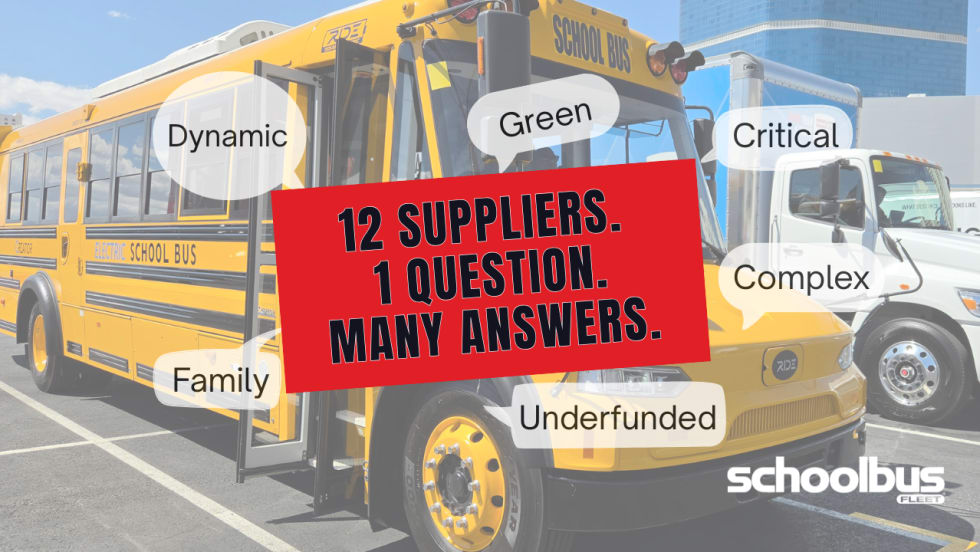
13 Industry Leaders Describe School Transportation in One Word
What word best describes the school bus industry today? We posed that question to over a dozen manufacturers, resulting in a revealing mix of perspectives on the challenges and opportunities ahead.
Read More →
Tyler Technologies Adds New AI, Transactions Leadership Roles
Two company executives are promoted to newly created C-suite positions to accelerate the company's long-term growth in both artificial intelligence and payments.
Read More →
Pro-Vision Acquires Convoy Technologies
The deal aims to broaden customer relationships and adds specialized vehicle video capabilities for commercial fleets.
Read More →


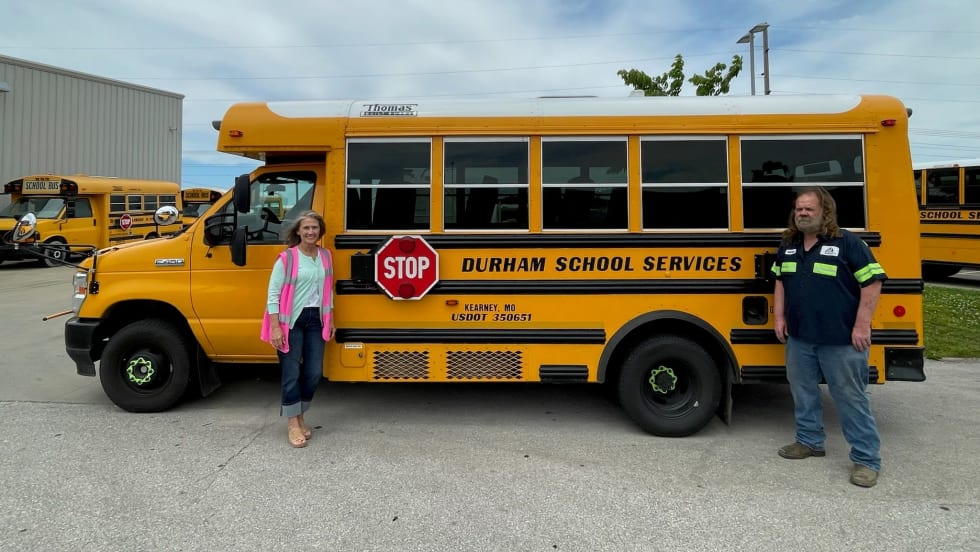
Durham School Services Maintenance Teams Earn Missouri Fleet Excellence Awards
Eight of the contractor’s school bus fleets achieved a distinction few maintenance teams earn during the state’s rigorous annual inspection program.
Read More →
How Incentives, AI, and Energy Markets Are Reshaping School Transportation
Sit down with Joe Annotti of TRC Companies to talk district grant funding, utility challenges, AI, and why school buses are evolving from transportation assets into energy assets.
Read More →
Inside the Contracting Shift: What School Transportation Operators Are Seeing Now
School transportation contractors weigh in on recent trends, costs, driver shortages, and the rise of multimodal student transportation.
Read More →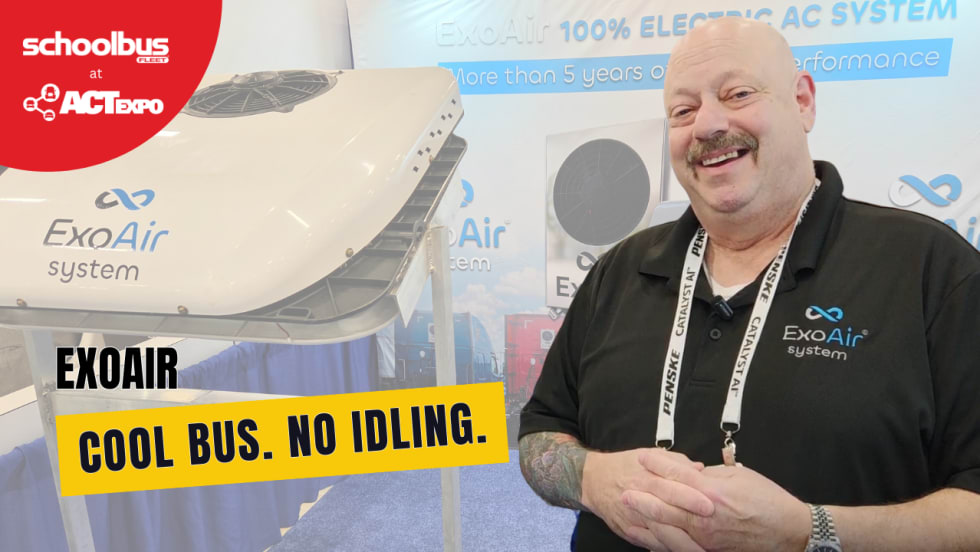
The No-Idling School Bus AC System
Take a peek at ExoAir Systems’ battery-powered cooling solution designed to run for up to 10 hours without the engine on, reducing fuel use and improving comfort for drivers and students.
Read More →
Geotab on Three Major Trends in School Transportation
School bus fleets are becoming more proactive than ever. From AI driver alerts to vehicle-to-grid opportunities, Geotab outlines the biggest technology trends transforming school bus operations.
Read More →
Gatekeeper Lands Major School Bus Deals as Revenue Surges
The video solutions provider announces contracts with Atlanta Public Schools and other fleet operators as it records quarterly revenue growth and expanding subscription business.
Read More →
Building Leaders Who Last: Creating a Successful Mentorship Program in Student Transportation
Discover five strategies for building an effective mentorship program to strengthen leadership development and support staff retention.
Read More →