




How Small Operations Conquer Big Challenges
The challenges some smaller operations face can mirror those of larger operations. However, dealing with difficult routing scenarios, attendance issues or the expense of training materials for just a handful of drivers makes a huge difference.

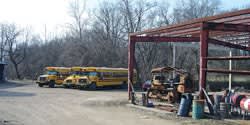
Whether it’s fuel costs, routing problems or staff shortages, pupil transportation operations across the U.S. have their hands full with day-to-day operational challenges. But when it comes to smaller, more rural districts, these same problems can appear monumental if not insurmountable.
Facing the challenge
Mesilla Valley Christian Schools (MVCS) in Las Cruces, N.M., transports approximately 500 students using a fleet of four buses. The private school district performs activity trips only. Drivers navigate desert terrain and some mountainous areas where, occasionally, there is snow. Currently, MVCS has a staff of six drivers.
John Foreman, superintendent at MVCS, says his greatest challenge is recruiting quality drivers. He handles the challenge by offering a competitive wage of $11 per hour. While MVCS can’t offer drivers a regular route, Foreman says that they earn more per hour than their counterparts at local public schools.
It has also been difficult to get affordable training materials at MVCS. “If I’m having a meeting with six people, it’s hard to go out and buy a video series for $495,” says Foreman. “That’s a lot of money for a small group and for a small school.”
To save on the cost of materials, Foreman searches the pages of trade magazines like SCHOOL BUS FLEET and shares resources with other districts whenever possible.
Similar to MVCS, Bloomfield-Mespo Local Schools in North Bloomfield, Ohio, has trouble recruiting substitute drivers to fill in for its staff of full-time drivers.
“People can’t get past the money part of it,” says Luci Eaton, transportation coordinator. Bloomfield pays its drivers $9 an hour, while the neighboring district pays $13. The district offers subs six hours of work a day.
Eaton tells new recruits that Bloomfield has fewer disciplinary problems on the school bus than larger neighboring districts, but she says this is hardly enough to lure new subs.
To make matters worse, new recruits must deal with a mandate stipulating that new drivers pursue CDLs through federal channels as opposed to a third-party school bus examiner. The rate for CDL examinations has increased to about $85 in Ohio.
More trials ahead
Darnese Nicholson is director of pupil transportation at Gallaudet University in Washington, D.C. Gallaudet, which was one of SBF’s Great Fleets Across America in 2001, has a staff of 18 drivers that complete 11 runs daily for the deaf students at Kendall Demonstration Elementary School. The school, which is on the university campus, is a private entity receiving Congressional appropriation with oversight by the Department of Education.
Fuel costs, says Nicholson, are the department’s greatest challenge. “We burn an awful lot of fuel living in a largely metropolitan area,” she says. Few remedies exist for this common problem.
Last year, Nicholson and her mechanic applied unsuccessfully for a grant to have particulate filters installed on her fleet. “It was very disappointing,” she says. “We’re not a state school district and therefore did not qualify for the program, yet I purchase the same school buses as any school district.”
Although the experience left Nicholson a little disheartened, she has not lost hope. She recognizes the multiple benefits of air-quality programs and plans to reapply this year.
Balancing acts
Routing is the greatest challenge for Jeff Walker, transportation supervisor at the School District of Black River Falls (Wis.).
The school district is 500 square miles and includes hilly terrain. Thirty-two buses carry 1,700 students to five schools. The eastern part of the district is desolate. When a new student moves to this area, it can add 20-plus minutes to a route.
The northwest part of the district is hilly and has unpaved roads. This too requires extra time, especially during the winter. Students from kindergarten through 12th grade ride together, which is a challenge for some drivers who are used to transporting only elementary, middle or high school students.
[PAGEBREAK]
Keeping ride-time down is also tough. “Some of the kids are 45 minutes or more away from the school. It’s a challenge to make sure they’re not on the bus for too long,” Walker says.
At Nell Holcomb School District in Cape Girardeau County, Mo., most of the drivers are also teachers. This creates an interesting situation in that the teachers often miss after-school meetings because of their routes and are challenged to find teachers to cover for them during driver training. Routing is also a problem.
“It’s difficult to come up with good elementary bus routes,” says Sue Rees, who is a driver, a driver trainer and a teacher at Nell Holcomb.
Some of the district’s routes, although short in length, are full to capacity, while other bus routes that may be more than an hour long have fewer students. Then there is the challenge of finding a safe place to load or unload students on the rolling hills and highways in the district.
The bright side
Despite the many obstacles and challenges faced by these operations, there are some advantages to being smaller. The greatest advantages are low turnover and the close relationships between drivers, passengers and their families. Transportation managers also enjoy the close-knit communities and the manageability of student passengers.
“We have personal relationships with probably all of the students we transport and their parents,” says Nell Holcomb’s Rees. “I wouldn’t have it any other way.”
Rees likes to contrast the rigidity of the student/teacher relationship to that of the driver/passenger, which she says is more relaxed. “A schoolteacher can have a student all day and not know a whole lot about them,” she says. “But when you get on that school bus and drive them home, it tells you a whole other story.”
The close-knit dynamic works wonders for in-house matters as well. Take, for instance, the high morale at some operations. When drivers feel good about coming to work each day — when they feel a part of the family and the importance of what they do — they tend to stay on longer.
“One of our greatest strengths is our drivers’ dedication to their jobs,” says Walker. “The average driver in this district has been driving for 10 years. One of my drivers has driven for over 40 years.”
Bloomfield’s Eaton has been with the district for 26 years. Her staff is made up of mostly veteran drivers, who won’t take off from work unless it’s absolutely necessary. “We’re older here,” she says. “My youngest driver is in her mid 40s.”
As an added benefit to their competitive pay, MVCS drivers who have children attending the private Christian school receive tuition discounts. “We started this program in which bus drivers can earn tuition discount points for each year of service,” says Foreman.
Gallaudet University also can offer a quality level of service because of its size. Gallaudet provides door-to-door transportation for most children in its program. And because of the students’ hearing disabilities, none is required to cross in front of the bus. All pick-ups and drop-offs are on the same side of the street as the student’s home.
Good communication also adds to the spirit of community at Gallaudet. As a condition of employment, every staff member is required to learn American Sign Language.
“The worst thing that could happen is to have a child telling you their stomach hurts and you’re smiling and nodding your affirmatively,” says Nicholson. “You need to understand what the children are saying to you.”
Strength in small numbers
Working together to cut costs wherever possible also adds to the family dynamic of smaller operations. The efforts usually have multiple benefits.
“We don’t have a lot of areas where we can cut,” says Eaton. “But we’ve cut back on idling, which cuts down on fuel usage.”
Bloomfield drivers are allowed to take their buses home. In addition to being a convenience for drivers, it cuts down on storage costs and travel time.
Nicholson is also working on a no-idling program. She hopes that this and a new automated fleet maintenance program will help save the operation money.
Black River Falls purchased routing software that is used to re-evaluate the efficiency of routes. Optimized routing can not only curtail the number of miles traveled but can sometimes find ways to reduce the number of buses required to cover the routes.
Meanwhile, Nell Holcomb Schools is trying to pare maintenance costs to a minimum by standardizing its fleet of buses.
More Management
13 Industry Leaders Describe School Transportation in One Word
What word best describes the school bus industry today? We posed that question to over a dozen manufacturers, resulting in a revealing mix of perspectives on the challenges and opportunities ahead.
Read More →
Tyler Technologies Adds New AI, Transactions Leadership Roles
Two company executives are promoted to newly created C-suite positions to accelerate the company's long-term growth in both artificial intelligence and payments.
Read More →
Pro-Vision Acquires Convoy Technologies
The deal aims to broaden customer relationships and adds specialized vehicle video capabilities for commercial fleets.
Read More →


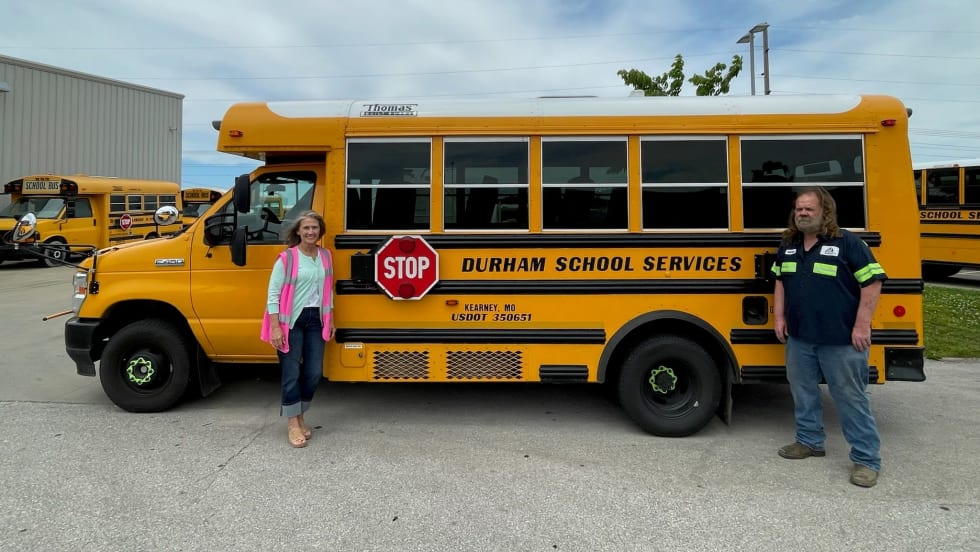
Durham School Services Maintenance Teams Earn Missouri Fleet Excellence Awards
Eight of the contractor’s school bus fleets achieved a distinction few maintenance teams earn during the state’s rigorous annual inspection program.
Read More →
How Incentives, AI, and Energy Markets Are Reshaping School Transportation
Sit down with Joe Annotti of TRC Companies to talk district grant funding, utility challenges, AI, and why school buses are evolving from transportation assets into energy assets.
Read More →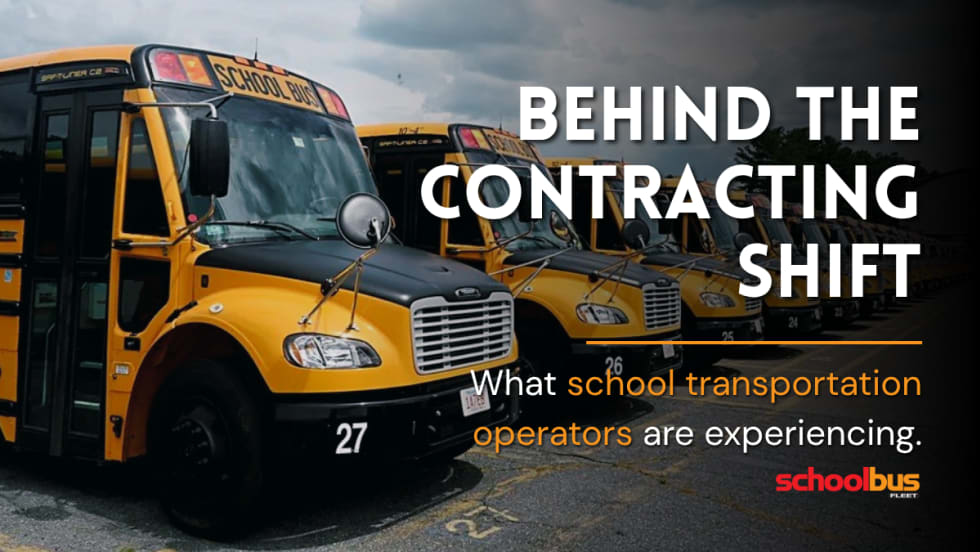
Inside the Contracting Shift: What School Transportation Operators Are Seeing Now
School transportation contractors weigh in on recent trends, costs, driver shortages, and the rise of multimodal student transportation.
Read More →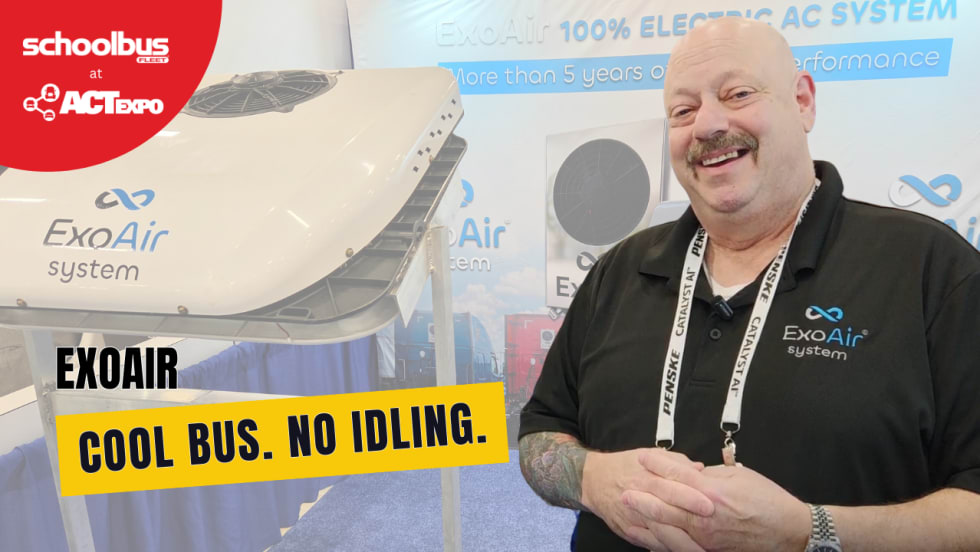
The No-Idling School Bus AC System
Take a peek at ExoAir Systems’ battery-powered cooling solution designed to run for up to 10 hours without the engine on, reducing fuel use and improving comfort for drivers and students.
Read More →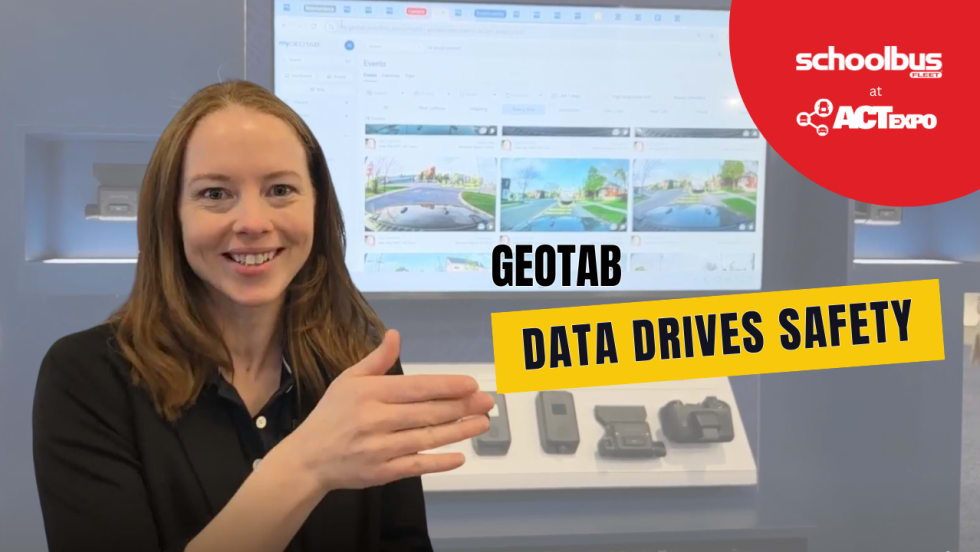
Geotab on Three Major Trends in School Transportation
School bus fleets are becoming more proactive than ever. From AI driver alerts to vehicle-to-grid opportunities, Geotab outlines the biggest technology trends transforming school bus operations.
Read More →
Gatekeeper Lands Major School Bus Deals as Revenue Surges
The video solutions provider announces contracts with Atlanta Public Schools and other fleet operators as it records quarterly revenue growth and expanding subscription business.
Read More →
Building Leaders Who Last: Creating a Successful Mentorship Program in Student Transportation
Discover five strategies for building an effective mentorship program to strengthen leadership development and support staff retention.
Read More →