




NASDPTS Examines Array of National, State Issues
At its annual meeting, the state directors association discussed a wide range of issues, including the National Congress on School Transportation, hurricane preparedness and federal directives.
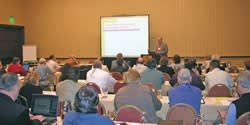
The National Association of State Directors of Pupil Transportation Services (NASDPTS) examined key state and federal issues during its annual meeting, held Oct. 27-31 in Austin, Texas.
Officials from the Transportation Security Administration, National Highway Traffic Safety Administration and Federal Motor Carrier Safety Administration spoke on the latest developments in pupil transportation.
As well, several state directors provided information about developments in their states or regions, including briefings on Web-based vehicle and driver information tracking, third-party CDL examiners, driver-screening companies and safe-crossing procedures.
Whither NCST?
The meeting also included a debriefing of the 14th National Congress on School Transportation (NCST) that turned contentious when facilitator John Green, California’s state pupil transportation director, suggested that his state did not benefit from the meeting, which is held every five years to develop guidelines for school bus operations and specifications.
“I don’t think it’s right to go down this path without looking at the process,” Green said. “If this was a business, it would be bankrupt.” He said California has always developed its own pupil transportation standards without regard to the document prepared at the NCST.
Charlie Hood, Florida’s pupil transportation director and NCST conference chair, reported that the 2005 Congress, held last May in Warrensburg, Mo., attracted 297 delegates from 47 states.
Hood said the major themes from the meeting included the increased leadership taken by delegates, improved accessibility and productivity and the name change: from the National Conference on School Transportation to the National Congress on School Transportation, a proposal forwarded by Donald Tudor, pupil transportation director in South Carolina.
Pete Japikse, Ohio’s state pupil transportation director and president of NASDPTS, said his state, like California, doesn’t use the NCST. “We believe that we’ve got a tougher standard,” Japikse said. “But it’s an incredible benchmark.”
Charlie Gauthier, executive director of NASDPTS, said “millions of dollars are spent by the industry to put the document together. We need to make it usable and desirable by everyone in the industry.”
Pete Baxter, who has been named the conference chair for the 2010 Congress, said he’d like to see the meeting evolve. “The process has pretty much stayed the same, but the industry has changed,” he said. “I’d like to see the process become cleaner, faster and more responsive.”
Storm warnings
The hurricanes that pounded Florida and the Gulf Coast were discussed during the four-day meeting. Leonard Swilley, state pupil transportation director in Mississippi, spoke about his state’s response to Hurricane Katrina, which devastated parts of his state, Louisiana and Alabama.
“We were grasping at straws as to what to do,” Swilley said, explaining that Mississippi has never been hit so hard by a hurricane. He said 79 of the state’s 102 school districts sustained at least some damage. Approximately 160 school buses were damaged, with about 66 destroyed. The cost of replacing the vehicles is estimated at $10 million, he said.
Obtaining fuel was one of the key issues for hurricane-afflicted school bus operations. Swilley said he had to wait in line for six hours to fill up his tank so he could drive into southern Mississippi to survey the damage. “If we hear of a storm approaching, we’re going to have school buses top off their tanks,” he said.
“Our flood was in children,” said Charley Kennington, Texas’ state pupil transportation director. He said 47,000 Katrina evacuees started school in the state the day after Labor Day. Two months later, nearly 45,000 were still in Texas schools.
[PAGEBREAK]
Helping to keep school districts in communication with each other for school transportation purposes was the emergency contact list compiled by the Texas Association for Pupil Transportation, Kennington said. “It’s one of the most important things you can have.”
Ronnie McCallister, assistant director of school transportation management for the Florida Department of Education, said his state has faced eight major hurricanes in the past 14 months, prompting transportation officials to create emergency plans and procedures.
Foremost, he said, is maintaining an adequate supply of fuel, especially for what could be a recovery period of several days. “It’s important to order fuel early and top off tanks no later than 72 hours [before the hurricane],” he said. “Ships carrying fuel will discontinue serving the ports about 48 hours from landfall of the storm.”
Communication is also an essential consideration in a hurricane. McCallister cautioned against relying on cellular service. “We’ve found the 800 MHz radios are the most dependable form of communication,” he said.
Reflections on 3 points
Derek Graham, North Carolina’s state pupil transportation director, and Jeff Tsai, director of pupil transportation at the Institute for Transportation Research and Education at North Carolina State University, discussed the ongoing testing of three-point belt systems in 13 buses in North Carolina.
The buses, which are divided among 11 school districts, were placed into service in January 2003. The seating options were three-two or two-two. Use of the restraint systems was not mandated.
In a survey of parents, 56 percent said they felt “much more positive” about the safety of the belt-equipped buses, while 18 percent said they felt “somewhat more positive.” About 26 percent said they felt about the same.
Drivers of the buses estimated about 50 to 70 percent of elementary pupils used the belts, while use among middle and high school students was almost non-existent.
A survey of principals found that they generally ascribed an improvement in behavior to the buses. But the principals also said they did not expect that the addition of three-point systems would increase ridership.
SNAC activities
In addition to the state directors, several members of the State and National Association Council (SNAC) attended the meeting.
Several breakout sessions were directed at SNAC members, including a workshop on association marketing by Robert Bookout, safety manager and emergency management coordinator for the Katy (Texas) Independent School District and founder and director emeritus of the Texas Schools Risk Managers Association.
Bookout said that associations interested in bolstering membership should identify key benefits that they provide.
Associations should try to offer services such as certification programs and training, Bookout said. But the key to a successful membership drive is having a dedicated person at the helm who understands how to use word of mouth, e-mail, newsletters and direct mail.
David Peterson, communications officer for the Minnesota Association for Pupil Transportation (MAPT), provided his insights on revenue-generating ideas for pupil transportation associations.
Peterson, who’s also transportation analyst for St. Paul Public Schools, said the association generates revenue through sales of safety and training products such as videos and DVDs.
One animated video, “The Safety Squadron Is Riding the Bus,” cost about $26,000 to produce, Peterson said. To date, about 800 copies have been sold at $50 each. The video is available in English, Spanish, Hmong and Somali.
The association uses its Website, www.mnapt.org to market its products. For example, a 30-second preview of the Safety Squadron can be downloaded at the Website. The full video can then be ordered through the Website.
More Management
13 Industry Leaders Describe School Transportation in One Word
What word best describes the school bus industry today? We posed that question to over a dozen manufacturers, resulting in a revealing mix of perspectives on the challenges and opportunities ahead.
Read More →
Tyler Technologies Adds New AI, Transactions Leadership Roles
Two company executives are promoted to newly created C-suite positions to accelerate the company's long-term growth in both artificial intelligence and payments.
Read More →
Pro-Vision Acquires Convoy Technologies
The deal aims to broaden customer relationships and adds specialized vehicle video capabilities for commercial fleets.
Read More →


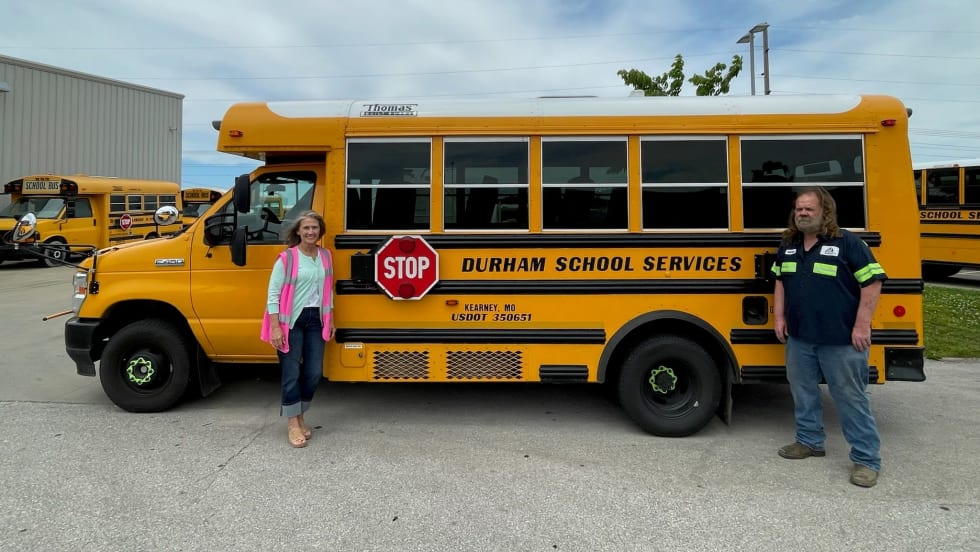
Durham School Services Maintenance Teams Earn Missouri Fleet Excellence Awards
Eight of the contractor’s school bus fleets achieved a distinction few maintenance teams earn during the state’s rigorous annual inspection program.
Read More →
How Incentives, AI, and Energy Markets Are Reshaping School Transportation
Sit down with Joe Annotti of TRC Companies to talk district grant funding, utility challenges, AI, and why school buses are evolving from transportation assets into energy assets.
Read More →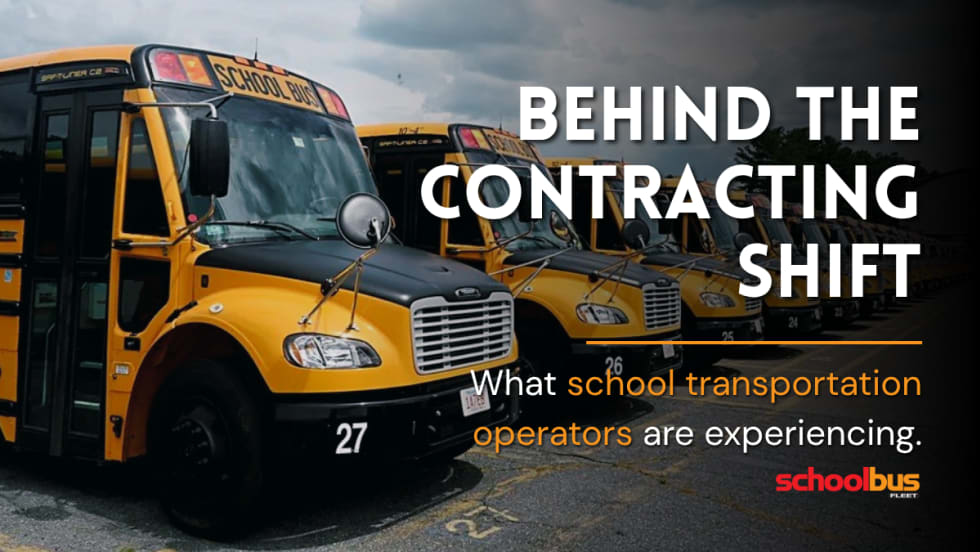
Inside the Contracting Shift: What School Transportation Operators Are Seeing Now
School transportation contractors weigh in on recent trends, costs, driver shortages, and the rise of multimodal student transportation.
Read More →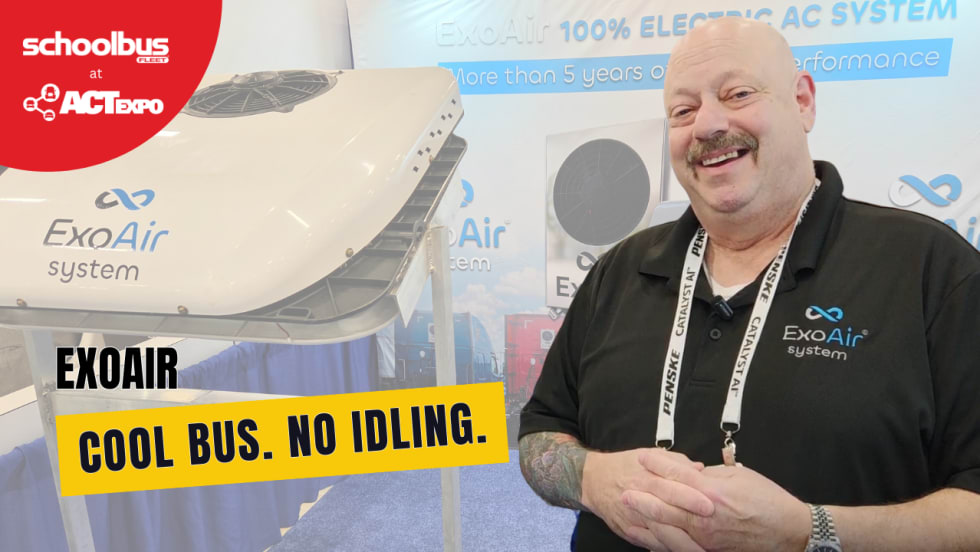
The No-Idling School Bus AC System
Take a peek at ExoAir Systems’ battery-powered cooling solution designed to run for up to 10 hours without the engine on, reducing fuel use and improving comfort for drivers and students.
Read More →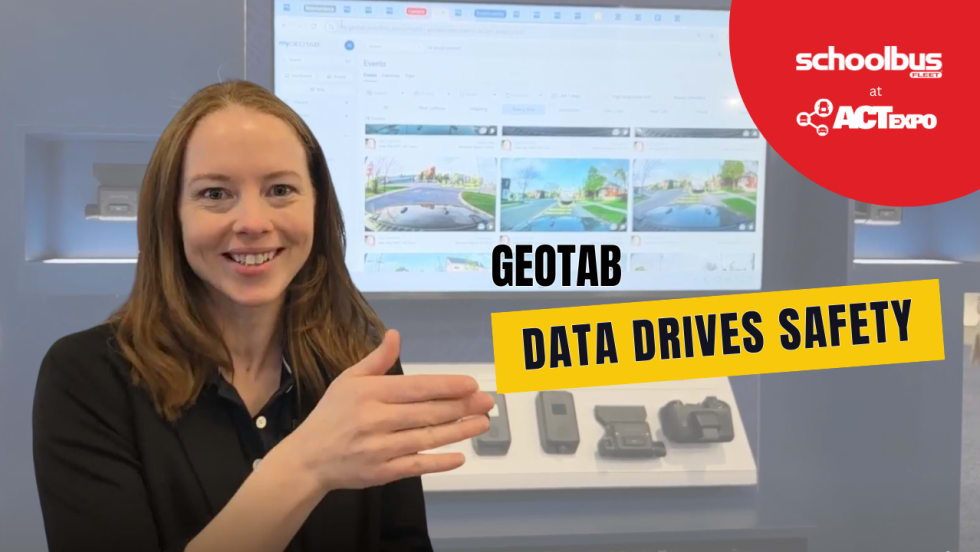
Geotab on Three Major Trends in School Transportation
School bus fleets are becoming more proactive than ever. From AI driver alerts to vehicle-to-grid opportunities, Geotab outlines the biggest technology trends transforming school bus operations.
Read More →
Gatekeeper Lands Major School Bus Deals as Revenue Surges
The video solutions provider announces contracts with Atlanta Public Schools and other fleet operators as it records quarterly revenue growth and expanding subscription business.
Read More →
Building Leaders Who Last: Creating a Successful Mentorship Program in Student Transportation
Discover five strategies for building an effective mentorship program to strengthen leadership development and support staff retention.
Read More →