



Can Parent-Pay Systems Alleviate Your Budget Woes?
As school transportation funding grows increasingly slim, school bus operators nationwide struggle to make ends meet. Here’s how some have turned to parents for added support.
In the face of increasing budget constraints, more and more operators are asking parents to pay for some or all of their children’s transportation services. In most cases, this applies only to those students ineligible to ride for free — those who live within walking distance or who attend schools of choice or special programs. In other cases, it applies only to activity trips, rather than home-to-school transportation. Some states prohibit charging students for school transportation services, even if they live within the walking distance. Others, such as California and Texas, which don’t require regular education transportation and offer limited funding, allow schools to charge students for services. As could be expected, California and Texas are replete with parent-pay systems.
Home-to-school travel
“This is one of the ways to defray the cost, by charging children to ride the bus. It’s a service we provide and that service costs money,” explains Betty Manwill, transportation director for Irvine (Calif.) Unified School District, which has been on a parent-pay system since 1981. All home-to-school transportation in the district is optional and fee-based. The standard cost per child is $270 a year, but the fees vary depending on the family income and the number of children transported. “We try to provide the best service that we can. Now that the cost is prohibitive, there has to be a fee,” she explains. Otherwise, the money would come out of the general fund. Neal Abramson, acting transportation director for Santa Monica-Malibu (Calif.) Unified School District, similarly characterizes his parent-pay system, which transports 600 regular education students to schools in Malibu. “Our annual transportation budget is somewhere around $1.3 million. Let’s say 250 students pay full price. That’s $59,000 in revenue, which isn’t much, but it’s better than nothing. It’s $59,000 less that has to come out of the classroom.” Though a large percentage of the student population qualifies for reduced-price or free bus passes, Abramson says the parent-pay system is still the only way the district can afford to provide school busing to those students. And even with the added funds, it’s becoming increasingly difficult to accommodate all of the riders. “We’re not increasing our bus routes right now. I put a freeze on all bus pass sales. This is the first time I’ve had to do that. I’ve got a waiting list,” says Abramson. Until the superintendent decides to raise the ridership fee or supplement funding in some way, there just isn’t enough money to go around.
Walking-distance riders
Many operators offer parent-pay transportation to students ineligible for free transportation — those who live within a certain radius of the school, normally one or two miles, depending on grade level. Oftentimes, this means waiting until several weeks into the school year to determine space availability. “We don’t start until the beginning of the third week of school, when we see how much room we’re going to have on the bus. The children who live outside the two-mile limit have priority,” says Steve Bond, transportation director for the Grapevine-Colleyville (Texas) Independent School District. He adds that it’s difficult to accommodate students living in certain areas where there aren’t routes running. He currently has about 60 students paying $25 a month to ride. “If we get more equipment, we’d like to expand to other areas,” he says. Another key factor in transporting walking-distance students is designation of bus stops, says Patricia Bye, transportation supervisor for Piscataway (N.J.) Township Schools. She has learned to have the school board approve stops for her 600 subscription (parent pay) bus riders well in advance of the school year and to have parents sign up for a bus stop when they pay their fees. “The problem we had was parents assumed, ‘I’m paying for this bus. I want door-to-door service,’” she says. Instead, she sends them a packet in June explaining why their students are not eligible for free transportation, how payment works and that service is provided along existing routes, using existing stops. It’s important to include a notice that any requests for changes to stops will be forwarded to the transportation committee and will require full approval of the board, she says.
Programs and activities
In Jackson, Wyo., the parent-pay system used by Teton County School District students serves a different purpose. “Our program is referred to as ‘The Afterschool Activities Bus,’” says Knowles Smith, transportation director. The Wyoming Department of Education reimburses all costs at 100 percent for school-related activities, field trips and home-to-school transportation. At Teton County, the purpose of parent pay is to transport students to club meetings, doctor’s appointments and other non-school–related activities. The fee is $10 a year for unlimited student rides. At the 10,000-student Sheboygan (Wis.) Area School District, a parent-pay system was used for eight years to transport students to “choice” schools outside of their normal attendance areas. The students were picked up at existing stops along normal bus routes and taken to schools the district commonly serves. Four years ago, however, a parent appealed to eliminate the fee-based system. The school board accepted. “In the last few years, our board has adopted a policy that says — if we’re going past there anyway and we’re not making another stop and it’s not costing us any more, we’ll pick you up for nothing,” says Gretchen Thomes, coordinator of financial services. Though Thomes agrees that the current policy works well for students and transporters alike, she supports parent-pay systems where they are necessary. “People think, ‘I’m paying taxes. I deserve this. Why should I pay more?’ But the idea is that you’re paying taxes to cover what the district has set in policies. Anything additional above that becomes an additional cost,” she explains.
Payment and tracking
The structure of fee-based systems varies widely. Some operations require payment up front for the entire year. Others break it down into semester or quarter and some offer special one-way or activity trip passes. Many schools issue students hand-made bus passes while some use computer software to generate photo ID cards. System management can be daunting and, in some cases, more effort than it’s worth. Lee Gillman, transportation coordinator for the Alpine School District in Linden, Utah, says that monitoring which students have paid and which haven’t is too difficult to justify the added income. After three years of charging $85 per student or $100 per family, the district has abandoned parent pay altogether. Bye at Piscataway Township says that she has learned a lot about administering a parent-pay system over the past five years. In the beginning, parents would walk in with cash and leave without a receipt and no way to track them. Others would put down a deposit but never pay the balance, despite numerous invoices. “We were chasing people until January to get their balances and sending certified letters to take their kids off the bus. It was getting pretty ugly. So now it’s cash up front,” says Bye. Applications for subscription busing are mailed out June 1. Parents are allowed 45 days to return the application with payment of $220. Those who apply on time receive a bus pass by Aug. 15. “I’m able to track on my computer the paid students and the eligible students,” says Bye. “I create a file out of our student database in Excel, input the money, send it to the business office with the spreadsheet and it works out pretty well.” Frances Bussell, contract manager for School Services and Leasing in Merriam, Kan., agrees that computerized tracking is the way to go. “Years ago, we did it all by hand. With the school IDs, it’s much simpler. You don’t have to issue a separate bus pass. Everything is downloaded into the computer when contracts come in,” she explains. Stickers color-coded by semester are adhered to each paying student’s ID card. The computer tracks names, grade levels, payment amounts and other vital information for the 3,800 Shawnee Mission School District students on the parent-pay system. However, even when closely tracked, payment is not always easy to collect. “We get quite a few returned bad checks,” she admits. Though she gets requests for credit card use, Bussell doesn’t foresee accepting them anytime soon. “I think that’s going to be a hassle if we do it,” she says. Use of credit cards, however, has helped to streamline operations for Laidlaw Education Services in Olathe, Kan., which transports between 400 and 500 students on the parent-pay system. Parents can either pay fees in person or call in and register by telephone using a major credit card. “It reduces traffic into the office, and it’s more convenient,” says operations manager Linda Sallaz. The bus cards are then made out by hand and mailed to the students. The base rate for one student is $202 a year, with discounts for early payment or multiple riders
Learning to communicate
Everyone involved in parent pay agrees that the key to a successful system is getting the support of the community. Communication is essential. “If you have not had a paying system and now you’re going to go to one, I would venture to say that you’re going to have opposition,” says Bye. “I think that’s why you have to involve the community.” This means sending out notices, calling meetings, addressing parental concerns and perhaps even posting parent-pay fees on the transportation department Website, as is done by Irvine Unified School District. But community buy-in is only half the battle. The other half is in getting employees to change their mindset, says Emil Frates, transportation director for Morgan Hill (Calif.) Unified School District, which has been charging fees for regular education transportation for six years. “The pay program asks a lot of our drivers,” says Frates, who admits that parents seem to expect more now that they’re paying for services. “We have lost paying customers precisely due to insensitivity to this perception,” he says. Within the first two weeks of school, his department processes 3,200 bus passes, and his drivers must monitor bus pass use in addition to all of their other duties. The workload, though overwhelming at times, is unavoidable due to the rapid increase in local population, explains Frates. “In the final analysis, parent pay is the only way to respond to our particular transportation dilemma,” he says. “What the state won’t support, our riders will have to make up the difference if they want to get to school.”
More Management
13 Industry Leaders Describe School Transportation in One Word
What word best describes the school bus industry today? We posed that question to over a dozen manufacturers, resulting in a revealing mix of perspectives on the challenges and opportunities ahead.
Read More →
Tyler Technologies Adds New AI, Transactions Leadership Roles
Two company executives are promoted to newly created C-suite positions to accelerate the company's long-term growth in both artificial intelligence and payments.
Read More →
Pro-Vision Acquires Convoy Technologies
The deal aims to broaden customer relationships and adds specialized vehicle video capabilities for commercial fleets.
Read More →


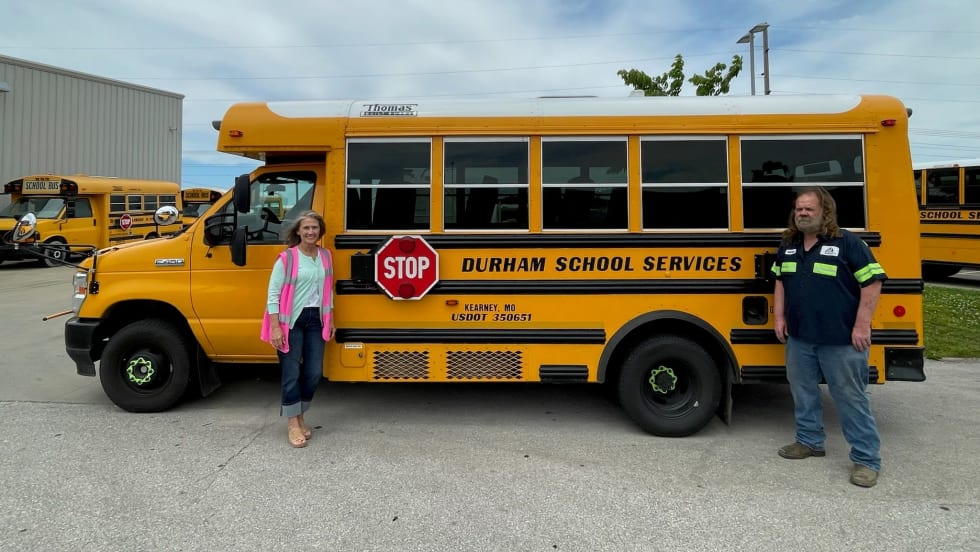
Durham School Services Maintenance Teams Earn Missouri Fleet Excellence Awards
Eight of the contractor’s school bus fleets achieved a distinction few maintenance teams earn during the state’s rigorous annual inspection program.
Read More →
How Incentives, AI, and Energy Markets Are Reshaping School Transportation
Sit down with Joe Annotti of TRC Companies to talk district grant funding, utility challenges, AI, and why school buses are evolving from transportation assets into energy assets.
Read More →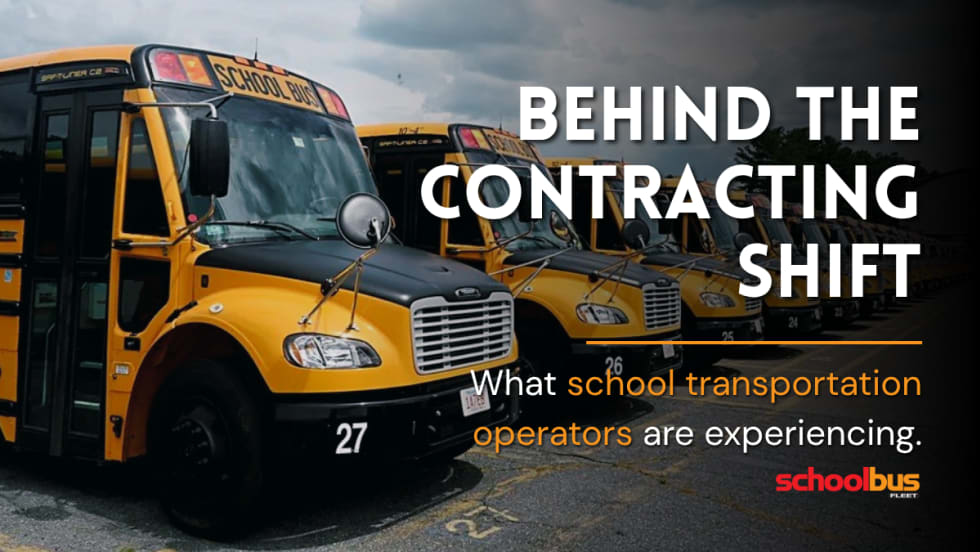
Inside the Contracting Shift: What School Transportation Operators Are Seeing Now
School transportation contractors weigh in on recent trends, costs, driver shortages, and the rise of multimodal student transportation.
Read More →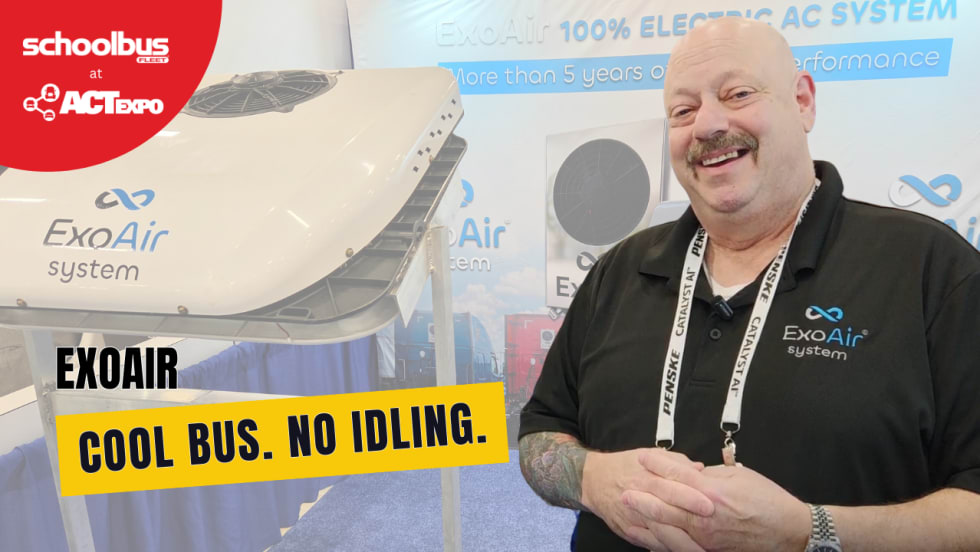
The No-Idling School Bus AC System
Take a peek at ExoAir Systems’ battery-powered cooling solution designed to run for up to 10 hours without the engine on, reducing fuel use and improving comfort for drivers and students.
Read More →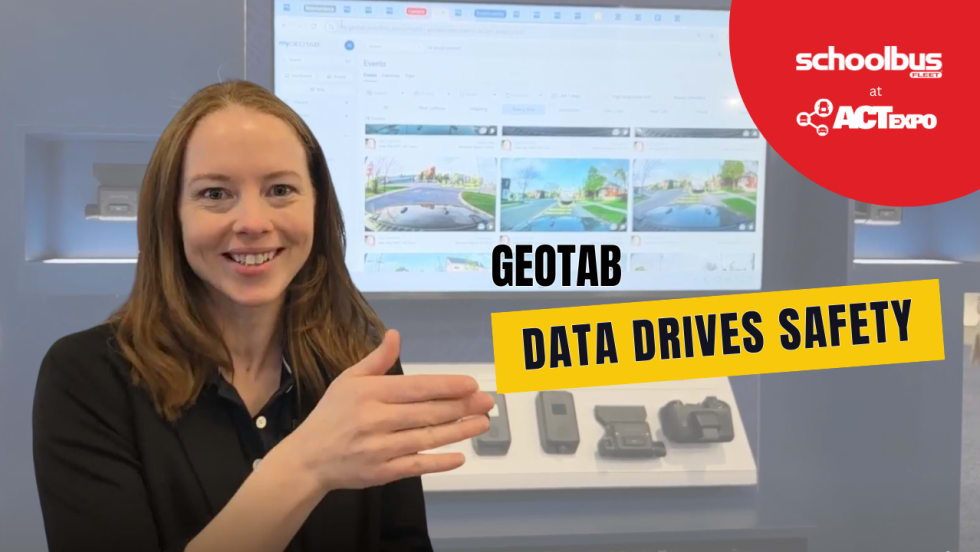
Geotab on Three Major Trends in School Transportation
School bus fleets are becoming more proactive than ever. From AI driver alerts to vehicle-to-grid opportunities, Geotab outlines the biggest technology trends transforming school bus operations.
Read More →
Gatekeeper Lands Major School Bus Deals as Revenue Surges
The video solutions provider announces contracts with Atlanta Public Schools and other fleet operators as it records quarterly revenue growth and expanding subscription business.
Read More →
Building Leaders Who Last: Creating a Successful Mentorship Program in Student Transportation
Discover five strategies for building an effective mentorship program to strengthen leadership development and support staff retention.
Read More →